The microphone squealed across the crowded demonstration field as Grant Holloway looked down from the equipment trailer. Behind him stood a massive green tractor with polished yellow wheels, its spotless hood reflecting the afternoon sun. Nearly two hundred farmers had gathered around the roped-off pulling lane, expecting a routine sales exhibition from the largest machinery dealership in western Iowa. Instead, they watched Grant publicly challenge the weathered man standing below him.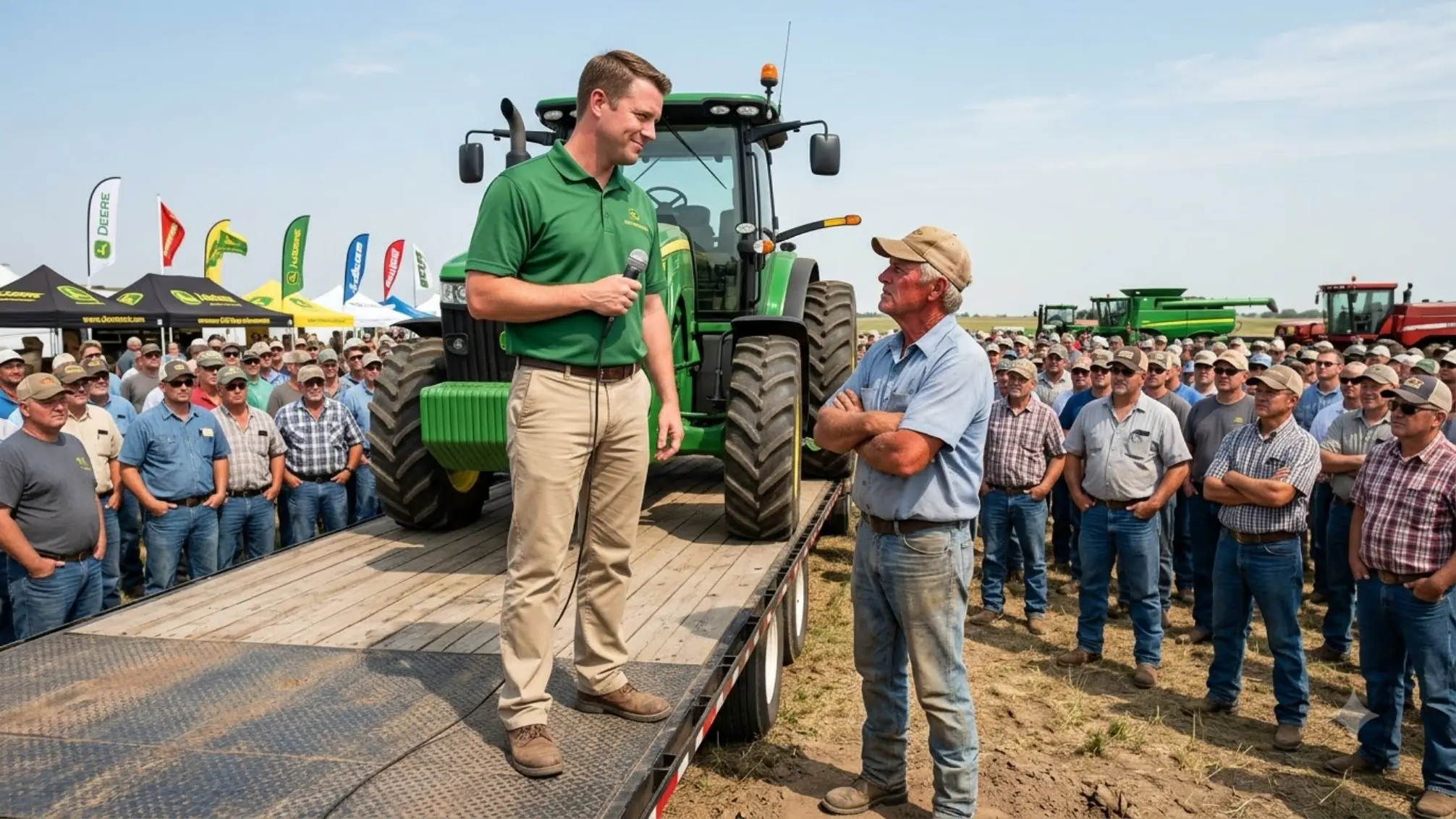
Grant wore a fitted green dealership polo, pressed khaki pants, and brown shoes that had never touched a muddy field. His smooth brown hair remained perfectly combed despite the dry wind, and the expensive microphone in his hand carried every trace of contempt across the fairground. At forty years old, he had inherited Holloway Agricultural Equipment from his father and expanded it by convincing struggling farmers that newer always meant stronger. He had never planted a field, harvested through the night, or repaired a transmission with a storm closing in.
The man below him had done all three.
Walter Briggs stood with his arms folded over a faded blue work shirt. The sixty-two-year-old farmer had a lean build shaped by decades of physical labor, gray hair beneath a worn tan cap, and hands marked by grease, weather, and old machinery. His dusty jeans rested over battered brown boots, and his sun-lined face remained calm as Grant smiled for the audience.
Dealer Grant Holloway (mocking, leaning down with the microphone): “Let me save you the embarrassment, old man. No Massey Ferguson you own is pulling that load.”
Old Farmer Walter Briggs (coldly, lifting his chin): “Hook it up and quit talking. I didn’t drive out here to hear a salesman hide behind a microphone.”
A few farmers laughed under their breath.
Grant’s smile tightened.
Dealer Grant Holloway (taunting, pointing toward the crowd): “You fail in front of all these people, don’t blame me when your pride snaps before the hitch does.”
Old Farmer Walter Briggs (firmly, stepping closer): “Drop the chain, son. In thirty seconds, this crowd will learn the difference between a farmer and a man who only sells to them.”
The laughter stopped.
Grant had expected Walter to retreat. The demonstration load was a reinforced steel sled carrying concrete blocks, scrap iron, and two water-filled tanks. Holloway’s employees claimed the total weight exceeded forty thousand pounds, though no independent scale had verified it. The new green tractor had pulled it only sixty feet before its tires began digging into the loose soil.
Grant had turned that incomplete pull into a sales speech.
He told the crowd that no older tractor could move such a load. He specifically named Massey Ferguson because Walter’s red tractor sat on a trailer near the edge of the field. The machine was twenty-eight years old, faded along the hood, and missing the bright appearance Grant believed impressed buyers.
Walter knew Grant had chosen him for a reason.
Three months earlier, Walter had refused to surrender Briggs Family Farm to Holloway Land Holdings, a company secretly controlled by Grant and his business partners. The farm bordered a planned grain storage complex and blocked the only affordable access road from the highway. Grant offered Walter half the property’s real value, then warned that refusing would bring consequences.
Walter refused anyway.
Grant’s dealership canceled Walter’s parts account the following morning. Two regional suppliers suddenly claimed they could no longer deliver to him. A loan officer who had worked with Walter for fifteen years announced that the farm’s operating credit would not be renewed unless Walter accepted a new appraisal from a company chosen by Holloway.
Walter recognized the pressure, but he refused to bend.
He had raised his daughter, Emily, on that farm after his wife died when Emily was six. Walter learned how to braid a child’s hair before school, repair combines after midnight, and cook meals between feeding cattle and checking irrigation lines. Every fence post, field, and machine carried a memory of the life they had survived together.
He would not sell those memories because Grant Holloway wanted a private road.
Emily Briggs stood near Walter’s faded red tractor as the confrontation unfolded. At thirty-one, she had inherited her father’s steady blue eyes and stubborn patience. She wore dark work jeans, steel-toed boots, and a red plaid shirt with the sleeves rolled above her elbows.
A small laptop rested open on the hood of the support truck beside her.
Grant had not noticed it.
Emily worked as an agricultural engineer for a manufacturer in Des Moines, but she returned to Briggs Farm every weekend. When Walter’s tractor began losing power the previous winter, she helped rebuild its fuel system, recalibrate the hydraulic controls, and reinforce several worn components. They did not replace the machine’s faded exterior because neither of them cared how it looked.
They cared whether it worked.
Walter glanced toward her.
Emily gave one small nod.
The challenge had not been planned. Walter had come to the demonstration because dozens of farmers complained that Holloway’s dealership had forced them into expensive financing agreements after refusing to repair older equipment. He wanted to hear Grant’s presentation and speak privately with neighbors afterward.
Grant saw him near the rope and turned the entire event into a public attack.
He mocked Walter’s tractor, his farm, and his refusal to modernize. Then he invited anyone owning an older Massey Ferguson to attempt the same pull, knowing most farmers had not brought tractors to the event.
Walter had.
A dealership employee approached Grant and whispered into his ear. Grant listened, glanced toward Walter’s trailer, and smiled again. He believed the faded tractor would become the perfect warning for anyone considering resistance.
Dealer Grant Holloway (smugly, raising the microphone): “All right, Walter. We’ll give the crowd what they came for. Bring that antique onto my pulling lane.”
Old Farmer Walter Briggs (calmly, turning away): “It’ll be there.”
Dealer Grant Holloway (calling after him): “When it stalls, I’ll offer you scrap value.”
Walter stopped but did not turn around.
Old Farmer Walter Briggs (coldly, tightening his fists): “Save the money. You’ll need it when these farmers see what your company put inside that sled.”
Grant’s expression changed for less than a second.
Emily noticed.
Walter climbed into the support truck while Emily drove the tractor down the loading ramps. The faded red Massey Ferguson started with a low, steady growl that drew farmers away from the tents. Its paint was chipped around the hood, its rear tires carried old mud in the deep treads, and one fender showed a dent from a gatepost Walter struck fifteen years earlier.
It did not look like a show machine.
It looked like a tractor that had earned its place.
As Emily guided it toward the pulling lane, Walter walked beside the left rear wheel and listened carefully. He knew every sound the machine produced. He could identify an uneven injector from across a field and detect a hydraulic problem before a warning light appeared.
The engine remained smooth.
Grant spoke through the microphone as though hosting a comedy performance.
He asked the crowd to stand clear in case the tractor “came apart.” He suggested someone should prepare a tow chain for Walter’s machine. A few dealership employees laughed because they believed Grant expected them to.
The farmers did not.
Many had known Walter for decades. They remembered him repairing neighbors’ equipment during harvest without charging labor. They remembered Emily studying engineering books at the diner while Walter worked late shifts to pay her tuition.
They also remembered Holloway’s prices rising every year.
Walter stepped onto the tractor’s lower rung.
Old Farmer Walter Briggs (quietly, looking up at Emily): “How does she feel?”
Emily Briggs (focused, watching the gauges): “Strong. Temperatures are stable, and the rear pressure is exactly where we set it.”
Old Farmer Walter Briggs (softly, touching the faded hood): “Your mother would say we’ve lost our minds.”
Emily Briggs (smiling faintly, gripping the wheel): “She’d say it after handing us the chain.”
Walter nodded.
He climbed into the cab while Emily stepped down and moved toward the rear hitch. A Holloway employee dragged the thick chain from the steel sled, but Grant stopped him before he could attach it.
Dealer Grant Holloway (sharply, raising one hand): “My people handle the equipment.”
Emily Briggs (coldly, examining the chain): “Then tell your people why this chain is mounted four inches higher than the one used on your tractor.”
The crowd shifted closer.
Grant lowered the microphone.
Dealer Grant Holloway (dismissively, stepping down from the platform): “The hitch meets event standards.”
Emily Briggs (firmly, pointing toward the connection): “A higher attachment transfers more downward force onto the sled and reduces traction at the tractor. You changed the geometry after your demonstration.”
Grant walked toward her.
Dealer Grant Holloway (angrily, lowering his voice): “You don’t run this event.”
Emily Briggs (unmoved, holding up her phone): “No, but I measured your hitch before you noticed.”
Several farmers began murmuring.
Walter remained inside the tractor, watching Grant through the side window. He had expected the load to be unfair. He had not known exactly how Grant planned to manipulate it until Emily spotted the altered hitch.
Grant faced the crowd again.
Dealer Grant Holloway (defensively, lifting the microphone): “Different machines require different connection points. Anyone familiar with modern equipment understands that.”
A farmer near the front raised his hand.
His name was Samuel Price, a seventy-year-old corn grower who had competed in tractor pulls for more than four decades. He wore denim overalls and a seed-company cap that had faded almost white.
Farmer Samuel Price (skeptically, pointing at the sled): “Then put the chain where it was for your green tractor.”
Grant ignored him.
Another voice joined.
Farmer Linda Mercer (firmly, folding her arms): “Use the same hitch, Grant.”
Linda owned six hundred acres north of Bellwether and had recently received a repair estimate from Holloway’s dealership that exceeded the value of her tractor. She stood beside her two adult sons, both of whom nodded.
Soon other farmers repeated the demand.
Grant looked across the crowd and realized the demonstration was slipping away from him. Refusing would appear dishonest, but accepting could allow Walter’s older tractor to perform better than expected. He finally ordered an employee to move the chain to the original connection point.
Emily watched the adjustment.
Then she crouched beside the sled’s front frame.
A steel cover had been bolted over the braking mechanism. Fresh tool marks surrounded two of the bolts, and an electrical cable disappeared beneath the panel toward a small control box held by one of Grant’s employees.
Emily straightened.
Emily Briggs (suspiciously, pointing at the controller): “What does that operate?”
The employee hid the device behind his leg.
Grant stepped between them.
Dealer Grant Holloway (furious, moving into her path): “Back away from my equipment.”
Old Farmer Walter Briggs (warningly, opening the cab door): “Take one more step toward my daughter, and this demonstration ends with every farmer here inspecting that sled.”
Grant looked up at him.
The two men held each other’s gaze as the tractor idled between them. Walter did not shout, but the warning carried farther than Grant’s microphone.
Samuel Price walked toward the sled.
Farmer Samuel Price (sternly, extending his hand): “Give me the controller.”
The employee looked at Grant for permission.
That was enough to confirm the suspicion.
Samuel took the device and examined its switches. He recognized the system immediately. It controlled an adjustable resistance brake, allowing the operator to increase or decrease drag during a pull.
The new green tractor had faced reduced resistance.
Walter’s machine had been prepared for maximum resistance.
The farmers erupted.
Some shouted demands for an explanation. Others raised phones and began recording. Two men who had been standing beneath the dealership tent quietly removed their Holloway hats and placed them on a table.
Grant grabbed the microphone.
Dealer Grant Holloway (shouting, raising both hands): “Settle down! Variable resistance is standard during equipment testing!”
Farmer Linda Mercer (angrily, pointing at him): “Not when you hide the control and lie about the results.”
Dealer Grant Holloway (defensive, stepping backward): “The settings account for machine age and horsepower.”
Emily Briggs (coldly, holding up the laptop): “Then your records should show every setting.”
Grant stared at the screen.
Emily had connected a diagnostic sensor to the sled’s control cable while everyone focused on the hitch. The system recorded resistance values, timestamps, and the identity of each saved program.
The green tractor’s test had used forty percent resistance.
Walter’s profile had been set to ninety-five.
Grant reached for the laptop.
Emily pulled it away.
Old Farmer Walter Briggs (furiously, climbing down from the tractor): “Touch her equipment, and the sheriff can collect it after he collects you.”
Grant stopped.
Dealer Grant Holloway (bitterly, glaring at Walter): “You think one dishonest test changes anything? That tractor still can’t pull the load.”
Walter looked toward the crowd.
Old Farmer Walter Briggs (calmly, returning to the cab): “Set it to the same resistance you used.”
Samuel adjusted the control.
Emily checked the reading twice.
The farmers moved behind the rope while Grant stood beside the platform with his microphone hanging at his side. His polished confidence had disappeared, replaced by the strained expression of a man watching his authority move into other hands.
Walter closed the cab door.
Emily climbed onto the step and leaned through the open window.
Emily Briggs (quietly, meeting his eyes): “You don’t have to prove anything to him.”
Old Farmer Walter Briggs (gently, resting one hand on the wheel): “I’m not doing it for him.”
He looked toward the crowd.
Old Farmer Walter Briggs (firmly, nodding toward the farmers): “I’m doing it for everyone he convinced they were powerless.”
Emily squeezed his shoulder and stepped down.
The chain tightened.
Walter eased the tractor forward until the slack disappeared, then paused. He adjusted the transmission, watched the gauges, and placed both hands on the wheel.
The field became silent.
He increased the throttle gradually.
The old Massey Ferguson leaned into the load. Its rear tires pressed deep into the dirt, the engine note grew heavier, and the steel sled shifted forward by several inches.
Then it moved.
A cheer rose from the farmers.
Walter did not react. He kept his eyes on the lane and allowed the tractor to build momentum without losing traction. The faded red hood vibrated, but the engine remained steady.
Ten feet.
Twenty.
Thirty.
The sled’s front pan dug into the ground, pushing loose soil ahead of it. Walter adjusted his line slightly and maintained power.
At sixty feet, the mark where Grant’s green tractor had stopped passed beneath the rear wheel.
The crowd exploded.
Caps flew into the air. Farmers shouted Walter’s name while Emily covered her mouth with both hands, laughing and crying at the same time. Samuel Price slapped the rope post so hard it nearly tipped over.
Walter kept pulling.
Seventy feet.
Eighty.
At ninety-four feet, the tractor slowed. The tires turned once more, then stopped as the sled settled into the earth.
Walter lowered the throttle.
The old machine had exceeded Grant’s new tractor by thirty-four feet under identical resistance.
For several seconds, Grant stood motionless.
Walter climbed down from the cab.
He did not celebrate or raise his arms. He walked to the rear hitch, examined the chain, and then faced Grant across the dirt.
Dealer Grant Holloway (angrily, gripping the microphone): “That proves nothing. Your tractor was modified beyond factory standards.”
Emily opened the laptop.
Emily Briggs (firmly, turning the screen toward the crowd): “Every modification is legal, documented, and available to any repair shop. Dad and I rebuilt worn systems instead of replacing the entire tractor.”
Dealer Grant Holloway (mocking, recovering his smile): “So you admit it isn’t original.”
Old Farmer Walter Briggs (coldly, stepping closer): “Neither is your sales pitch.”
The farmers laughed openly.
Grant’s face reddened.
Walter reached into his shirt pocket and removed a folded document. It was not related to the pulling test. It was a copy of an internal Holloway dealership memo sent anonymously to Walter two weeks earlier.
The memo instructed service departments to classify repairable equipment as “economically nonviable.” Customers would then be pressured into trading their machines for new tractors financed through Holloway’s lending partner. Employees received bonuses when farmers abandoned repair requests and signed new contracts.
Walter handed the document to Linda Mercer.
She read it and passed it to Samuel.
Grant’s eyes narrowed.
Dealer Grant Holloway (threateningly, moving toward Walter): “That is stolen company property.”
Old Farmer Walter Briggs (fiercely, holding his ground): “It’s proof you lied to people who trusted you.”
Dealer Grant Holloway (furious, pointing at Walter): “You’re finished in this county. No dealer will sell you parts. No bank will carry your farm.”
Walter looked toward the crowd surrounding them.
Old Farmer Walter Briggs (calmly, spreading his hands): “Ask them whether I’m alone.”
Samuel stepped beside him.
Then Linda.
One farmer after another crossed the rope and joined Walter near the tractor. Some had purchased machines from Holloway. Others owed money through financing Grant helped arrange.
Within a minute, nearly two hundred farmers stood between Walter and the dealership platform.
Grant lowered the microphone.
The story spread across the state before sunset. Videos of the pull appeared online, followed by recordings of Emily exposing the resistance controller. Agricultural reporters contacted farmers who described inflated repair estimates, misleading financing terms, and canceled parts accounts.
State consumer-protection officials opened an inquiry.
The equipment manufacturer suspended Holloway’s dealership certification pending review. The regional bank froze new agricultural loans connected to Grant’s company after auditors discovered appraisal irregularities. Several technicians admitted managers had ordered them to exaggerate equipment damage.
The pressure campaign against Briggs Farm became evidence.
Grant’s holding company had coordinated with the appraiser, suppliers, and loan officer to force Walter into selling his land. Emails showed Grant intended to acquire neighboring farms at reduced prices and resell access rights to a national grain corporation.
Walter’s refusal exposed a plan much larger than one road.
Within six months, Holloway Agricultural Equipment lost its primary dealership contract. Grant faced civil fraud charges, and farmers organized a cooperative repair center using technicians who had left his company. Emily designed the diagnostic program, while Walter provided a section of an old machine shed as the cooperative’s first workshop.
They called it the Honest Acre.
The center repaired older equipment whenever repair remained safe and practical. It sold new machines when farmers genuinely needed them, but every estimate included photographs, test results, and a clear explanation.
Samuel Price became its first customer.
Linda Mercer became its first board chair.
Walter never sold Briggs Family Farm.
The following summer, the county farm show invited him to repeat the pulling demonstration. Walter declined the public competition but agreed to display the faded Massey Ferguson beside several restored tractors repaired by the cooperative.
Grant’s polished green machine was not there.
A teenage boy approached Walter during the show and ran one hand over the dented fender.
Teenage Farmer (curiously, looking up at him): “Is this really the tractor that beat the dealer’s machine?”
Old Farmer Walter Briggs (gently, resting a hand on the hood): “It moved farther that day.”
Teenage Farmer (confused, tilting his head): “Isn’t that the same thing?”
Walter looked toward Emily, who was explaining an engine diagram to a group of young farmers.
Old Farmer Walter Briggs (proudly, smiling at his daughter): “No. A tractor can pull a sled. What beat that dealer was two hundred people deciding they were done being pushed.”
The boy nodded, though Walter was not certain he completely understood.
Someday he would.
Walter looked across the land his family still owned. The fields beyond the fairground were green, the repair cooperative had a waiting list, and Emily planned to move home permanently before the next planting season.
The old tractor had not saved the farm alone.
It had simply pulled hard enough for the truth to catch up.