“Ma’am… folks in town said you might be looking for a ranch hand.”
The exhausted rider stood beyond Evelyn Thorne’s broken front gate with his battered hat held between both hands. His dark coat had been repaired along one shoulder, dust covered his boots, and the ribs of the brown horse behind him showed through its coat. Yet he kept his back straight, speaking with the quiet respect of a man who had little left except dignity.
Evelyn studied him from beside the fence post.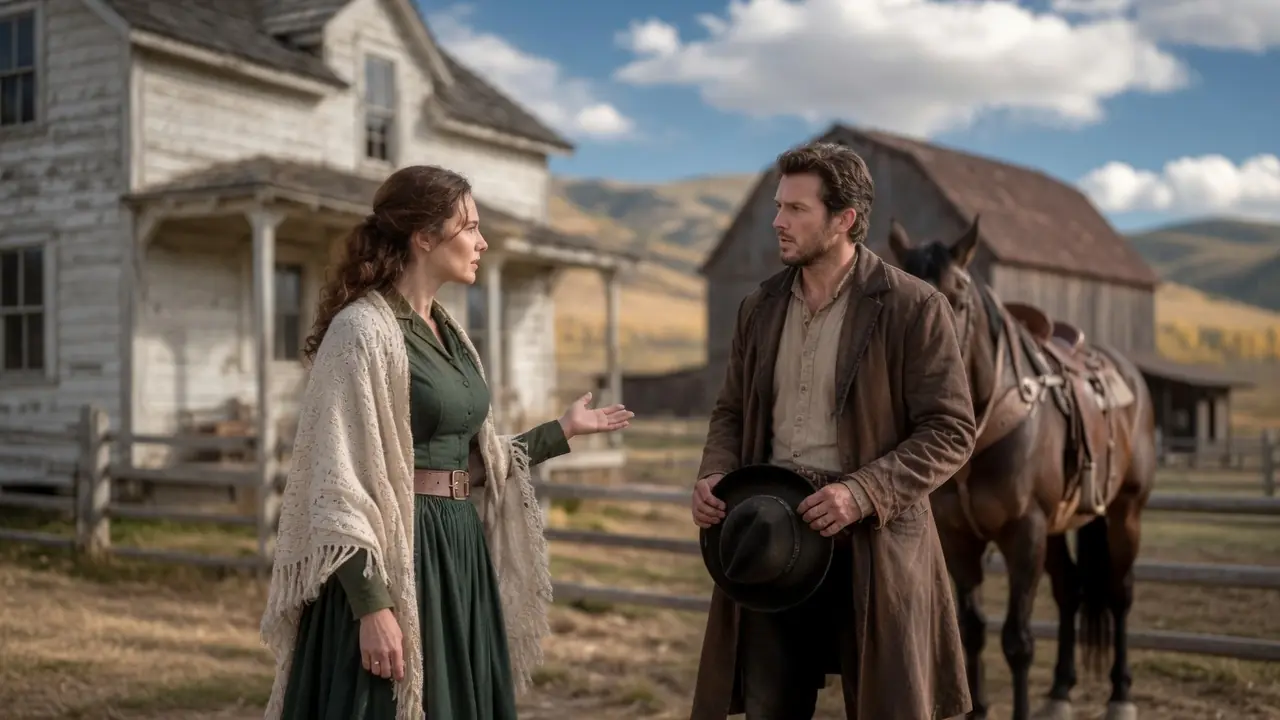
Autumn sunlight stretched across Thorne Ranch, revealing every weakness she could no longer hide. One barn door hung from a single hinge, several sections of fence sagged toward the ground, and only thirty-eight cattle remained from the herd her late husband had once counted in the hundreds. Beyond the pasture, cottonwoods followed a narrow spring that kept the ranch alive.
That water was why strangers had begun appearing.
“I am looking,” Evelyn admitted. “But I cannot afford to pay an honest wage.”
The man glanced across the damaged pasture.
“I’m not asking for riches. Just work, meals I earn, and somewhere dry enough to sleep.”
“What is your name?”
“Gideon Vance.”
Evelyn had heard no stories about him in Silver City, which could mean he was harmless or clever enough to keep his crimes elsewhere. He appeared around thirty-eight, with rough hands, a short dark beard, and a scar disappearing beneath his shirt collar. His eyes carried exhaustion without surrender.
Most drifters stared too long at a widow living alone.
Gideon looked at the broken fence.
“How long have you been riding?” Evelyn asked.
“Long enough that the horse deserves employment more than I do.”
Despite herself, she nearly smiled.
Then she remembered the letter waiting on her kitchen table.
The Silver Basin Land Company had given her until the first snowfall to accept its purchase offer. If she refused, its lawyer intended to challenge the boundaries of her spring and demand payment on a livestock debt Evelyn had never agreed to. The county judge attended dinner regularly with the company representative, Silas Miller.
Evelyn possessed land.
Silas possessed influence.
She looked toward the silent farmhouse behind her. Three years had passed since a mining collapse killed her husband, James. Fever took their six-year-old son, Matthew, less than eight months later, leaving Evelyn alone in rooms where every piece of furniture remembered someone.
She had survived grief.
She was less certain she could survive winter.
“I need a husband more than a ranch hand, Mr. Vance.”
Gideon became completely still.
His hat remained pressed between his hands, but the wind moved the hem of his coat. Even the horse seemed to raise its head as though it had heard something impossible.
“I beg your pardon?”
“You heard me.”
“We met five minutes ago.”
“That is four minutes longer than I need to know you are hungry.”
His face hardened slightly.
“If this is a joke, ma’am, it is an unusual one.”
“I have forgotten how to make jokes.”
Evelyn opened the gate and gestured toward the porch. Gideon followed cautiously, leaving his horse near the water trough. She did not invite him into the house until he had washed his hands and removed the mud from his boots.
Inside, she placed the Silver Basin letter before him.
The company claimed that the northern spring supplying Thorne Ranch lay outside the property’s federal patent line. Unless Evelyn accepted six thousand dollars for the ranch, Silver Basin would divert the water toward a planned cattle operation and demand repayment for years of unauthorized use.
Six thousand dollars would barely cover the mortgage and livestock debt.
It would leave Evelyn with no land and nowhere to go.
“Why would marriage stop them?” Gideon asked.
“Silas has spent months telling creditors I am an unstable widow who cannot maintain the property. He persuaded two suppliers to cancel my accounts, and he has men willing to testify that the ranch is abandoned.”
“It is clearly not abandoned.”
“The county judge has never visited.”
Gideon read the letter again.
“And you believe a husband changes the judge’s mind?”
“No. But it gives me another legal owner, another witness, and someone Silas cannot frighten as easily.”
Gideon looked toward her.
“You do not know whether I frighten easily.”
“No.”
“You do not know whether I am honest.”
“No.”
“You could be inviting a thief to own half your ranch.”
Evelyn folded her hands.
“And you could be speaking to a woman desperate enough to understand the risk.”
Silence settled between them.
Gideon turned toward the window. From there, Matthew’s grave could be seen beneath a cottonwood on the low hill. Wildflowers had faded with the season, leaving only pale grass around the small wooden marker.
“Why me?” he asked.
“You came asking to earn food instead of begging for it.”
“That proves little.”
“You looked at the fence before you looked at the house.”
“That proves I understand fences.”
“It proves you saw work before comfort.”
Gideon pushed the letter away.
“What exactly are you offering?”
“A legal marriage. Half ownership after one year, provided you work the ranch and do not leave without settling the partnership.”
“And what do you expect as a wife?”
Evelyn’s posture tightened.
“Nothing beyond appearances in town and cooperation concerning the property.”
He understood the fear beneath her answer.
“We would have separate rooms?”
“Yes.”
“You keep control of your money?”
“Yes.”
“And either of us may end the arrangement after the land dispute?”
“Yes.”
Gideon leaned back.
“You have planned this.”
“I have been planning how not to lose my home since summer.”
“And if I refuse?”
“I offer you stew before you continue riding.”
That answer decided more than any promise could have.
Gideon had met people who offered food as a hook, expecting loyalty or gratitude afterward. Evelyn offered it even while believing he might leave. He looked again toward the failing ranch.
“I want no ownership until I have earned it.”
“You may not receive another chance.”
“Then write that I receive a quarter after one year and half after three.”
Evelyn stared at him.
“You are negotiating downward?”
“I am refusing to profit from your fear.”
For the first time since he arrived, her guarded expression weakened.
“You might be the worst fortune hunter in New Mexico.”
“I have never been successful at fortune.”
They wrote the agreement that afternoon.
By sunset, Gideon sat across from Evelyn eating venison stew inside a house that had forgotten the sound of another person’s spoon against a bowl. Neither spoke about love, family, or the unusual wedding waiting for them the next morning. They discussed fences, cattle, stored hay, and how many weeks remained before snow.
Gideon slept in the barn.
Evelyn remained awake in her bedroom, wondering whether desperation had saved her or simply invited a different danger through the gate.
They rode into Silver City shortly after sunrise.
The preacher listened to their request with visible disapproval but could find no lawful reason to refuse. Evelyn wore her dark green Sunday dress, while Gideon had brushed most of the trail dust from his coat. Two ranchers from the neighboring property served as witnesses after Evelyn promised to pay them with winter feed.
There were no flowers.
No celebration followed the vows.
When the preacher asked whether Gideon would take Evelyn as his lawful wife, he looked directly at her before answering.
“I will.”
His voice held no romance.
It held certainty.
Outside the church, whispers moved faster than the autumn wind. Shopkeepers watched from windows, and several women gathered near the general store. A widow marrying a penniless stranger one day after his arrival provided more entertainment than Silver City had enjoyed in months.
Across the street stood Silas Miller.
He was tall, clean-shaven, and dressed in a gray coat untouched by dust. A silver watch chain crossed his vest, and his smile appeared polite enough to deceive anyone who did not examine his eyes.
“Mrs. Thorne,” he called.
Evelyn stopped.
Silas looked toward Gideon.
“Or should I say Mrs. Vance?”
“Either will do.”
“This happened quickly.”
“The company’s threats taught me efficiency.”
Silas smiled.
“You misunderstand business as threat.”
“Men rarely arrive with lawyers when they mean friendship.”
His eyes moved over Gideon’s worn clothing.
“And you are?”
“Her husband.”
“For how long?”
Gideon placed his hat on his head.
“Long enough.”
Silas stepped closer to Evelyn.
“A marriage performed in panic will not alter the spring boundary.”
“No,” Gideon said. “But it may alter how easily you enter this ranch uninvited.”
Silas’s expression cooled.
“You have no idea what you married into.”
Gideon looked toward Evelyn.
“I am beginning to.”
Silas tipped his hat and walked away.
By afternoon, half the town knew Evelyn had married a drifter to protect her property. By evening, the story had changed: Gideon was an outlaw, a gambler, or a hired gun. One version claimed Evelyn had promised him the ranch before learning his name.
Gideon heard all of them at the feed store.
He purchased nails and returned home without answering.
During the following week, he repaired the eastern fence, rehung the barn door, and rebuilt a section of the cattle pen. He worked without needing instruction, rising before dawn and stopping only after darkness made the tools difficult to see. Evelyn discovered that he understood horses, irrigation, and timber framing better than most hired men she had known.
He also understood silence.
Gideon never entered a room without knocking. He never questioned why Evelyn kept Matthew’s wooden horse beside the fireplace or why James’s coat still hung near the kitchen door. When grief interrupted her work, he found another task instead of asking her to explain.
Evelyn prepared meals and maintained the accounts.
At first, they spoke only about the ranch. Gradually, their conversations expanded to weather, books, and the strange habits of their neighbors. Gideon possessed a dry humor that emerged unexpectedly.
One morning, Evelyn found him standing inside the chicken yard surrounded by angry hens.
“What happened?”
“They rejected my leadership.”
“You stole their eggs.”
“I collected taxes.”
“You were overthrown.”
“Violently.”
Her laughter surprised both of them.
It disappeared quickly, but the cabin seemed less empty afterward.
On Sunday, Evelyn asked whether he wished to attend church.
Gideon studied her face.
“Do you?”
“No.”
“Then why ask?”
“Because people will notice if we stay away.”
“People noticed when we appeared.”
She understood the truth of that.
Still, they attended because Silas had begun suggesting the marriage was fraudulent. Evelyn believed being seen together might strengthen their position. She did not anticipate the preacher’s sermon.
The church fell silent when they entered.
Gideon and Evelyn sat near the back. Women who had once greeted her warmly turned their faces, while two ranchers whispered openly about “a widow’s bargain.”
The preacher climbed to the pulpit.
His message began with scripture and ended with accusation.
He spoke about marriages created from greed, lonely women who abandoned modesty, and strangers who entered homes for earthly gain. He never mentioned Evelyn’s name, but every glance in the room moved toward her.
Evelyn’s breathing became shallow.
She thought of the nights following James’s death, when no church member came to repair the roof or help move cattle during the storm. She remembered burying Matthew while women offered advice about faith but left her to carry water alone.
Now they judged the method by which she tried to survive.
Her hands tightened in her lap.
Gideon noticed.
Without looking toward the pulpit, he reached across the pew and took her hand. Not secretly or cautiously, but firmly enough for everyone to see. His rough fingers closed around hers without possession.
The preacher stopped for half a second.
Gideon looked directly at him.
“Continue,” he said.
The challenge was quiet.
That made it impossible to ignore.
Evelyn expected shame, but something inside her changed. Gideon had been offered part of a ranch, not her loyalty, yet he chose to share the town’s judgment rather than distance himself from her.
She held his hand until the service ended.
Outside, the preacher approached.
“Mrs. Vance, my sermon was not directed toward any one person.”
“Then you should be troubled that everyone knew exactly whom you meant.”
Silas stood nearby, smiling.
Gideon turned toward him.
“You arranged that.”
“I do not write sermons.”
“No. You only give frightened men subjects.”
Silas’s smile vanished.
Two nights later, someone cut the ranch’s northern fence.
Twelve cattle escaped, and one disappeared into the hills. Gideon followed tracks until he found evidence that the fence had been opened deliberately rather than broken by livestock. A horseshoe print matched the narrow European shoes used by Silas’s hired riders.
Evelyn wanted to report it.
The sheriff claimed there was no proof.
The following week, their feed wagon overturned after a wheel pin disappeared. Gideon was nearly thrown beneath the load but escaped with a bruised shoulder. Again, the sheriff called it an accident.
Silas visited the ranch the next morning.
He remained outside the gate.
“Difficult season,” he said.
Gideon stood beside Evelyn.
“What do you want?”
“I came to make a final offer.”
He increased the purchase price to eight thousand dollars. Evelyn refused before he finished speaking.
Silas turned toward Gideon.
“Perhaps the husband has more sense.”
“My wife answered you.”
The word wife changed Evelyn’s breathing.
Silas noticed.
“You are protecting land that will never become yours.”
Gideon’s expression remained still.
“You read our agreement?”
“I know what desperate people offer.”
He removed an envelope from his coat.
“Three thousand dollars now. Another three when she signs the sale.”
Evelyn stared at him.
Silas continued speaking only to Gideon.
“You leave town, I tell everyone the marriage ended naturally, and she accepts that survival requires compromise.”
Gideon took the envelope.
For one terrible moment, Evelyn believed he might accept.
Then he tore it in half.
The money fell into the dust.
“I arrived hungry,” Gideon said. “Not purchasable.”
Silas’s face hardened.
“You think she chose you?”
“No.”
Gideon looked toward Evelyn.
“She chose a chance.”
He returned his attention to Silas.
“I intend to become worthy of it.”
Silas rode away without another word.
That evening, Evelyn found Gideon repairing the wagon beneath a lantern. His bruised shoulder made every movement difficult, but he refused to stop.
“You could have taken the money,” she said.
He did not look up.
“So could you.”
“The ranch belonged to my family.”
“You believe that makes your refusal different?”
“Yes.”
Gideon set down the wrench.
“I had nothing when I arrived. That does not mean nothing matters to me.”
Evelyn lowered her eyes.
“I am sorry.”
“For doubting me?”
“For placing you in this fight.”
“I entered it knowingly.”
“You did not understand Silas.”
“I understand men who believe hunger makes others obedient.”
He looked toward her.
“I used to work for one.”
That was the first time Gideon spoke about his past.
Before drifting west, he had served as an assistant surveyor for a railroad company in Colorado. His supervisor falsified boundary lines to seize homesteads along a planned route. When Gideon reported the fraud, the company accused him of theft and dismissed him.
He spent months searching for work.
Every large employer had received notice that Gideon was unreliable. By the time he reached Silver City, he possessed one horse, eight cents, and a reputation built by a man he had challenged.
“You can read land surveys?” Evelyn asked.
“Yes.”
“Why didn’t you tell me?”
“You needed a ranch hand.”
“I needed someone who could understand Silas’s claim.”
Gideon stood.
“Show me every deed and map you own.”
They spent the night examining documents at the kitchen table.
The original federal patent from Evelyn’s grandfather defined the property using landmarks rather than modern measurements. It mentioned a survey post “east of the split cottonwood” and followed a stone ridge toward the northern spring.
Silver Basin’s newer map moved the boundary nearly three hundred yards south.
Gideon compared the documents.
“The company used a different starting marker.”
“Could it be an error?”
“Not across three separate lines.”
“Can we prove it?”
“If the original marker still exists.”
At sunrise, they rode toward the northern ridge.
The split cottonwood had died years earlier, but its enormous stump remained near the dry wash. Gideon measured east using the original survey chain distance and began searching among rocks and scrub.
Hours passed.
Evelyn’s hope weakened.
Then Gideon found a square iron post buried beneath a fallen cedar. One side carried a nearly erased federal survey mark. From that point, the original boundary ran directly around the spring.
Silver Basin had no legal claim to the water.
Gideon continued examining the area.
Near the marker, he found newer tool marks where someone had attempted to remove it. The cedar covering the post had been cut rather than naturally fallen.
Silas knew the marker existed.
He had hidden it.
They brought the sheriff, county clerk, and two independent witnesses to the ridge. Gideon explained the measurements, while Evelyn produced the original patent. The county clerk confirmed that Silver Basin’s map referenced a marker never appearing in federal records.
Silas arrived before the inspection ended.
He dismounted quickly.
“This survey has already been certified.”
“By whom?” Gideon asked.
“A licensed county surveyor.”
“The man is your brother-in-law,” Evelyn said.
Silas looked toward the exposed marker.
His confidence cracked.
“That post could have been placed yesterday.”
The county clerk crouched beside it.
“Not with forty years of corrosion.”
Silas turned toward the sheriff.
“They are attempting fraud.”
Gideon handed over a notebook.
Inside were measurements from the original patent, current landmarks, and photographs taken before the post was moved. He had documented everything after learning what unproven accusations could do.
The sheriff looked toward Silas.
“You told me no historic marker existed.”
“I was relying on professional advice.”
“You also filed an affidavit saying you personally inspected this ridge.”
Silas said nothing.
The dispute moved to territorial court.
For three weeks, Evelyn and Gideon traveled repeatedly to Silver City while neighbors whispered about the outcome. Silver Basin hired two attorneys and attempted to delay the case until winter.
Gideon testified about the altered starting point.
The county clerk confirmed the original patent.
A former Silver Basin employee appeared after hearing about the investigation. He produced a letter from Silas ordering workers to “clear the obsolete iron from the north ridge” before the company survey.
The judge ruled the spring belonged entirely to Thorne Ranch.
He also referred Silver Basin’s documents for a fraud investigation.
Silas left the courtroom without looking at Evelyn.
Outside, townspeople gathered around her, suddenly eager to offer congratulations. Some were the same people who had whispered inside church.
Evelyn accepted their words politely.
Gideon stood several feet away.
The legal threat had ended.
So had the reason for their marriage.
That truth followed them home.
For several days, Gideon worked more quietly than usual. Evelyn found him repairing the barn roof, organizing tools, and calculating the value of his agreed share.
One evening, she entered the barn and saw his belongings packed beside the stall.
Her stomach tightened.
“You are leaving.”
Gideon looked toward the small bedroll.
“The land is safe.”
“That was our agreement.”
“Yes.”
“You were entitled to remain for a year.”
“I do not want you trapped by gratitude.”
Evelyn looked at the horse.
“Where will you go?”
“North, perhaps.”
“To another ranch?”
“If someone needs work.”
The thought of the cabin returning to silence frightened her more than Silver Basin’s threats had. Gideon had entered as a stranger, but his boots now rested beside hers near the door. His laughter lived in the kitchen, and his hands had repaired nearly everything James’s absence allowed to break.
She had offered him marriage to save the ranch.
Somewhere along the way, he had helped save the woman living inside it.
“You said you intended to become worthy of the chance I gave you.”
Gideon lowered his eyes.
“I hope I did.”
“You did.”
“Then let me leave before the arrangement becomes another obligation.”
Evelyn stepped closer.
“What if I no longer want an arrangement?”
He looked at her.
Her voice trembled, but she continued.
“I needed your name when you arrived. Then I needed your labor, your knowledge, and your courage.”
Gideon remained still.
“What do you need now?”
Evelyn reached for his hand.
“You.”
The word seemed to take the strength from him.
“I came here with nothing,” he whispered.
“You came with everything Silas could not buy.”
“That is not a promise of an easy life.”
“I have never asked for one.”
Gideon looked toward the farmhouse.
“And the ranch?”
“Still half mine.”
He almost smiled.
“Only half?”
“You negotiated poorly.”
He laughed, and Evelyn felt three years of silence break around them.
Their second wedding took place the following spring.
The first marriage remained legal, but Evelyn wanted vows made without fear. They stood near Matthew’s grave beneath blooming wildflowers, surrounded by neighbors who had finally learned that survival did not always look respectable from a church pew.
The preacher who shamed them was not invited.
Mrs. Dalton, the elderly schoolteacher who brought Evelyn meals after the court case, read the vows instead. Gideon promised never to mistake partnership for possession.
Evelyn promised never again to offer herself as payment for protection.
They built no grand house.
They repaired the one already standing.
The herd grew slowly, the spring continued flowing, and Gideon planted new cottonwoods along its banks. Evelyn maintained the accounts and later purchased the neighboring pasture when Silver Basin abandoned its plans.
Silas Miller was convicted of filing fraudulent land documents and bribing a surveyor. His company dissolved before the following winter. Men who once believed him untouchable denied ever trusting him.
Evelyn did not celebrate his fall.
She had already received what mattered.
Years later, travelers passing Thorne-Vance Ranch sometimes asked how Gideon had come to own such valuable land. Town stories claimed he was a clever drifter who married a desperate widow and discovered a hidden survey marker.
Gideon always corrected them.
“The widow saved the ranch before I arrived,” he said. “I only helped her prove it.”
Evelyn corrected him too.
“The drifter came asking for a job. I offered him a marriage because I believed a husband was more useful than a ranch hand.”
“And was he?”
She would look toward the man repairing fences, teaching their adopted daughter to ride, or placing fresh wildflowers beside Matthew’s grave.
“Much more troublesome,” she would say.
Their love did not begin with romance.
It began with hunger, fear, and a contract written by two people who expected nothing beyond survival. Yet Gideon refused to purchase security with Evelyn’s desperation, and Evelyn gave a disgraced stranger the first honest chance he had received in years.
She offered him half a ranch for his name.
He gave her loyalty no agreement could demand.
What happened next left Gideon speechless because, for the first time in his wandering life, someone did not merely offer him shelter.
She asked him to stay—and meant forever.