The Duke of Lansworth said no for the fourth time that morning.
And the agent on the other side of the desk closed his portfolio with the careful patience of a man who had run out of names.
The list of England’s available daughters was finite.
The Duke’s reasons were not.
Three London seasons of refusals had become a story the city told itself at every supper table.
And outside the study door, unaware of any of it, a woman with a leather measuring case was being shown in by a footman who did not yet realize she was blind.
“Your Grace, the tailoring party from Bond Street has arrived for the fitting.”
Henry Bramwell did not look up from the letter he had not been writing.
“Send them to the dressing room. I will be along.”
Outside, a wheel turned on the wet stones of the square.
“Yes, Your Grace.”
The footman withdrew.
The agent rose, hesitated at the threshold, and risked one last sentence.
“Lady Vespasia called this morning, sir. She left her card. She asked me to tell you that the investiture is in 11 days.”
The candle on the table guttered once and recovered.
“I’m aware of when the investiture is.”
“Yes, Your Grace.”
The door closed.
The Duke set his pen down and pressed the heel of his hand against the side of his jaw, the right side, where the scar ran from the corner of his mouth up to the bone beneath his ear in a thin pale seam.
He had stopped noticing it years ago, except when he was being measured, or being looked at by women who had been sent to look at him, or when the high stiff collar of a court coat pressed against the place where the skin had healed thicker than the rest.
All three of those things were about to happen in that order, in his own house, today.
He rose.
He told himself the fitting would take 20 minutes.
He told himself he had refused three brides already this week and could survive a tailor.
He had no idea what was waiting in the dressing room.
She was standing very still beside the long mirror, which was the first thing he noticed because most people moved when he entered.
The footman had announced him from the hallway.
She had heard the announcement and chosen not to turn.
She was facing the window instead.
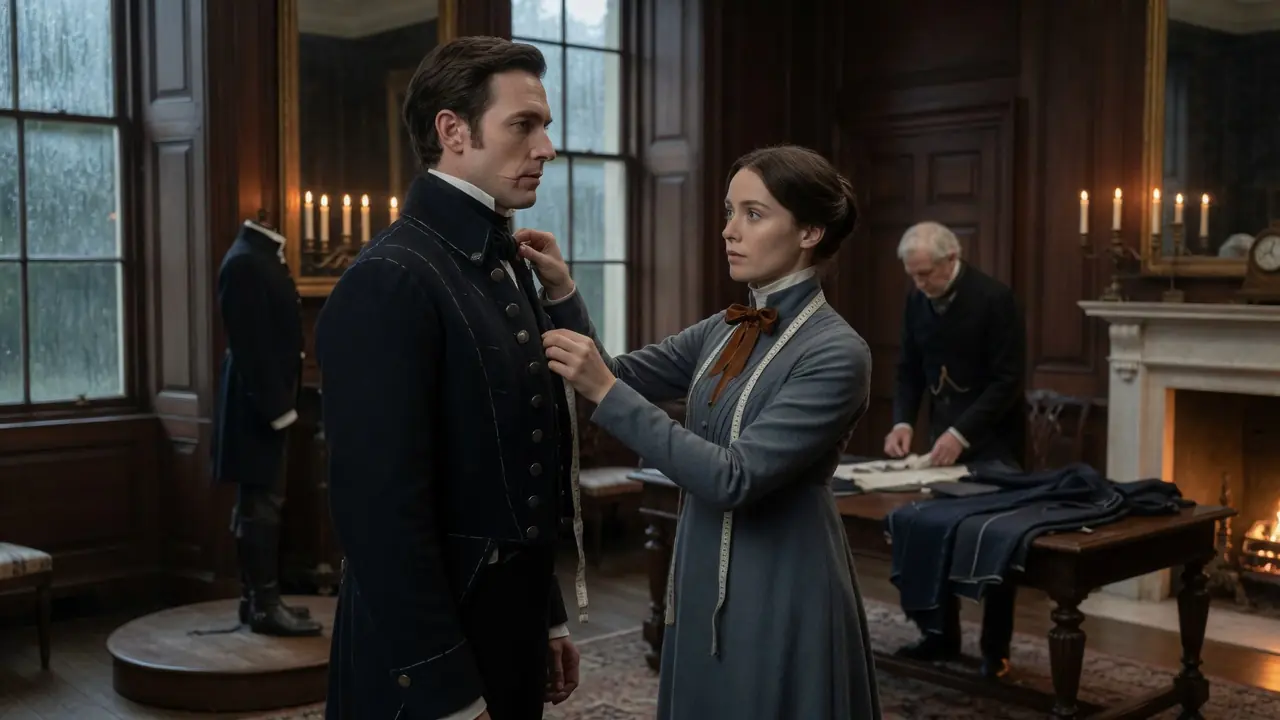
Behind her, Mrs. Hartcombe, the master of the Bond Street house that had dressed the Bramwell men for two generations, was unrolling a length of dark wool across the fitting table.
“Your Grace,” Mrs. Hartcombe said, straightening. “Thank you for the appointment. The ceremonial coat for the naval investiture requires a great deal of close work. I have brought my best hand to do the measuring. Miss Bramwell.”
The woman at the window turned at the sound of her name.
She was not what he had expected.
She was young, six-and-twenty, and slight, but she stood with the composed straightness of someone who had been taught to compensate for not being able to glance around for orientation.
Her hair was dark, pinned cleanly, no ornament.
Her gown was a soft gray-blue, severely cut.
The only striking element was a deep amber ribbon at the high collar that caught the afternoon light.
Her face was finely made, with the broad cheekbones and the long jaw of a woman who would be called handsome before she was called pretty.
Her eyes did not find him.
They went with the practiced gentleness of someone who had done this introduction a thousand times to a point just to the left of where his shoulder ought to be.
“Your Grace,” she said.
Her voice was low, exact, and entirely without deference.
“I am Caroline Bramwell. I will be doing the close measurements. Mrs. Hartcombe will manage the pinning.”
He registered her blindness in the same instant he registered that she was waiting for him to register it.
He said nothing for one heartbeat too long.
Then he said, “Miss Bramwell, will it serve, Your Grace?”
Somewhere along the corridor, a door was closed by an unseen hand.
The directness of the question, the calm offering of a refusal, the absence of pleading, caught him entirely.
He had been preparing since the agent’s visit to be rude to several people today.
He had not been preparing to be respected by one.
“It will serve.”
“Thank you.”
She turned her head slightly toward Mrs. Hartcombe.
“The coat first, or the trousers?”
The fire shifted.
A small log dropped half an inch in the grate.
“The coat, Caroline. We have 11 days.”
“Then I will need His Grace at the platform, shoulders square, arms loose at his sides. I will begin with the shoulder line and work down. I count aloud sometimes. Your Grace may find it distracting. If so, please tell me and I will stop.”
The clock on the mantel struck the half and then went quiet.
He stepped onto the low platform without speaking.
Mrs. Hartcombe drew a half-canvassed garment from the dressing rail and brought it to him.
He shrugged into it.
She pulled the back closed with two practiced pinches and stepped away.
Then he was alone with Caroline Bramwell.
She came forward.
She did not put her hand out for an obstacle.
She had measured the distance from window to platform on the way in by the sound of his footstep and the shift of his voice.
She stopped a foot in front of him, lifted both hands, and said, “I will touch the seam at your shoulder first. May I?”
“You may.”
A coal cracked.
The shadow of the fire-screen moved once across the wall.
Her fingers found the seam.
They were warm, dry, and absolutely steady.
She traced the line of the shoulder out to the point of his arm, then back to the base of his neck, then down across the collarbone.
She did not speak.
He realized, three seconds in, that he was holding his breath.
“This shoulder is a quarter inch higher than the other,” she said. “You compensate when you stand. We will cut the coat to your body, not to the symmetry. It will lie quieter that way.”
“Most tailors fight my shoulder.”
The rain had stopped without either of them noticing.
“Most tailors are fighting a drawing in their head. I am only listening to you.”
She said it without flirtation and without warmth, as a workshop observation.
It landed in him like a stone into a still pond.
She moved to the arm.
The cool slip of the linen tape over his wrist.
The murmur of the count.
“Twenty-three and a half. The cuff will sit a thumb below the heel of the hand when your arms hang loose. It will rise correctly when you bend.”
She wrote nothing down.
There was no notebook.
And he realized she was committing the numbers to memory.
Then she reached for the collar.
He had been waiting, without admitting to himself that he was waiting, for this moment.
The collar of the investiture coat sat high, five inches at the back, stiffened.
The front, mandarin cut to expose only the throat.
It would press, when finished, exactly along the line of his scar.
Every tailor he had ever sat for had paused at this point.
The good ones had pretended not to notice.
The poor ones had said something kind, which was worse.
Caroline’s hand found the side of his jaw.
She did not pause.
She traced the line of the collar where it would lie, down from the angle of his ear, around the curve of his throat, up again to the matching point on the other side.
Her thumb passed across the scar at the apex of the line and did not falter.
She made one small adjustment in the air with her left hand, as if marking a line only she could see, and said, “The collar will press here, on the right side, between this point and this point. The skin has healed thicker than the rest. We will let the collar out a quarter inch along that span. It will sit slightly off true to the eye, but it will lie quietly against the skin. May I have your permission?”
He could not for a moment locate his voice.
“Yes,” he said.
“Thank you, Your Grace.”
She continued.
She measured the length of his back from the seventh cervical to the small of his back.
She measured the seat.
She had Mrs. Hartcombe set in the pins for the side seams, and at each one, Caroline ran her fingertips down the line a second time to feel that the placement was true.
She worked for 40 minutes.
She spoke only when she needed to give an instruction or request a permission.
She did not once ask him anything personal.
She did not once say the word scar.
A bell sounded faintly from the church two streets distant.
When she stepped back, she said, “I have what I need for today. We will need a half-canvas fitting in three days and a final fitting four days after that. Mrs. Hartcombe will write.”
She inclined her head, picked up the slim leather case at her feet, found her way to Mrs. Hartcombe by the sound of the rustling wool, and laid her free hand at the older woman’s elbow.
“Your Grace,” Mrs. Hartcombe said briskly, “we will see ourselves out. Thank you for your patience with the work.”
He inclined his head.
He did not trust his voice.
He stood on the platform after they had gone, the half-canvassed coat still hanging loosely from his shoulders, and stared into the long mirror at the man in it.
His own scar was visible in the reflection, the way it had been visible since the morning four years ago when he had been thrown from the bay stallion he had been breaking for his brother’s regiment.
He had looked at it every morning for four years.
He had refused 12 brides in the years since because each time the candidate’s eyes had gone to it first, and her mouth, with great civility, had pretended she did not see it.
The pretense was worse than the looking.
Caroline Bramwell had not looked.
Caroline Bramwell could not look.
Caroline Bramwell had put her hand on the scar and adjusted his collar for it, and in 40 minutes had done what no one had managed in four years, which was to treat the thing on his face as a fact instead of a misfortune.
He took the coat off.
He hung it himself, which the dresser would later complain about.
He went down to the study.
He sat at the desk and pulled forward the unanswered correspondence.
Three letters from mothers of eligible daughters, one from his aunt, one from the master of the King’s household reminding him of the necessity of an announcement before the investiture.
He looked at the letters for a long time.
He did not reply to any of them.
He rang for the butler.
“Find me the card Lady Vespasia left this morning. I will call on her tomorrow. And, Pearson, when Mrs. Hartcombe sends word about the next fitting, you will confirm that Miss Bramwell is the apprentice attending. If any other hand is sent, the appointment is to be declined.”
Pearson, who had served three Dukes and was unflappable on principle, did not allow his eyebrow to rise.
“Yes, Your Grace.”
The light at the window had thinned by another half shade.
The Duke turned back to the window.
Outside, the late October light was failing across the square and the lamplighters had begun their slow circuit.
He pressed his thumb absentmindedly to the side of his jaw and felt the ridge of the seam beneath the skin.
It was still there.
Nothing had changed.
Everything had changed.
The Hartcombe house stood on the corner of Bond Street and a narrow lane whose name nobody used, and the workroom at the back smelled of beeswax candles, fresh wool, and the particular ironed paper scent of patterns laid out for cutting.
Caroline took off her bonnet at the door, set her measuring case on the hook beside it, and counted three paces to the long work table.
Hetty was already there.
She had been waiting, Caroline could tell by the held breath and the suspiciously casual way the shears were being shuffled.
“Well,” Hetty said.
“Well, what?”
“Well, the Duke.”
Hetty was 20, dark-haired like Caroline, and entirely incapable of restraining her curiosity for the time it took to say good evening.
“The Duke of Lansworth. Mrs. Hartcombe said you went. You went to his house. You measured a Duke. What was he like?”
Caroline could hear the slow creak of the house settling around them.
She murmured his name.
He murmured hers.
“Quiet. Polite. Stood still. He has one shoulder a quarter inch higher than the other. He does not bring himself to speak unless he means to.”
“That is not what I want to know, and you know it.”
She heard her own pulse for a moment and then heard it stop being the only sound in the room.
Caroline laid her palms flat on the work table, found the chalk by feel, and slid it back to its proper notch on the rail.
“There is nothing more to know. He stood for a fitting. I measured him. We will return in three days.”
“The papers say he refused the Winter-Marsh girl twice last month. They say he has refused everyone. They say.”
The smell of the beeswax candles deepened as the wicks burned lower.
“Hetty. People say a great deal about men they have not met. None of it traveled into the dressing room with me.”
Mrs. Hartcombe came through from the front, smelling of cold air and street dust, and put her gloves down on the table with a small thud that meant she was satisfied.
“He kept her on, Caroline. He sent word through Pearson before we had cleared the square. You are to do every subsequent fitting. No one else.”
A draft moved the curtain at the south window an inch and then released it.
“Did he say why?”
“Dukes do not say why.”
“This one might.”
Mrs. Hartcombe paused.
The pause was small enough that an ordinary listener would have missed it.
Caroline had spent four years listening for the pauses people made when they were deciding whether to say a thing.
“Mrs. Hartcombe.”
“He kept you on, Caroline. That is what matters. The investiture coat is the largest commission of the year and the second largest of my career. Whatever about him you have decided not to be curious about, I would be obliged if you would continue to not be curious about it in his presence until the coat is delivered.”
Mrs. Hartcombe drew the workroom curtain closed against the night.
“After that, you may pursue your indifference at your leisure.”
The kettle in the next room ceased its slow whisper.
“I have no curiosity in either direction.”
“That is what I’m asking you to maintain.”
Caroline tilted her head.
There was something Mrs. Hartcombe was not saying.
But Caroline had learned long ago that pressing the older woman simply caused her to plant her feet.
She set the chalk down and reached for the worn leather notebook in which she dictated her measurements to Hetty each evening so that the numbers entered the books in her sister’s hand.
The smell of the leather was familiar.
The small ridge along the spine, the corner Hetty had bent four months ago when she had dropped it into the basin while laughing at a joke neither of them now remembered.
“Hetty, pen up.”
“Yes.”
“Lansworth, His Grace the Duke. Coat, ceremonial naval investiture. Shoulder, twenty-one and a quarter, right. Twenty-one even, left.”
She went through it number by number the way she always did, and Hetty wrote it down without interrupting.
The only sound in the workroom was the scratch of the nib and Mrs. Hartcombe’s careful folding of the day’s offcuts.
When she had finished, Hetty said in a much smaller voice, “Caroline, he really is the Duke of Lansworth.”
“Yes.”
“And he has refused every…”
“Hetty.”
“All right.”
He listened for a moment to the silence she had introduced into the room.
But Hetty’s hand, when she reached over to touch Caroline’s wrist, was warm and lingering.
And Caroline understood in the wordless way her sister communicated her largest worries, that Hetty was already frightened on her behalf.
She closed her own hand briefly over her sister’s.
“Three fittings, dearest. That is all this is. Three fittings, a coat, a delivery, and we are back to widows mourning and merchant wives. Do not begin a romance for me. I am not equipped to live in one.”
“I know. Truly, I know.”
She let the quiet hold for the length of a slow breath, but the lie sat between them on the worktable, small and obvious as the chalk.
The Duke called on his aunt the following afternoon, and the visit went exactly as he had expected it to go, which was to say, badly.
Lady Vespasia Stanhope received him in her morning room, where she had been pouring coffee for Lady Augusta Winton-Marsh for the better part of an hour.
He had not been told Lady Augusta was there.
He suspected, in the moment he saw her, that this was the point.
“Henry, my dear.”
His aunt rose with the swift, practiced grace of a woman who had been arranging marriages in this exact room since before he could ride.
“How fortunate. Lady Augusta has been calling on me, and we were just speaking of you.”
“Aunt.”
Neither of them moved for the space of three heartbeats.
He bowed to Lady Augusta.
She rose, returned the bow with the controlled precision of a woman who had been taught at 12 how to make a curtsy that was simultaneously deferential and unimpressed, and then sat back down.
She was beautiful in a way that the city had agreed upon.
Tall, dark-haired, with the long pale throat and severe cheekbones of her family.
The deep emerald silk of her morning gown was unkind in its perfection.
Her eyes, when they came to rest on the Duke, performed the small involuntary movement he had seen 40 times this season.
A half-second flick to the right side of his jaw, and then a deliberate refusal to flick again.
She had been raised, like the rest of them, to pretend the scar did not exist.
The pretense was, as always, the worst part.
“Your Grace,” she said. “I trust the morning finds you well.”
“Tolerably, Lady Augusta. And yourself?”
“Tolerably.”
The fire was the only language in the room.
She did not smile.
He liked her, faintly, for not pretending to.
He could see, he had always been able to see, that she did not want him any more than he wanted her.
The arrangement that had been pushed at them both for two months was something neither of them had originated.
The Winton-Marsh estate needed the Bramwell connection in the Lords.
The Bramwell title, his aunt insisted, needed a wife by the investiture.
The fact that the two principals had no interest in each other was, in the structure of these things, irrelevant.
Lady Vespasia, with the air of a woman who had remembered an urgent letter, excused herself.
He was left alone with Augusta Winton-Marsh in his aunt’s morning room, with the door not quite shut.
He sat.
He did not pretend the situation was anything other than what it was.
“Lady Augusta, I will not occupy your time. I’m not going to announce a betrothal at the investiture. I will not allow my aunt or your father to assume otherwise.”
She did not flinch.
She set her coffee down with the same care she had set down the bow.
“Then I require a service from you, Your Grace.”
A horse, somewhere in the mews, shifted its hoof against straw.
“Name it.”
“If you will not have me, and I have no wish to be had, then you will need to refuse me in a way that does not destroy me. If you simply do nothing, I will be the woman the Duke of Lansworth could not be persuaded to marry. The next bachelor of equivalent rank will not look at me for three seasons. I will be 28 with no offers and no recovery.”
The light caught the side of her hair and lost it again.
“You are 26.”
“I am 27 this December. Twenty-eight is six months after that.”
She turned her face an eighth of an inch toward the warmth.
He inclined his head, accepting the correction.
“What do you require?”
“A public choice that is unmistakably about you and not about me.”
Her voice was even.
“You must marry someone, anyone, before the investiture. Or you must remove yourself from London for two seasons. Or you must take some action that makes it clear to the world that you have refused everyone, not me specifically. I do not care what the action is. I care only that the action exists.”
He let his shoulders drop a fraction, which she heard without seeing.
He thought about it for a moment.
“You are reasonable, Lady Augusta.”
“I have been raised to be reasonable. It is not a virtue. It is a survival.”
The corner of the fireplace ticked as the iron cooled.
“It is a virtue in this room.”
She permitted herself, for the first time, a small movement of the mouth that was not quite a smile, but was certainly not the cold composure of the past five minutes either.
“Will you do it?”
Outside, the lamplighter’s pole tapped once against a far railing.
“I will do something.”
“That is sufficient. Thank you.”
She rose.
He rose.
She did not offer her hand.
He did not reach for it.
At the door, she paused.
She turned only her head, and she spoke without looking at him.
“Your Grace, the thing on your face. I have a brother who came back from the peninsula with worse. He stopped being permitted in our drawing rooms within three months. I have never been able to make my mother understand that we lost him for it, not because of it. So, when I tell you that I do not wish to marry you, I want you to know that it has nothing to do with the scar. It has to do with the fact that I, like you, have not been consulted in any of this. Good morning, Your Grace.”
She closed the door behind her.
He sat for a long minute in his aunt’s morning room before he stood up.
And when he stood up, he did so with the distinct, surprising feeling of having met an ally in a war he had been fighting alone.
His aunt returned.
She had heard the door.
She knew the visit was over.
She crossed her hands in her lap and waited for him to speak.
He spoke.
“Aunt, I will not marry Lady Augusta.”
“Henry.”
“I will not marry the Pendlebury girl, or the Colterne girl, or the Stenison girl. I will not announce a betrothal at the investiture. I’m telling you now, in writing, in front of two witnesses if you require them, so that you do not arrange any further introductions in my name. You may continue to hold morning rooms full of young women in deep emerald silk for as long as it pleases you. I will continue to call on you for tea. I will not propose to any of them.”
The room held its breath with them.
Lady Vespasia, who had not raised her voice to him since the morning of his brother’s funeral, did not raise it now.
She said only, “And what is your alternative, my dear?”
“I do not have one yet.”
“Henry.”
“The King is asking. The King.”
“I will manage the King.”
“You will not manage the King.”
She set her fingertips against the wood and oriented herself by the small grain.
“I will see.”
She studied him for a long moment.
Lady Vespasia, at 52, was a beautiful woman.
Sleek silver streaking the dark hair at her temples.
The long, elegant bones of his mother’s family.
He could see in the set of her mouth the calculation she had been running.
He could see the precise moment she realized the calculation had a variable she had not previously had to consider.
“Henry.”
“Who is she?”
“I beg your pardon?”
“Who is she?”
“There is a who?”
“I have known you since you were three days old. A man does not refuse Augusta Winton-Marsh in the morning room of a woman whose patronage he has accepted since he was a boy unless there is a who.”
He realized he had been standing in exactly the same place for two minutes.
“There is no who, Aunt.”
“Henry.”
“There is no who.”
It was, he realized as he said it, perhaps the first lie he had told his aunt in his adult life.
He did not enjoy the experience.
She did not say anything more.
She rose.
She rang for tea, which was her version of a battlefield reset.
They drank the tea.
They discussed the renovations at her country house in Kent.
They discussed the Stanhope cousins.
They discussed nothing of consequence for 40 minutes, during which Lady Vespasia did not, even once, look at him in a way that suggested she had let the question go.
He left the morning room knowing, with the cold clarity he had relied on through four years of public scrutiny, that his aunt was going to find out who Caroline Bramwell was within the week.
And that what she did next would depend entirely on what she found.
The half-canvas fitting fell on a Tuesday, mid-morning, in a light gray rain.
Caroline arrived with Mrs. Hartcombe and a junior who was permitted to carry the basket and not permitted to speak.
The footman who had announced her on the first visit had clearly been given his orders.
He showed her the doorway, named the threshold, and then stepped aside without taking her elbow.
Caroline noted the courtesy and filed it.
The Duke was already in the dressing room.
She felt the quality of the silence before she heard him.
The small adjustments of breath that a tall man made when he was being still on purpose.
“Your Grace.”
“Miss Bramwell.”
“Are you in the half canvas?”
“I am.”
“Then I will not need preliminary observations. I will go straight to the seam check. May I begin?”
The fire was warm against the inside of his wrist.
“You may.”
She came forward.
She had been in the room twice now, and the geometry was settled.
Eleven paces from the door to the platform.
Two from the platform to the long mirror.
The dressing table to the right of the window.
She did not count the paces aloud today.
She placed her hands at his shoulders and then ran them slowly down the side seam to the hip.
“The right side is a thread too tight at the waist. We will let it out before the next fitting.”
She moved to his back.
“The yoke is well placed. The vent at the back is correct.”
She circled to the front.
She lifted her hands to the collar.
This time she did not warn him.
Her thumb passed along the line where the collar would sit, found the place where the cloth was tighter than the rest, paused, and then made the practiced tiny gesture in the air that he had begun to recognize as her version of writing on an invisible slate.
“The let-out I marked three days ago is in. Touch it now.”
He hesitated.
“It is your collar, Your Grace. Run your finger inside the line and tell me if it is loose enough.”
He did.
The collar, which he had been wearing for 45 seconds, was sitting in a place where it had not sat in four years.
The pressure was not on the scar.
It was on the unscarred side of his throat.
He could feel the small dimple where the cloth fell away from the place she had told the cutters to ease.
“It is loose enough.”
“Good. We will fix the cut. You will wear it on the night, and you will not think about it. That is the point.”
She heard a footman cross the corridor and listened him out of audible range.
“That is the point.”
He said it back to her, not as agreement, but as a small private wonder.
She could not see his face.
She let the silence sit for a moment, then turned to Mrs. Hartcombe and began listing the corrections in the brisk, neutral voice of a woman doing her work.
When the corrections were done, she said, without raising her voice, “Mrs. Hartcombe, would you be so kind as to take the half canvas back to the workroom this afternoon? Your Grace, I would value five minutes after the fitting on a small technical matter, if that is acceptable.”
He said, “It is acceptable.”
The smell of the autumn garden came in faintly through the chimney.
Mrs. Hartcombe, who had not been born yesterday, did not allow her face to register any opinion.
She took the coat.
She took the junior.
She left.
Caroline did not immediately say anything.
She stood at the edge of the platform with her hands folded over her measuring tape, her head slightly tipped as if listening for the door to fully shut and the footsteps in the corridor to recede.
When they had, she said, “Your Grace, the cuff measurement I took on the first visit was wrong by a quarter inch.”
He blinked.
“I beg your pardon?”
He noticed, without intending to, the careful symmetry of her hands at rest.
“It was not wrong because I made an error. It was wrong because on that day you held your arms a quarter inch above their natural hang. Today they are at their natural hang. A man holds his arms higher than natural when he is bracing.”
She did not say bracing for what.
“I have retaken it. The cuffs will be cut to today’s number. I’m not telling you this because I require permission. I’m telling you because the difference will be visible when you put the finished coat on, and I would rather you knew why.”
There was a pause.
“That is not a technical matter.”
“It is technically a technical matter.”
“Miss Bramwell.”
“Your Grace.”
He did not know what to say.
He took two breaths.
He stepped down from the platform slowly so that she would hear the descent and place him.
He stood three feet from her on the level floor of his own dressing room, with the mid-morning rain hissing softly against the window glass.
“Caroline.”
He had not meant to use her given name.
He heard himself use it and did not retract it.
She tilted her head a fraction.
“Yes, Your Grace.”
“How long have you been measuring men who lie about how things feel?”
A clock somewhere in the house struck three quarters and let the room have it.
“All my life, Your Grace. People mostly say, ‘Fine.’ Their bodies say something else. I learned before I lost my sight to read it in their faces. I have learned since to read it in the small braces and unbraces of muscle when I touch them.”
She lifted her chin.
“I am very good at it. It is, in fact, the reason I am the apprentice Mrs. Hartcombe sends to gentlemen who do not enjoy being measured.”
“And what does my body say, Caroline?”
The October dusk was beginning to settle along the floorboards.
She did not answer at once.
When she did, her voice was lower than it had been a moment before and absolutely without flirtation.
“It says that you have been bracing for someone to flinch for a very long time. And no one has flinched today. And you do not yet know what to do with the unbraced air.”
The rain in the window.
The fire shifting in the grate.
Somewhere down the hall, a clock with a soft chime.
He said, “Will you tell me your address, Caroline?”
“I will not, Your Grace. Mrs. Hartcombe knows it. The next fitting is in four days. I will see you then.”
She tightened the strap on her measuring case.
“Will you ring for the footman, please? I would rather not navigate the great hall on my own.”
Pearson, somewhere down the corridor, was conducting his evening rounds.
“I will walk you to the carriage myself.”
“Your Grace.”
“Caroline.”
She inhaled slowly, the way a person inhales when they have just been handed something heavier than they expected and are calculating the weight before they take a step.
“Very well.”
He offered her his arm.
She placed her hand at the inside of his elbow with the exact light pressure of a woman who had taken the arms of men she did not know a hundred times.
They walked the length of the corridor without speaking.
The soft tap of her boots and the heavier tread of his Hessians fell into an unconscious rhythm.
At the great front door, the footman opened the carriage for her.
She let go of his arm.
She turned just before stepping in and said, “Your Grace, I will fit the coat to your body. That is what I have undertaken. You may permit me also to fit nothing else.”
She paused.
“I would rather be paid for the work I’m qualified to do than misread as the work I’m not.”
“I will not misread you, Caroline.”
“Thank you.”
A coal split with a small clean sound.
She climbed into the carriage.
The door shut.
The wheels turned on the wet stones.
He stood on the steps of his own house in the gray rain and watched the carriage out of sight.
And his right hand, without instruction, went to the side of his jaw and rested there.
That night, he dreamed of his brother.
Frederick had been gone three years that November.
Major Bramwell of the 12th Light had been carried off by the fever that had taken so many of them in the cantonments outside Madras.
Quietly, in a way the family had been grateful for, in a way Henry had hated himself for being grateful for.
There had been nobody to bury.
The regiment had sent his sword, his watch, and a folded letter Frederick had written for the contingency.
The letter had said the things one would expect a man to write to a younger brother.
The letter had also said, “Do not become a person who refuses everything for me. Marry. Have children. Forgive the horse for the scar. Live.”
He had refused everything for three years.
In the dream, Frederick was standing in the gallery of the country house in his regimentals with the dust of the road still on his boots.
He was laughing about something.
He did not look at the scar.
He never had while he was alive.
Frederick had said the morning after the bay struck Henry, “It will scar handsomely. Women will tell their grandchildren that they saw the Duke of Lansworth’s scar at a ball when they were young. He will be more interesting now than you were yesterday, which is saying something, because yesterday you were already insufferable.”
Then he had emptied Henry’s decanter and gone whistling out into the corridor.
In the dream, Frederick said, “Who is she?”
In the dream, Henry said, “I do not know yet.”
He heard the brass of the fender expand half a degree as the fire built.
In the dream, Frederick said, “Find out, you fool. Find out before the investiture. The collar will press the scar if you do not.”
He woke at four in the morning to the sound of the watch in the square calling the hour.
He lay in the dark for a long time.
He thought about the soft tap of her boots.
He thought about the let-out of a quarter inch along a seam she could not see.
He thought about her hand on his jaw and the absolute absence of pity in it.
And the fact that he had asked for her address and she had refused.
And the way the refusal had felt like the only honest answer anyone had given him in a year.
At half past four, he got up, lit the candle himself, and wrote a note to his land steward authorizing a charitable settlement on the Hartcombe house, 12 months’ worth of work in advance, with the condition that the house’s apprentices were to be retained at the house’s discretion, free of any external influence.
He sealed the note.
He had Pearson dispatch it by the first morning post.
He did not know yet that his aunt had already paid her visit to Mrs. Hartcombe.
Lady Vespasia Stanhope arrived at Bond Street the morning after Henry’s third refusal in a closed carriage, with the card she did not hand to a footman because she had never in her life waited to be announced to a tradeswoman.
Mrs. Hartcombe met her at the workroom door.
Caroline, at her station behind the cutting table, set down the shears and did not move.
The voices were familiar to her.
Mrs. Hartcombe’s brisk voice.
Lady Vespasia’s polished iron voice of a woman who had given orders to bishops.
“Mrs. Hartcombe, may I have 10 minutes?”
“Of course, my lady. Will you come through?”
“I will not. The matter is brief. I understand my nephew is being measured here for the investiture coat.”
The candle nearest her tilted in its socket and was steadied by a current of warm air.
“He is, my lady.”
“His Grace has been a client of this house since he came of age, as you well know.”
“I do.”
“I also understand that the apprentice attending his fittings is a young woman without sight.”
A small silence.
Caroline did not, by any flicker of expression, betray that she could hear this.
She picked up the shears again and began to trim a length of chalked muslin with the practiced steady scrape that was her first audit of any cut.
“Miss Bramwell is one of my best hands, my lady. His Grace has specifically requested her on each visit.”
“That is the matter, Mrs. Hartcombe. I would prefer that she not attend further fittings. I will, of course, compensate the house for the inconvenience. I do not expect you to do this for nothing. I will also see to it that any future commissions from my own circle are increased to reflect my appreciation.”
The room remembered every word they had not yet said.
“My lady, with respect, the Hartcombe house has dressed your family for 40 years. We have done it because we are good at it. I do not select my apprentices for the comfort of my clients’ aunts. I select them for the work. Miss Bramwell has done the work.”
“I’m not questioning the work.”
“You are questioning the worker.”
“Mrs. Hartcombe.”
“My lady.”
She turned the cup in her fingers without lifting it.
A longer silence.
Caroline kept her hands steady on the muslin.
She did not breathe loudly.
She had learned, over four years, that a person sitting quietly in a workroom while two others discussed her was a person in possession of a great deal of information.
And that the discipline of withholding her own contribution to that discussion was the same discipline that allowed her to walk through a strange room without breaking china.
Lady Vespasia, when she spoke again, had softened her voice in a way that was not, Caroline understood, an admission of defeat.
It was a tactical refit.
“Mrs. Hartcombe, I am not a cruel woman. I have a great deal of regard for the position you have built here. I am asking, with the utmost respect for your judgment, that on this one occasion, for reasons I will not insult you by elaborating, you find an alternative arrangement. Surely a more senior hand could attend His Grace for the remaining two fittings.”
“His Grace would dismiss us if I sent another hand.”
“He will be persuaded otherwise.”
“His Grace, my lady, has made his preference unmistakable. I am not going to challenge a Duke in his own house in defense of an arrangement his own aunt does not approve of. With respect, I am also not going to remove my best worker from a commission because she has performed it well. If you wish to take the matter up with His Grace directly, you must do so.”
The slow, long shadow of the chimney crept across the rug.
“I see.”
“I’m sorry, my lady.”
“You are not, Mrs. Hartcombe, but I take your meaning.”
She heard the wind change direction in the street outside.
The carriage door, presumably, was closing.
Caroline could hear the soft creak of a glove being drawn on with displeasure.
The shop bell.
Then footsteps did not retreat.
The footsteps turned.
The footsteps came back into the front of the shop, paused at the doorway of the workroom, and Lady Vespasia Stanhope said very pleasantly, “Miss Bramwell.”
Caroline set the shears down.
She turned her face toward the doorway.
“My lady.”
“I will not ask you to step out into the front. May I speak with you here for a moment?”
A pigeon landed on the windowsill and did not stay.
“You may, my lady.”
Lady Vespasia came forward.
Caroline could smell the perfume, something dry and bitter, vetiver and old roses, expensive.
She heard the rustle of a heavy silk gown taking up more space than it needed.
She kept her hands at the edge of the cutting table, fingertips lightly against the wood, oriented.
“You have measured my nephew twice.”
“I have, my lady.”
“I have another fitting in four days.”
He listened to her breathing settle.
“You will not have another fitting. I will see to that. I’m not here to dismiss you, Miss Bramwell. That is Mrs. Hartcombe’s authority. I’m here to give you the courtesy of knowing what I intend, so that you may make your own arrangements.”
“Thank you, my lady.”
“May I ask what your objection is?”
The fire ate another half inch of the log and made no comment.
A faint inhalation.
“You may not.”
“Then may I ask you a question of my own, my lady, since we are being courteous?”
She allowed her hand to rest, palm down, on the wood of the table.
“You may try.”
“Have I behaved with impropriety toward His Grace at any point in this house or his?”
He let the question stand in the room for as long as it required.
“You have not.”
“Then I will ask Mrs. Hartcombe to send me in four days to His Grace’s fitting. I am his appointed measuring hand. I have a half-canvas garment that must be true on the night of the investiture. If you wish to remove me from the commission, you must petition Mrs. Hartcombe, who has already given you her answer, or His Grace, who I suspect will give you a sharper one. I will not remove myself.”
Somewhere upstairs, a maid moved across a floorboard that needed silencing.
The silence in the workroom was the silence of a struck bell.
Lady Vespasia said, “You are a clever young woman.”
“I am a working young woman, my lady. The two have occasionally been confused in my experience by people who have not had to do either.”
The light had gone amber at the edges of the window.
“Miss Bramwell.”
“My lady.”
“Forgive me, my lady. I’ve not had occasion to learn the tone of address proper to women who come into workrooms to ask me to disappear. I have used the tone I do have.”
She heard the very faint hiss of the lamp burning.
A longer silence.
Then, to Caroline’s enormous surprise, Lady Vespasia laughed once.
A short, surprised sound, more breath than voice.
“Mrs. Hartcombe.”
“My lady.”
“Send her to the fitting. I withdraw the request.”
The room was so warm she could hear the small flick of the wick.
“Yes, my lady.”
“Miss Bramwell.”
“My lady.”
“I will see you again. I do not yet know in what circumstances. Good morning.”
He did not for a moment trust his own breath.
The carriage door.
The wheels.
The soft, brittle quiet of a workroom in which two women had been left to absorb a visit.
Mrs. Hartcombe came through the doorway.
She did not speak immediately.
She walked to the cutting table, laid both hands flat upon it, and looked at Caroline for a long time, although Caroline could not see the look.
“Well,” Mrs. Hartcombe said at last. “Well, you have made an enemy and possibly an ally in the same five minutes. I do not envy you the next 10 days.”
The fire turned itself over and built up again.
“Should I withdraw, Mrs. Hartcombe?”
“After what you have just done? No. You should certainly not withdraw. But you should also write to your sister at home in case the matter spills beyond this room. And you should consider, very privately, what you are prepared to permit yourself to want.”
She kept her fingertips on the wood and let the silence take the next half minute.
“I do not want anything, Mrs. Hartcombe.”
“Caroline, dearest.”
The older woman put a hand briefly on Caroline’s wrist.
“I have known you for four years. I have known myself for 53. I am very poor company for people who are lying to themselves. Please, do not begin.”
She did not tell the Duke of the visit at the next fitting.
She decided this before she arrived, and the decision held until she stood three feet from him on the platform, with her hands lifted to his shoulders.
Then it broke.
She lowered the chalk.
She said quietly, “Your Grace, your aunt called on Mrs. Hartcombe two days ago. She asked that I be removed from your fittings. Mrs. Hartcombe refused. Your aunt spoke also to me. She has withdrawn her request. I considered not telling you. I have decided that I would rather you know.”
He went absolutely still.
It was the stillness of a man who had been bracing for a hundred small slights and had been struck instead by one large fact.
“What did she say to you?”
“She asked me not to attend you further. I declined.”
Outside, the late October wind walked the length of the square.
“You declined?”
“I declined.”
“Caroline.”
“I was civil, Your Grace. I think she found the civility more disconcerting than rudeness would have been. Forgive me. I should have allowed you to be the first to manage your aunt.”
The light shifted across the carpet, the way it always shifted at four in the afternoon.
“You should not.”
“Your Grace?”
“You should not have allowed me to be the first. You should have done exactly what you did.”
His voice had a curious tight quality, as if the words were being released from somewhere they had been held a long time.
“I have spent four years allowing other people to manage things for me. The horse was managed. The funeral was managed. The investiture is being managed. The brides have been managed. You have not managed me. You have spoken to me. I am asking you, Miss Bramwell, not to begin to manage me now.”
Neither of them lifted a cup.
Neither of them needed to.
“I will not, Your Grace.”
“Thank you.”
She lifted her hands again.
She placed them at his shoulders.
He did not move.
She measured a line that did not need remeasuring, across the back of the neck, down the center seam, and she said it aloud as she went, the practiced murmur, because she needed the room to fill with something that was not the held breath of two people who had just admitted something neither of them was ready to name.
When the measuring was done, when the seams were good, when Mrs. Hartcombe had taken the half canvas and left, Caroline did not step down from the work she had been brought there to do.
She stood at the edge of the platform.
She said, “Your Grace.”
“Caroline.”
“What do you want?”
It was, she would think afterwards, the most reckless question she had asked in four years.
She had asked it in the voice she used to ask measurements, neutral, technical, as if the answer were a number that could be written down.
She felt his breath alter beside her.
He said, “I want to know what you are doing in three weeks’ time when the coat has been delivered and the investiture is over.”
“I will be at Bond Street. I will be measuring a half-mourning gown for a baroness whose husband was lost last spring.”
She heard him swallow, which he did not know she could hear.
“I want to know what you will be doing in four months. In a year.”
“Your Grace.”
A length of coal in the scuttle shifted and was still.
“Caroline. I’m not asking you to want anything yet. I’m asking you to tell me whether the question can be asked at all.”
A long silence.
She said, “It can be asked, Your Grace.”
He let out a breath that he had, she realized, been holding for a very long time.
Longer, perhaps, than three weeks.
Perhaps four years.
“Thank you. That is all I needed today.”
The Duke had not been in the long gallery at Lansworth House for 14 months.
He had been avoiding it, he told himself, because the paintings there were not very good.
A steady decline of family portraits painted by progressively less talented men over the course of 150 years, in which the most recent likeness was of his brother in the regimentals of the 12th Light, painted from a miniature the year before Frederick had gone to India.
The portrait was not good.
Frederick had had to sit twice and had complained both times.
The hair was too neat.
The eyes were too still.
The painter had made him look like a man on the verge of a sermon, when Frederick had been a man on the verge of a joke.
Henry had taken down the older paintings the year after the funeral and rehung them in the smaller gallery in the country house, but he had left the portrait of Frederick where it was, because he could not look at it and he could not move it.
And to do either felt like an indignity.
He found himself in the long gallery the afternoon after the third fitting.
He stood in front of the bad portrait of his brother for a long time.
He had told Caroline, without intending to, about a brother who was not here anymore.
He had not, in 14 months, used that sentence aloud.
The footman who walked the gallery to dust the frames once a week did not require it.
The aunts did not require it.
The people who had loved Frederick best had already done their grieving in private and did not require Henry to perform the thing on their behalf.
Caroline had asked, “What did he sound like?”
He turned the question over in his mind for the third time in three days.
No one had asked it.
They had asked what Frederick had said in his last letter.
They had asked what his rank had been.
They had asked, in the early weeks, how Henry was bearing it.
They had not asked what his brother had sounded like.
Frederick had sounded like he was about to laugh, even when he was being grave.
Frederick had sounded like the room he was in was already warmer than it had been before he walked in.
Frederick had spoken with a slight catch in the back of the throat, not a stammer, just a small, thoughtful gather, as if every sentence required a deliberation.
Henry could hear it now in the long gallery, more clearly than he had heard it in two years.
He could hear Frederick saying, “Live, you fool. Live,” in the casual, fond tone with which Frederick had said almost everything that mattered.
He stood there until the light had fallen and the gallery was nearly dark.
He sent a note that evening to Mrs. Hartcombe.
It was a short note.
It asked whether Miss Bramwell would be available in the afternoon of the day after next to attend his house, not for a fitting, but to inspect the cloth being delivered for a second commission, a domestic dressing gown for the Duke’s personal use.
The note was scrupulously correct in tone.
The reason it gave was scrupulously correct in content.
The reason it did not give was that he wanted, for the space of an hour, to be in a room with a woman who would speak to him about his brother without needing him to perform grief.
Mrs. Hartcombe wrote back the next morning.
Miss Bramwell would attend.
The hour was confirmed.
He stood at his window when the carriage arrived, and he watched the footman hand her out into the late October sun.
And he felt, for the first time since the day the bay had thrown him, that an ordinary afternoon was about to be the most important hour of his year.
She came into the small sitting room, not the great dressing room, not the morning room.
A smaller chamber on the south face of the house that he used for private correspondence, and that no woman outside his immediate family had been admitted to in four years.
He had moved a fitting screen out of the corner.
He had placed a low chair near the fire.
He had asked Pearson to set out tea and to remain in the house, but not in the room.
None of this was usual.
Caroline registered the unusualness within four seconds of crossing the threshold.
He could see it in the small tilt of her head, the cataloging flicker of her hands as she counted the absence of fitting equipment, the soft inhalation that took in the smell of beeswax candles and a banked fire and tea instead of the dressing room’s wool and starch.
“Your Grace.”
“Miss Bramwell. Thank you for coming. The cloth has not yet arrived. I expect it within the hour. May I offer you tea while we wait?”
The fire was warm.
The room was warm.
The next sentence had not yet arrived.
“You may, Your Grace.”
“Will you sit?”
“I will. May I have your elbow to the chair, please?”
He let his shoulders go down another half inch.
He came to her.
She placed her hand at his arm.
He walked her the four paces to the chair near the fire.
She sat.
He poured the tea.
He poured it himself, which the kitchen would later complain about, and brought her cup to her, naming the side of the saucer he had set it down on so that her hand would find the handle.
“Cream? No sugar.”
“Mrs. Hartcombe would have told you that.”
“I know that, Your Grace.”
She could feel in the cushion of the chair the small adjustments of his weight.
“She did. I was performing the courtesy of telling you that I had asked.”
A faint quirk at the corner of her mouth.
“Thank you, Your Grace.”
The fire irons gleamed faintly in the half light.
He sat opposite her.
He did not begin a conversation immediately.
He had learned in the last three fittings that she would speak when she was ready, and that the silences between her sentences were not anxious silences.
He could afford to let one sit.
She said, “Your Grace, the cloth is not coming, is it?”
“It is coming. It is also late on purpose.”
“I see.”
Outside, a wheel turned on the wet stones of the square.
“I owe you the truth on that. I would not have invited you here under a false pretext.”
“You would have invited me here under a slightly delayed pretext.”
The candle on the table guttered once and recovered.
“Yes.”
“That is more honest than most invitations I have received, Your Grace.”
Somewhere along the corridor, a door was closed by an unseen hand.
“I would prefer you call me Henry in this room for this hour.”
She set her teacup down on the saucer with the smallest deliberate click.
“Henry.”
It was the first time, he thought, that anyone had said his name in this house in two years without an honorific.
He felt the loss of 14 syllables of formal address as a strange tilting freedom.
“Caroline, I asked you the other day what you wanted. I did not ask you the question I actually wanted to ask, which is whether you would be willing to spend an hour in this room with me every week until the investiture, with no fitting and no pretense. I would like to ask it now.”
“That is not how a Duke courts an apprentice tailor, Henry.”
The fire shifted.
A small log dropped half an inch in the grate.
“I am aware. I have not been very good at being a Duke this year. I do not intend to begin now.”
She considered.
“You may ask the question. I will answer it more slowly than you expect.”
“Take all the time you require.”
He waited.
The fire shifted.
Outside, the late October sun was setting somewhere behind the chimneys of the next square, throwing a thin slanting light through the south window onto the carpet by her chair.
She said, “I will come. On the condition that the hour is recorded as a fitting in Mrs. Hartcombe’s book, so that there is no question of impropriety, and on the condition that I am paid for the time, so that there is no question of charity. If those conditions are met, I will come.”
“They are met.”
“Then I will come.”
She did not say it warmly.
She said it as a working agreement.
He registered the gravity of the agreement in the lack of warmth.
A warm yes from Caroline Bramwell, he was beginning to understand, would have been worth much less than the small, exact yes she had just given him.
He said, “Caroline, may I ask you a question that is not a measurement?”
“You may.”
“What did you do before you were a seamstress?”
She was quiet for a moment.
Then she said, “I was a physician’s daughter in Hertfordshire. I read for him in the evenings. I wrote his letters in a clear hand. I kept his accounts. I was, at the age of 21, engaged to be married to the son of a country gentleman whom my father had attended in an illness. I was, at the age of 22, no longer able to read by candlelight. By Michaelmas of that year, I could not see color. By Christmas, I could not see at all. The engagement was concluded by mutual agreement in the early spring.”
“By mutual agreement?”
“By his agreement, Henry. I would have honored the engagement. He found, when the moment came to honor it, that he could not. He said, I will quote him exactly because the sentence has been useful to me, he said he could not bear the idea of a wife who would never see her own children. He was very gentle about it. He was, I think, even sorry. But he was relieved.”
The fire shifted again.
He said, “What was his name?”
“You will not call upon him, Henry.”
“I’m asking what his name was.”
“Edmund Powell. He has since married a girl whose father owned the next estate but one. I’m told they have two daughters. I’m told he is a good father.”
“He is not.”
“Henry.”
“I’m sorry. That was… I’m sorry. Go on.”
“There is not much more. My father was lost 18 months after my engagement was concluded. The estate could not support two unmarried daughters of a country physician. My sister and I came to London. I had a steady hand and a memory for numbers, and Mrs. Hartcombe was advertising for a measuring assistant with strong fingers and a quiet manner. She did not know I was blind when I came for the interview. She found out within the first five minutes. She told me she would try me for a week. The week was four years ago. That is the story.”
“That is not the story.”
“That is the story, Henry. The interior is mine.”
He inclined his head.
The slight movement was lost on her, but she registered the small shift in his breath that accompanied it.
And she understood it as acceptance.
He said, “May I tell you the story you did not ask for?”
“You may. I do not require it.”
“I want to tell it.”
“Then you may tell it.”
He told her.
He told her about the bay stallion.
He told her about Frederick laughing the morning after, about the brandy stolen from his decanter.
He told her about Frederick going out to India eight months later.
He told her about the regiment’s letter and the watch and the line about being more interesting now than yesterday.
He told her about refusing 12 brides in three years because every one of them had looked at the scar first and had then politely pretended that they had not.
She listened without interrupting.
When he was finished, she did not offer comfort.
She did not say, “I am sorry.”
She said, “You have refused 12 women because they performed a pretense about the scar.”
“Yes.”
“And what would you have done if one of them had not?”
“I do not know. I have not been in a position to find out.”
“You are in a position now.”
The fire.
The light on the carpet.
The cup in her hand.
He said, “I am.”
Hetty Bramwell was being courted in the autumn of 1819 by a young clerk of the Pall Mall stationers named Jonas Thrupp.
Jonas was tall, anxious, and conscientious, and his courtship consisted almost entirely of bringing Hetty pieces of unusually fine paper, which Hetty did not need and could not afford, and of standing on the doorstep of the rooms above the workroom every Wednesday at half past five with the look of solemn determination that did not, Caroline thought, do justice to the actual hopefulness inside him.
Hetty, who had been wound up like a watch spring since Caroline had returned from the small sitting room with the news that there would be a weekly hour in the south-facing room with no fitting attached, sat down on the trunk in their shared bedchamber at the end of the day and said, “If you marry the Duke, what happens to me?”
Caroline, brushing out her hair by feel, said, “I am not marrying the Duke, Hetty.”
“You are, however, having tea with him in a small room with no other persons present.”
“He has not asked me to marry him.”
“He is preparing to.”
“You do not know that.”
“Caroline, I have read three novels in which a Duke conducted himself exactly as this one. In all three, he proposed before Christmas.”
“Hetty, novels are not data. Mrs. Hartcombe is data. Mrs. Hartcombe has been a tradeswoman for 30 years, and she dressed every one of His Grace’s 12 previous candidates for their introductions. She has informed me that, in her experience, Dukes do not, in fact, propose to women they like. They propose to women whose families are useful to them. They have tea with the others and then they go to Italy.”
“Mrs. Hartcombe has had a very narrow experience of Dukes.”
“Mrs. Hartcombe has had the only experience of Dukes available to a woman like me.”
Hetty was quiet for a moment.
She drew her knees up under her chin on the trunk and looked, even at 20, very much like the 7-year-old girl Caroline had taught to read at the kitchen table in Hertfordshire.
“Caroline, if he does…”
“He will not.”
“If he does…”
Caroline set down the brush.
She turned her face toward her sister, found her sister’s knees by the tiny rustle of the cotton nightgown, and put a hand on the nearest one.
“Then I will refuse him.”
“What?”
“Hetty, the world does not allow what you are imagining. A Duke who married a blind apprentice tailor would spend the next 20 years protecting her from women whose acquaintance is the only currency he has. He would lose the friendships of his class. He would lose the patronage he commands. The first child would be the next contest. There would be discreet inquiries about whether I had any cousin or aunt who had also lost sight, and the household would arrange itself around the question. I have spent four years arranging myself around a smaller version of the same question. I do not wish to arrange a Duke.”
“Then why are you going on Wednesday?”
“Because he asked me a question no one has asked me in four years, and I’m not yet ready to leave the room in which he is permitted to ask it.”
“Caroline.”
“I am being honest with you, dearest. I will go for as long as the question is being asked. When the question changes, when it becomes a proposal of marriage or a proposal of anything else, I will go home.”
“He will not let you go home.”
“He will. He is a courteous man. He will be hurt. He will be courteous about that, too. And then we will both find that the rest of our lives are very long. And we will both eventually be grateful that we did not make a worse decision in October.”
Hetty pressed her forehead briefly against Caroline’s knee.
Caroline felt the small warmth of her sister’s tears through the wool of her dressing gown and pretended not to.
“Jonas brought paper again today.”
“What kind?”
“Cream wove with a watermark of the Thames bridges.”
“He is courting you in stationery, dearest. It is the most expensive form of love a clerk’s salary can support. Be kind to him.”
“I have been.”
“Be kinder.”
“I will.”
The investiture was 11 days away, and then it was eight, and then it was four.
The final fitting fell on a Friday afternoon.
The coat was beautiful.
Caroline could feel it as soon as her hands found the shoulder seams.
The cloth had the heavy fall of the best ceremonial wool.
The canvas was holding the front clean.
The collar sat exactly where it should and not where it had been wrong.
And the let-out at the right of the throat was invisible to any eye that had not been told to look for it.
She walked the seams with her fingertips, the chalk in her left hand, the small leather measure looped at her wrist.
She walked them once.
She walked them twice.
She did not need to walk them a third time.
But she did.
Because she would not have another chance.
“It is good,” she said.
The Duke in the coat on the platform said, “Caroline.”
“Yes.”
“It is good because of you.”
“It is good because Mrs. Hartcombe’s house and four pattern cutters and a half dozen seamstresses have been working past midnight. I have done the measurement. I have not done the coat.”
“You have done the part of the coat that mattered.”
She inclined her head, accepting the credit because it was the truth.
She gave Mrs. Hartcombe the small nod that meant the work was done.
The senior pattern cutter came forward to take the coat.
The Duke shrugged it off himself with the ease of a man who had been doing it since he was old enough to dress for dinner and handed it across.
The pattern cutter took the coat.
Mrs. Hartcombe took the junior.
The dressing room emptied.
Caroline did not step down from the platform’s edge.
She said, “Henry.”
“Caroline.”
“There is something we have not discussed. We’ve had four Wednesdays now. We have not discussed Tuesday next.”
He did not for a moment understand her.
Then he did.
“The investiture.”
“Yes.”
“What about it?”
“You will be there in the coat. The King will be there. Half of London will be there. Your aunt will be there. Lady Augusta Winton-Marsh will be there. The candidates whose mothers’ letters Pearson has been bringing you for three weeks will be there. And the announcement that the master of the King’s household has been waiting for will not be there. I would like to know what you intend.”
“You would like to know what I intend regarding the announcement.”
“I would like to know what you intend regarding the announcement, yes. I would also like to know what you intend regarding the four months and the year you asked me about in this room.”
He came down off the platform.
He came to the edge of it at the same height as her face.
He did not touch her.
He did not raise his voice.
He said, “I intend to refuse to announce an engagement at the investiture. I’ve told my aunt this. I’ve told Lady Augusta this. Lady Augusta and I have arrived at a private understanding. I will not embarrass her, and she will not embarrass me. The King will be displeased. The King will recover. The political consequences will fall on me, and I will take them. As to the four months, I intend to ask you a question, Caroline, on the night of the investiture, after the ceremony, in a place of your choosing, not on the platform of my dressing room, not in a small sitting room with the door not quite shut, in a place where the answer will be yours and not the room’s. I would like, in the meantime, to ask your permission to call upon Mrs. Hartcombe on Saturday morning, in her capacity as your employer and oldest friend in London, to tell her what I intend. Not to ask her permission, because the permission is yours alone. To tell her, so that she is not surprised.”
She said his name.
He said hers.
“I do not know that I will say yes. I am telling you this with no coquetry. I do not know that I will say yes.”
“I have understood every Wednesday that you do not know. I’ve been counting on the fact that you do not know. A yes from you without that not knowing would be worth less than the yes I am hoping for.”
She was silent for a moment.
“You may call on Mrs. Hartcombe.”
“Thank you.”
“You will not, I trust, announce anything at the investiture.”
“I will not.”
“What will you do?”
He smiled, which she heard in the shape of his breath.
“I will wear a coat that does not press the scar. I will stand where I am told to stand. I will bow to the King. I will not bow to my aunt. I will return home. I will write the note to Bond Street myself, asking whether you will receive me on the Tuesday following at an hour and a place of your choosing. I will then attempt to sleep. And I will probably fail.”
“You will fail.”
“I will fail.”
She returned his name.
He returned hers.
“I want you to sleep.”
She did not know, until she said it, that she had wanted to say it.
She heard her own voice in the quiet room, small, exact, without flirtation.
The voice she had refused for four years to put into any of the small private rooms a man had asked her into.
She heard the Duke’s breath catch and not release.
She turned away.
She found her measuring case at the edge of the table by feel.
She picked it up.
She walked, counting the 11 paces to the door, and she said over her shoulder, “Wear the coat well, Henry.”
“I will.”
The door shut behind her.
The investiture was held in the audience chamber at St. James’s, with the King in attendance and the principal officers of the Navy in full dress, and the families of the men being honored in their best, and a small, sharp, watching company of society women who had come not for the Navy, but for the Duke of Lansworth, and who began their work of watching as soon as the doors opened.
Lady Vespasia had positioned herself early.
She was in a gown of dark wine silk with the small pearl earrings that had been her mother’s, and she was standing in the corner of the chamber from which it was possible to see both the door through which the Duke would enter and the door through which Lady Augusta Winton-Marsh would enter.
She had asked her own steward that morning whether he had received any unusual correspondence from her nephew’s house.
He had not.
She had asked her woman whether she had heard anything from her cousin Pearson’s parlor.
She had not.
Lady Vespasia therefore did not know when the Duke walked in what she was about to witness.
He walked in alone.
He was in the new coat.
The collar, to her eye, sat slightly off true at the right of the throat.
And she cataloged this faint imperfection and decided, with the brisk private satisfaction of a woman who notices what others cannot, that the tailor had not, in the end, been as competent as she had been led to believe.
The Duke came up the chamber.
He bowed to the King.
He bowed to the principal officers.
He took his place at the right of the dais in the section of the room reserved for the Sefton-Bramwell title holders, where he had stood at every investiture since his father’s.
He did not look once at Lady Vespasia.
He did not look once at the door through which Lady Augusta would enter.
He looked once, briefly, almost incidentally, at the high windows of the chamber, where the late October sun was beginning to gild the ceiling beams.
The ceremony proceeded.
It took an hour and a quarter.
The principal officers were named.
The orders were conferred.
The naval secretary read the names of those who had fallen in the past year of service.
And Henry Bramwell, who was not navy, who had no obligation to the names being read, listened to every one of them with the attention of a man who was rehearsing something he intended to say later.
When the secretary had finished, when the King had risen, when the ceremony had ended, the room rearranged itself for the reception that was the actual purpose of every important social occasion at St. James’s.
Lady Augusta Winton-Marsh came in on her father’s arm.
She was in deep emerald.
The same shade, Henry registered, that she had worn at his aunt’s.
She caught his eye across the room.
She inclined her head a sixteenth of an inch.
He inclined his head a sixteenth of an inch.
The exchange, to the dozens of women watching, communicated absolutely nothing.
Which was the exchange Henry and Lady Augusta had agreed in private would be the exchange.
Lady Vespasia crossed the chamber.
She answered with his name.
He answered with hers.
“There is no announcement.”
“There is not.”
“There will be no announcement.”
“There will not.”
Lady Vespasia studied his face for a long moment.
And Henry, who had been watched in this manner by his aunt since he was three days old, let her watch.
He felt no particular need to perform any expression for her.
He felt instead a calm composed of the slow breath he had been practicing for 10 days, the let-out of the right of his throat, and the certainty of the question he was going to ask in a small private room on Tuesday evening at a time and place to be named by the woman he intended to ask it of.
His aunt said, “Henry, I have given 30 years of my life to this family. I have made you what you are.”
“Aunt.”
“I am asking you as the woman who stood with your mother the night you were born, who has kept the title from being a wreck since your brother’s death. I am asking you, tell me who she is.”
He looked at her.
He said, “Aunt, you have already met her.”
The silence around them.
They were standing in the middle of the chamber in the slow refit between ceremony and reception, with the thousand small chatters around them going, in his hearing only, perfectly quiet.
Lady Vespasia did not for a moment understand.
Then she did.
“The tailor.”
“Miss Caroline Bramwell.”
She replied with his name.
He replied with hers.
“You cannot.”
“Aunt, I do not yet know whether she will permit me to. I’ve not asked her. I will ask her on Tuesday evening at an hour she will name. She has told me with some clarity that she does not know whether she will say yes. If she says no, I will return home. I will write to the master of the King’s household to inform him that I will be in Italy until Easter and the Bramwell title will be ungoverned for that period. If she says yes, I will marry her. There will not be a third arrangement.”
His aunt put a gloved hand on his arm.
Her fingers were trembling.
He had not seen her hand tremble in seven years.
“Henry, you will be…”
“I will be what?”
“You will be ruined.”
“Aunt, I have been ruined by being the man who has refused every bride in England. The ruin has been quiet because the world has not been able to decide what to do with me. The ruin will be loud now. I am content with the change. The quiet ruin was the heavier of the two.”
She did not let go of his arm.
“Henry, will you bring her to Stanhope House for tea?”
“What?”
“Will you bring her before you ask the question? I am not…”
“Henry, I am not asking to give my approval. I have no approval to give. I am asking as a favor to be in the same room with her for one hour before you change the world. I am asking because I cannot otherwise prepare myself for what I will have to do for you in the next year and what I will have to do for her.”
He looked at his aunt for a long time.
He said, “I will ask her, Aunt. I cannot promise. She has been ill-used by this family already in your name. I cannot ask her to come to your house unless she has decided to come.”
“I understand. I will write you tomorrow.”
She echoed back his name.
He echoed back hers.
“Yes. Thank you.”
He bowed.
He turned.
He crossed the chamber, past the watching women, past the principal officers, past Lady Augusta Winton-Marsh, who, as he passed, allowed herself a small, dry, congratulatory inclination of the head that no one in the room but Henry understood, and out through the great doors into the late October dusk.
Caroline was in the workroom when the note arrived.
It was Saturday morning.
The light through the high north windows was thin and clear, the way the light always was in Bond Street after a rain.
Mrs. Hartcombe brought the note in herself in the cupped manner she reserved for letters that were going to require a reply she did not envy.
“From the Duke?”
“I know.”
“You know because of the wax?”
“I know because of the footfall in the front room. I’ve heard it three times in October. He has come himself.”
“Caroline?”
“Read it to me.”
Mrs. Hartcombe broke the seal.
She sat down on the stool opposite Caroline at the cutting table.
She read the note.
“It is short. He says his aunt has asked as a favor that you take tea at Stanhope House before he asks you the question he intends to ask on Tuesday. He says she is not asking for approval because she has no approval to give. He says she is asking to be in the same room with you for an hour before he changes the world. He says he is sorry to put this question to you. He says if you wish not to go, he will not press. He says he will ask the question on Tuesday regardless. He has signed it, Henry.”
Caroline took a slow breath.
She placed both hands flat on the cutting table.
The wood was cold beneath her palms.
“Mrs. Hartcombe.”
“Yes.”
“What is your counsel?”
“Go.”
“You do not advise that I refuse.”
“I do not. I do not because Lady Vespasia is going to be in your life every Christmas for the next 40 years if you marry him. I would rather you met her at her own table, on her own ground, with her best china, with her made-to-fit civility, on a day she has prepared for. The next time you meet her will be at a dinner. There will be 20 other people. She will be performing for them. You will be performing for them. Nothing of any use will be exchanged. Go now.”
“What will I wear?”
“You will wear the soft blue with the amber ribbon. Hetty has freshened the ribbon.”
“You knew this was coming.”
“I am 53 years old, Caroline. I knew this was coming the morning after the first fitting.”
“Mrs. Hartcombe.”
“Yes.”
“I do not yet know what I’m going to say to him on Tuesday.”
“Caroline, you will know on Tuesday. You will not know before because the question is not yet in the room. When the question is in the room, you will know. Until then, please do me the kindness of having tea with the aunt.”
Caroline laughed once.
It was the first laugh in the workroom in a fortnight.
“Yes, Mrs. Hartcombe.”
Stanhope House was on the south side of the square, three doors from the Bramwell house, and Caroline arrived in a hired carriage on the Monday afternoon with Hetty in the seat opposite her, in the soft blue gown over a fresh chemise and the amber ribbon at her throat.
Hetty was to wait in the carriage on Mrs. Hartcombe’s strict instruction, because no good ever came of two sisters being seen together at a great house when only one of them was being received.
The footman handed her down.
Lady Vespasia’s butler, a man named Cruise with the dry warm voice of a Suffolk villager, said, “Miss Bramwell, Her Ladyship is in the small drawing room. Will you take my arm to the stairs?”
“Yes, thank you, Cruise.”
He took her up.
He did not over direct.
He named the turn in the stair.
He named the doorway.
He stood aside.
“Miss Bramwell, my lady.”
“Cruise, thank you. Close the door, please.”
The door closed.
Caroline stood at the threshold.
She heard the small inhalation Lady Vespasia took, the rustle of silk, the soft set of a cup back on a saucer.
“Miss Bramwell.”
“My lady.”
“Will you come in? The chair on the left of the hearth is empty. I have placed a small table at your right elbow. The tea is poured. The sugar is on the table.”
“Thank you, my lady.”
Caroline crossed the room.
She counted seven paces.
She found the chair by the soft contact of her shin against the leg.
She sat.
She found the cup.
She lifted it without rattling.
Lady Vespasia said, “I owe you an apology.”
“My lady.”
“For the visit to Bond Street. It was not… I will not embarrass us both by claiming it was anything other than what it was. I came to your place of work in order to remove you from my nephew’s life. I did so without speaking to him first. I did so without speaking to you first. I assumed the matter could be settled below his notice and below yours. I was wrong on both counts. I am sorry.”
Caroline did not for a moment reply.
She said, “My lady, thank you for the apology. I accept it. I should also tell you that I am not certain I will accept what your nephew intends to ask me tomorrow. I am here at his request, but I am not here in the character of his betrothed.”
“I know that.”
“Then we know the same things, my lady.”
“We do.”
There was a small silence.
Caroline took a sip of the tea.
It was strong, with a slight bitterness from being held a moment too long in the pot, and tea poured by a woman who had not herself been able to set the leaves at the exact ease.
Lady Vespasia said, “May I ask you a question?”
“You may.”
“Why do you not flinch?”
Caroline tilted her head.
The question landed with the same uncoded directness it had landed with on the day of Lady Vespasia’s first visit to Bond Street, and Caroline understood in the second she heard it that Lady Vespasia had been holding it for a week and had wanted to ask it properly.
“My lady, I do not flinch because I cannot afford to. A blind woman in a hearing world spends a great deal of her day being startled by sound, by touch, by the sudden proximity of a person she did not hear approach. If I flinched at every alarm, I would do nothing else. I trained myself very deliberately in my second year of blindness not to flinch at small things. The result is that I do not flinch at large things either. It is a discipline. It is not a kindness.”
“It is also a kindness.”
“It is also, yes.”
“My nephew has the scar.”
“He does.”
“I do not look at it. Most people do not. He believes that we do not look at it because we are pretending it is not there. I am not pretending. The scar is precisely there. It is a thin line of healed skin from the corner of his mouth to the bone beneath his ear. I’ve looked at it every day for four years. It is part of his face. I do not understand why a fact about a face requires comment.”
“My lady, he has not heard you say that.”
“He has not.”
“Will you tell him?”
“I will not. He will not believe me. He believes that I’ve been protecting him from the world’s flinching, and that my refusal to discuss the scar is a form of my own. The fact that it is not, the fact that I simply do not require a fact to be discussed in order to acknowledge it, is the kind of distinction he is not in a position to credit me with. You may credit me with it. He may not. He has earned the right to interpret his aunt as he wishes.”
Caroline set her cup down.
She said, “My lady, may I tell you something?”
“You may.”
“He will believe you if you tell him. He has spent four years protecting himself from people who pretended. He has not spent four years protecting himself from his aunt. He has spent four years protecting his aunt from himself. The sentence you have just said to me is, I think, the sentence he most needs to hear before he asks me anything tomorrow. I would be grateful if you would say it to him.”
A very long silence.
Lady Vespasia said, “Miss Bramwell.”
“My lady.”
“You have done me a courtesy in this room I did not deserve.”
“My lady, you apologized before I sat down. The courtesy is mutual.”
“It is not, but I take the kindness of the lie.”
Another silence.
Then, with the careful warmth of a woman whose habit of authority had not survived the last 20 minutes intact, she said, “Miss Bramwell, I will not ask you what you intend to say to my nephew tomorrow. I will tell you only what I intend to do this evening, which is to write him a letter and to say in it the sentence I have just said to you. I will tell him, in addition, that you have come to my house on his request, and that you have left it on my respect. I will leave the conclusion to him.”
“Thank you, my lady.”
“Will you take another cup?”
“I will.”
Lady Vespasia arose.
She came across the room.
She did not ring for Cruise.
She poured the second cup herself, and she set it down on the small table at Caroline’s right elbow with the careful precision of a woman who had been measured in the last hour by a more exacting instrument than she had previously consented to.
“The cup is at your elbow, Miss Bramwell.”
“Thank you, my lady.”
Tuesday came.
The Duke arrived at the address Caroline had named.
Not Bond Street.
Not Stanhope House.
Not Lansworth House.
But the small parlor of the rooms above the workroom that Caroline and Hetty shared.
Caroline had chosen it deliberately.
She had told him in a note, in Mrs. Hartcombe’s hand, dictated by Caroline at the cutting table, “I will receive you in my own rooms with my sister in the next chamber. It is the only room in London in which I am the host. If you intend to ask me a question that will alter my life, you may do so where my life is.”
He came on foot.
He did not bring the carriage.
He climbed the narrow stair, knocked at the door at the top, and was admitted by Hetty, who was, for the only time in her 20 years on earth, entirely silent.
The parlor was small.
It contained a fire, two chairs at the hearth, a low table, a vase of late chrysanthemums Hetty had bought from a Covent Garden barrow that morning, and Caroline in the soft blue gown with the amber ribbon in the chair on the left of the fire.
She rose when he came in.
She turned her face toward him.
He said, “Caroline.”
“Henry.”
“May I sit?”
“You may. The chair on the right.”
He sat.
Hetty closed the parlor door behind her and withdrew to the bedchamber.
The latch clicked.
The fire shifted.
He said, “I received my aunt’s letter.”
“Yes.”
“Caroline, I do not yet know what I’m going to do with the fact that she wrote me the sentence she wrote me on the night before today. I will not waste your time addressing it now. I will only say that I have understood since reading it that you have already begun to make my house easier to live in, and that you have done so without intending to. Thank you.”
“I did not intend to.”
“I know. That is the part I’m thanking you for.”
She inclined her head.
She did not speak.
He drew a breath.
“Caroline, I am asking not because the investiture is past, not because the King is displeased, not because my aunt has been refit, but because I have spent four Wednesdays in a room with you, and because every other room I have been in for the last fortnight has been audibly emptier.”
He paused.
The fire shifted in the grate.
He had rehearsed none of this, and the absence of rehearsal sat in him like a strange, clean air.
“I would like to ask you to marry me. I would like to ask you to do it in the country church at Lansworth, with my aunt and your sister in attendance, and no one else, on a morning in early December before the snow.”
She did not move.
Her hands rested in her lap as they had rested at the cutting table for four years, the fingertips lightly together, oriented to the world by the small, steady contact.
“I would like to ask you to come back to that house with me, and to walk the gallery with me, and to permit me to walk it with you. I would like, in addition, to commission you formally to design the cut of every coat I’m required to wear in public for the next 40 years, because the let-out at the right of my throat has done a thing in 10 days that no other tailor has done in 20 years, which is to permit me to stand in a room without bracing.”
He drew a slow breath.
“I would like to put the question now, and I would like to ask you to take all the time you require to answer it.”
She did not, for a long moment, reply.
She said, “Henry.”
“Caroline.”
“I’m going to put conditions.”
“Put them.”
“The first is that I am not to be displayed. I will not be brought into drawing rooms to demonstrate to the world that the Duke of Lansworth has chosen a blind seamstress. I will go where you go, when you ask me to. I will not be exhibited. If your aunt makes a fuss about a first dinner, the first dinner will be at my pace. If your friends do not understand, you will explain it to them. If they will not be educated, they will not be invited.”
“Granted.”
“The second is that I will continue to work. Not at Bond Street. Mrs. Hartcombe and I have discussed this. She will be relieved to release me. But at Lansworth, I will set up a workroom in the country house. I will dress your wife, which is to say myself, and your aunt, and the household, and any tenant who comes to the gate. I will dress the village. I will train two girls a year. I will do this because I am very good at it, and because I would rather be a duchess with canvases than a duchess with idle hands.”
“Granted, with enthusiasm.”
“The third is the hardest. I will not have a husband who in five years, or in 10, says any version of the sentence Edmund Powell said to me. If you find, at any point, that you cannot bear a wife who will never see her own children, and the question of children is itself one I would like to defer, but I will not pretend it is not the question I am being asked to consider. If you find that, Henry, you will tell me. You will tell me before you tell anyone else. You will not perform a courtesy around it. You will not allow your aunt to manage it. You will tell me. We will then arrange ourselves around the truth. That is the only condition I will not negotiate.”
She murmured his name.
He murmured hers.
“I will not say that sentence. I am not promising it because I am certain of myself. I am promising it because I am certain of you. The sentence requires me to mean less by the word see than you have meant by it for four years. You have, by some considerable margin, seen me more clearly than any of the 12 women who looked at me. I’m not in a position to claim the word see as anything other than yours.”
The fire shifted.
She said, “Henry.”
She said his name.
He said hers.
“Yes.”
“Yes, Henry.”
He did not, for a long moment, move.
Then he reached across the small space between the chairs.
He took her hand.
He did not kiss it.
He turned her palm up.
He placed his right cheek, the scarred cheek, against the inside of her hand, and he held it there.
He closed his eyes.
And he did not say anything at all.
She let her thumb travel, very gently, along the line of the scar.
She had done it before.
She would do it for 40 years.
She did it now.
After a long time, she said, “Henry, the collar will press tomorrow. Tell Pearson to bring the everyday coat to the workroom on Friday. I will see to it.”
He laughed once into her palm.
The laugh was wet and entirely unembarrassed.
“Yes, Caroline. I will tell him.”
They were married, as she had asked, at the country church at Lansworth on a morning in early December, before the snow.
Lady Vespasia stood at the front of the small congregation in a gown of dove gray, holding Hetty’s hand, because Hetty had been so frightened of crying in the wrong key that Lady Vespasia had taken her hand at the lychgate and had not let go.
Mrs. Hartcombe, in the new burgundy traveling silk that had been her wedding present to herself, stood at the back and noted that the cut of the Duke’s morning coat was the cleanest she had seen on any man’s shoulder in 20 years.
She decided, with the brisk satisfaction of a woman whose best apprentice had become a duchess and yet had agreed to keep a workroom in the country, that she was about to have the most interesting decade of her professional life.
Jonas Thrupp, who had proposed to Hetty on the steps of the workroom three weeks before the wedding, in writing, on cream wove paper with a watermark of the Thames bridges, sat in the third pew with his hands folded over his hat and looked at Hetty with the expression of a man who could not quite believe his own luck.
Hetty did not, throughout the service, take her eyes off her sister.
The vicar read the service.
Caroline made her responses in the clear, exact voice she had used for four years to dictate measurements.
Henry made his responses in the slow, careful voice of a man who had not, in his life, expected to be making them at all.
The Duke placed the ring on Caroline’s finger.
Caroline placed the ring on the Duke’s finger.
The vicar named them husband and wife.
The small bell at the back of the church rang once.
The wedding breakfast was at the house.
Lady Vespasia made the toast.
Mrs. Hartcombe made the second toast, which was longer and contained two jokes about the let-out of a quarter inch at the right of a Duke’s collar that only three people in the room understood, all of whom laughed.
The bay stallion, long since retired to a paddock at Lansworth, a fat, affable creature who had not been ridden in three years, was led past the dining room window at the moment of the toast by the head groom with a wreath of holly tied at his halter.
Henry, at the head of the table, lifted his glass to the horse and to his bride in the same movement, and the room laughed in the particular relieved way a room laughs when the host has just made it understand that he is at last content.
It was March when Lady Vespasia came to Lansworth for a fortnight.
She found, in the late afternoon of the second day, the new Duchess of Lansworth in the south workroom that had been converted from a small parlor the November before.
Caroline was at the long table.
There was a length of dove gray wool spread across it.
The same shade Lady Vespasia had worn at the wedding, which had not in the end escaped her niece-in-law’s notice.
Caroline’s hands were running slowly and exactly down the bolt, gathering the small variations of weave that no machine and no eye could catalog, but that her fingertips could.
The fire was low.
The light through the south window was the long pale gold of early spring.
Henry stood in the doorway.
He had walked up from the stables, his boots still cold.
He had stopped at the threshold the way he had stopped at the threshold of his own dressing room four months before, and he was watching her hands.
She knew he was there.
She did not turn.
She said, “Henry, the gray is for your aunt. The cut will need to allow for the way she holds her left shoulder higher when she is pretending not to be tired. I will need her for half an hour this evening if she can spare it.”
“She can spare it.”
“Good.”
He crossed the room.
He stopped behind her.
He did not put his hand on her because they had agreed in the first week of marriage that he would never approach her from behind without first letting her hear him.
And she had heard him from the moment of his boot fall on the stair.
She said, “Henry.”
“Yes.”
“Come closer.”
He came closer.
He stood at her shoulder.
She turned her face toward him.
She lifted her right hand from the wool and found his jaw without searching, and her thumb traveled the line of the scar in the small everyday gesture that had become, over four months, the way she said good afternoon when she did not feel like saying it in words.
His face beneath her hand was not bracing.
It had not braced, she realized, in some time.
She returned her thumb to the wool.
The dove gray would suit Lady Vespasia.
The cut would allow for the higher shoulder.
The bolt was a yard longer than she had thought.
She made a note of the length in her head and set her chalk down at the end of the table.
The long late March light fell across her hands and the wool and the small bright ridge of the scar on her husband’s cheek.
And the room, the south workroom, the country house, the whole long winter of her short married life, was very quietly not bracing either.