The smell came before the trucks did.
It always did.
By the time sixteen-year-old Elsie Wren stepped onto the back porch that summer morning, the air over the south pasture was already carrying it.
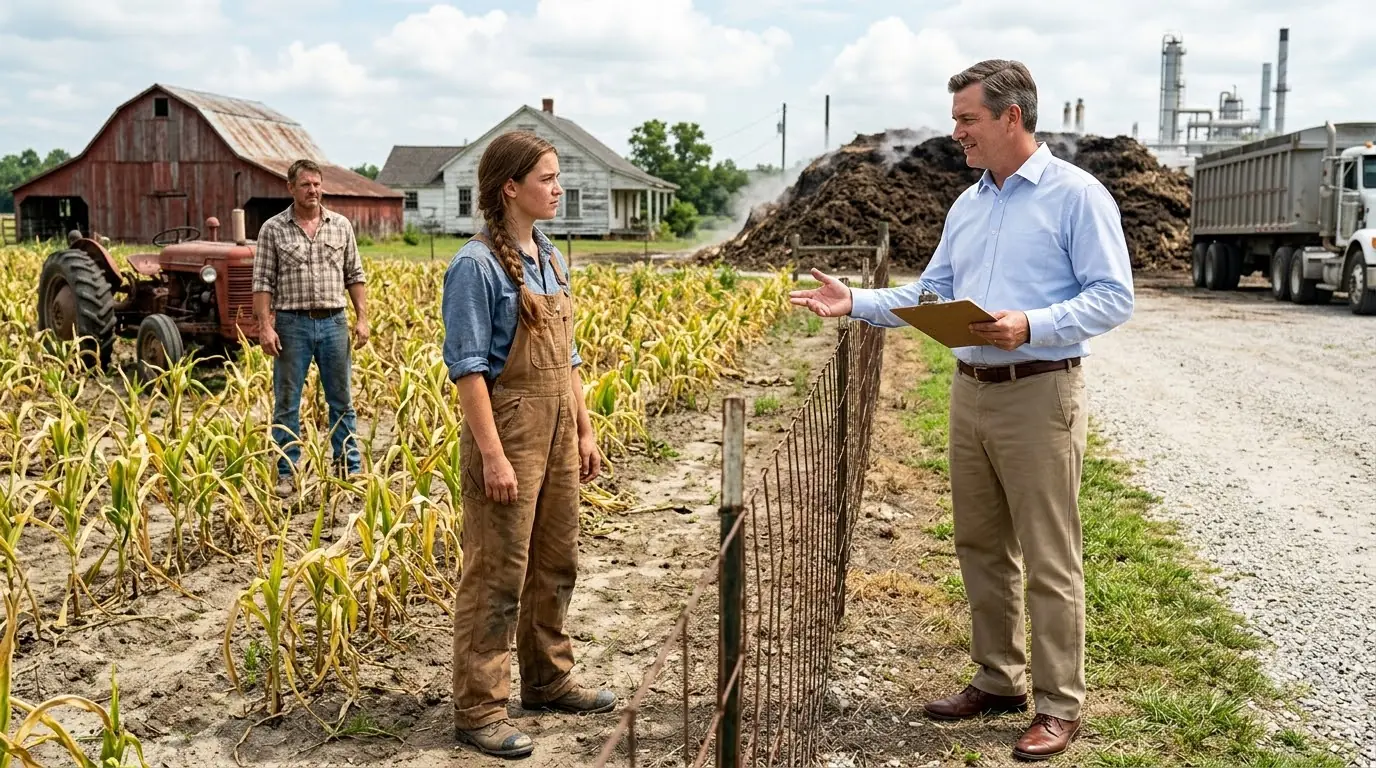
Thick.
Sweet.
Fermented.
Half molasses and half rot.
The kind of smell that slipped through window screens, settled into clothes hanging on the line, followed you into the kitchen, and somehow stayed inside your nose even after you had driven ten miles into town.
Elsie stood there holding a chipped enamel mug of coffee she was technically not supposed to drink yet.
Her father knew.
Her mother knew.
Neither had the energy to argue about caffeine anymore.
The morning was barely seven, but heat already pressed against the valley.
Flies drifted in slow circles above the drainage ditch.
Near the south fence, grass that should have been deep green had faded to the color of weak tea.
Past that fence, on low ground that belonged to Callaway Sugar Refining Company, a black mound of crushed cane fiber and wet mill residue rose above the pasture like a small hill that had not existed when Elsie was born.
Steam lifted faintly from its upper surface.
Then came the sound.
Diesel.
Low at first.
Growing.
Elsie did not turn.
She knew the truck before she saw it.
A white Callaway flatbed with high steel sides appeared on the service road beyond the fence, rolled toward the dumping area, then reversed until its rear wheels were almost hidden by old cane fiber.
The driver never looked toward the farmhouse.
None of them did.
The hydraulic bed rose.
The rear gate opened.
A heavy mass of wet bagasse and dark processing residue slid backward.
It struck the pile with a thick collapsing sound.
Flies lifted.
Steam rolled.
The smell strengthened.
Elsie took one sip of coffee.
The truck lowered its bed and drove away.
No apology.
No hesitation.
Another Tuesday.
Another load.
Another addition to the black mountain behind the Wren farm.
The dumping had begun when Elsie was ten.
At first, adults called it temporary.
By twelve, she learned that temporary was one of those words people used when they wanted you to stop asking what would happen later.
By fourteen, the south pasture had stopped producing properly.
By fifteen, her father had stopped driving to the refinery office because every visit ended the same way.
By sixteen, Elsie no longer believed anybody with authority was coming to fix the problem.
What she did not know, standing on that porch with taped boots and chapped hands, was that the mound everyone in Holt County had learned to ignore was about to become the center of her life.
Not because it was harmless.
It was not.
Not because all industrial waste secretly had value.
It did not.
But because buried inside years of badly managed organic byproduct was something Elsie had never been taught to ask about.
What exactly was in it?
What part of it was damaging the land?
What part could be separated?
What part could be treated?
And what would happen if somebody stopped calling it waste long enough to understand what it actually was?
The Wren farm sat along a broad river valley where the land flattened just enough to hold moisture but still rose gently toward wooded ridges in the distance.
Eighty acres.
Not large by local standards.
Not small enough to be a hobby.
The farmhouse had been white once.
By the time Elsie was old enough to notice paint, it had faded into a soft gray-beige except beneath the porch roof, where protected boards still showed what the color used to be.
The red barn leaned slightly east.
Her grandfather claimed it had leaned that way since 1976 and therefore should be trusted.
Nobody knew whether that was structurally sound reasoning.
The barn remained standing.
That seemed to be enough for him.
Elsie’s grandfather, Amos Wren, had farmed the property for forty-one years.
He grew cane when prices were good.
Sweet corn.
Beans.
Hay.
Some soybeans.
Vegetables for a roadside stand during the years when Elsie’s mother had enough energy to run it.
The best soil lay in the southern forty acres, the low bottom land beside a tributary drainage channel that eventually emptied toward the river.
Amos called it the good bottom.
“You can push a fence post into that soil with your hand,” he used to say, “and something will climb it by Sunday.”
Elsie believed him when she was little.
Grandfathers were allowed to exaggerate.
Then she saw photographs.
Corn shoulder-high by June.
Cane standing thick.
Dark earth turning beneath a plow.
Amos beside a tractor with mud reaching halfway up his boots.
The good bottom had really been good.
Then Callaway expanded.
The refinery had existed for decades.
Cane trucks were as normal in the county as school buses.
People complained about the smell occasionally, but Callaway employed nearly four hundred workers directly and supported hundreds more jobs through hauling, maintenance, contracting, farming, and distribution.
Everybody knew somebody who depended on it.
That gave the company a kind of social gravity.
People did not simply ask whether Callaway was right.
They asked what would happen if Callaway left.
When Elsie was nine, the company purchased sixty acres bordering the Wren property.
A representative named Thomas Keene visited the farm that autumn.
He wore a pale blue shirt tucked into khaki pants.
Clean boots.
Clipboard.
Friendly smile.
Elsie remembered him because he called her “young lady,” which she hated.
Her father, Owen Wren, stood beside the kitchen table while Thomas explained that Callaway needed temporary space for agricultural processing byproducts during construction of a new handling facility.
“Mostly bagasse,” Thomas said.
Owen frowned.
“Mostly?”
“Crushed cane fiber.”
“I know what bagasse is.”
“Of course.”
Thomas smiled.
“There may also be some organic mill residue.”
“What kind?”
“Screened plant solids.”
“Any chemicals?”
Thomas shook his head quickly.
“Nothing classified as hazardous under our operating permits.”
That sentence would bother Elsie years later.
Nothing classified as hazardous was not the same as something being good for soil.
Owen asked about runoff.
Thomas said engineering had reviewed drainage.
Owen asked about odor.
Temporary.
Owen asked how long.
One season.
Possibly into the next year.
Thomas used temporary six times.
Elsie counted because she was bored.
The first piles arrived that winter.
They were smaller then.
Mostly pale tan cane fiber.
Dry-looking.
Harmless-looking.
Within months, the color darkened.
More trucks.
Wetter loads.
Material compacted beneath its own weight.
Rain soaked through it.
Dark liquid began draining from low edges after storms.
The company dug a shallow ditch on its side of the fence.
The ditch frequently overflowed.
At first, the Wren farm seemed unaffected.
Then came the second year.
Grass near the boundary thinned.
Some cane rows along the lowest part of the Wren property yellowed early.
Owen blamed wet weather.
Year three was worse.
Corn stalks near the drainage line emerged unevenly.
Roots looked weak.
Some areas stayed waterlogged days longer than before.
The soil developed a sour odor when turned.
Amos had died by then.
A stroke took him during Elsie’s eleventh winter.
He never saw the worst of it.
Owen sometimes said that was a mercy.
Other times, especially after two beers, he said Amos would have driven a tractor straight through Callaway’s front office.
Elsie’s mother, Helen, usually told him not to say that in front of the children.
Elsie was their only child.
Nobody ever stopped calling her “the children” when conversations became serious.
Owen wrote letters.
The first went to Callaway.
Then county environmental services.
Then the agricultural extension office.
Then the county commissioner.
He photographed runoff.
Saved crop records.
Marked yield losses.
The company sent people.
They took samples.
Walked the boundary.
Explained that unusually wet years could produce localized nutrient issues.
One report suggested soil compaction from farm equipment.
Another referred to “multifactor agricultural decline.”
Owen hated that phrase.
“What does that mean?” he asked Helen one night.
“It means they used two words instead of saying they don’t know.”
Owen laughed.
Then stopped laughing.
He went to Callaway headquarters three times.
The refinery manager was Hal Brennan.
Hal was in his early fifties then.
Gray beginning at the temples.
Always looked tired.
He was not cruel.
Elsie eventually decided cruelty might have been easier.
Cruel people give you something obvious to oppose.
Hal gave coffee.
Sympathy.
Procedures.
He listened.
He nodded.
He said:
“I understand your frustration.”
Then:
“We’re reviewing it.”
Then:
“These things take time.”
Then:
“There are operational realities.”
Then:
“The drainage conditions existed before our expansion.”
Then:
“Our consultants have not established causation.”
Owen came home from the first meeting furious.
“They know.”
Helen looked at him.
“Know what?”
“They know that runoff is crossing.”
“Will they fix it?”
“They said they’ll study it.”
Second meeting, Owen came home quieter.
Third, he walked through the kitchen, hung his coat, and went directly to the barn.
Helen did not follow.
Neither did Elsie.
That was the year the well water began tasting faintly sour after heavy rain.
Helen stopped using it for drinking until tests came back.
The first laboratory result did not show acute danger, but several indicators had shifted enough that the family installed additional filtration and began testing more regularly.
That cost money.
Everything cost money.
Lower yield.
Extra lime in some fields.
Drainage work.
Testing.
Filters.
Lost production.
The piles continued growing.