The storm was less than two days away when the dog stepped directly in front of Wesley Granger’s combine.
Wesley hit the brake.
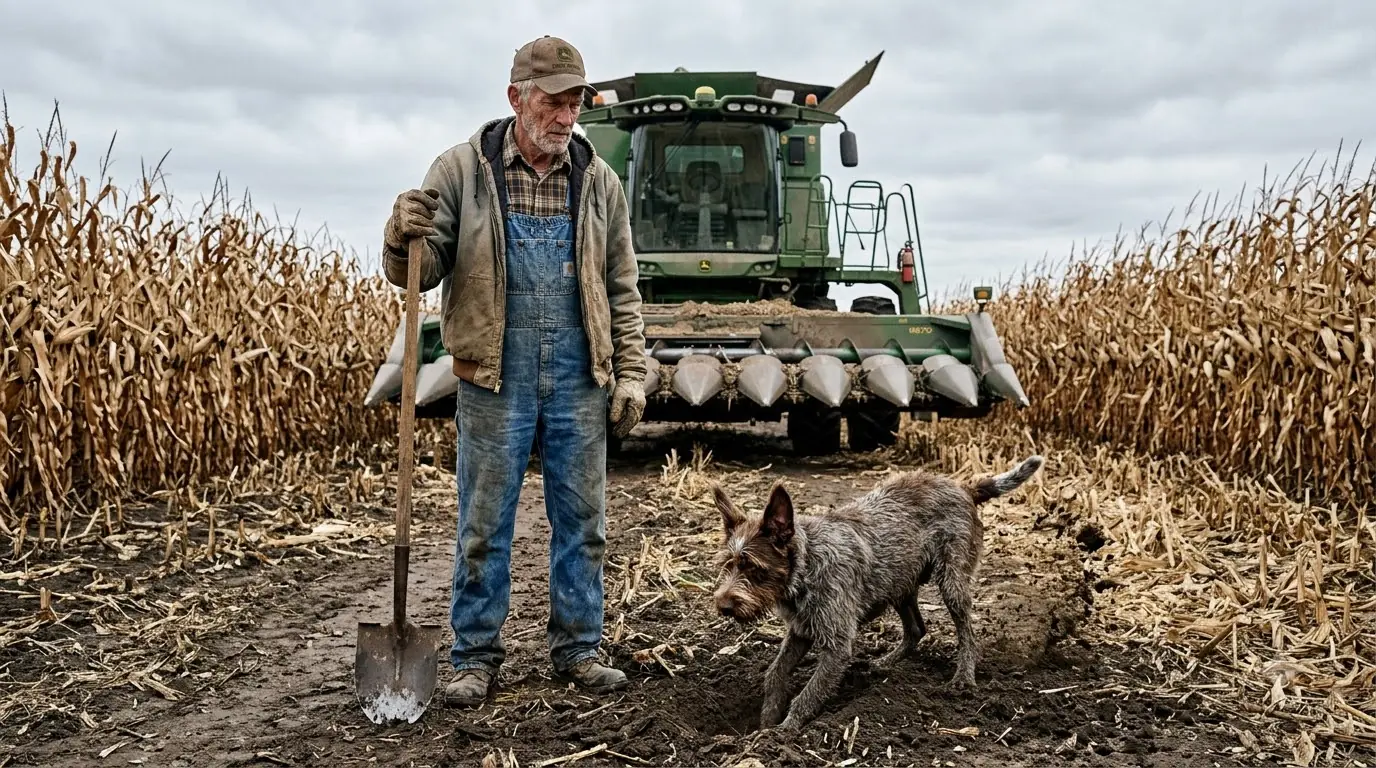
The machine stopped with the header less than twenty feet from the animal.
For a second, neither moved.
The dog stood in the field entrance with mud dried across its brown-gray coat, ribs visible beneath the fur, one ear upright and the other folded at the tip.
Amber eyes stared through the windshield.
Wesley leaned toward the glass.
“You have got to be kidding me.”
The western sky was already turning gray.
Not black.
Not dramatic.
But Wesley had spent seventy-one years beneath Iowa weather and forty-seven harvest seasons watching storms become worse than forecasts promised.
His corn was ready.
The elevator had room.
The grain cart was waiting.
And every hour now mattered.
He honked.
The dog did not move.
Wesley opened the cab door.
“Go on!”
The dog barked once.
“Go!”
Still nothing.
Wesley shut down the combine and climbed down.
Cold wind rattled dry corn leaves around him.
The dog backed away.
“That’s right.”
Wesley waved one gloved hand.
“Keep going.”
The animal retreated toward the standing corn.
Wesley returned to the cab.
Restarted the machine.
The dog ran back.
Same place.
Same stare.
Wesley’s jaw tightened.
“No.”
He climbed down again.
Clapped his hands.
“Move!”
The dog trotted thirty yards away.
Stopped.
Watched him.
Wesley climbed back into the machine.
The dog returned.
By the third time, Wesley had lost whatever patience survived nearly five decades of farming.
He opened the cab door.
“You trying to harvest this field yourself?”
The dog barked.
Wesley looked toward the clouds.
One windstorm at the wrong time could flatten standing corn and turn an ordinary harvest into weeks of crawling through twisted stalks.
He did not have time to negotiate with a stray.
So Wesley backed the combine away.
Drove nearly two hundred yards south.
Entered from another side.
“That ought to settle it.”
He eased forward.
The header reached the first row.
Then something exploded from the corn.
The dog.
It crossed directly in front of the machine.
Stopped.
Wesley froze.
His hands tightened around the controls.
The dog stared at him.
Then turned.
Ran into the field.
Fifty yards.
Maybe sixty.
Stopped.
Looked back.
Wesley frowned.
The dog lowered its head.
And began digging.
Hard.
Fast.
Dirt flew behind its front paws.
Then it stopped again.
Looked at Wesley.
Dug harder.
Something inside Wesley’s irritation changed.
He shut the combine down.
Climbed from the cab.
And followed.
Wesley had lived on that ground most of his life.
His father, Raymond, bought the original eighty acres after the Second World War.
Wesley expanded slowly.
Some land purchased.
Some rented.
One parcel lost during the brutal interest years of the 1980s.
Another bought later.
Nothing dramatic.
Just the mathematics of surviving long enough to become old on the same farm.
His wife Helen had understood that life better than anyone.
For forty-three years, they measured time in seasons.
Planting.
Calving.
Harvest.
Taxes.
Weather.
Then cancer took her.
The farmhouse became too large almost overnight.
Wesley stopped setting two coffee cups long before he stopped reaching for the second one.
Work became easier than silence.
Machines required attention.
Cattle needed feeding whether a man felt lonely or not.
Fields did not ask how he was doing.
So Wesley kept moving.
That morning, however, something beneath his corn was forcing him to stop.
The dog waited until Wesley came closer.
Then resumed digging.
“What's your problem?”
No answer.
Wesley looked around.
At ground level, something was different.
Several stalks leaned slightly toward a narrow strip running between the rows.
Not storm damage.
Not enough to notice from the combine.
He stepped closer.
There was a shallow depression.