“Mold, worms… what’s next? You gonna sell us rotten dirt too?”
Earl Dawson laughed so hard he had to grab the edge of the worktable.
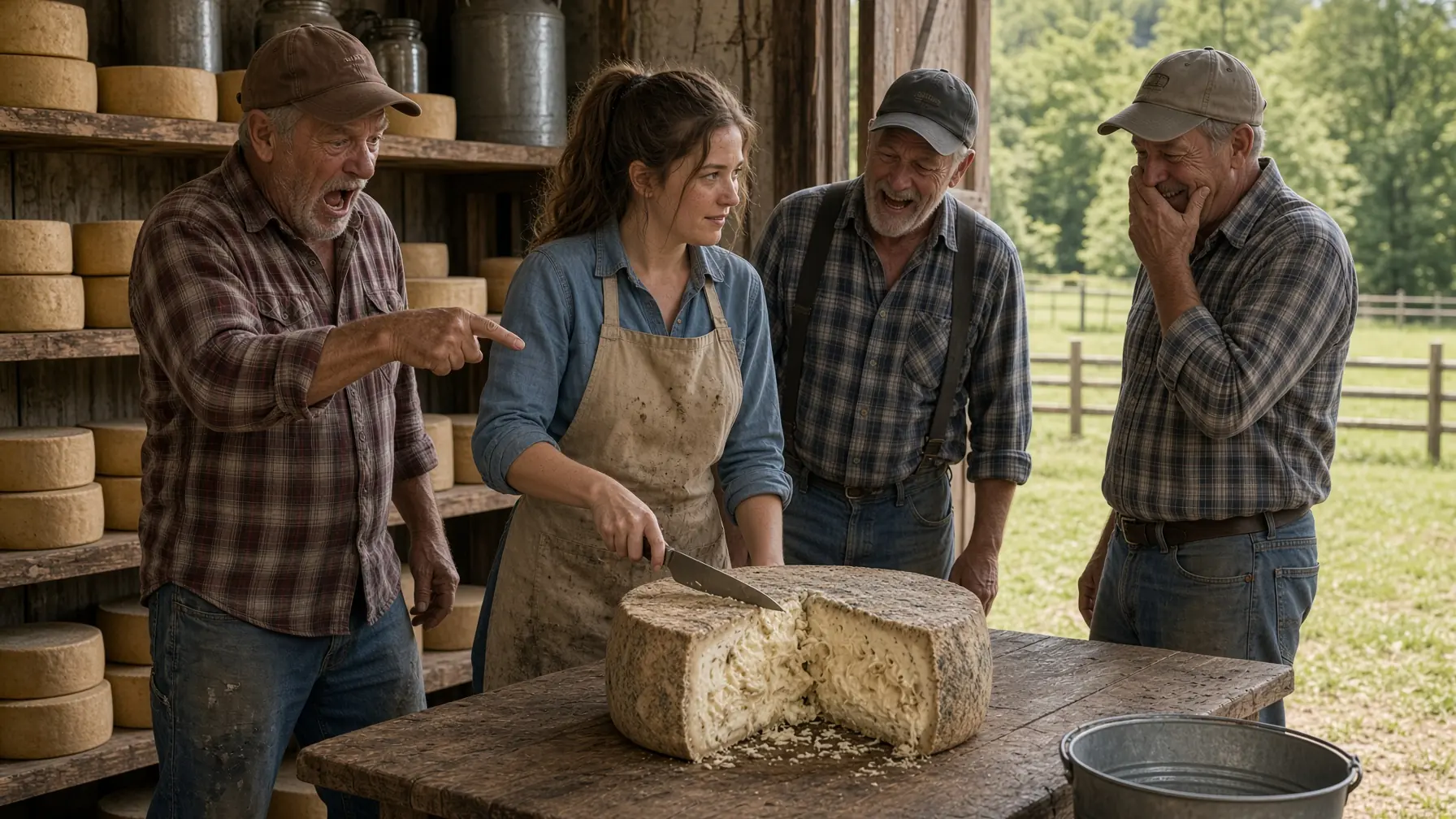
The two farmers beside him joined in.
One turned his face away in disgust.
The other pointed directly at the cheese wheel sitting between them.
Tiny pale larvae moved inside several openings in the softened rind.
The wheel smelled sharp, earthy, almost wild.
To the three men standing inside the old farmhouse cheese room, it looked like something that should have been thrown behind the barn days ago.
Maya Brooks did not laugh.
She stood on the opposite side of the wooden table wearing a faded blue work shirt, dark jeans and a stained canvas apron.
At twenty-four, she was younger than Earl had been when he bought his first dairy cow.
Her chestnut hair was pulled into a loose ponytail.
A thin layer of summer heat had reddened the freckles across her nose.
One hand held the wheel steady.
The other rested around the handle of a long cheese knife.
“You still think this is spoiled?” she asked.
Earl stared at her.
“Look at it.”
He pointed again.
“What else could it be?”
Maya slowly pushed the blade into the rind.
The men laughed once more.
Behind them, bright afternoon light came through the open barn doorway and spilled across the stone floor.
Outside, Holsteins grazed beyond the fence.
Milk cans stood cooling beside the wall.
Shelves carried ordinary wheels of cheddar and washed-rind cheese.
Everything in the room looked normal.
Except the wheel under Maya’s knife.
She cut deeper.
Halfway through, the resistance changed.
Maya slowed.
The blade reached the center.
Then she stopped.
Her expression shifted.
Barely.
But Earl noticed.
“So?”
No answer.
Maya separated the halves.
Looked down.
And smiled.
“That’s exactly what I was waiting to see.”
The laughter stopped.
All three farmers leaned forward.
None of them understood yet that the ugliest cheese in Franklin County was about to become the most important thing Maya Brooks had ever made.
Six months earlier, Maya had been ready to sell the cows.
Not all of them.
At first.
Only twelve.
Then probably another eight before winter.
That was how farm problems usually arrived.
Not as catastrophe.
As subtraction.
A few animals.
One field.
One repair postponed.
One bill paid late.
One expense cut because surely it could wait another month.
Brooks Family Dairy sat on ninety-three acres of rolling Tennessee farmland that had belonged to Maya’s mother’s family for three generations.
Her grandfather had milked forty cows there.
Her parents expanded to sixty-eight.
Then milk prices flattened while everything necessary to produce milk seemed to become more expensive.
Feed.
Fuel.
Veterinary care.
Equipment.
Cooling.
Insurance.
Labor.
A gallon of milk left the farm looking simple.
The mathematics behind that gallon did not.
Maya’s father, Thomas Brooks, died unexpectedly from a heart attack when she was twenty-one.
Her mother, Rebecca, lasted another year before arthritis in both hands made daily milking nearly impossible.
Maya had studied food science at the University of Tennessee.
Her plan had never been to return permanently.
She wanted product development.
Maybe a commercial dairy company.
Maybe graduate school.
Then the farm needed somebody.
So Maya came home.
At first, neighbors admired that.
“Good girl.”
“Keeping the family place going.”
“Your daddy would be proud.”
The admiration lasted until she started changing things.
That part rural communities were less enthusiastic about.
Maya tested feed ratios.
Changed sanitation records.
Installed inexpensive temperature sensors in the milk room.
Started tracking yield by cow.
And most controversial of all—
she began making cheese.
The Brooks family had sold fluid milk for decades.
Cheese, according to Earl Dawson, was what city people did after buying goats.
Earl farmed two properties down.
Sixty-two.
Large hands.
Permanent sunburn across his neck.
A voice that could be heard from one pasture to another.
He was not cruel.
He was simply deeply convinced that every farming idea had already been discovered before Maya was born.
When she built a small licensed cheese room inside an unused section of the old milking barn, Earl came to inspect.
He looked at the stainless-steel vat.
Shelving.
Drainage.
Temperature controls.
Then Maya.
“How much all this cost?”
She told him.
He whistled.
“You know milk buyers already own trucks, right?”
Maya smiled.
“Yes.”
“You put milk in tank.”