“What’re you fishing for, kid? A tractor?”
Dale’s laughter carried across the pond, disturbing a pair of birds in the reeds. Thirteen-year-old Eli Voss kept both hands on the rope and looked toward the patch of water where the hooked end had disappeared. He stood on firm ground above the shallow bank, his muddy boots planted apart, trying to feel through the line what he could not see beneath the surface.
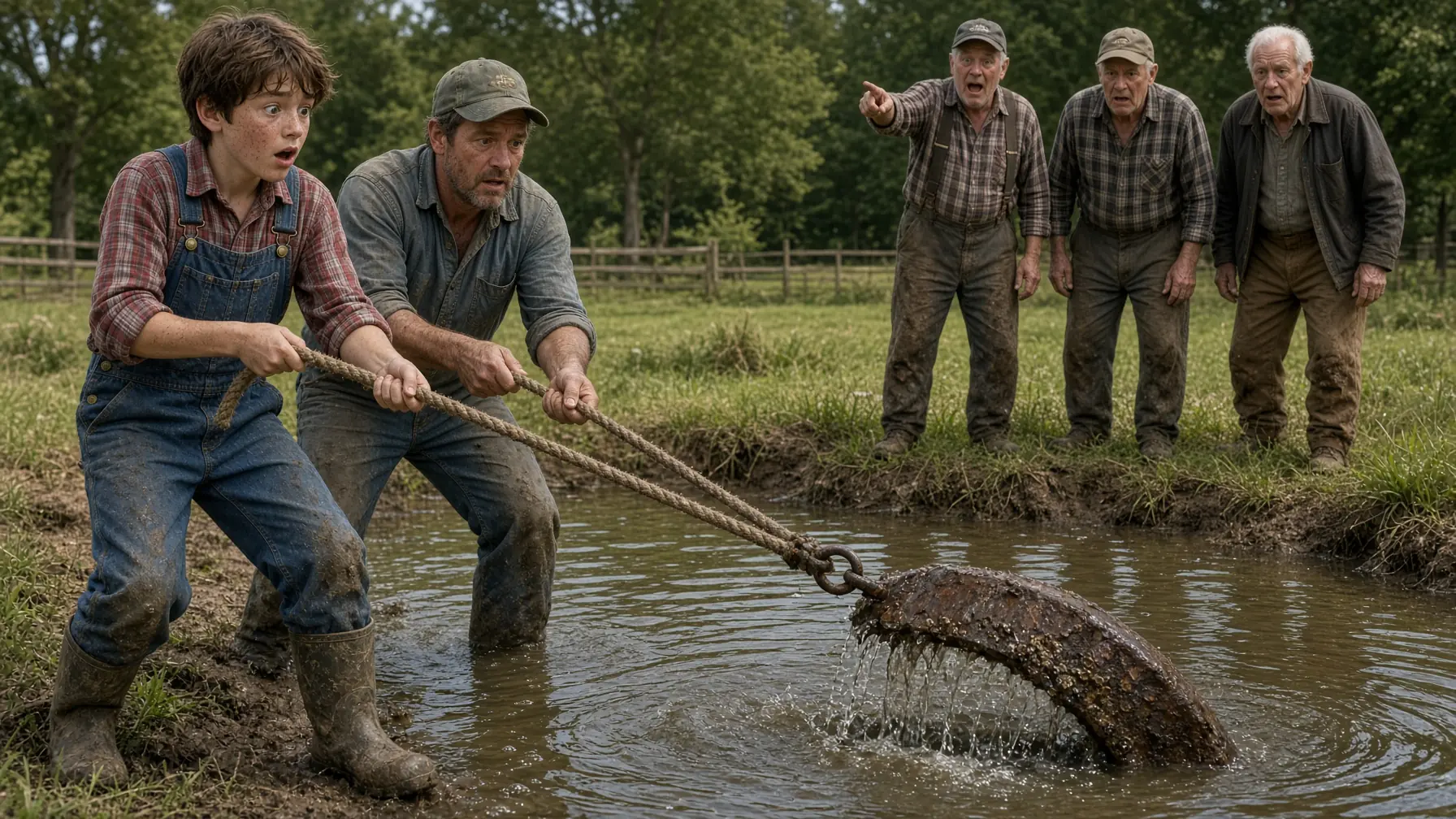
Otis folded his arms.
“He thinks there’s a whole house down there.”
Behind them, Eli’s father watched with the weary patience of a man who had agreed to five minutes and already regretted it. His grandfather stood farther back beside the wooden fence, leaning against a post. Pasture stretched beyond him, green under the late-summer sun, with leafy trees along the far bank and cattle moving slowly toward the shade.
Eli shifted his grip.
The rope tightened.
He stopped pulling.
At first, he thought the hook had caught another root. He had found three already, and Dale had made a joke about every one. But this resistance felt different. It did not spring, drag, or release. When Eli eased the rope sideways, something beneath the water answered with a dull scrape.
“Dad.”
His father did not move immediately.
“Eli, if it’s another—”
“This isn’t mud.”
Something in the boy’s voice brought him forward. Eli’s father stepped beside him, took hold of the rope above his hands, and tested the weight.
His expression changed.
“Hold it. Let me help.”
They pulled together, slowly.
The water shivered where the hook had sunk. Then a brown cloud rose from the bottom, spreading beneath the surface as something heavy shifted. Dale stopped laughing. Otis lowered his arms, and Eli’s grandfather pushed away from the fence.
A curved piece of rusted iron broke the water.
It came up a few inches at a time, thick and rounded, with a pale crust along one edge and a small irregular patch where two pieces had once been joined. More remained hidden. Eli’s father froze with the rope clenched in both hands.
Behind him, the old man stepped toward the bank.
“No,” he said.
Nobody had asked him a question.
Eli looked back.
His grandfather was staring at the metal as though it had risen from somewhere much deeper than the pond.
“Grandpa?”
The old man took another step.
“Lower it.”
His father turned.
“What is it?”
“Lower it.”
Eli felt the rope move beneath his palms. For the first time all morning, he wanted to let go, not because of the weight but because of the fear in his grandfather’s voice.
His father caught the change.
“Easy,” he told Eli. “We’re not dropping it.”
Together they allowed the curved iron to sink until only its upper edge remained visible. The water settled around it, leaving a small crescent of rust above the brown surface.
His father held the line.
“What did we catch?”
The old man looked at him.
“Something that should have stayed covered.”
The five minutes had become something else.
Eli had begun looking at the pond three days earlier because the irrigation pump would not hold its prime.
His father blamed a worn fitting, then a seal, then a length of old hose that had developed a crack near the coupling. Each repair helped briefly. Each time they tried again, the pump sounded wrong, and the pressure fell before they could finish watering the vegetable ground beyond the barn.
The pasture still looked healthy. The trees were full, and the pond reflected them neatly enough that a visitor might have assumed the farm had all the water it needed. But the reservoir was shallow in places, silted in others, and losing usable capacity year by year.
Eli’s father had been watching the forecasts.
He had also been watching the bills.
The farm was not failing in the dramatic way people imagined farms failed. There were no empty cupboards, no auction notices nailed to the barn, no abandoned animals calling from broken stalls. There were simply repairs that cost more than expected, prices that did not improve when they needed to, and equipment old enough that every quiet day felt borrowed.
A lower field had gone out of production the previous season.
His father called it a temporary decision.
Otis had asked whether he might lease it.
Then he had asked whether he might buy it.
Eli had heard the second conversation through the kitchen window and gone outside before his father could tell him not to listen.
He understood that money mattered. He did not understand how land could become an answer to a problem when losing it would create a different one.
His grandfather had avoided the conversation entirely.
The old man still helped with small tasks, checked gates, and offered opinions about weather, but he had grown careful whenever the pond was mentioned. Eli thought it was because age made some people dislike discussing improvements they could no longer perform themselves.
Now, standing beside the rope, he was no longer sure.
The first clue had appeared near the shallow bank after the water dropped.
Eli had been sent to clear weeds around the intake line. He noticed a straight edge beneath the brown water, too regular to be a root and too long to be a stone. When he moved along the bank, he saw another edge meeting it at an angle.
He called his father.
His father looked from several feet away.
“Old timber.”
“Why would it be square?”
“Because people used to throw things in ponds.”
“What kind of things?”
“Everything they didn’t want to haul farther.”