The trucks came on a Tuesday, same as always.
Three of them.
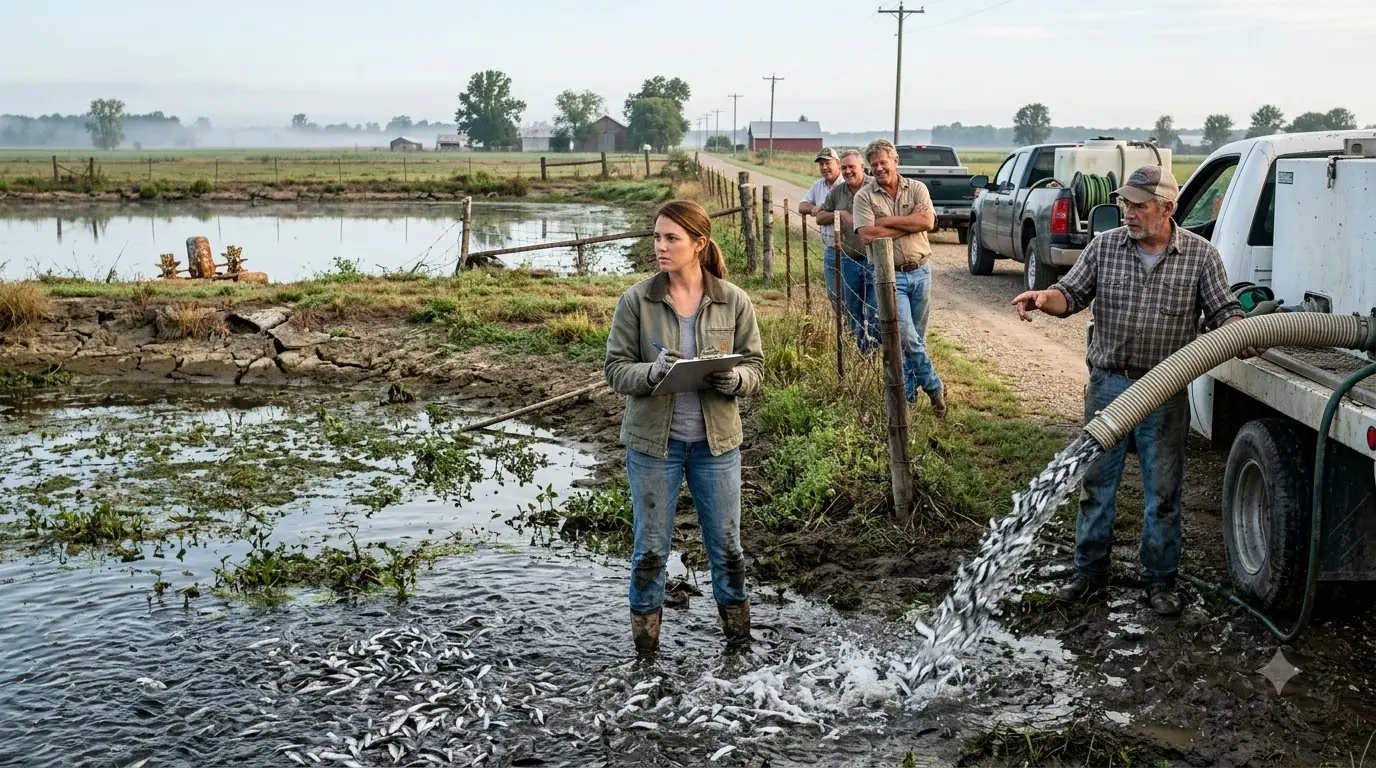
Unmarked tank trucks with dull aluminum sides, each backing slowly down the gravel road toward the old Halverson ponds outside a town so small that the nearest traffic light was seventeen miles away.
The drivers did not talk much.
They had made deliveries to commercial fish farms all over the state, places with concrete raceways, automated feeders, backup generators, laboratory equipment, and crews that knew exactly what to do when a truck carrying thousands of live fingerlings arrived.
This place had none of that.
What it had was four old ponds sitting behind six acres of neglected ground, a leaning equipment shed, a rusted aerator that sounded as though every rotation might be its last, and a twenty-six-year-old woman standing in mud with a clipboard she had bought at a dollar store.
The first driver climbed onto the rear platform and checked his oxygen line.
“You ready?”
Delaney Cross looked toward the water.
“As ready as I’m going to be.”
He glanced at the cracked pond banks.
Then at the homemade inlet screen Delaney had built two days earlier.
Then back at her.
“That does not inspire confidence.”
“It’s honest.”
The driver laughed once.
“Fair enough.”
He opened the transfer valve.
Water rushed through the hose.
Then the fish came.
Thousands of fingerlings poured into Pond One in a flashing silver stream.
For a moment, the surface looked almost alive.
Tiny bodies twisted beneath the morning sun, disappearing into muddy water and resurfacing again in quick bursts of movement.
Cars slowed along the county road.
That had started before the second truck arrived.
People knew those ponds.
Everybody did.
Twenty years earlier, a man named Halverson tried running a catfish operation there.
He borrowed aggressively.
Stocked heavily.
Cut corners.
Then lost most of his fish during two brutal summers.
After the bank took the operation, different people attempted different things.
A baitfish project.
Failed.
A recreational fishing pond.
Failed.
One man tried raising crawfish.
That lasted less than a year.
By the time Delaney inherited the property, people no longer called them fish ponds.
They called them Halverson’s mud holes.
So when three hatchery trucks appeared on a Tuesday morning and began unloading good living fish into water that had killed almost everything people had put into it for two decades, the county did what small counties do best.
It watched.
Pickup trucks slowed.
A school-bus driver leaned toward the window.
A man in a feed-company cap stopped entirely and took a picture.
Someone laughed loudly enough that Delaney heard it from the pond bank.
The second driver shook his head.
“Everybody knows this place, huh?”
“Apparently.”
“Doesn’t bother you?”
Delaney looked toward the road.
“It would bother me more if they were right.”
The driver studied her.
“They usually are.”
“Probably.”
Then the third truck arrived.
That driver was older than the others.
His name was Walter Graves.
He had hauled live fish for more than thirty years.
He watched the first transfer finish, then pulled Delaney aside before opening his own tank.
“How many are you taking total?”
“About six thousand today.”
“And next week?”
“Depends how today goes.”
Walter raised an eyebrow.
“You asked Carol for more.”
“Yes.”
“Why?”
“Because if I’m going to learn how to do this, I need enough stock to make the ponds worth managing.”
Walter looked out across the water.
“Kid.”
Delaney waited.
“These fish are worthless.”
He nodded toward the tank.
“Off-grade.”
“Mixed.”
“Too inconsistent for commercial customers.”
“Nobody wants them.”
“Nobody’s going to pay for them.”
Delaney looked through the tank window.
Catfish fingerlings moved beneath the oxygenated water.
Mixed among them were smaller hybrid bream.
Healthy.
Active.
Alive.
“Carol told me.”
Walter frowned.
“And you still want more?”
“Yes.”
“That should concern me.”
“It concerns everyone.”
He laughed.
Then shook his head.
“You know something I don’t?”
“No.”
“That concerns me more.”
He opened the valve.
Delaney watched another stream of unwanted fish enter a pond everyone had already declared dead.
When Walter finished, he climbed back into his truck.
Before pulling away, he leaned out the window.
“You lose half of them, don’t blame the hatchery.”
Delaney nodded.
“I won’t.”
“You probably will.”
“I won’t.”
Walter pointed toward the ponds.
“Those fish aren’t an opportunity just because they’re free.”
“I know.”
“Free things can get expensive fast.”
That sentence stayed with her.
Within seventy-two hours, she understood exactly what he meant.
A year earlier, Delaney would not have known the difference between a fingerling and a minnow.
She grew up two counties away on twelve acres belonging to her grandfather, Henry Cross.
Henry was an orchard man.
Apples mostly.
A few pears.
Peaches in the years when late frost did not destroy them.
He had never been wealthy.
He had never been especially poor either.
He simply spent forty years living in the narrow space between those two conditions.
The orchard made enough money to continue.
That was Henry’s definition of success.
He repaired equipment until bolts no longer had recognizable heads.
He saved fence wire.
Straightened bent nails.
Rebuilt broken ladders.
Kept old jars full of washers because, according to him, throwing away a perfectly good washer was how civilizations collapsed.
Delaney moved in with him when she was nine.
Her parents separated badly.
Neither was cruel.
Neither was particularly stable either.
Her mother moved away for work.
Her father moved through jobs and apartments with the optimism of someone who always believed the next arrangement would finally last.
Henry provided what neither parent could at that moment.
Consistency.
Breakfast at six-thirty.
School at eight.
Dinner at six.
Work before excuses.
Questions before assumptions.
Delaney used to complain that he never threw anything away.
One afternoon, when she was thirteen, she found him repairing the wooden handle of a pruning tool for the third time.
“Why don’t you buy a new one?”
Henry looked at the handle.
“What’s wrong with this one?”
“It broke.”
“Yes.”
“That means it’s bad.”
“No.”
“It means it broke.”
Delaney rolled her eyes.
“That’s the same thing.”
“It isn’t.”
He fitted the repaired handle back into the tool.
“Broken tells you what happened.”
“Useless tells you what you decided afterward.”
At thirteen, Delaney considered that exactly the sort of sentence old men used when they wanted to make ordinary repairs sound philosophical.
She remembered it years later.
Henry rarely talked about Delaney’s parents.
Never blamed them.
Never asked her to choose sides.
He simply built a life around whatever was actually in front of him.
When Delaney turned sixteen, he taught her bookkeeping.
Not because she asked.
Because orchard margins were small enough that ignoring numbers could kill a season.
He made her record fuel.
Fertilizer.
Packaging.
Labor.
Market fees.
Truck repairs.
Storage.
Shrink.
“You don’t make money because people buy apples,” he told her.
“You make money if what they pay exceeds what it cost you to put the apple in their hand.”
She laughed.
“That sounds obvious.”
“Most expensive mistakes do.”
When Delaney left for community college at nineteen, Henry gave her $600 he had been saving.
She tried to refuse.
He said:
“Take it.”
“I don’t need it.”
“Then save it.”
“You could use it here.”
“I have washers.”
That was Henry.
By twenty-six, Delaney was living in an apartment above a dental office.
She worked in quality control at a frozen-food packaging plant.
The job was not terrible.
That almost made leaving harder.
She had health insurance.
A predictable schedule.
A supervisor who left her alone when the work was done.
But nothing about it felt like hers.
She inspected records.
Temperature logs.
Packaging seals.
Sanitation checklists.
Every day she confirmed other people’s systems were functioning.
Then went home to a one-bedroom apartment whose rent increased every year.
Henry died in January.
Stroke.
Fast.
The funeral was small.
Delaney handled the estate because nobody else wanted to.
There was not much.
The orchard had already been sold several years earlier when Henry’s knees made the work impossible.
The house had a small mortgage.
A modest savings account.
Truck.
Tools.
Then the lawyer handed Delaney another deed.
Six acres.
She stared.
“What is this?”
“You didn’t know about it?”
“No.”
“Your grandfather owned it for twenty-three years.”
“Where?”
The lawyer gave her the parcel description.
Delaney recognized the road vaguely.
“Why?”
“No idea.”
Attached to the deed was a folded piece of notebook paper.
Henry’s handwriting.
Some things aren’t broken. They’re just waiting on the right person to notice them.
That was all.
No explanation.
No letter about dreams.
No instructions.
No story about why he purchased four failed aquaculture ponds.
Delaney nearly laughed.
“Of course.”
The lawyer looked up.
“What?”
“He left me a riddle attached to mud.”
Three weeks later, a local land buyer offered $4,000 cash.
Delaney almost accepted.
Four thousand dollars would cover several months of rent.