The ripping sound carried farther than Bethany Walsh expected.
One moment, Dr. Kesha Washington’s first-class boarding pass was resting between the gate agent’s fingers. The next, Bethany tore it down the center, ripped the halves again, and released the fragments over the gray carpet at Gate C14. White scraps fluttered around Kesha’s black heels while dozens of passengers watched from the boarding line.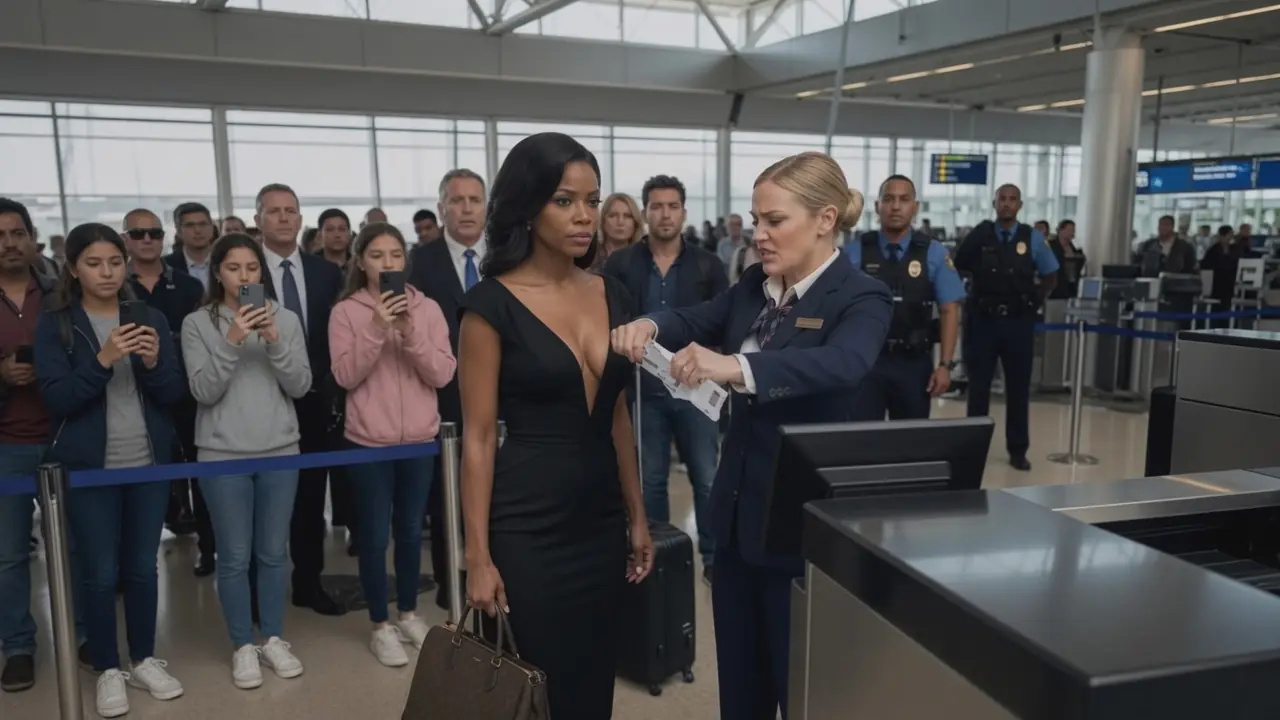
“A first-class seat isn’t for people who fake their way through the gate,” Bethany announced.
Kesha did not bend to collect the pieces.
At thirty-nine, she had spent enough time in boardrooms, courtrooms, and hostile negotiations to understand what happened when a powerful person lost control of the situation. Anger would give Bethany a distraction. Calm would leave her alone with what she had just done.
“You destroyed a valid ticket without checking my name,” Kesha said.
Bethany folded her arms across her navy uniform. Her blonde hair was twisted into a tight bun, her patterned scarf sat perfectly beneath her collar, and a polished name badge read BETHANY WALSH — SENIOR GATE SERVICES. She had worked for Meridian Skies Airlines for fourteen years and carried herself as though the gate, aircraft, and passengers all belonged to her personally.
“I checked enough,” Bethany replied. “Your boarding pass showed an unauthorized first-class reassignment.”
“It showed a confirmed seat.”
“It showed Seat 2A, which was released to an executive traveler this morning.”
Kesha glanced toward the scanning terminal. “Then scan my identification and open the reservation.”
Bethany gave a short laugh. “People who belong in first class don’t usually arrive five minutes before priority boarding with a ticket that suddenly appears in the premium cabin.”
Kesha’s expression remained still.
She had arrived late because the acquisition meeting at Meridian’s headquarters had run forty minutes beyond schedule. Lawyers had delayed final signatures, federal compliance officers had requested one last disclosure, and the board had insisted on confirming the announcement timetable. Her car reached the airport with twenty-three minutes remaining before departure.
She carried no entourage.
Her chief legal officer had offered to accompany her, but Kesha wanted the flight to Atlanta precisely because nobody at the airport knew who she was. For months, her investment group had received complaints about customer treatment within Meridian Skies. Some involved lost luggage or delayed refunds. Others described passengers being humiliated, ignored, or treated as suspicious based on appearance rather than evidence.
Kesha intended to observe the airline before the acquisition became public.
She had expected inefficiency.
She had not expected her ticket to be destroyed.
Behind her, a teenage passenger in a pink sweatshirt held up her phone and recorded. A middle-aged businessman stepped out of line as though he wanted distance from the conflict. Near the windows, an older couple whispered while watching Bethany point toward the concourse.
“You need to leave the boarding area,” Bethany said.
“I have a valid reservation on Flight 417.”
“You had a piece of paper that claimed you did.”
“The reservation exists in your system.”
“I’m not delaying one hundred eighty passengers while you argue about a fraudulent upgrade.”
Kesha placed her brown leather handbag on top of her carry-on. “Then verifying it should take less time than this conversation.”
Bethany’s jaw tightened.
The boarding scanner stood less than two feet from her. Opening Kesha’s reservation would have required entering her last name and confirmation number. Instead, Bethany reached for the desk phone.
“Security to Gate C14,” she said. “Disruptive passenger refusing to leave.”
The crowd became quieter.
Kesha looked at the clock above the gate. It was 10:46 a.m.
The ownership announcement was scheduled for eleven.
Fourteen minutes.
A younger gate employee named Miguel Santos stood behind Bethany with a handheld scanner. He looked from Kesha to the ticket fragments and shifted uneasily.
“Bethany,” he said softly, “I can pull up the reservation.”
She turned on him. “I’ve handled it.”
“But if the seat is confirmed—”
“I said I’ve handled it.”
Miguel fell silent.
Kesha noticed that reaction. It was not respect. It was fear practiced over time.
Two airport security officers approached through the crowd. One was a Black man in his early forties named Officer Daniel Price. The other, a younger white officer named Julia Bennett, kept one hand near her radio while studying the scene.
Bethany pointed at Kesha before either officer spoke.
“This passenger presented a fraudulent first-class boarding pass, became confrontational, and refuses to leave.”
Officer Price looked at Kesha. “Ma’am, may I see your identification?”
Kesha handed him her driver’s license.
Bethany immediately interrupted. “The name is irrelevant. The seat belongs to a corporate traveler.”
Officer Price examined the license. “Dr. Washington, do you have your booking confirmation?”
Kesha opened the airline application on her phone.
The screen displayed:
MERIDIAN SKIES FLIGHT 417
WASHINGTON/KESHA
FIRST CLASS — SEAT 2A
CONFIRMED
She held it out.
Officer Bennett leaned closer. “That appears active.”
Bethany shook her head. “The app can retain outdated information. The seat was reassigned.”
“Then the reservation system should show that,” Kesha said.
Bethany’s voice sharpened. “You don’t understand airline operations.”
“I understand records.”
“You understand how to make a scene.”
Kesha looked toward the passengers filming them. “I did not tear anything.”
A murmur moved through the line.
Bethany heard it and became more aggressive.
“She approached the desk demanding special treatment,” she told the officers. “When I explained that her upgrade was suspicious, she accused me of discrimination.”
“I have not used that word once,” Kesha said.
“Because you were about to.”
Officer Price lifted one hand. “Ms. Walsh, please let her answer for herself.”
Bethany’s face changed.
She was accustomed to airport personnel accepting her version before a passenger spoke. Being interrupted in front of the crowd threatened something larger than her authority over one ticket.
“This is my gate,” she said. “I am responsible for keeping the flight secure.”
“And we are responsible for determining whether someone should be removed,” Officer Price replied.
Miguel placed his scanner on the counter.
“I found the reservation,” he said.
Bethany spun toward him. “What did I tell you?”
Miguel swallowed but continued. “Seat 2A is confirmed under Dr. Kesha Washington. Full-fare first class. No upgrade. Ticket issued directly through executive services.”
Silence settled over the gate.
Bethany stared at the screen.
“That is impossible.”
Miguel turned the device toward her. “It is right here.”
“Executive services issued the ticket incorrectly.”
Kesha’s voice remained level. “First the ticket was fraudulent. Now your own department made a mistake.”
Bethany ignored her and typed rapidly at the terminal. Her confidence weakened as the reservation loaded.
The screen showed more than a standard passenger record.
Several fields were restricted. A red banner appeared across the top:
CORPORATE PROFILE — DO NOT MODIFY WITHOUT EXECUTIVE AUTHORIZATION
Bethany’s hands stopped.
Officer Bennett saw it. “What does that mean?”
“It could mean anything,” Bethany replied.
Miguel looked over her shoulder. “It means her profile is protected by headquarters.”
Bethany clicked another tab. “There is no frequent-flyer status.”
“I didn’t book through a frequent-flyer account,” Kesha said.
“Then why would executive services issue your ticket?”
“You could ask them.”
Bethany reached for the phone again.
This time she did not call security. She called the airline’s internal operations desk.
“Gate C14,” she said when someone answered. “I need verification on a restricted passenger record. Washington, Kesha. Flight 417, Seat 2A.”
She listened.
Her expression shifted from irritation to confusion.
“No, that cannot be right.”
The voice on the other end continued.
Bethany lowered her voice. “I understand the code, but there must be a duplicate profile.”
Another pause.
“What do you mean I’m not authorized to access it?”
Kesha checked the clock.
10:52.
Eight minutes remained.
The older man standing near the boarding lane stepped forward. He wore a gray suit and carried a leather laptop case.
“I was behind her the entire time,” he told Officer Price. “She never raised her voice. The agent accused her before checking anything.”
The teenage girl filming nodded. “I recorded all of it.”
Bethany slammed down the phone.
“This passenger’s record is restricted,” she said. “That does not prove she belongs in first class.”
Officer Price looked at the torn pieces on the floor. “But the confirmed reservation does.”
“She may have accessed an employee profile.”
Kesha finally allowed a trace of disbelief into her expression. “You are now suggesting I hacked your airline because the evidence contradicts you.”
Bethany pointed toward security. “Remove her before she embarrasses herself any further.”
Officer Price did not move.
“Ms. Walsh, we have not identified any reason to remove her.”
“I am the senior gate agent.”
“And she has a valid ticket.”
Bethany reached across the counter and pressed several keys.
A warning appeared asking whether she intended to cancel the passenger’s reservation. Miguel stepped forward.
“Don’t do that.”
Bethany glared at him. “Return to your boarding position.”
“You cannot cancel a protected booking without cause.”
“I have cause.”
“What cause?”
“Disruptive conduct.”
Miguel looked at Kesha, who stood silently beside her luggage. “She hasn’t done anything.”
Bethany clicked CONFIRM.
The system rejected the action.
ACCESS DENIED — EXECUTIVE OVERRIDE REQUIRED
Her face flushed.
At 10:55, the gate manager arrived.
Richard Hale was a heavyset man in his late fifties who had supervised the terminal for nearly nine years. He moved through the crowd with the impatient expression of someone who had already decided the lower-ranking employee was probably right.
“What is happening?” he demanded.
Bethany answered immediately.
“This woman presented a fraudulent premium ticket, refused instructions, and caused a disturbance. Security will not remove her.”
Richard looked at the crowd, the phones, and the fragments scattered around Kesha’s shoes. He did not inspect the reservation.
Instead, he faced Kesha.
“Ma’am, regardless of your ticket status, your behavior has disrupted boarding. I need you to step away from the gate.”
“What behavior?” Kesha asked.
“You are arguing with staff.”
“I requested that your employee verify a confirmed booking before destroying it.”
Richard looked at Bethany. “You tore the ticket?”
“It was invalid.”
“The reservation is active,” Miguel said.
Richard frowned at him. “Nobody asked you.”
Kesha watched the same pattern repeat.
Bethany avoided verification because she had already decided what kind of passenger stood before her. Richard avoided verification because protecting an employee was easier than questioning his own supervision. Every layer of authority defended the one beneath it without checking the truth.
This was exactly what the acquisition reports had described.
Passengers did not face isolated mistakes.
They faced systems trained to protect themselves.
Richard lowered his voice as though offering Kesha a final kindness. “Leave voluntarily, and we will place you on a later flight after the matter is reviewed.”
“My seat is on this flight.”
“That may no longer be possible.”
“Because she destroyed the paper?”
“Because you created an operational delay.”
Kesha looked at the gate clock.
10:57.
Three minutes.
She picked up her handbag but left the suitcase standing beside her.
Richard interpreted the movement as surrender.
“Thank you,” he said.
“I’m not leaving.”
His expression hardened. “Then airport police will escort you out.”
Officer Price stepped between them slightly. “Sir, she has a confirmed reservation, and we have no legal basis to remove her from the terminal.”
Richard stared at him. “Airline staff may deny boarding to disruptive passengers.”
“Then document the disruptive act.”
Richard looked toward Bethany.
Neither produced one.
The first corporate alert arrived at 10:59.
Miguel’s handheld scanner chimed. Then Bethany’s terminal displayed a blue notification bar. Richard’s phone vibrated inside his jacket. Across the concourse, digital employee tablets lit up nearly simultaneously.
MANDATORY CORPORATE ANNOUNCEMENT — EFFECTIVE 11:00 A.M. EASTERN
Bethany tried to dismiss it.
The message remained locked.
A countdown appeared in the corner.
00:00:37
Richard removed his phone and frowned.
“What is this?”
Miguel read the preview. “Ownership transition.”
Bethany glanced at Kesha.
For the first time, something resembling fear entered her eyes.
Kesha remained silent.
Thirty seconds.
Twenty.
Passengers noticed the alert on the large gate display when the airline logo briefly vanished. The boarding information disappeared, replaced by a white screen with Meridian Skies’ navy emblem.
Ten.
Nine.
Eight.
Bethany whispered, “Who are you?”
Kesha met her eyes.
The display changed.
MERIDIAN SKIES ANNOUNCES COMPLETION OF ACQUISITION
Beneath the headline appeared a professional portrait of Dr. Kesha Washington wearing the same navy suit and ivory blouse she wore at the gate.
The message continued:
WASHINGTON AERONAUTICS GROUP HAS COMPLETED ITS ACQUISITION OF MERIDIAN SKIES AIRLINES. DR. KESHA WASHINGTON WILL SERVE AS EXECUTIVE CHAIR AND MAJORITY OWNER, EFFECTIVE IMMEDIATELY.
Nobody spoke.
Phones rose throughout the waiting area.
Bethany looked from the photograph to the woman standing before her, then back to the screen.
Her mouth opened.
Nothing came out.
Richard’s phone began ringing. A second call followed before he answered the first.
“This is Hale.”
The voice speaking through the device was loud enough for Kesha to hear fragments.
Headquarters.
Incident report.
Do not allow departure.
Preserve video.
Corporate legal en route.
Richard’s face lost its color.
“Yes,” he said. “She is here.”
Another pause.
“No, she has not boarded.”
His eyes moved toward the ticket fragments.
“Yes. The ticket was destroyed.”
Bethany stepped backward from the counter.
Kesha picked up one torn piece and placed it on the desk.
“Read that message first,” she said. “It explains why I now own this airline.”
Bethany’s lips trembled. “Dr. Washington, I didn’t know.”
Kesha looked at her.
“That is the problem.”
“I was following security procedures.”
“No procedure instructed you to tear a valid ticket without scanning it.”
“The seat had been flagged.”
“It was protected.”
“I thought—”
“You decided.”
Bethany swallowed.
Kesha continued, still calm. “You decided I did not belong in first class. Then every fact became something you needed to explain away.”
“This is a misunderstanding.”
“No. A misunderstanding ends when evidence appears. You continued after the reservation, identification, corporate code, and your colleague all proved you wrong.”
Richard stepped forward.
“Dr. Washington, I sincerely apologize. We can immediately prepare another boarding pass and escort you personally.”
Kesha turned toward him. “Would you have apologized if that screen had shown someone else’s face?”
He did not answer.
“Would you have checked the reservation if I did not own the company?”
Silence.
Kesha looked toward Officer Price. “Thank you for refusing an unlawful removal.”
He nodded. “I was doing my job.”
“That should not be unusual.”
Then she faced Miguel.
“You attempted to verify the record from the beginning.”
“Yes, ma’am.”
“Why did you stop when she ordered you?”
Miguel glanced at Bethany and Richard. “Because employees who challenge them lose hours, routes, and promotion opportunities.”
Richard’s head turned sharply. “That is not true.”
Miguel met his eyes for the first time. “You cut Elena’s schedule after she reported passenger complaints. You moved James to baggage after he questioned an improper denial. Everyone knows.”
Several airline workers near the neighboring gate looked away.
Kesha took out her phone and called her chief legal officer.
“Marianne, activate the passenger-treatment investigation at Terminal C. Preserve all recordings, staffing records, disciplinary reports, and denied-boarding complaints connected to Walsh and Hale. No records are to be altered.”
Richard whispered, “Investigation?”
“Yes.”
“Are we suspended?”
“You are removed from passenger contact pending review.”
Bethany’s panic became anger.
“You cannot judge my entire career based on one difficult interaction.”
Kesha looked down at the shredded ticket.
“You judged my entire identity in less than thirty seconds.”
Bethany’s face tightened. “You set this up.”
“I bought a ticket.”
“You came without telling anyone who you were.”
“Passengers should not need to reveal ownership of the airline to receive basic verification.”
A woman near the front of the boarding line began clapping.
The sound was brief and uncertain, but others joined. Kesha raised one hand, stopping it.
“This is not entertainment,” she said. “A passenger was publicly humiliated while employees and strangers watched. Today that passenger happened to own the company. Most people in this situation have no announcement arriving to rescue them.”
The applause ended.
Her words settled more heavily than celebration could have.
Corporate representatives reached the gate twelve minutes later. Marianne Cole, Meridian’s new general counsel, arrived with the regional vice president, an employee-relations investigator, and two members of airport administration. Bethany and Richard surrendered their badges and were escorted to a private office for interviews.
Flight 417 remained at the gate.
Kesha refused the offer to delay the aircraft further.
“Board the passengers,” she said. “They have already lost enough time.”
Miguel printed a new boarding pass.
His hands trembled slightly as he gave it to her.
“Seat 2A, Dr. Washington.”
Kesha accepted it. “Thank you.”
Before entering the jet bridge, she turned toward the teenage girl who had recorded the incident.
“Keep the original video,” Kesha said. “Legal may request a copy, but the airline will not ask you to delete or edit it.”
The girl nodded. “Are you going to fire her?”
“I’m going to establish what she has done before and who allowed it.”
That answer reached the passengers standing nearby.
Kesha boarded without an escort.
The first-class cabin contained wide leather seats, polished surfaces, and attendants suddenly aware that the woman in 2A could alter all their careers. Their nervous attention made her uncomfortable. She ordered water, opened her laptop, and began writing before the aircraft moved.
Her first document was not a termination order.
It was a list of questions.
How many passengers had been denied boarding without proper verification? How often were complaints dismissed as disruptive behavior? Which employees had reported misconduct, and what happened to their schedules afterward? Why did reservation systems allow gate agents to cancel protected bookings without an independent review?
By the time the plane landed in Atlanta, Kesha had outlined the first phase of Meridian’s reform.
The investigation lasted six weeks.
Security footage confirmed Bethany initiated the confrontation before examining Kesha’s reservation. Employee testimony revealed a long history of similar behavior. She had mocked passengers’ clothing, questioned legitimate premium bookings, and repeatedly described calm objections as threats.
The pattern was not limited to race.
She targeted people who looked poor, young, foreign, disabled, or unfamiliar with airline procedures. She treated first class as a private club and herself as the person entitled to decide who appeared worthy of entry.
Richard’s record was worse in a different way.
He had received seventeen formal complaints about Bethany in three years. He dismissed twelve without interviewing witnesses. In four cases, he reduced complainants’ work hours after they challenged her decisions. The remaining complaint disappeared because the passenger accepted travel credit in exchange for closing the case.
Both employees were terminated.
But Kesha understood that removing two people would not repair a culture that had rewarded silence.
She created an independent passenger-advocacy unit with authority to review boarding disputes in real time. Gate employees could no longer cancel a confirmed premium ticket after a passenger challenged the decision without secondary approval. Body-camera and terminal footage had to be preserved automatically whenever security was summoned.
Most importantly, employees were protected when reporting improper treatment.
Miguel became part of the team designing the new process.
When Kesha offered him the role, he hesitated.
“I only did what anyone should have done,” he said.
“That is exactly why I want you involved.”
Passenger complaints were reopened.
Several revealed incidents painful enough to reach national attention. A decorated veteran had been accused of stealing another passenger’s boarding pass. A family traveling for a funeral had been removed after questioning why their seats were reassigned. An elderly immigrant was left overnight in the wrong terminal because no employee wanted to find a translator.
Meridian issued refunds, compensation, and public apologies.
Kesha also required executives to spend two days each quarter working alongside frontline employees—not posing for photographs, but observing the pressure created by understaffing, confusing software, and unrealistic departure targets.
She refused to excuse cruelty.
But she also refused to pretend cruelty grew without conditions.
Three months after the incident, Kesha returned to Gate C14.
The layout looked almost identical. Travelers still rushed through the concourse, children cried, announcements overlapped, and impatient passengers questioned every delay. Yet a small sign now stood beside the service counter:
EVERY RESERVATION DESERVES VERIFICATION. EVERY PASSENGER DESERVES DIGNITY.
Miguel supervised the gate.
He smiled when he saw her but did not abandon the passenger he was assisting. Kesha waited until he finished.
“How is it working?” she asked.
“Slower at first,” he admitted. “Better now.”
“Complaints?”
“More documented. Fewer repeated.”
A young man in worn clothes approached the desk carrying an old backpack. He appeared nervous and held a first-class boarding pass. The employee beside Miguel scanned it without hesitation.
“Welcome, Mr. Carter,” she said. “Seat 3D. Priority boarding begins shortly.”
The man’s shoulders relaxed.
Kesha watched him walk away.
Nobody knew whether he had purchased the ticket himself, received it from an employer, used miles, or been given it by family. Nobody asked him to justify looking different from whatever image they associated with first class.
The system simply checked the record.
That was all Kesha had requested on the morning her ticket was torn apart.
Later, the preserved pieces of the original boarding pass were framed inside Meridian’s training center. Kesha rejected the communications department’s suggestion to turn them into promotional material. The frame contained no heroic language and no photograph of her.
Only a sentence:
THE TRUTH SHOULD NOT DEPEND ON WHO THE PASSENGER TURNS OUT TO BE.
New employees studied the incident during training.
They heard the full recording, watched Bethany reject each opportunity to correct herself, and discussed the moment professional judgment became personal prejudice. Trainers emphasized that the most dangerous mistake was not the first assumption.
It was the refusal to change after facts appeared.
Years later, passengers still told the story of the woman whose first-class ticket was torn up before the gate agent discovered she owned the airline. Most versions focused on Bethany’s face when the corporate alert appeared or the silence that followed Kesha’s photograph on the terminal screen.
Kesha remembered something else.
She remembered Miguel quietly saying he could check the reservation.
She remembered Officer Price refusing to remove her without cause.
She remembered the passengers who recorded because they understood the truth might otherwise disappear.
Ownership gave Kesha the power to expose what happened.
But ordinary people choosing not to remain silent made the exposure possible.
Bethany had believed first class belonged only to people who looked the way she expected wealth and authority to look. She believed a uniform gave her permission to turn suspicion into fact and humiliation into procedure.
So she tore the boarding pass.
She called security.
She demanded removal.
Then every screen at Gate C14 changed at once.
The woman standing among the shredded pieces had not faked her way into first class.
She had just purchased the airline.