The whole county laughed the day Clara Wren bought three hundred doomed turkey poults in the dead of summer. They laughed under the tin awning behind Merritt Feed Cooperative, with sweat running down their necks and dust sticking to their boots. They laughed because everyone in Buck Hollow knew turkey poults were supposed to be started in spring, not in June when the heat already made the fields shimmer. They laughed because Clara Wren was poor, young, and desperate, and people often mistake desperation for stupidity when it belongs to someone else.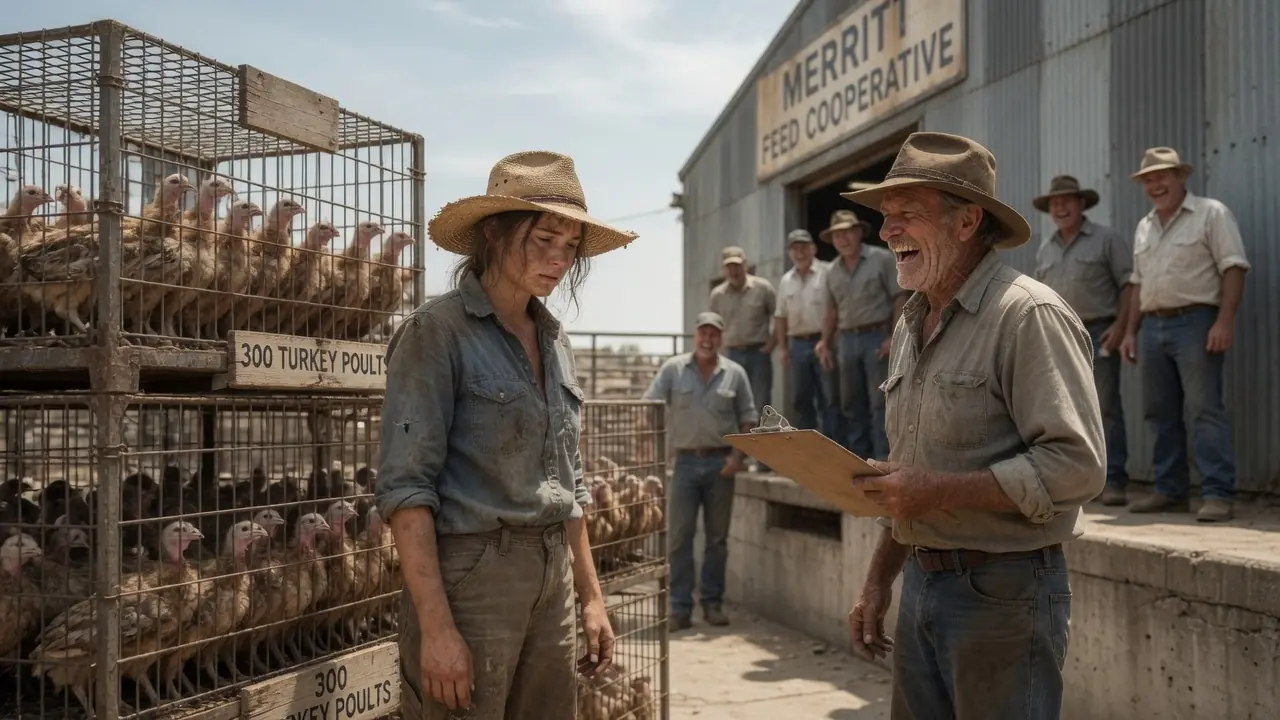
The poults had arrived late because a truck broke down two counties over, and by the time they reached the auction yard, nobody wanted them. They were small, weak, and packed in wire crates, peeping in the dry heat as if begging for someone to believe they were still worth saving. Amos Pike, the auctioneer, had tried to sell them in groups of fifty, then twenty, then ten. By noon, even he had started looking at them like a problem that would soon become a loss.
Old Reuben Vale spat into the dust and folded his arms over his suspenders. “Amos, you could tie ribbons on those birds and call them Christmas angels, and I still wouldn’t bid a dime.” Several men laughed behind him, because Reuben’s opinion carried weight in Buck Hollow. He owned three hundred acres, two tractors, and a voice that always sounded like it expected agreement. When he mocked something, most of the town mocked it too.
Then Clara Wren stepped through the side door. She was twenty-three, with chestnut hair tucked beneath a frayed straw hat and gray eyes made older by too many hard years. Her faded blue shirt was buttoned wrong at one cuff, and both knees of her canvas trousers had been patched by hand. She had walked four miles from her grandmother’s farm after the old pickup refused to start, and dust clung to her boots like proof of it.
Nobody paid her much mind at first. Clara was the kind of girl Buck Hollow remembered without ever truly seeing. Her parents had left when she was young, her grandmother had raised her on a failing farm, and Clara had gone away for a while before returning with quieter eyes and no explanation. Some called her hardworking, some called her unlucky, and some called her strange when they did not want to admit she made them uncomfortable.
Clara walked straight to the crates and crouched beside them. One tiny poult had pushed its beak through the wire, its eyes black and bright despite the heat. Its thin body trembled, but it was still alive, still peeping, still asking the world for one more chance. Clara touched the wire gently and whispered, “You’re late.”
The poult peeped back.
Amos sighed from the loading dock. “Clara, don’t get attached. Nobody’s taking them.”
She stood slowly, wiped dust from her palms, and looked at him. “What would it take to buy the whole lot?”
Every sound died at once.
Reuben Vale stared at her, then burst into laughter. “The whole lot?”
Clara did not look away from Amos. “All three hundred.”
Amos lowered his clipboard. “Clara, that’s not a little risk.”
“I asked the price.”
Reuben stepped forward, his face red from heat and amusement. “Girl, you lose your mind walking through that heat?” The men behind him laughed louder, grateful for permission. Clara felt the laughter crawl over her skin, but she held her chin steady. She had endured worse than laughter from men who owned more land than kindness.
“Girl, buying three hundred turkey poults in June isn’t farming,” Reuben said, waving his clipboard toward the crates. “It’s burying your money before August.”
Clara’s throat tightened, but her voice stayed clear. “Then tell me the price, Reuben, because I’m buying the whole lot.”
The laughter came again, bigger this time. Someone muttered that the Wren girl was trying to turn dead birds into a miracle. Someone else said her grandmother should lock up whatever little money they had left before Clara fed it all to the coyotes. Clara looked only at the poults because looking at the men would have made her anger show, and anger from a poor girl was always judged harder than cruelty from a rich man.
Amos named a price so low it was nearly an apology. It still emptied the small cloth envelope Clara carried in her shirt pocket. That money had come from selling preserves, mending dresses, and one secret thing she had not told her grandmother yet. Clara had sold her mother’s silver comb, the last pretty object left in the Wren house, because memories did not pay feed bills.
When she handed Amos the money, he hesitated. “Clara, you sure?”
“No,” she said honestly. “But I’m doing it.”
Reuben clapped slowly, cruel amusement shining in his eyes. “You hear that? The unlucky Wren girl thinks dead birds will save her farm.”
Clara turned to him at last. The auction yard went quiet because there was something in her face that did not look like embarrassment anymore. It looked like a match struck in a dark barn.
“Laugh now if you need to,” she said, voice trembling but fierce. “By Thanksgiving, every one of you will remember this moment.”
That made them laugh even harder.
Getting the poults home should have been impossible. Amos let Clara borrow cracked wooden panels to shade the crates, and one teenage feed clerk named Jonah felt sorry enough to help load them onto the cooperative’s old flatbed trailer. The pickup that hauled it belonged to Amos, and he drove because Clara had no working truck. When they reached Wren Farm, her grandmother stood on the porch with one hand pressed to her chest.
Lydia Wren was seventy-one, thin as a fence rail, with white hair braided down her back and hands bent from years of work. She did not speak at first. She looked at the trailer, then at Clara, then at the hundreds of tiny birds peeping beneath the shade panels. Finally she said, “Clara May Wren, tell me those are not turkeys.”
“They are turkeys.”
“In June.”
“Yes, ma’am.”
“All three hundred of them?”
Clara swallowed. “Yes, ma’am.”
Lydia closed her eyes for a moment. Clara waited for shouting, or worse, disappointment. Instead, her grandmother opened her eyes and stepped down from the porch. “Then we’d better get water under them before they decide dying is easier than living.”
That was how it began.
They cleaned out the old tobacco shed, patched holes with scrap boards, hung burlap sacks over the south openings, and dragged every usable trough from the barn. Clara worked until her arms shook and her palms blistered. Lydia moved slower, but she knew things Clara did not, like how to angle shade, how to mix weak birds a mash of cornmeal and egg, and how to listen to poultry the way some people listened to sermons. By midnight, the poults were under shelter with water, feed, and a fighting chance.
The first week nearly broke them. The heat stayed merciless, and Clara slept in the shed on a feed sack so she could wake whenever the birds crowded too tightly. She lost twelve poults in two days and buried each one near the fence with a tight face and shaking hands. Lydia told her not to count the dead more than once because grief wasted time if it did not teach you something.
The town kept laughing. At the post office, Mrs. Abernathy asked loudly if Clara had started sewing tiny funeral shrouds. At church, Reuben told three farmers that Thanksgiving at Wren Farm would be nothing but boiled feathers and regret. Even children began calling after Clara when she passed, making gobbling sounds behind their hands. Clara walked on with feed sacks over one shoulder and said nothing.
But silence was not surrender. Clara studied every poultry bulletin she could get from the county office. She wrote temperatures, feeding amounts, water changes, and losses in an old ledger that had once belonged to her grandfather. She mixed feed with chopped greens, moved the poults into shaded runs at dawn, pulled them back before the afternoon heat peaked, and rigged misting lines from punctured garden hose. By July, the weakest had died, but the rest had begun to grow.
Reuben rode by the farm one morning and slowed his truck near the gate. Clara was carrying two buckets, sweat darkening the back of her shirt. He leaned out and smiled like a man enjoying a private joke.
“How many left, girl?”
“Enough.”
“That means not many.”
Clara set the buckets down. “It means enough.”
He laughed and drove away, kicking dust over the fence. Clara watched the truck disappear, then picked up the buckets again. She did not know yet whether she would prove him wrong, but she had learned something important. People who wanted to see you fail often checked your progress more faithfully than friends.
By August, the poults were no longer fragile little things. They were awkward, growing birds with stronger legs, bold eyes, and voices that filled the yard every morning. Clara had lost thirty-one total, fewer than Amos later admitted he expected her to lose in the first two weeks. Lydia said nothing about miracles, but sometimes Clara saw her grandmother standing near the shed at dusk, one hand over her mouth, hiding a smile.
Then the feed bill came.
It was worse than Clara had feared. Three hundred turkeys ate like a storm with feathers, and the Wren farm had very little cash left. Clara sold quilts, preserves, and eggs. She took mending from every woman willing to pay, even Mrs. Abernathy, who inspected Clara’s stitches like she hoped to find failure there too. At night, Clara counted coins at the kitchen table while Lydia pretended not to notice when the pile came up short.
One evening, Clara found her grandmother taking down the blue pitcher from the top shelf. It had belonged to Lydia’s mother, and Clara knew it was the last thing of real value in the house. Lydia wrapped it in newspaper with careful hands. Clara stood in the doorway and felt shame rise in her throat.
“No,” Clara said.
Lydia did not turn. “Don’t start.”
“I won’t let you sell that because of my mistake.”
Her grandmother looked back then. “Is it a mistake?”
Clara opened her mouth, but no answer came.
Lydia set the pitcher on the table. “You tell me those birds are dying, and I’ll call it a mistake. You tell me you bought them because pride got louder than sense, and I’ll call it a mistake. But if you bought them because nobody else saw life where you did, then we keep going until life proves us foolish or faithful.”
Clara cried after that, not loudly, but enough that Lydia came around the table and held her. They did not sell the pitcher that week. Instead, Clara went to the county diner and asked for kitchen scraps, then to three gardens for bruised vegetables, then to the orchard for fallen fruit. She learned to stretch feed without starving growth, and every turkey that survived became proof that poor did not mean helpless.
September brought cooler nights and a new kind of attention. The turkeys had grown broad and healthy, with glossy feathers and strong bodies. People driving by Wren Farm slowed more often. Clara saw them looking over the fence, counting, measuring, wondering. Laughter became quieter when curiosity took its place.
Amos Pike came by one afternoon carrying a sack of grain he claimed had split at the cooperative. It had not split, and both he and Clara knew it. He stood by the fence, looking out at the flock with his hands on his hips.
“I’ll be,” he muttered. “You still have a fine number.”
“Two hundred sixty-four.”
Amos looked at her. “You counted quick.”
“I count every morning.”
He nodded slowly. “You got buyers lined up?”
Clara’s stomach tightened. “Not yet.”
He scratched his jaw. “Thanksgiving market’s strange this year. Heard two big farms south of here lost flocks to sickness. Prices might climb.”
Clara tried not to show how much those words mattered. “Might?”
“Might,” Amos said. Then he looked at her more gently. “Don’t let Reuben talk you into selling early.”
That warning stayed with her.
Three days later, Reuben Vale came to the farm.
He arrived in his clean truck with a leather checkbook and the relaxed confidence of a man who believed people in need could always be purchased cheaply. Clara met him at the gate. Lydia watched from the porch with narrowed eyes.
Reuben leaned one arm out the window. “I’ll admit, girl, you did better than I expected.”
Clara said nothing.
“I’ll take the flock off your hands now. Save you the last stretch of feed.”
“At what price?”
He named a number so low Clara almost laughed. It would cover debts, but leave nothing for profit, nothing for repairs, and nothing for the winter ahead. It was not an offer. It was a trap wrapped in politeness.
“No.”
Reuben’s smile faded slightly. “Don’t get greedy.”
“I’m not.”
“You’ve got feed bills, and I know your truck’s dead. I’m offering you rescue.”
Clara rested both hands on the gate. “No, Mr. Vale. Rescue doesn’t sound that much like taking advantage.”
His face hardened. “You think you can sell all these birds yourself?”
“Yes.”
“You don’t have customers.”
“I will.”
He laughed once, short and sharp. “Thanksgiving won’t wait for little girls with ledgers.”
Clara’s cheeks burned, but she held her ground. “Neither will people who want a turkey and can’t get one from the farms that failed.”
For the first time, Reuben did not have an answer ready.
By October, the shortage became real. Two major poultry farms in the county had lost birds, and another had already sold out to restaurants. Suddenly, people who had laughed at June poults began asking whether Clara planned to sell. She did not answer quickly. She had learned from the summer that the person who speaks first often gives away their hunger.
She printed order slips at the library, with Jonah helping her set the type on the old computer. Wren Farm Thanksgiving Turkeys, pasture-raised, limited number. Deposit required. Pickup Thanksgiving week. Jonah grinned when the first orders came through the cooperative bulletin board.
“You’re going to make them pay deposits?”
Clara smiled faintly. “They laughed on credit. They can buy with cash.”
Orders came faster than she expected. First from families who had always been kind. Then from families who had not. Then from the diner, the boarding house, and a restaurant in the next town that wanted twenty birds at premium price. Clara filled the ledger, took deposits, and kept every receipt pinned neatly in a box.
Reuben did not order.
He waited until early November, when prices had climbed again and the truth had become too obvious to pretend away. Then he came to Wren Farm with his hat in his hands and an expression that tried to be friendly. Clara was repairing a latch when he approached the gate.
“Clara,” he said.
She looked up. “Mr. Vale.”
“My daughter’s coming in from Kansas City with her husband’s family. Big table this year.”
“That’s nice.”
He cleared his throat. “I’ll need two turkeys.”
Clara wiped her hands on a rag. “I’m sold out.”
His smile froze. “What do you mean sold out?”
“I mean every available bird has a deposit.”
“Surely you kept extras.”
“I did. For losses, not for men who told me they’d cook before August.”
His face flushed. “Now, don’t be petty.”
Clara walked to the porch and opened the order box. She removed one paper and returned to the gate. “I can put your name on the waiting list.”
“The waiting list?”
“Yes, sir.”
He stared at her as if the words had personally insulted him.
Clara handed him the paper. “Deposit required if a bird becomes available.”
Reuben did not take it. “This town won’t forget if you shame me.”
Clara’s voice stayed calm. “This town laughed when you shamed me. I think it remembers plenty.”
He left without a turkey.
Thanksgiving week arrived with cold mornings, golden fields, and a line of wagons and trucks at Wren Farm’s gate. Clara stood beside the barn with her ledger while Lydia handled receipts from a folding table. People came quietly at first, then awkwardly, then with compliments they seemed embarrassed to offer. The birds were beautiful, broad-breasted and healthy, exactly what everyone had said they could never become.
Amos Pike bought one and paid extra without making a show of it. Jonah helped load orders and whispered that the whole cooperative was talking. Mrs. Abernathy came for her bird with a forced smile and a pie as an apology. Clara accepted the pie, but she did not pretend the summer had not happened.
By Thanksgiving morning, the final birds were ready for pickup. The sun had just cleared the east ridge when Clara saw a crowd gathering near the gate. Not laughing this time. Not leaning with smug ease. Farmers, neighbors, and townspeople stood in the cold with their hats in their hands and shame sitting plainly in their eyes.
At the front was Reuben Vale.
Clara stepped out of the barn, her straw hat replaced by a wool cap, her hands rough, her shoulders straight. She looked at the people who had mocked her in June and then at the empty crates stacked against the shed. Three hundred doomed poults had become the salvation of Wren Farm.
Reuben cleared his throat. “Clara.”
“Mr. Vale.”
He looked older in the morning light. “I came to say I was wrong.”
No one moved.
Clara waited.
Reuben swallowed. “I laughed at you because I thought sense belonged only to folks who had already succeeded. I was wrong about that too.”
The crowd stayed silent, and for once, Reuben did not look pleased to be listened to.
He removed his cap. “You did fine work, Clara Wren. Better than fine. You saw what the rest of us didn’t, and you worked harder than any of us gave you credit for.”
Clara felt Lydia step onto the porch behind her. Her grandmother said nothing, but Clara could feel her pride like warmth at her back.
“Thank you,” Clara said.
Reuben shifted. “If there’s any bird left, I’d be grateful to buy one. If not, I reckon I deserve beans.”
A few people laughed softly, but this time it was not cruel.
Clara looked toward the barn. There was one turkey left, smaller than the others but healthy. She had planned to keep it for herself and Lydia. Their first real Thanksgiving in years. Their first holiday without stretching soup and pretending not to miss meat.
She looked back at Reuben. “There is one left.”
His eyes lifted.
Clara continued, “But it’s for my grandmother.”
Reuben nodded slowly. “That’s right.”
Then Lydia stepped forward. “Clara.”
Clara turned. “Grandma?”
Lydia’s eyes were bright. “We have enough. Sell it to him.”
Clara stared at her.
Lydia smiled. “Not because he deserves it. Because we do.”
Clara understood then. Refusing him would have felt good for a minute. Selling to him at full price, with her head high and her farm saved, would last longer. She turned back to Reuben.
“One bird,” she said. “Full price.”
Reuben reached for his wallet without argument. “Full price.”
“And next time you see a poor girl take a risk, you don’t get to call it foolish just because you were too afraid to try it.”
His face reddened, but he nodded. “Fair.”
Clara took the money, wrote the receipt, and handed it to him. When Jonah brought the last turkey from the barn, Reuben accepted it with both hands like something heavier than a bird. Maybe it was. Maybe it carried the weight of a whole summer of laughter returned as shame.
That afternoon, Clara and Lydia ate Thanksgiving dinner at the kitchen table with roasted vegetables, biscuits, apple preserves, and a smaller chicken Amos had left on the porch with no note. They had money in the tin box, orders promised for next year, and enough feed credit to begin again properly in spring. The blue pitcher still sat on the shelf, unsold and shining in the soft light.
Lydia poured tea into two mismatched cups. “You know they’ll call you lucky now.”
Clara smiled. “They can.”
“They’ll forget they laughed.”
“No, they won’t.”
Lydia raised an eyebrow.
Clara looked out the window at the empty turkey yard, the repaired fencing, and the farm that had made it one more season. “Because I won’t.”
Her grandmother laughed, a warm and tired sound that filled the little kitchen better than any crowd ever could. Clara laughed too, and for once, laughter did not feel like something thrown at her. It felt like something that belonged in the house.
By the next spring, Wren Farm had a new sign at the gate. Clara painted it herself on a white board with blue letters: Wren Farm Holiday Turkeys, Orders Open Early. People came in March this time, not November, and they brought deposits without being asked twice. Reuben Vale was among the first in line.
He stood at the gate holding his check and looking uncomfortable. “Two birds for Thanksgiving,” he said.
Clara took the order slip. “Ordering early this year?”
“Yes, ma’am.”
The ma’am almost made her smile.
Behind him, the road filled with trucks and neighbors and farmers who had once laughed beneath the tin awning at Merritt Feed Cooperative. They came because Clara had been right, but more than that, because she had survived being laughed at long enough for truth to grow feathers, weight, and value. The town had learned a lesson it would not admit easily. Sometimes the thing everyone calls foolish is only a harvest they are too impatient to imagine.
Clara looked toward the brooder house where the new poults waited under clean lamps, warm, early, and full of promise. She thought of the first tiny bird pressing its beak through the wire in June, late and trembling and alive. She thought of every laugh, every insult, every night she had counted losses by lantern light. Then she wrote Reuben’s name in the ledger with steady hands.
That was how Buck Hollow changed its mind about Clara Wren.
Not all at once.
Not kindly.
But thoroughly.
And every Thanksgiving after that, when families in Buck Hollow carved their turkeys and praised the flavor, someone always remembered the summer auction. Someone always remembered the girl in the frayed straw hat who bought three hundred birds nobody wanted. Someone always remembered how loudly the town had laughed.
And how quietly Clara Wren had proved them wrong.