At 4:18 on a cold October afternoon, Mara Bennett stood beside a silver tanker truck with one gloved hand locked around the transfer hose while twelve thousand catfish circled beneath the dark surface of Pond Seven.
The fish were healthy.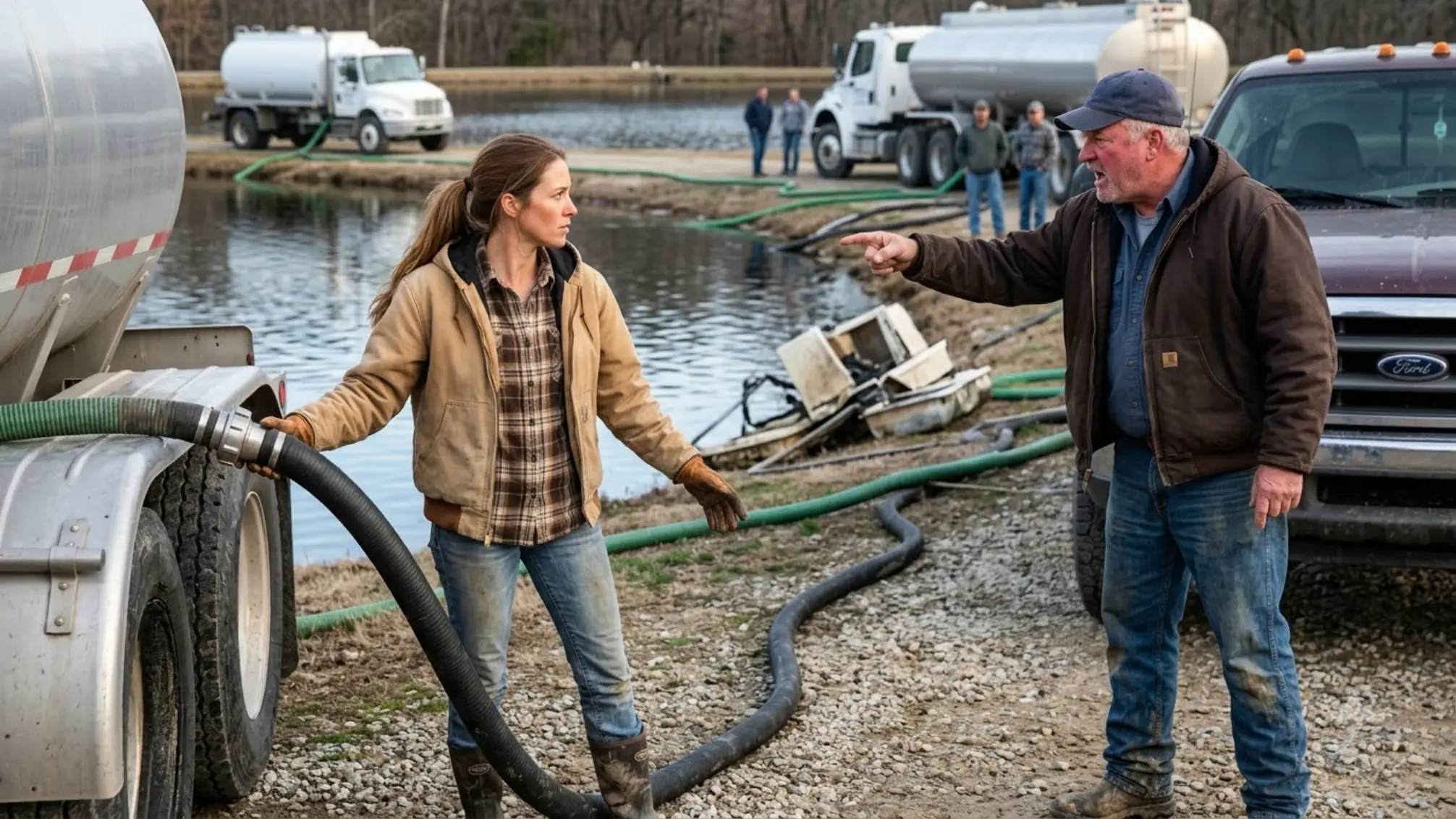
They were active.
And according to the destruction order clipped to Supervisor Wade Mercer’s clipboard, every one of them had to be removed before midnight.
Three tanker trucks waited along the gravel road beside the pond. Their steel bodies reflected the clean autumn sky, while portable pumps, black hoses, weighing equipment, and oxygen tanks had been arranged near the shoreline. Workers stood beside the vehicles without speaking because none of them wanted to be the first person to begin.
Wade Mercer did not share their hesitation.
He was fifty-eight, broad through the shoulders, with gray stubble, a weathered face, and an old green cap darkened by years of sweat. He had managed Clear River Hatchery for almost twenty years and spoke about its ponds as though every fish belonged personally to him.
The hatchery had once supplied catfish fingerlings to farms across southern Missouri and northern Arkansas. In better years, trucks lined the access road waiting to collect stock. Now half the ponds were empty, the processing shed needed repairs, and the county development board had begun discussing whether the property should be sold.
Wade blamed cheap imports, changing restaurant menus, and younger farmers who believed spreadsheets mattered more than experience.
Mara believed the problem was simpler.
Clear River had stopped listening to the market.
She was thirty-one, with sun-touched skin, hazel eyes, and chestnut-brown hair pulled into a practical ponytail. Her tan work jacket carried dust from the road, while waterproof boots and faded jeans showed she had not dressed for an office meeting.
She owned Bennett Aquaculture, a sixty-acre fish farm outside Willow Creek. Her operation was small compared with Clear River, but it had survived because she sold directly to restaurants, smokehouses, specialty grocers, and community food programs rather than depending on one industrial processor.
Wade stepped toward her and pointed at the hose.
Hatchery Supervisor (furious, pointing toward the gate): “Why are you still here? Those oversized catfish are worthless, and I’m paying crews to destroy them.”
Aquaculture Farmer (coldly, tightening her grip on the hose): “Then stop paying them and load every fish into my tanks.”
Hatchery Supervisor (threateningly, stepping into her space): “Touch that valve, and my men will drag you off this property before the first truck fills.”
Aquaculture Farmer (fiercely, raising the signed permits): “Try it, then explain why the buyers who rejected you are coming here tonight because I asked for more.”
Wade stared at the permits.
They came from the Missouri Department of Agriculture, county animal-health authorities, and the regional transport office. Each one allowed Mara to receive, relocate, and quarantine the fish if Clear River formally surrendered ownership.
“You cannot move twelve thousand fish on a promise,” Wade said.
“I have three oxygenated transport tanks arriving within the hour.”
“You have no buyer.”
“I have six.”
“Not for fish this size.”
Mara glanced toward the pond.
Most of the catfish weighed between twelve and eighteen pounds. Industrial processors preferred fish closer to two pounds because standard cutting equipment handled them quickly and produced uniform portions. Anything larger required different labor, different knives, and different customers.
Clear River’s contracted processor, Prairie River Foods, had rejected the entire pond three days earlier.
Its inspection report called the stock commercially unsuitable.
Wade interpreted that phrase as worthless.
Mara did not.
“Prairie River cannot process them,” she said. “That does not mean nobody can use them.”
Wade held up the clipboard. “They failed market standard.”
“They failed one company’s machinery.”
“The difference does not matter.”
“It matters to the fish, the hatchery, and anyone willing to buy them.”
Wade looked toward the workers as though expecting support. Most avoided his eyes. They had spent the morning attaching pumps for the destruction contractor and knew Clear River would pay nearly forty thousand dollars to remove the stock.
That amount did not include the feed, labor, electricity, and water already invested.
Mara had reviewed the numbers.
Clear River was about to lose more than two hundred thousand dollars and pay another company for the privilege.
She had first heard about Pond Seven from her uncle, Daniel Bennett, who delivered feed to Clear River twice a month. He called her after watching workers place warning signs around the pond.
“They are killing the big ones,” he told her.
“Why?”
“Processor says they grew past contract size.”
“How far past?”
“Some are fifteen pounds.”
Mara almost laughed.
A smokehouse in Memphis had asked her only the previous week whether she could locate large catfish suitable for whole smoked sections. Two restaurants in St. Louis wanted thick collar cuts and belly meat. A pet-food manufacturer sought clean fish protein too large for normal retail processing.
None of those buyers cared whether a fish fit Prairie River’s machines.
They cared about health records, flavor, texture, and consistent handling.
Mara called Clear River immediately.
Wade refused to speak with her.
She drove there anyway.
The first time she arrived, he told her the fish were already committed to disposal.
The second time, he claimed transferring them would violate health rules.
The third time, he threatened to call law enforcement.
Mara responded by obtaining the permits herself.
She also requested water tests, disease records, growth histories, and feed logs. Clear River’s office initially refused. A young technician named Owen Price quietly sent her the documents after learning the fish would be destroyed.
The records showed no disease.
Oxygen levels were stable.
Feed conversion had been excellent.
The fish were simply large.
Too large, Mara suspected, because someone had intentionally delayed harvest.
The original Prairie River contract required Clear River to deliver Pond Seven during the second week of August. Internal logs showed Wade postponed collection three times despite warnings that the stock was approaching maximum processor weight.
He blamed high water temperatures.
The temperature records did not support him.
He blamed transport shortages.
Truck records showed vehicles were available.
He blamed a county inspection delay.
The inspector signed clearance eleven days before the original collection date.
Every delay allowed the catfish to gain more weight.
By October, Prairie River could reject them without violating its contract.
Mara did not yet understand why Wade wanted that outcome.
She only knew it had been created.
A black pickup entered the access road while they argued. Owen Price stepped out carrying a folder and walked toward the pond. He was twenty-six, thin, serious, and still wore the blue uniform shirt issued by the hatchery laboratory.
Wade’s expression darkened.
“You are supposed to be in the testing shed.”
Owen held out the folder. “The final water and tissue results came back.”
“I already approved destruction.”
“They are clean.”
“I know.”
Mara looked at him. “No disease markers?”
“None.”
“Chemical residue?”
“Within normal limits.”
“Feed contamination?”
“No.”
Wade snatched the report from his hand.
“Go back to work.”
Owen remained.
“Why are we destroying healthy stock?”
Wade stepped close enough that the younger man lowered his shoulders.
“Because Prairie River rejected them.”
“That is not an answer.”
“It is the only answer you need while I sign your paycheck.”
Mara moved between them slightly.
“He asked a fair question.”
Wade turned toward her. “This is my hatchery.”
“Then explain why you delayed harvest until the fish became unmarketable under the contract.”
The workers looked toward him.
Wade’s jaw tightened.
“You accessed private records.”
“I reviewed documents connected to stock you plan to surrender.”
“Who gave them to you?”
Mara did not look at Owen.
“The state permits required supporting information.”
That answer was technically true, though it did not explain where she obtained the internal collection logs.
Wade lowered his voice.
“You think you can walk onto my property, wave papers around, and build a business out of my problem.”
“I think you created the problem.”
His hand tightened around the clipboard.
For a moment, Mara thought he might grab the permits.
Instead, he turned toward the nearest tanker driver.
“No fish move until I authorize it.”
The driver nodded reluctantly.
Mara pointed toward the destruction contract clipped behind his inspection form.
“Clear River is paying thirty-eight thousand dollars for removal.”
Wade looked at her sharply.
“That number is confidential.”
“The contractor filed it with the county waste office.”
“It covers equipment and labor.”
“I will take the fish at no charge and assume transport.”
“You cannot handle them.”
“My quarantine ponds are ready.”
“They will overwhelm your oxygen system.”
“I upgraded it last spring.”
“You do not have enough tanks.”
“Three are coming from Arkansas.”
“You cannot sell them.”
“Let the buyers decide.”
Wade’s face had become red.
Every objection he offered had an answer.
That did not mean Mara was certain her plan would work. Her entire farm could be damaged if the rescued fish carried an undetected disease. The quarantine ponds consumed space she normally used for winter production. Transport alone would cost more than twelve thousand dollars.
If the buyers changed their minds, she would inherit twelve thousand enormous catfish with no industrial market.
Still, she could not watch healthy animals be destroyed because one manager had built his entire operation around a single buyer.
At 5:03, three transport trucks appeared along the county road.
They belonged to Delta Live Haul, a family company that moved large fish between farms, lakes, and commercial ponds. Each truck carried oxygenated tanks, backup generators, and equipment designed for heavy stock.
Wade watched them turn into the hatchery.
“You called them before I agreed.”
“I called them before you finished making excuses.”
A few workers smiled.
Wade heard them.
His humiliation turned immediately into anger.
He approached the first driver and ordered him to leave. The driver, a forty-year-old woman named Carla Dawson, handed him a copy of Mara’s permit.
“We are contracted to Bennett Aquaculture,” Carla said.
“You are trespassing.”
Carla looked toward Mara.
Mara raised another document.
“The county owns the access road and Clear River accepted state emergency-transfer review. We can remain until the officer makes a decision.”
“What officer?”
A white state vehicle entered behind the trucks.
Inspector Dana Mills stepped out.
Wade went still.
Dana had supervised aquatic-health compliance across the region for eleven years. She was known for reading complete records before believing anyone’s summary.
She shook Mara’s hand, then addressed Wade.
“Mr. Mercer, I am here to witness surrender or review your destruction justification.”
“There is no surrender.”
“Then show me the biological reason for disposal.”
“The processor rejected them.”
“That is commercial rejection, not biological necessity.”
“The fish have no approved market.”
“That is not a health determination.”
Wade pointed toward Mara. “Her farm cannot absorb this stock safely.”
Dana looked at the quarantine plan.
“Her oxygen calculations meet requirements.”
“The paperwork is theoretical.”
“All farming begins on paper before equipment is activated.”
Mara almost smiled.
Wade demanded a private conversation. Dana refused because employees and contractors had already been included in the dispute.
She reviewed the tissue results.
Then she looked toward Pond Seven.
“Healthy fish cannot be classified as waste merely because the manager does not have a buyer.”
Wade lowered his voice. “They belong to Clear River.”
“Yes.”
“And I have authority to dispose of them.”
“Only if the ownership board approved the financial loss.”
Silence spread along the road.
Mara had not known that requirement existed.
Wade did.
His hesitation revealed it.
Dana continued. “Where is the board resolution?”
“It is pending.”
“Then you scheduled destruction without approval.”
“The chairman verbally authorized it.”
“Who is the chairman?”
Wade answered reluctantly.
“Travis Kell.”
Mara recognized the name.
Travis Kell owned Prairie River Foods, the processor that rejected the fish.
He also served as chairman of the county authority controlling Clear River Hatchery.
The same man sat on both sides of the failed contract.
Mara looked at Wade.
“Prairie River delays the harvest, rejects the oversized stock, and its owner authorizes the hatchery to pay for destruction?”
Wade’s expression hardened.
“You are inventing a conspiracy.”
“No. I am describing your paperwork.”
Dana requested the original delivery correspondence.
Wade claimed it was stored at the main office.
Owen spoke quietly.
“I copied it.”
Wade spun toward him.
“You did what?”
“The harvest warnings and delay orders are in the laboratory archive.”
“You had no authority.”
“I was told to adjust the growth projections after each delay.”
“Go home.”
Owen’s face became pale.
“You cannot fire me for preserving records.”
“I just did.”
Dana stepped between them.
“Do not remove his access until the state copies the files.”
Wade stared at her.
“This is becoming absurd.”
“No,” Mara said. “It is becoming expensive for the right people.”
The confrontation ended with Dana suspending destruction for twelve hours. Clear River’s ownership board had until 5:30 the following morning to approve surrender, prove a legitimate disposal basis, or accept an emergency state review.
The fish remained in Pond Seven overnight.
Mara’s trucks stayed.
The buyers were due before sunrise.
She did not sleep.
At 7:00 that evening, Mara returned to Bennett Aquaculture to inspect the quarantine ponds. Her younger brother, Luke, had installed new aeration lines while her mother organized feed and fuel records in the farmhouse office.
Bennett Aquaculture had not always been Mara’s operation.
Her father, Samuel Bennett, built the original catfish ponds after leaving construction work with damaged knees. He raised fish for regional processors and believed stable contracts mattered more than high prices.
For twelve years, the system worked.
Then Prairie River Foods reduced its approved supplier list.
The Bennett farm lost its contract with six weeks’ notice.
Samuel took a second mortgage to survive the season, sold equipment, and tried to find new buyers. The stress wore him down. He died from heart failure two years later, leaving Mara with debt, empty ponds, and a business every adviser told her to abandon.
She refused.
Instead of competing for another industrial contract, she created smaller markets.
She sold live fish to church festivals.
She developed whole-fish agreements with immigrant-owned grocers.
She worked with chefs who wanted cuts unavailable from large processors.
She learned smoking, cold storage, and direct distribution.
The business remained difficult, but no single buyer could destroy it with one rejection.
Wade called that model amateur.
Mara called it survival.
Her mother, Ellen, watched her check the aerators.
“You believe Clear River will surrender the fish?”
“They may not have a choice.”
“And if they do?”
“We load immediately.”
“Have the buyers guaranteed purchase?”
“No.”
Ellen folded her arms.
“How much money is at risk?”
Mara looked toward the pumps.
“Enough that I did not write it down where you could find it.”
“That is not reassuring.”
“It was not supposed to be.”
Luke returned from the second pond carrying an oxygen meter.
“Everything is stable.”
Mara nodded.
“What happens if the buyers reject them?” he asked.
“We divide the stock, slow the feed, and find smaller outlets.”
“All twelve thousand?”
“Yes.”
Luke looked toward the dark ponds.
“That could take months.”
“I know.”
“Are you sure?”
Mara answered honestly.
“No.”
At 10:36 that night, Owen called.
He was sitting inside his truck outside Clear River’s main office. After Wade fired him, he copied the archive before his system access could be blocked.
The files contained more than harvest delays.
Prairie River Foods had paid Clear River a quarterly consulting fee through a company registered to Wade’s wife. The payments were described as operational efficiency services.
No services were listed.
The destruction contractor, Mercer Environmental Recovery, belonged to Wade’s older brother.
Clear River would pay Wade’s brother to remove fish made unmarketable by delays Wade approved on behalf of a hatchery chaired by Prairie River’s owner.
Then the stock would not truly be destroyed.
Owen found transport records from an earlier pond.
Mercer Environmental collected rejected fish, moved them across state lines, and sold them as low-cost protein to a rendering company. Clear River paid for destruction, while Mercer earned additional money from resale.
Everyone profited except the hatchery.
The fish were labeled waste.
The loss became public.
The money became private.
Mara told Owen to send copies to Dana Mills and lock the originals somewhere Wade could not reach.
At 12:12 a.m., someone entered Clear River’s testing shed.
A security camera recorded a figure removing computers.
Owen recognized Wade’s brother.
Dana contacted county law enforcement.
By 1:00, investigators were on the property.
The transfer dispute had become a financial investigation.
Mara returned to Clear River at 3:45.
Fog hung above Pond Seven. The catfish moved slowly beneath the surface while truck lights illuminated the transfer hoses. Hatchery workers stood near the pumps, speaking in quiet groups.
Wade’s pickup was gone.
His office had been sealed.
Dana met Mara beside the pond.
“The board is voting remotely at five.”
“What happened to Wade?”
“He left before investigators arrived.”
“Do they know where he went?”
“They are looking.”
“Will the fish be released?”
Dana looked toward the pond. “The state can authorize emergency transfer if the board fails to act.”
At 4:28, the first buyer arrived.
Chef Adrian Ross stepped from a dark van carrying insulated containers and a knife case. He owned three smokehouses and two Southern restaurants in Memphis. Behind him came purchasing director Elena Cruz from Riverstone Specialty Foods, followed by representatives from a pet-nutrition company, a regional food bank, and a family seafood processor in Louisiana.
Wade had spent years asking Riverstone to purchase Clear River fish.
The company repeatedly declined because the hatchery could not guarantee traceable handling outside Prairie River’s system.
Mara had provided every record they requested in one afternoon.
The buyers examined live samples in portable tanks.
They checked eyes, gills, skin condition, muscle firmness, temperature, and water quality. Adrian selected one fish that had been humanely processed for evaluation and divided it into large sections.
He inspected the collar meat.
Then the belly.
Then the thick center fillet.
“This is what the smokehouse asked for,” he said.
Elena examined the texture. “The size is unusual, but the flesh is clean.”
A Clear River worker shook his head.
“Prairie River said they were too old and tough.”
Adrian looked at him.
“They are too large for its blades. That is not the same as tough.”
He cooked a small portion over a portable burner.
The meat remained firm, mild, and rich without the muddy flavor sometimes associated with large pond fish.
Mara watched every reaction.
She had built contracts around the assumption that the catfish would be good.
Now the buyers had to prove she had been right.
At 5:02, Adrian offered to purchase twenty-five percent of the stock for smoked products.
Riverstone requested thirty percent for direct restaurant distribution.
The Louisiana processor offered to take fish within a specific weight range for specialty cuts.
The pet-nutrition company wanted trim and by-products.
The food bank accepted smaller portions under a subsidized processing agreement funded by Mara’s emergency-rescue proposal.
Every part of the stock had a destination.
Elena looked at Mara.
“We need more.”
Mara almost laughed.
“You have not seen my quarantine results.”
“We will sign contingent on final health clearance.”
“How much more?”
“As much as you can produce under the same standards.”
A voice came from behind them.
“You cannot sign anything.”
Travis Kell walked toward the pond with two attorneys and a county commissioner. He wore a dark coat over business clothes and carried himself like a man accustomed to meetings ending when he entered.
He had chaired Clear River for eight years and owned Prairie River Foods for eighteen.
The workers moved aside.
Travis looked at Mara, then at the buyers.
“These fish remain Clear River property.”
Dana approached.
“The board missed the emergency deadline.”
“I am the chairman.”
“You are also the owner of the processor that rejected them.”
“That relationship is disclosed.”
“The private payments were not.”
Travis’s attorneys stepped forward.
He raised one hand to silence them.
Then he looked at Adrian.
“Prairie River has supplied this region for decades.”
Adrian closed his knife case.
“Prairie River does not process fish this size.”
“We could create a special line.”
“You rejected them.”
“Based on incomplete information.”
Mara folded her arms.
“The information became complete when someone else found a market.”
Travis ignored her.
He told the buyers that Clear River’s stock could not be transferred without indemnity agreements, long-term liability protections, and board review. Elena handed him a signed emergency purchase offer already approved by state compliance.
“You had twelve hours to raise those concerns,” she said.
Travis looked toward Dana.
“You are allowing a small farmer to take control of public property.”
Dana answered evenly.
“I am preventing public property from becoming private profit through a false destruction process.”
The workers began whispering.
Travis’s calm expression broke.
He pointed at Mara.
“You arranged this to embarrass Prairie River.”
Mara stepped closer.
“I arranged it because you called healthy fish worthless.”
“You do not understand processing economics.”
“I understand that your chairman delayed harvest, your company rejected the stock, your manager hired his brother to remove it, and your preferred contractor planned to sell it after Clear River paid for destruction.”
Travis looked toward the cameras.
Local reporters had arrived after hearing about the investigation.
He lowered his voice.
“You are making claims that will destroy this hatchery.”
“No. The records will decide what happens to the hatchery.”
“You think buyers will stay after the attention disappears?”
“They are standing beside me.”
“They will abandon you the moment your costs rise.”
“Then I will adjust.”
“You cannot scale.”
“I did not ask permission.”
Travis stepped closer.
“This county built Clear River for serious producers.”
Mara held his stare.
“My father was serious when Prairie River canceled his contract. You just did not care whether he survived.”
For the first time, Travis recognized her surname.
“Bennett.”
“Yes.”
“Samuel Bennett’s daughter.”
“The farm your company dropped after twelve years without one failed delivery.”
“He could not meet volume targets.”
“You changed them halfway through the season.”
Travis said nothing.
Mara continued.
“He died believing he had failed. I spent years learning that one processor’s rejection was not the same as worthlessness.”
She pointed toward Pond Seven.
“You used the same lie on these fish.”
At 5:31, Dana authorized emergency surrender.
The pumps started.
Water moved through the black hoses as workers guided the first catfish into the transport tanks. Oxygen systems hissed, engines idled, and checklists passed between Clear River staff and Mara’s team.
The workers who had arrived expecting destruction now handled the fish carefully.
Wade was arrested before sunrise at his brother’s storage yard.
Investigators found computers from the testing shed, altered destruction reports, and invoices showing more than six hundred thousand dollars in payments connected to rejected stock. Mercer Environmental had transported fish from four previous ponds and resold nearly all of them.
Travis Kell resigned from the Clear River board two days later.
He denied authorizing the scheme, but emails showed he knew harvest dates had been delayed. He also knew Wade’s brother owned the removal company. Prairie River received favorable supply prices after each pond was written off.
The county opened an independent audit.
The hatchery’s losses reached nearly three million dollars across five years.
Wade accepted a plea agreement involving fraud, evidence removal, falsifying records, and misuse of public funds. His brother was charged separately for false disposal certifications and unauthorized resale.
Travis went to trial.
His attorneys argued that the hatchery’s delays resulted from operational uncertainty rather than design. Prosecutors presented messages in which he told Wade to “let Pond Seven grow itself out of Prairie River’s obligation.”
Another message instructed him to “use Mercer’s crew and close the loss before the county asks questions.”
Owen testified about altered projections.
Dana explained the health records.
Mara testified about the permit dispute and the buyers’ inspection.
Defense Attorney (skeptically, pacing before the jury): “Ms. Bennett, you profited from the transfer, correct?”
Aquaculture Farmer (calmly, resting her hands on the witness rail): “I paid transport, quarantine, and processing costs, then sold the fish to buyers who valued them.”
Defense Attorney (pressing, lifting his notes): “So the alleged waste became your opportunity.”
Aquaculture Farmer (firmly, meeting his eyes): “It became an opportunity only because the people controlling it were paid to call value waste.”
Defense Attorney (sharply, pointing toward her): “You entered Clear River determined to prove its management corrupt.”
Aquaculture Farmer (coldly, looking toward Travis): “I entered determined to save healthy fish. Their records proved the rest.”
Travis was convicted of conspiracy, fraud, and misuse of public resources. Prairie River Foods paid penalties, lost its exclusive hatchery contract, and entered independent monitoring.
Clear River did not close.
The county reorganized it as a producer cooperative with seats reserved for small farms, hatchery workers, independent biologists, and regional buyers. No processor could control the board while holding an exclusive purchasing contract.
Owen became laboratory director.
Dana remained the state inspector responsible for quarterly review.
Mara refused the manager position.
She had her own farm to run.
The rescued fish spent twenty-one days in quarantine. No disease appeared. Mortality remained far below projections, and the buyers honored every agreement.
Adrian’s smokehouses introduced thick-cut smoked catfish collars that sold out within two weekends. Riverstone placed the center fillets in specialty seafood counters with a full traceability label. The Louisiana processor developed large smoked sections for restaurants, while the food bank distributed thousands of prepared meals.
The stock described as worthless generated more than four hundred thousand dollars across all markets.
After costs, Mara earned enough to pay the emergency transport, upgrade her processing room, and settle the final portion of the mortgage her father had taken out years earlier.
She kept the canceled loan statement inside Samuel Bennett’s old desk.
Not as proof that she had defeated Prairie River.
As proof that rejection had not ended the farm.
Six months after Pond Seven, Elena Cruz returned to Bennett Aquaculture.
She walked beside Mara through a renovated holding facility where large catfish moved beneath clean, oxygenated water.
“We want a three-year contract,” Elena said.
“For oversized fish?”
“For fish raised intentionally to these specifications.”
Mara stopped beside the pond.
“You want me to grow what Clear River paid to destroy?”
Elena smiled.
“We want collar cuts, smoking sections, and full traceability.”
“How much volume?”
“More than you can produce alone.”
Mara looked toward neighboring ponds.
“Then I will not produce it alone.”
She formed the Clear Water Producers Network with eight small fish farms across Missouri and Arkansas. Members shared health testing, transport schedules, processing equipment, and buyer contracts. Every farm remained independently owned.
No single processor controlled their survival.
Clear River supplied fingerlings and laboratory support.
Bennett Aquaculture coordinated specialty markets.
The rescued stock did more than create one profitable season. It proved that large catfish could support a separate market when handled deliberately rather than treated as production mistakes.
Two years later, Mara returned to Pond Seven for the launch of Clear River’s new specialty-growth program.
The old warning signs were gone.
A new sign stood beside the access road:
POND SEVEN LARGE-FORM CATFISH PROGRAM
Developed in Partnership With Regional Producers
Owen joined her near the water.
“Wade used to call this the failure pond.”
Mara watched the fish rise near the feeding station.
“He was measuring them against the wrong buyer.”
Adrian arrived later with a group of chefs. Elena came with purchasing staff. Farmers from three states toured the facility, asking questions about feed, oxygen levels, harvest size, and processing options.
The buyers Wade and Travis pursued for years stood beside the pond because Mara had not tried to force the fish into an unsuitable system.
She found a system that wanted the fish.
At sunset, Luke drove a transport truck toward the loading dock. The thick black hose connected to its tank looked nearly identical to the one Mara had held during the confrontation.
Her mother stood beside her.
“Do you remember what you told me that night?” Ellen asked.
“That I did not know whether the buyers would take them?”
“You also said you might have twelve thousand fish and nowhere to put them.”
“That was true.”
“You sounded calm.”
“I was terrified.”
Ellen smiled. “Your father would have understood.”
Mara looked across the water.
Samuel Bennett had spent years believing losing one industrial contract meant losing the value of everything he raised. The belief had shaped his final seasons and nearly ended the family farm.
Mara could not change his past.
She could change what his farm taught the next generation.
A rejection described a buyer’s limits.
It did not always describe the product.
The fish hatchery paid crews to destroy Pond Seven because its managers believed value existed only when Prairie River recognized it. Mara asked for every fish because she understood that markets were built by matching overlooked resources with people willing to use them differently.
Everyone called the catfish oversized.
She called them unfinished business.
By morning, the buyers had purchased the entire stock.
Within two years, they were asking for more.
And the fish once scheduled for destruction became the foundation of the contract that finally taught Clear River the difference between having no value and being offered to the wrong customer.