The first warning had been tucked beneath the Rolls-Royce’s windshield wiper. The second had been taped to the front door. By the time Diane Whitmore arrived with the third, she had stopped pretending she was there to ask a question.
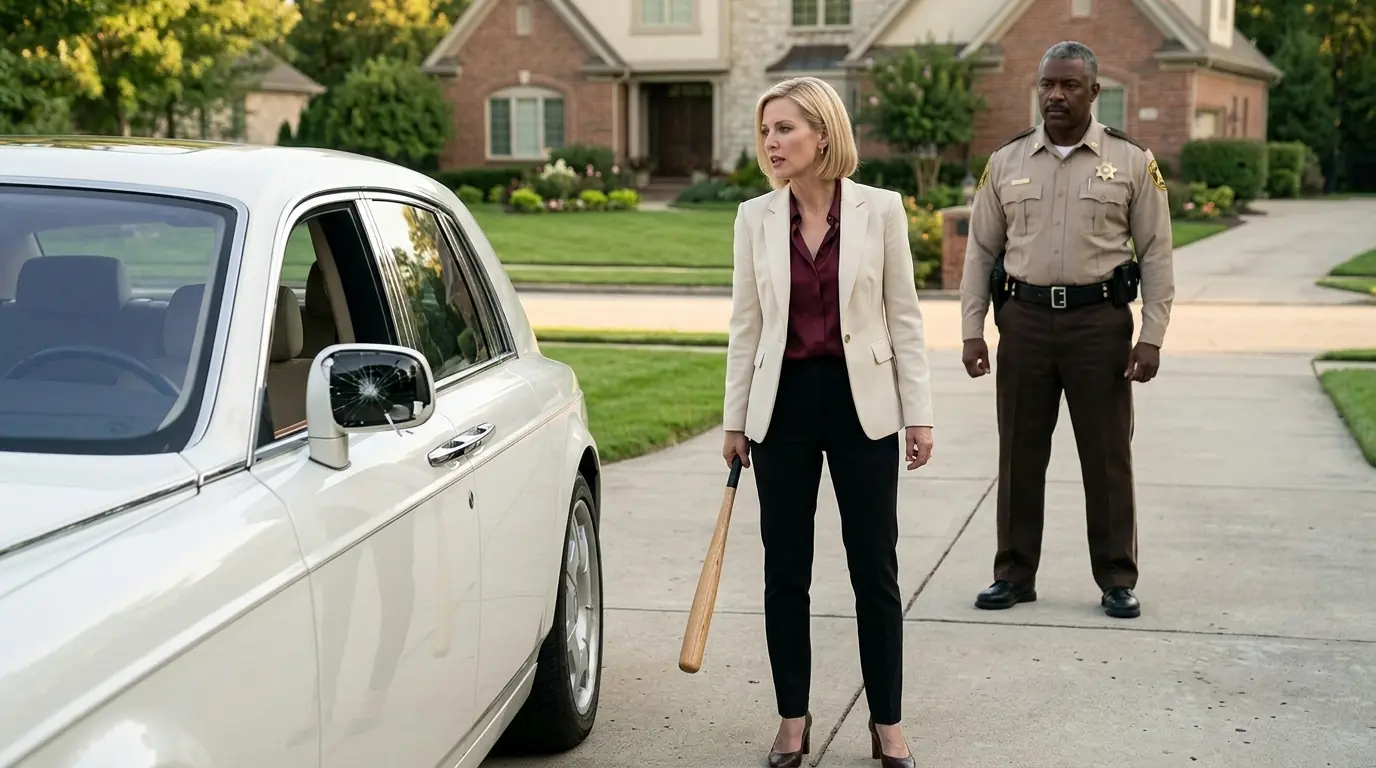
She stood at the edge of the driveway, holding a white envelope against her fitted cream blazer, and stared at the pearl-white car as though it had deliberately insulted her. Behind her, the neighborhood lay quiet beneath the late-afternoon sun: clipped hedges, pale stone houses, clean sidewalks, lawns maintained by people whose trucks were expected to disappear before dinner.
The Rolls-Royce sat beside the lawn, entirely within the driveway. Nothing blocked the pavement, nothing leaked beneath it, and no music came from inside.
That was what made it difficult.
Diane could enforce a blocked sidewalk. She could photograph an oil stain. She knew how to turn an actual violation into a neatly organized chain of emails, fines, and compliance deadlines.
This car offered her none of those things.
It was simply there, gleaming beneath a tree at a house that had changed owners recently, and she had decided it should not be.
Across the street, a garage door began to rise. Diane waited until the woman inside had stepped out with a watering can, then raised her voice enough to be heard.
“Three notices,” she said. “And not the courtesy of a response.”
The woman glanced at the envelope, then at the car. “Maybe they’re still moving in.”
“They’ve had time to park that thing.”
Diane smoothed one edge of the envelope with her thumb. The woman gave a small, uncertain smile and turned toward a row of planters, making it clear she had no intention of becoming part of the conversation.
Diane watched her for a moment.
People had become remarkably good at looking busy.
She turned back toward the house and rang the doorbell. From somewhere beyond the door came a faint electronic chime, followed by silence.
The narrow camera above the bell caught the sunlight. Diane had noticed it during her first visit and disliked it immediately; she preferred conversations in which she could decide afterward what had been said.
She rang again.
“This is Diane Whitmore, president of the homeowners association,” she announced. “I’m here regarding the outstanding vehicle notices.”
No one answered.
She waited another few seconds before sliding the envelope beneath the edge of the doormat. Then she took out her phone and photographed it.
The picture would establish delivery. She knew that much.
What it would establish beyond delivery was becoming a more uncomfortable question.
The trouble had begun five days earlier, when Diane first saw the Rolls-Royce turn into the neighborhood.
She was walking home from inspecting a fence repair when the pearl-white car passed her. Through the windshield she saw a man sitting upright behind the wheel, but the reflection of the trees obscured his face.
The car slowed at the corner house and turned into the driveway.
Diane stopped walking.
The house had stood empty for several months. Its former owners had obeyed almost every rule she cared about, including some that did not appear anywhere in the association documents.
Their trash cans disappeared before noon. Their garage stayed closed. Their visitors parked in tidy groups, and their holiday decorations were gone before Diane had to mention them.
She had expected the new owners to introduce themselves.
Instead, a Rolls-Royce appeared.
Later that afternoon, she walked past the house again. A moving truck stood near the garage, and two men carried a dining table through the open front door.
Diane approached the older of the two.
“Who is supervising this?”
He shifted his grip on the table. “Ma’am, we’re just bringing this inside.”
“Yes, I can see that. Who owns the property?”
“You’d have to ask the office.”
“What office?”
“Our office.”
He looked toward his coworker, who was beginning to struggle under the weight. Diane stepped back reluctantly, allowing them to carry the table inside.
When they returned, she was waiting.
“Commercial vehicles need to be removed promptly.”
“We’ll be finished soon.”
“And that car?”
He followed her gaze. “What about it?”
“Is it staying?”
The mover wiped his forehead with his sleeve. “I don’t know.”
Diane disliked being told that. It made her feel as though she had asked someone beneath the level of responsibility required to answer her.
“Well, someone needs to inform the owner that this is a residential community.”
The mover glanced at the house.
For a moment, she thought he might smile.
Instead, he said, “I’ll pass it along.”
By evening, the moving truck was gone.
The Rolls-Royce remained.
Diane stood in her kitchen that night with the association’s governing documents spread across the counter. Her reading glasses rested low on her nose, and the light above the stove reflected off the plastic sleeves in her binder.