The first thing Marcus Reed noticed was that Barbara Whitmore had stopped pretending her visits were routine inspections.
For nearly three weeks, the homeowners association president had been appearing outside his house at increasingly strange hours. Sometimes she carried a clipboard. Sometimes she brought a measuring tape. Twice, Marcus had found fresh footprints beside the wooden privacy fence, directly below a security camera overlooking his backyard.
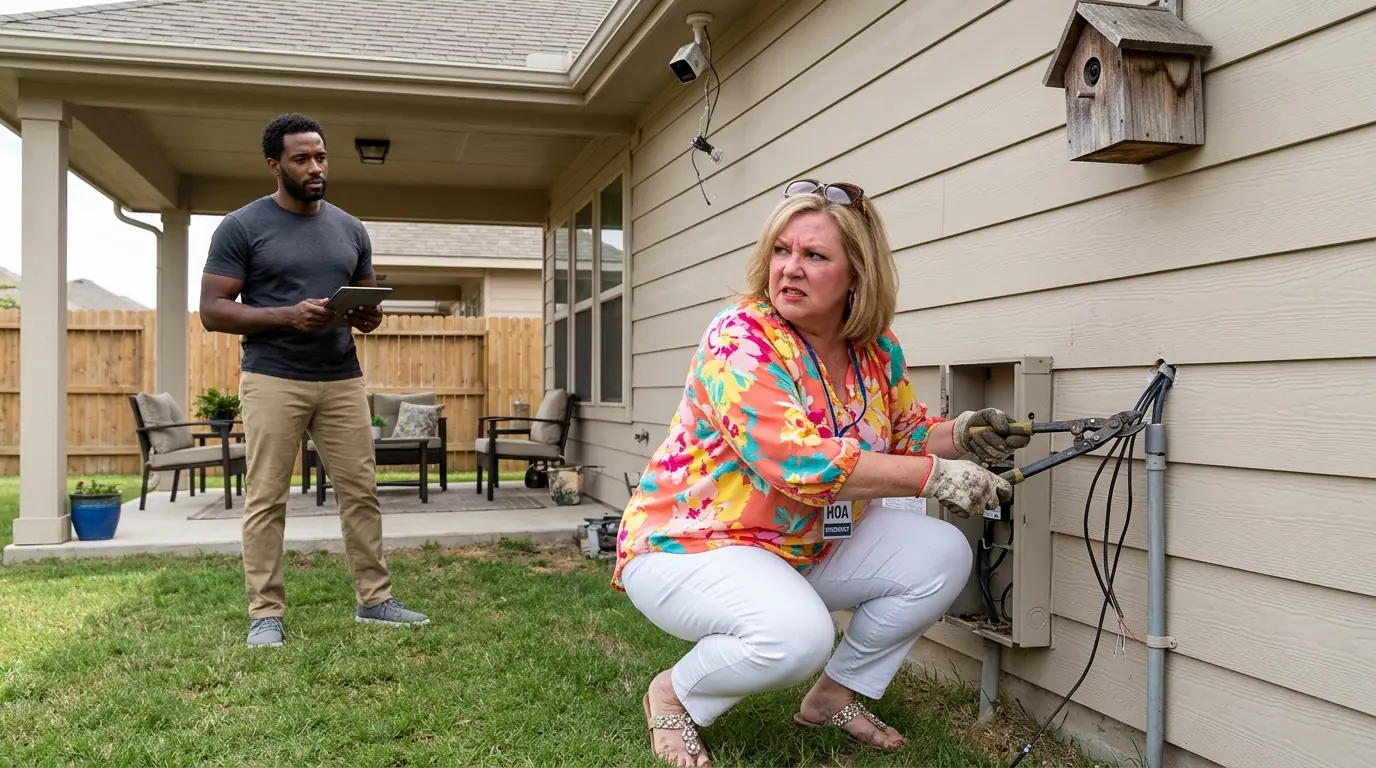
The footprints were never enough to prove anything. But Marcus had stopped believing in coincidences.
On Thursday morning, he stood inside his kitchen with a cup of black coffee, studying a series of security alerts on his tablet. At 6:14 a.m., the camera overlooking his side gate had registered motion. The image showed the gate shifting inward a fraction, then settling against its latch. At 6:17, a figure crossed the narrow field of view beyond the fence. At 6:19, a second camera briefly lost its signal.
By themselves, the alerts might have meant wind, a passing landscaper, or a faulty connection. Together, they resembled an interruption. Someone had moved through a place Marcus owned, close enough to touch his fence and careful enough to avoid the ordinary front entrance.
He replayed the feed three times. Then he checked the backyard camera near the roofline. The scene was clear: trimmed lawn, covered patio, narrow beds of low shrubs, a wooden fence tall enough to make casual viewing difficult. No person appeared. The very absence bothered him.
Marcus set down his coffee and walked to the patio door.
At forty-two, he had learned to distinguish inconvenience from threat without announcing the distinction to everybody around him. He was tall, athletic, broad through the shoulders, with deep-brown skin, short curls, a close-trimmed beard, and an expression that could remain calm even when his mind was working fast. His work involved maintaining technical systems for several small commercial properties, enough of it done remotely that neighbors sometimes mistook his presence at home for leisure. He liked precision, disliked drama, and had spent five years restoring the house because he wanted the freedom to choose what happened on his own side of a fence.
Now he stood before that fence and wondered how much of his freedom Barbara had decided to rewrite.
He unlocked the patio door and stepped into the cold shade beneath the awning. Morning birds moved in the magnolia beyond the neighboring yard. A sprinkler ticked twice before stopping. The house was quiet enough for Marcus to hear a delivery van rolling down the street beyond the front windows.
At the side gate, the latch held, but a faint smear of damp soil darkened the lower rail. The night before had been dry. No wind had carried rain into the yard. Marcus bent to inspect the latch. The metal plate showed a bright scratch near one screw, recent enough that it had not oxidized into the dull finish around it.
Someone had tested the gate.
He photographed the scratch, then stood with his back to the fence and looked toward the house. From the gate, a person could see the patio, the utility box mounted low on the exterior wall, and the black cable conduits climbing toward the security cameras. It was not a complicated view. A stranger looking for a way to interrupt the cameras would notice the exposed runs within seconds.