Marcus Reed thought the worst thing his HOA president could do was threaten him with another fine. Then she walked onto his property carrying a hammer and began smashing the lights his wife depended on to reach their front door safely. Karen Whitmore insisted she had the authority to do it, and she seemed certain the arriving officers would take her side. But a small object in her left hand would turn a neighborhood dispute into something she could no longer control.
The first light broke while Marcus was still opening the front door.
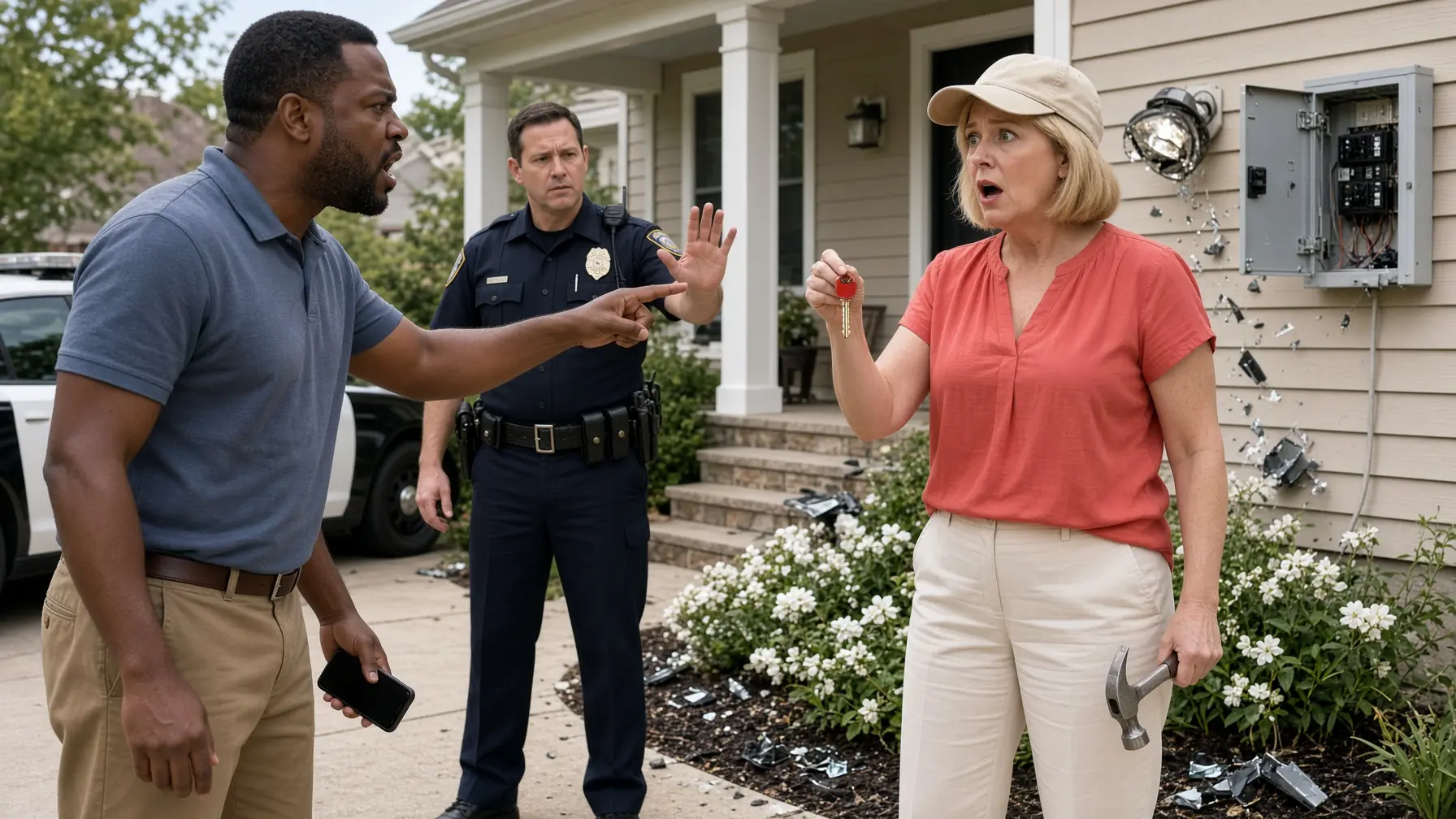
He heard a sharp crack, followed by the delicate scatter of glass across the concrete. For an instant, he thought someone had dropped a bottle near the driveway.
Then he saw Karen Whitmore lift the hammer again.
“Hey!”
She brought it down before he reached the porch steps.
The second blow crushed the metal housing of a low landscape light beside his driveway. Its cover sprang loose, hit the edge of the curb, and rolled into the street.
Karen straightened, breathing hard through her nose.
She wore a coral blouse, cream capri trousers, and flat shoes too clean for the grass she had trampled. Her blonde bob barely moved when she turned toward him.
“I told you to remove these lights,” she said. “You ignored me, so I’m removing them myself.”
Marcus stopped at the bottom of the steps.
He was forty-two, a Black man with an athletic build, short hair, and a neatly trimmed beard. He had come home early from work to meet a delivery, and his faded blue polo still bore a pale streak of dust near the shoulder.
For a moment, he could only look at the hammer.
It was small enough to fit in a kitchen drawer. Something used to hang pictures or repair a loose cabinet. In Karen’s hand, it had already destroyed two fixtures he had spent an entire Saturday installing.
“Put that down.”
“Don’t give me orders on association business.”
“This is my yard.”
“And this is a covenant-controlled community.”
She stepped toward the next light.
Marcus took out his phone.
Karen saw it and smiled without pleasure.
“Go ahead. Record your refusal to comply.”
He began recording.
“My name is Marcus Reed,” he said, forcing his voice into something steady. “This is my property. Karen Whitmore is destroying my outdoor lights without my permission.”
Karen rolled her eyes.
He kept the phone pointed at her.
“I am asking you to stop.”
She planted one shoe beside the next fixture and swung.
Glass snapped.
Marcus flinched despite himself.
Behind him, the front door opened farther.
“Marcus?”
His wife stood in the doorway with one hand on the frame.
Leah wore a loose green sweater over a T-shirt and held a cane against her right leg. She had been expecting a quiet afternoon, a delivery of household supplies, and perhaps enough time outside to sit beside the flower bed before dinner.
Instead, broken glass lay across the route she used to reach the driveway.
Marcus raised his free hand without turning away from Karen.
“Stay inside.”
Leah looked past him.
“Oh, no.”
Karen glanced toward the porch, then returned her attention to the light at her feet.
The absence of embarrassment struck Marcus harder than the next blow.
She knew why those fixtures were there.
Everyone on the board knew.
He had explained it at the meeting. He had included it in the application. He had brought photographs, measurements, and the specifications showing that the lights pointed downward rather than into anyone’s windows.
His wife’s mobility had changed after a car accident the previous year. She could manage the porch steps and short walks on good days, but uneven ground and poor visibility made ordinary trips difficult.
Marcus had not covered the house in floodlights.
He had installed a modest line of low fixtures along the driveway and walkway, with two beside the porch. Enough light to show the change in elevation and the edge of the concrete after sunset.
The application had been approved.
Karen had signed it.
Now she lifted the hammer again.
“Karen, she uses that walkway.”
“Then she should use it during reasonable hours.”
Leah made a small sound from the doorway.
Marcus felt his grip tighten around the phone.
He knew exactly what Karen was waiting for. She wanted him to move closer. She wanted a gesture she could describe later as threatening.
So he stayed beyond the hammer’s reach.
“Leave my property.”
“You’ll receive the invoice.”
“For what?”
“Enforcement.”
She struck the next light hard enough to bend it sideways.
Marcus looked down the street.
Several curtains had moved. A garage door stood halfway open. Across the road, his neighbor Ruth watched from beside her mailbox, one hand pressed against her chest.
Nobody approached.
Karen noticed them too.
“That’s right,” she said loudly. “People are finally going to see what happens when a homeowner thinks the rules don’t apply to him.”
Marcus called the police with his other hand while keeping the camera running.
He gave the address, explained that a woman was actively destroying property, and made clear that she was carrying a hammer. He also said he was keeping his distance and that his wife was inside.
Karen continued down the line.
By the time he ended the call, five fixtures lay broken.
There were nine in all.
He remembered buying them.
He had stood in a hardware store comparing two sets, calculating the cost and checking whether replacement parts were available. Leah had told him to buy the less expensive ones.
“You don’t have to make everything perfect.”
“I’m not trying to make it perfect,” he had said. “I’m trying to make it easy.”
She had laughed softly.
For months, their house had been full of things intended to make life easier: a bench near the door, a rail beside the steps, rearranged shelves, a stool in the shower.
The lights had been the first improvement that did not feel like an announcement of what she could no longer do.
After he installed them, Leah had walked down the path at dusk and stood beside him near the driveway.
“It looks like home again,” she had said.
Now Karen walked through their little pool of safety in daylight, crushing each fixture in turn.
Marcus tried not to think about that sentence.
Thinking about it made standing still much harder.
“Police are coming,” he told her.
“Good.”
Her answer was immediate.
That was when he noticed what she held in her left hand.
A brass key protruded between her fingers. Its head had been covered with something red, shaped into a triangle rather than the usual round plastic cap.
When she moved, it caught the light.
He had never seen that key before.
It did not belong to his house.
At first, he assumed it was something Karen carried for the association office. She often appeared with an oversized ring of keys, letting them jangle while she spoke as though the sound itself demonstrated authority.
Today, there was only one.
She closed her fingers around it when she noticed him looking.
“Stay off my landscaping,” Marcus said.
Karen stepped directly across the flower bed.
The sixth fixture broke with a duller sound. She had struck the post rather than the glass.
She hit it again.
Across the street, Ruth started toward them.
Karen looked up.
“You stay out of this.”
Ruth stopped near the curb.
She was in her seventies, with silver hair pinned away from her face, and had lived in the neighborhood longer than either of them. For the past year, she had served as the association treasurer.
Her expression held something Marcus could not quite identify.
Fear, perhaps.
Or recognition.
“Karen,” Ruth said, “the board did not vote for this.”
“The board authorized corrective action.”
“It authorized another letter.”
Karen turned fully toward her.
“You are not going to contradict me in front of residents.”
Ruth’s mouth tightened.
Marcus kept recording.
“That seems like something residents should hear.”
Karen’s eyes snapped back to him.
“Your attitude is exactly why this has become necessary.”
She moved to the seventh light.
Marcus followed at a distance, stepping carefully around the pieces on the concrete.
As he did, he glanced up at the camera mounted beneath the porch eave.
A tiny indicator remained lit.
Good.
He had installed that camera after packages disappeared from two houses on the block. It covered the walkway, most of the driveway, and a portion of the street.
Unlike the lights, it had attracted no complaints for several months.
Then, two weeks earlier, Karen had asked him to change its angle.
She said it violated the privacy of anyone walking on the public sidewalk.
Marcus had shown her the view on his phone. The image captured his property and a narrow strip of road. It did not show inside another home, behind anyone’s fence, or through a window.
She had repeated the demand anyway.
He had refused.
That afternoon, standing among broken glass, he began to wonder whether the lights had ever been the real issue.
The dispute had started six weeks after the installation.
Karen’s first letter called them “unapproved exterior alterations.”
Marcus had replied with a copy of the approval bearing her signature.
Her second letter described them as “excessive illumination.”
He sent the specifications and photographs taken from the road after sunset.
The third mentioned a “nonconforming visual pattern.”
He asked which rule he had violated.
No answer came.
Instead, notices accumulated in his mailbox, each on association letterhead, each with another deadline and a threatened fine.
The board meetings became difficult.
Karen spoke over him when he asked questions. She called his documentation “technical games.” Once, when Leah attended with him, Karen said the association could not allow “personal circumstances” to undermine neighborhood standards.
Leah had sat upright, both hands folded over the top of her cane.
Marcus remembered wanting to leave.
He also remembered Leah touching his wrist beneath the table.
“Ask her to show us the rule,” she whispered.
So he had.
Karen could not.
Ruth had been the only board member willing to say the approval remained valid.
Afterward, she found Marcus in the parking lot.
“Keep copies of everything,” she told him.
He thought she meant the letters.
Now, watching her stand at the curb while Karen raised a hammer, he suspected she had meant more.
The seventh light collapsed.
Karen looked toward the porch.
Two remained.
One stood beside the bottom step. The last was mounted near the railing, slightly higher than the others.
Marcus saw her glance at the camera again.
“Don’t touch another one,” he said.
She walked toward the steps.
Leah had not gone inside.
Her face was pale, but her voice was clear.
“Karen. Look at me.”
Karen paused.
Leah pointed toward the broken fixtures.
“I use those lights. You know I use them.”
“You have been given ample notice.”
“You approved them.”
“An approval can be withdrawn.”
“Then you could have called a meeting.”
“I am not required to debate every enforcement decision with you.”
Marcus felt anger rise so quickly that he lowered the phone for a second.
Karen saw it.
Her shoulders shifted.
He recognized the invitation in her expression.
A step closer. A hand raised. Anything she could use.
He brought the phone back up.
“Keep talking,” he said.
Her mouth tightened.
From the curb, Ruth spoke again.
“Karen, this is not an enforcement decision. This is damage.”
“You will explain your interference at the next board meeting.”
“There may not be another meeting with you in charge.”
The words surprised Marcus.
They surprised Karen too.
She stared at Ruth for several seconds.
Then she turned and struck the eighth light.
It broke beside the porch step.
Leah stepped back instinctively, her cane catching against the threshold.
Marcus turned toward her.
“Easy.”
“I’m all right.”
But her voice shook.
He could not reach her without moving close to Karen, so he stayed where he was and watched until Leah found stable footing.
Karen followed his attention.
For the first time, something resembling uncertainty crossed her face.
It lasted less than a second.
Then she pointed the hammer at the last fixture.
“I gave you every chance to do this voluntarily.”
Marcus looked at the one intact light.
It stood near the railing he had installed after Leah came home from the hospital. The housing was scratched where he had adjusted it, and one mounting screw was a slightly different color because he had dropped the original in the grass.
He knew those little imperfections.
Karen knew nothing about them.
She saw an object she could destroy to make a point.
He saw the evening Leah had tried the steps without him holding her elbow.
“Do it,” he said quietly, “and you’ll explain all nine.”
Karen raised the hammer.
A car turned onto the street.
Not a patrol car.
A dark sedan slowed beside the curb, then continued past.
Karen lowered the hammer.
She looked after it until it reached the far intersection.
Marcus watched her.
Something about that pause did not fit.
She had ignored the promise of police. She had ignored witnesses and a camera. But an ordinary passing car had made her stop.
Then the sound of another vehicle approached.
This time, a patrol SUV turned onto the block.
Karen tucked the brass key deeper into her left palm.
She straightened her blouse with the wrist of the hand holding the hammer.
The transformation was immediate.
The anger left her face. Her posture became offended rather than aggressive. She moved half a step away from the broken fixture, arranging herself as a person interrupted in some reasonable task.
Marcus kept the phone trained on her.
The patrol vehicle stopped at the curb.
A young officer stepped out first.
A second officer emerged from the other side, older, with gray at his temples and the practiced habit of looking at the entire scene before approaching anyone.
Karen moved toward them.
“Thank goodness,” she said. “I’m the association president. We have a homeowner who’s become hostile during a lawful correction.”
The younger officer looked from her to Marcus.
“Sir, let’s put the phone down for a moment.”
Marcus did not move.
“I’m recording.”
“I understand. We need to figure out what happened.”
“She’s holding the hammer she used to break my lights.”
Karen lifted it slightly.
“This is association business. He received multiple notices.”
The older officer looked at the walkway.
His gaze moved over the shattered glass, the bent posts, Leah in the doorway, and Ruth standing at the curb.
Then he looked at Karen’s hands.
“Ma’am, put the hammer on the ground.”
She hesitated.
“It’s just a household tool.”
“Put it down.”
She lowered it carefully beside a broken fixture.
Marcus felt a little tension leave his shoulders.
The young officer looked at him again.
“Are you Mr. Reed?”
“Yes.”
“Did you call?”
“Yes.”
The officer nodded toward the porch.
“Let’s have you stand over there while we talk to everyone.”
Marcus looked at the glass near the steps.
“I’ll stand here. My wife needs that entrance clear.”
Leah spoke from the doorway.
“I saw her break them.”
Karen sighed loudly.
“Of course she’s going to say that.”
The older officer turned toward her.
“Let her finish.”
Karen’s face tightened.
Leah gripped her cane.
“She came here with the hammer. Marcus asked her to stop. She kept doing it.”
“Did anyone touch anyone else?” the officer asked.
“No,” Leah said.
Karen opened her mouth.
Marcus lifted his phone a little.
“The entire thing is recorded.”
The older officer noticed the camera beneath the eave.
“On that too?”
“Yes.”
Karen’s eyes flicked upward.
There it was again.
Marcus saw the officer notice it.
“What’s your name?” the younger officer asked Karen.
“Karen Whitmore. I’m the president of the homeowners association.”
She delivered the title as if it settled the matter.
The older officer took out a small notebook.
“Do you have written authorization to enter this property and destroy these fixtures?”
“We have enforcement powers.”
“That wasn’t my question.”
“The homeowner agreed to the covenants when he purchased.”
“Do you have the document with you?”
Karen gestured toward the street.
“It’s in my vehicle.”
“Then we’ll look at it.”
She started to move.
The older officer held up a hand.
“In a minute.”
Ruth stepped forward from the curb.
“I’m on the board.”
Karen turned sharply.
“You’re not speaking for the board.”
“I’m speaking about the vote I attended.”
The younger officer moved toward Ruth to take her statement.
Karen watched them with growing irritation.
Marcus could almost see her recalculating.
She had expected an audience for his humiliation. She was getting separate witnesses, direct questions, and an officer who would not accept her title as a substitute for permission.
She tried another approach.
“Officer, this has been an ongoing problem. Mr. Reed has a history of refusing reasonable requests.”
The older officer looked at Marcus.
“Can I see the video?”
Marcus handed him the phone.
Karen took a step closer.
“That won’t show the context.”
“It shows this morning,” the officer said.
He watched the first blow Marcus had captured.
Then the second.
He listened to the request to stop.
He looked down at the broken lights around his shoes.
When he handed the phone back, his expression had changed.
“Ma’am, you need to remain here.”
“I haven’t gone anywhere.”
“And keep your hands where I can see them.”
Karen looked down at her left hand.
For the first time, Marcus saw real alarm pass across her face.
It was brief, but it was different from her anger.
The officer had seen the key.
“Open that hand,” he said.
Karen looked up.
“It’s my key.”
“Open your hand.”
She uncurlled her fingers reluctantly.
The brass key rested against her palm.
Its red triangular head looked almost childish now, a little piece of bright color in a scene full of bent metal and glass.
The officer stared.
He did not take it immediately.
Instead, he leaned closer, studying one corner of the red covering.
Marcus followed his gaze.
A narrow pale line ran through it, as if the material had split and been repaired.
The officer’s jaw shifted.
“Where did you get that?”
Karen swallowed.
“Association property.”
“Which association property?”
“This association.”
“That key opens what?”
She glanced toward Ruth.
Ruth had stopped speaking to the younger officer.
Her eyes were fixed on Karen’s hand.
“The service building,” Karen said.
The older officer looked at her.
“The building you reported burglarized?”
Nobody spoke.
A breeze moved the leaves of the small tree beside the driveway.
Marcus heard Ruth inhale.
Karen closed her hand again.
The officer’s voice sharpened.
“Don’t.”
She opened it.
“That isn’t the same key,” she said.
He had not yet said it was.
The sentence seemed to reach everyone at once.
The younger officer turned from Ruth.
“What is it?”
The older officer kept his eyes on Karen.
“Check the report from the association service building. Tuesday morning.”
Karen shook her head.
“There are several keys.”
“Then we’ll establish which one this is.”
He asked her to place it on the flat top of the porch rail.
She did so with visible reluctance.
Marcus looked at Ruth.
She had gone pale.
“What’s happening?” he asked.
Ruth did not answer immediately.
Karen did.
“Nothing. He’s confusing routine association equipment with a separate incident.”
The older officer spoke into his radio.
He requested confirmation of the items listed missing from the service building and the photographs attached to the report.
Karen stood very still.
Marcus remembered Tuesday.
A message had gone to every homeowner that morning. The association service building, a modest structure beside the common grounds, had reportedly been broken into overnight.
A laptop was missing.
So were several boxes of records and a master service key.
Karen had called it a serious security concern.
She had also mentioned “recent hostility toward the board.”
No homeowner had been named.
She had not needed to name one.
Marcus had received her latest violation letter the day before.
That evening, a neighbor asked whether he had argued with Karen again.
He said yes.
The neighbor looked uncomfortable and changed the subject.
At the time, Marcus thought it was just another consequence of living under her constant complaints.
Now he looked at the key on the rail.
The red triangle faced upward.
The older officer waited for the radio response without filling the silence.
Karen did.
“I reported that theft myself.”
“Yes,” he said.
“So obviously I’m cooperating.”
“Then tell me where you found the key.”
“I didn’t say I found it.”
“You said this isn’t the same one.”
“Because you’re making assumptions.”
The officer looked at her.
“I’m asking questions.”
Leah remained at the doorway, quiet and watchful.
Marcus wanted her to sit down. He also knew she would refuse until she understood what was happening.
He moved toward the bottom step, stopping short of the glass.
Karen shifted backward as if he had approached her.
“There,” she said quickly. “You see how he advances?”
Marcus stopped.
The older officer looked at the distance between them.
“He’s going toward his wife.”
“I don’t feel safe.”
“Then stay beside me.”
It was a simple answer.
It left her nowhere to put the accusation.
Marcus helped Leah lower herself onto the bench just inside the doorway. He did not take his eyes completely off Karen.
“You okay?”
Leah nodded.
“Don’t let her make this about you.”
He squeezed her hand once.
“I know.”
But until that moment, he had not known how close she had already come.
The older officer’s radio sounded.
He listened, then asked for a photograph to be sent to his device.
Karen looked toward her vehicle.
Ruth noticed.
“Karen,” she said, “where is the laptop?”
The younger officer turned toward her.
“What makes you ask that?”
Ruth pressed her lips together.
Karen stared at her.
“Be careful,” Karen said.
The warning came out softly.
It was the first thing she had said since the police arrived that sounded completely like the woman Marcus knew from the meetings.
The younger officer took a step between them.
“Ma’am, you can finish your statement.”
Ruth looked at Marcus.
Then she looked at the broken lights.
“I requested the payment records,” she said. “That’s why those files were gathered at the service building.”
Karen made a dismissive sound.
“We have been over this.”
Ruth continued.
“The board was supposed to review them Monday. I asked for invoices, bank statements, and the records for the landscaping contractor.”
The older officer looked up from his device.
“When did you request them?”
“Three weeks ago.”
“And when were they put in the building?”
“Friday.”
Karen crossed her arms.
“The office needed organizing.”
Ruth’s voice steadied.
“You told me you would have everything ready.”
“I did have everything ready.”
“Then everything disappeared.”
Marcus thought of the strange pauses, the demand to turn his camera, Karen watching the passing sedan.
He felt a chill despite the daylight.
The older officer placed his device beside the key without touching either together.
On the screen was a photograph of the red triangular head.
The split corner.
The pale repair line.
The same tiny black mark near the center.
Marcus could see the match from several feet away.
Karen looked at the screen, then at the officer.
“That photo is from an old inventory.”
“It’s attached to the report you made Tuesday,” he said.
She did not respond.
“You identified this key as missing.”
“It could be a duplicate.”
“Does the duplicate have the repair you described?”
Ruth closed her eyes briefly.
Karen looked at her.
“What repair?” Marcus asked.
Ruth opened her eyes.
“The red cover cracked last winter. I repaired it. Karen said the shape made it easier to find.”
The older officer nodded.
“That repair is described in the report.”
Karen’s face had lost its color.
For the first time, she looked less like an offended official than a person realizing that a detail she had once considered helpful could now trap her.
“Maybe it was returned,” she said.
“By whom?” the officer asked.
“I don’t know.”
“When?”
“I would have to check.”
“Where?”
She looked toward her vehicle again.
Marcus looked too.
It sat three houses down, beyond the stretch of curb his porch camera covered.
He remembered seeing it there when he first stepped outside.
At the time, he thought she had parked far away to avoid blocking his driveway.
Now he wondered why she had chosen a place she knew the camera could not see.
The younger officer asked her for identification.
While she searched her bag, the older officer turned toward Marcus.
“Can your porch camera show previous nights?”
“Yes.”
“How far back?”
“Long enough for Tuesday.”
Karen’s hand stopped inside her bag.
Marcus saw it.
So did the officer.
“I object to him recording association members,” she said.
“We’re asking about activity visible from his property.”
“You can’t just let him search through footage to make accusations.”
Marcus looked at her.
He had not made one yet.
The officer handed him a card.
“Show me what the camera sees near the service building.”
“It doesn’t see the building.”
Karen exhaled.
Marcus continued.
“It sees the corner people use to walk there.”
Her eyes returned to him.
The service building stood beyond the common lawn at the end of the street. Marcus’s camera did not reach it. But the shortest walking route passed a break in the hedge near his driveway.
He had shown Karen that view when she complained about the angle.
She knew exactly what it covered.
He opened the camera app.
His hands had begun to shake now, not with anger but with the strain of recognizing that the morning might be part of something larger.
The footage took several seconds to load.
Karen watched the screen.
“Marcus,” she said.
He looked up.
She had never used his first name like that before.
Not as a warning.
As a request.
He turned back to the phone.
The camera had recorded several events Monday night.
A cat crossing the walkway.
A car passing slowly.
A delivery driver leaving a package at the wrong house.
Then, later, a person moving through the gap in the hedge.
Marcus tapped the clip.
The image was clear enough to recognize the coral blouse beneath an open jacket.
Karen carried a rectangular bag in one hand and a shallow cardboard box in the other.
She paused near the driveway.
Her face turned toward the porch.
Toward the camera.
Marcus remembered the next morning.
Karen had knocked at seven-thirty.
She said she was checking whether any residents had seen suspicious activity near the service building.
Then she asked whether his camera stored recordings locally.
He told her it sent clips to his account.
Her expression had changed, just slightly.
He thought she disliked anything she could not inspect herself.
Now he understood the question differently.
The older officer watched the clip twice.
“Can you preserve that?”
“Yes.”
Karen stepped closer.
“That proves I was handling association property. I handle association property all the time.”
“At what time?” he asked.
“We don’t have office hours.”
“Was that before or after the burglary you reported?”
She stopped.
The younger officer took her identification.
Ruth moved closer to the driveway, careful to avoid the broken glass.
“The cardboard box,” she said.
The older officer turned toward her.
“What about it?”
“I labeled the records box with blue tape.”
Marcus enlarged the image.
A strip of blue tape crossed the near side.
Ruth’s face tightened.
“That looks like it.”
Karen shook her head.
“You cannot identify a box from tape.”
“No,” Ruth said. “But I can tell them what was in it.”
The older officer nodded.
“We’ll document that separately.”
He did not announce that the case was solved.
He did not declare the video conclusive.
He asked questions, recorded answers, and kept Karen beside him while the scene grew less manageable for her by the minute.
That methodical calm seemed to frighten her more than anger would have.
She could argue with anger.
She had spent months provoking it.
She could not interrupt a sequence of facts without drawing attention to the place where the sequence hurt.
Marcus opened another clip.
This one showed Karen returning along the path without the box.
Her right hand was empty.
Her left held something small.
He enlarged the image again.
The red triangle appeared for a fraction of a second beneath the streetlight.
The older officer looked from the screen to the key resting on the rail.
“Mrs. Whitmore,” he said, “we need to talk about your report.”
Karen’s breathing had become audible.
“I want to speak to someone in charge.”
“You can make that request.”
“I am the complainant in that case.”
“And you are being asked where you obtained an item you reported stolen.”
She pointed at Marcus.
“He has been harassing me for months.”
Ruth answered before either officer could.
“He asked you to stop fining him for lights you approved.”
Karen turned toward her.
“You have no idea what you’ve done.”
Ruth stepped back, but she did not lower her gaze.
“Yes,” she said. “I think I finally do.”
The older officer asked Karen to remain with his partner while he spoke privately with Marcus near the porch.
He kept the conversation short.
He wanted copies of the approval, the notices, the morning’s video, and the earlier camera footage. He also asked whether Marcus had entered the association service building recently.
“No.”
“Ever had a key?”
“No.”
“Has Mrs. Whitmore accused you directly of anything involving that building?”
Marcus considered the question.
“Not directly.”
“Tell me what she has said.”
He described the message to homeowners. The mention of hostility. The conversations that followed.
The officer wrote it down.
Then he looked toward the last intact light.
“Is that on the same circuit as the camera?”
“No.”
Karen had asked him that too.
Not in those words.
She had asked whether the camera would continue recording if the exterior power was shut off for association work.
He had told her it had backup power.
The memory made his skin prickle.
“She asked about that,” Marcus said.
“When?”
“After the burglary.”
The officer looked at the camera again.
Then at the hammer.
He wrote another note.
Across the driveway, Karen’s voice rose.
“I need to call my husband.”
The younger officer said she could make a call once they finished the immediate questions.
She looked toward Marcus.
Their eyes met.
The contempt was gone.
What replaced it was not apology.
It was resentment at having underestimated him.
She had assumed he would be too angry to preserve anything useful. She had assumed his wife’s vulnerability would let her control the scene. She had assumed the title on her letters could become authority simply through repetition.
For months, Marcus had felt trapped by her certainty.
Now he realized it had always been something she performed.
The older officer returned to his partner.
They spoke quietly.
Karen watched their faces.
Ruth stood beside Marcus.
“I should have said something sooner,” she whispered.
He looked at her.
“You did.”
“Not enough.”
He did not answer immediately.
There were still shards of glass near his shoes. Leah sat just inside the door. The last light remained upright beside the rail.
“No,” he said at last. “Not enough.”
Ruth nodded.
He had expected her to defend herself.
She did not.
That mattered.
“I was afraid she’d say I didn’t understand the accounts,” Ruth said. “She kept telling the other members I was confused.”
“Were you?”
“About why some invoices didn’t match. Yes.”
She looked toward Karen.
“About whether that was my fault. Not anymore.”
The older officer asked Karen to step away from the rail.
She refused at first.
Not loudly.
She simply stood there and said, “This is ridiculous.”
He repeated the instruction.
The younger officer positioned himself beside her.
Karen looked down at the key one final time.
Then she moved.
The officer told her she was being detained while they investigated the property damage and the connection to the reported burglary. He explained what he needed her to do.
She began talking over him.
She said Marcus had provoked her.
She said the lights were a hazard.
She said the board would confirm everything.
Ruth looked at the ground.
Marcus kept recording.
When Karen realized the officers were not going to let her walk to her car and drive away, her composure broke.
“You’re making a terrible mistake.”
The older officer did not raise his voice.
“Turn around, please.”
She looked toward the porches along the street.
People were outside now.
The woman with the dog stood farther down the block. A man who had ignored three of Marcus’s complaints watched from behind a hedge. Two board members had arrived on foot after someone called them.
Karen searched their faces.
Nobody stepped forward.
The younger officer secured her hands.
Marcus felt no sudden joy.
What he felt first was exhaustion.
His shoulders ached. His mouth was dry. The phone had grown hot in his palm.
Karen looked at him as they guided her toward the patrol vehicle.
“This isn’t over.”
He looked at the lights.
“I know.”
She seemed to misunderstand the answer as fear.
It was not.
He knew there would be reports, statements, repairs, meetings, and neighbors who wanted to pretend they had never believed the things she said about him.
He knew Leah would remember standing in the doorway while someone destroyed what made her feel safe.
He knew the end of Karen’s morning did not restore the afternoon she had taken from them.
The officers placed her in the vehicle.
The older one returned to photograph the damage.
He counted each fixture carefully.
Eight destroyed.
One remaining.
Marcus looked at the last light and felt an unexpected tenderness toward an object he had once considered interchangeable with the others.
Then a sound came from the patrol vehicle.
Karen had begun speaking loudly through the open window.
“That ninth fixture is part of the same violation. You need to document that he still hasn’t complied.”
The officer glanced toward her.
“Ma’am, stop discussing the property.”
She leaned forward as far as the restraints allowed.
“I already disconnected it. It’s useless anyway.”
Marcus looked at the fixture.
The older officer turned toward him.
“Did you see her do that?”
“No.”
“When could she have accessed the connection?”
Marcus thought of the side enclosure near the walkway.
It held the low-voltage lighting controls, protected inside a locked service cabinet installed by the previous owner. He had retained it because it kept the connections out of the weather.
The cabinet used the old community service lock.
He rarely opened it except for maintenance.
His house key did not fit.
The installer who helped him had used an authorized service key.
Marcus looked toward the porch rail.
At the red triangle.
Ruth saw his expression.
“That key opens the older cabinets too,” she said.
The officer looked at Karen.
Her face went still.
She had admitted it without meaning to.
The last fixture had survived because the patrol car arrived before she could swing the hammer again.
But she had already entered the locked enclosure and disconnected the entire system.
Every light on the property was dead.
Marcus walked to the side cabinet with the officer.
The door had been closed without fully catching.
Inside, the lighting supply had been disconnected.
No complicated sabotage.
Just another act she believed she could label enforcement.
The officer photographed it before Marcus touched anything.
Karen watched from the vehicle.
This time, she said nothing.
By evening, the street looked almost ordinary again.
The officers had gone.
Karen’s car remained down the block until a family member collected it.
The broken lights had been photographed, counted, and cleared from the concrete. Marcus placed the ruined fixtures in a cardboard box because the officer asked him to preserve them.
He used a shop vacuum along the walkway, then went over it with a broom, then knelt to inspect the seams for glass.
Leah watched from the bench.
“You’re going to wear a hole in the concrete.”
He did not look up.
“I want to be sure.”
“I know.”
He swept once more.
Only when he stood did he realize how tired he was.
Leah held out a glass of water.
He sat beside her.
For a while, neither spoke.
The sun had moved across the porch. The flower bed Karen trampled looked flattened along one edge. Near the railing, the last fixture stood intact but lifeless.
“I hate that she made me stay inside,” Leah said.
Marcus turned toward her.
“I asked you to.”
“I know why.”
Her voice was quiet.
“But it’s my house too.”
He looked down at the water.
He had spent the morning trying to protect her. He had not considered how much it cost her to stand behind a threshold while someone treated her needs as an inconvenience.
“I’m sorry.”
Leah shook her head.
“Just help me come out next time.”
He nodded.
After a moment, she leaned her shoulder against his.
“Not next time Karen brings a hammer,” she added.
He laughed once.
It was the first laugh of the day.
The investigation did not end with the key.
That was what people on the block seemed to misunderstand.
By the following morning, a version of the story had spread in which one look at a red piece of plastic exposed an entire scheme. The truth was slower, less tidy, and more useful.
The key gave the officers a question Karen could not answer.
The video gave them a contradiction they could investigate.
Ruth gave them records showing why the supposedly stolen materials mattered.
Together, those things opened doors Karen had spent months keeping shut.
The board held an emergency meeting three days later.
Karen did not attend.
Marcus did.
So did Leah.
He carried the original lighting approval, every notice, photographs of the damage, and a written request that the association preserve all communications about his property.
Leah carried her cane.
Nobody called her circumstances personal that evening.
The room was quieter than usual.
One board member tried to begin with a statement about misunderstandings.
Ruth interrupted.
“There was no misunderstanding about the hammer.”
The man looked down at his notes.
Marcus waited.
He had decided beforehand that he would not give a speech about who Karen was. Everyone in the room had seen enough. Some had seen more than they were willing to admit.
He wanted specific things.
Written confirmation that his approval remained valid.
Withdrawal of the unsupported fines.
A clear process for repairs.
An explanation of how Karen obtained authority no vote had granted.
The answers came unevenly.
There were apologies with excuses attached. There were statements about trusting the president to handle routine matters. There was one board member who admitted he had never read the notices sent under his name.
Marcus looked at him.
“You should start.”
The man nodded.
Ruth brought copies of the minutes.
The vote Karen cited had authorized a letter asking Marcus to attend another meeting.
It had not authorized entry.
It had not authorized removal.
It had certainly not authorized destruction.
The association rescinded the notices and agreed to cover replacement costs without requiring Marcus to sign away any other complaint.
Then Ruth placed a second folder on the table.
“The accounting review is continuing,” she said.
Several people shifted in their chairs.
Marcus noticed that some of the nervous faces belonged to people who had seemed comfortable until then.
Karen’s conduct had been possible partly because she acted alone.
It had continued because other people found her certainty convenient.
That distinction began to emerge over the following weeks.
The missing laptop was recovered.
So were the records.
Marcus did not learn every detail immediately. The investigator told him only what related to his statements and asked for patience while the rest was sorted out.
Ruth was less restrained about what the association’s own documents showed.
Several contractor invoices had been paid twice.
Other payments lacked the work records attached to ordinary jobs.
Karen had approved expenses through a process the board barely understood and had discouraged questions by calling them interference.
None of that was proven by a key.
But the key had survived the story she told about the missing evidence.
And once the story failed, people began checking the details beneath it.
The most unsettling discovery came in a message the investigator asked Marcus to review.
It had been saved on the recovered laptop.
A draft.
Not sent.
The investigator did not let him keep the device or browse through its contents. He showed Marcus a printed copy of the passage relevant to him.
Marcus read it once.
Then again.
The draft described an “escalating confrontation” with a homeowner over exterior lighting. It claimed the homeowner had become physically aggressive during enforcement and that Karen feared he had taken the missing service key to access association property.
His name appeared in the next paragraph.
The document had been created before Karen walked onto his lawn.
Before he opened the door.
Before the first light broke.
Marcus sat very still.
He thought of her planting her feet and lifting the hammer.
Of her watching him take a step.
Of the way she had looked almost disappointed when he stopped beyond her reach.
She had not merely expected him to become angry.
She had prepared a place to put his anger.
The investigator allowed him time.
“Does anything in that account reflect what happened?”
“No.”
“Your video shows that.”
Marcus nodded.
He knew.
Still, knowing there was proof did not erase the fear of what might have happened without it.
If he had grabbed the hammer.
If he had pushed her away from Leah’s path.
If he had stepped too close while she backed toward the street.
She had already written the beginning of that version.
All she needed was something the world could mistake for the rest.
When Marcus came home, Leah was sorting replacement light fixtures at the dining table.
She looked up.
“What happened?”
He told her.
She put down the small bracket in her hand.
For several seconds, she said nothing.
Then she reached across the table and held his wrist.
The contact brought him back to the room.
“I almost gave her what she wanted,” he said.
“But you didn’t.”
“I wanted to.”
“I know.”
He looked at her.
She did not pretend his anger had been wrong.
She did not tell him everything happened for a reason.
She simply sat with him while he understood how close the morning had come to becoming someone else’s story.
The replacements arrived in two shipments.
Marcus chose fixtures similar to the old ones, with stronger housings and readily available parts. He hired help for the work near the steps because he wanted it completed promptly and properly.
Ruth came over while they were installing them.
She carried a small envelope.
Inside was a handwritten note.
Marcus read the first line and looked up.
Ruth seemed uncomfortable.
“I don’t want you to think this substitutes for what I should have done.”
“It doesn’t.”
“I know.”
The note contained no explanation of Karen’s personality, no claim that everyone had been deceived equally.
It said Ruth had seen unfair treatment and waited too long to oppose it.
It said she was sorry.
Marcus folded it carefully.
“Thank you.”
Ruth nodded.
Then she asked where the broom was and helped clear the work area.
That was easier to accept than another speech.
Karen’s removal from the presidency became official before the next regular meeting. The board changed how complaints and expenditures were approved, and homeowners were given access to records they had previously been told were too complicated or too sensitive to review.
Some changes were sensible.
Some were overdue.
Marcus did not mistake them for a complete cure.
He still heard neighbors begin sentences with, “I always knew Karen could be difficult.”
He learned to answer honestly.
“You didn’t say anything.”
Some people withdrew after that.
Others stayed and listened.
The property damage case moved forward. The false account of the service-building burglary and the handling of association money became part of a separate investigation.
Karen’s attorney contacted Marcus once through the proper channels, proposing a payment for the lights along with an agreement limiting further statements.
Marcus read the document at the kitchen table.
Leah read it after him.
“Are you considering it?” she asked.
“The money would help.”
“The association already agreed to the repairs.”
“I know.”
He looked at the language again.
It treated the morning as a dispute both sides might prefer to forget.
Marcus thought of the draft on the laptop.
Of his name placed inside a story before he had done anything.
He declined.
He did not want to spend the rest of his life explaining why, after preserving the truth, he had agreed to make it harder to tell.
The first evening all the replacement lights worked, Leah waited until the sky began to change before opening the front door.
Marcus stood from the kitchen chair.
She looked back.
“Come with me.”
He followed her to the porch.
She took the steps slowly, cane in one hand, the other resting on the rail. At the bottom, she paused.
The walkway stretched ahead, its edges clear.
No glare.
No elaborate display.
Just a route she could see.
Marcus stayed half a step behind her.
She walked to the driveway, turned, and looked back at the house.
For a moment, he worried that the new lights would remind her only of the old ones breaking.
Then she smiled.
“Home,” she said.
He looked toward the porch.
The camera remained beneath the eave. The bench sat beside the door. The flower bed had begun to recover where Karen’s shoes had flattened it.
Near the railing stood the one original fixture.
He had repaired its connection and left it in place.
Leah noticed him looking.
“You kept that one.”
“Nothing was wrong with it.”
She gave him a sideways glance.
“Except everything around it.”
He nodded.
They stood quietly until a car moved along the street.
Neither of them turned to watch it.
That small freedom pleased him more than he expected.
Months later, people still asked Marcus about the key.
They wanted the instant when the officer recognized it. They wanted Karen’s expression, the sudden silence, the satisfaction of watching someone confident discover that confidence was not protection.
He understood.
He remembered all of it.
But what stayed with him was what happened afterward: the officer asking the next question, Ruth choosing to answer, Leah refusing to let her home become a place she watched from behind a door.
And the last light.
Karen had reached it with the hammer.
She had already killed its power.
She had believed she could leave him standing over the damage and write whatever explanation suited her.
Instead, the fixture remained.
So did the recording.
So did the approval she had signed and the report she had filed and the little repaired corner on a key she should never have brought to his yard.
One evening, Leah came out carrying two cups of tea and found Marcus adjusting the original light a fraction farther toward the path.
“Is it crooked?” she asked.
“A little.”
“It’s been a little crooked since you installed it.”
“I know.”
She handed him a cup.
He tightened the screw and stepped back.
The light fell across the bottom stair, showing its edge clearly.
Leah tested it with her foot, then rested her cane beside the railing.
“Leave it now,” she said.
Marcus looked at the fixture.
Then at his wife.
He put the screwdriver away.
Behind them, the house waited with its door open.
And this time, they walked into it together.