The first flash was so bright that Vivien Crowfoot saw the bones of her own fingers through the red flowers on her sleeve.
A blue-white arc leaped above the Montana hillside. The air cracked like a rifle fired beside her ear, and the remote machine beside the transmission corridor shuddered to a halt. One of the utility workers threw himself behind a parked truck. The other shouted something Vivien never heard.
Then the line failed.
A suspended span fell toward the rocky slope, scattering sparks as protective equipment at a distant substation responded to the fault. The hillside fell strangely quiet. There was no hum from the machinery, no buzzing from the line, only the restless wind in the pine trees and a sound that Vivien did not recognize at first.
It was her husband screaming her name.
“Vivien! Get back!”
She stumbled in her white trousers, caught herself against a boulder and looked downhill. The subdivision she had spent five years trying to control seemed unchanged in the brilliant summer sunshine. Its stone mansions were still perched along landscaped streets. The swimming pools still glittered. The ornamental gates still stood between the outside world and the kind of life Vivien believed she had earned.
Then she noticed the security lamps on the shaded driveways were out. The decorative waterfall outside the clubhouse had stopped. The electronic gate at the lower entrance went dark. Across the valley, the windows of the grand houses reflected mountains instead of the interior lights that normally burned all day.
Renton Crowfoot stared at the hillside with the expression of a man who had watched his future disappear in a single second.
“You killed the power!” he shouted.
Orin Osterman climbed out of his utility truck fifty yards away. At fifty-eight, the owner of the mountain utility company had spent enough summers around electrical infrastructure to know that an explosion was not the most frightening part of a serious fault. The frightening part was what might remain energized after the sound stopped.
He ordered everyone away from the damaged corridor and told them not to approach the fallen equipment. Then he took his radio, contacted system control and requested emergency responders. Only when his people were moving to safety did he cross toward the gravel access road where Vivien stood.
She lifted her sunglasses as if he were an employee who had failed to greet her properly.
“Orin, this was supposed to be a controlled removal.”
He stared at her. A streak of dust marked his faded denim jacket. Behind him, a crew member was checking the second worker for injuries.
“Controlled by whom?”
“My husband hired professionals.”
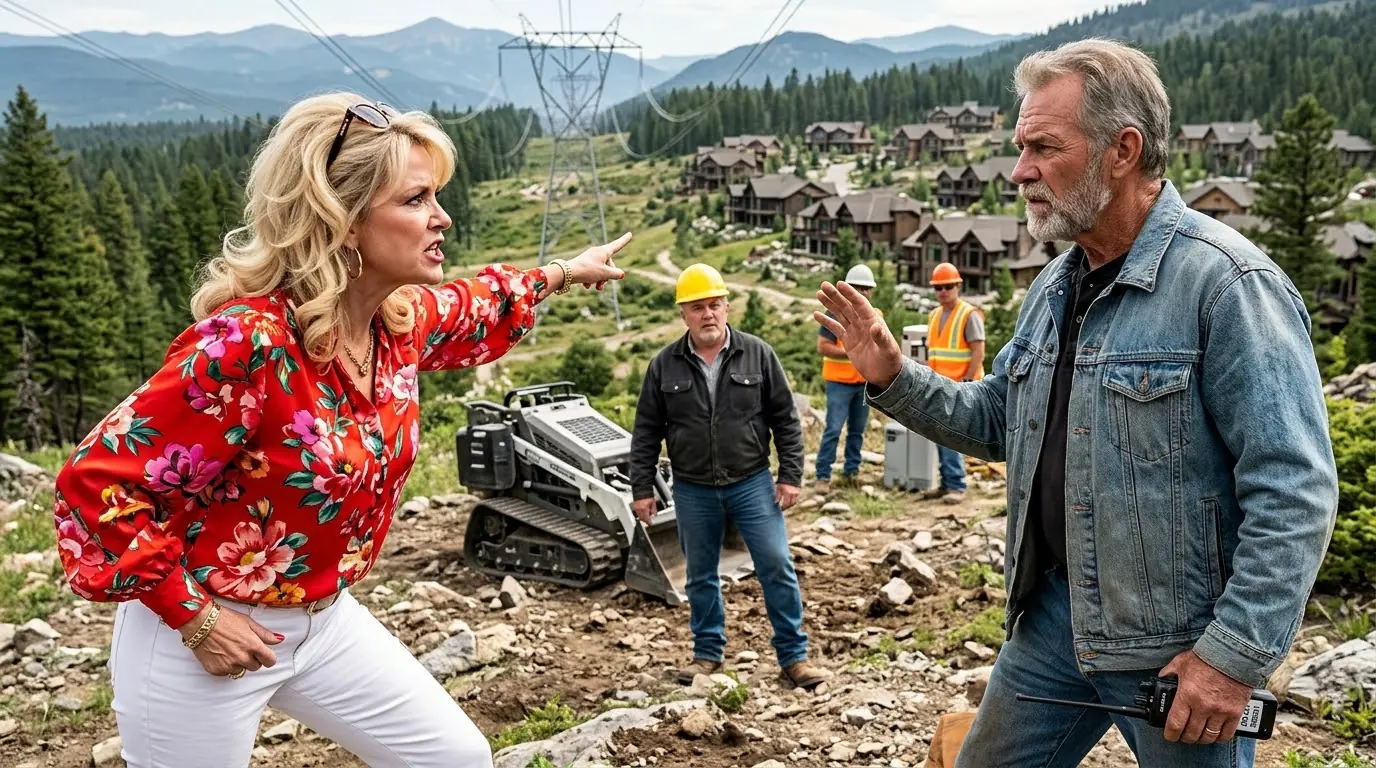
Orin looked at Renton's yellow hard hat, the disabled machine and the damaged transmission span. Then he looked directly at Vivien.
“You just blacked out a hundred and twenty homes.”
For the first time that morning, the HOA president had nothing to say.
Forty minutes earlier, she had been standing at the crest of the same hill, explaining why the power lines were an insult.
The view from Cinder Ridge Estates was magnificent. Pine-covered mountains rose behind a broad valley; high meadows caught the sunlight; expensive homes sat on terraces cut into the stone. From Vivien's private deck, the ridge looked almost like a painting. Almost, because a transmission corridor crossed the distant slope and several steel towers broke the horizon.