Malcolm Hayes woke to the sound of something heavy striking the pavement outside his house.
At first, he thought one of the garbage trucks had dropped a bin. It was just after seven on a Saturday morning in Briarwood Estates, a quiet subdivision outside Charlotte, North Carolina, where the streets were usually empty until joggers and dog walkers began appearing around eight. Malcolm rolled out of bed wearing a faded charcoal T-shirt, loose black pajama pants, and house slippers, rubbed one hand across his face, and walked toward the front door.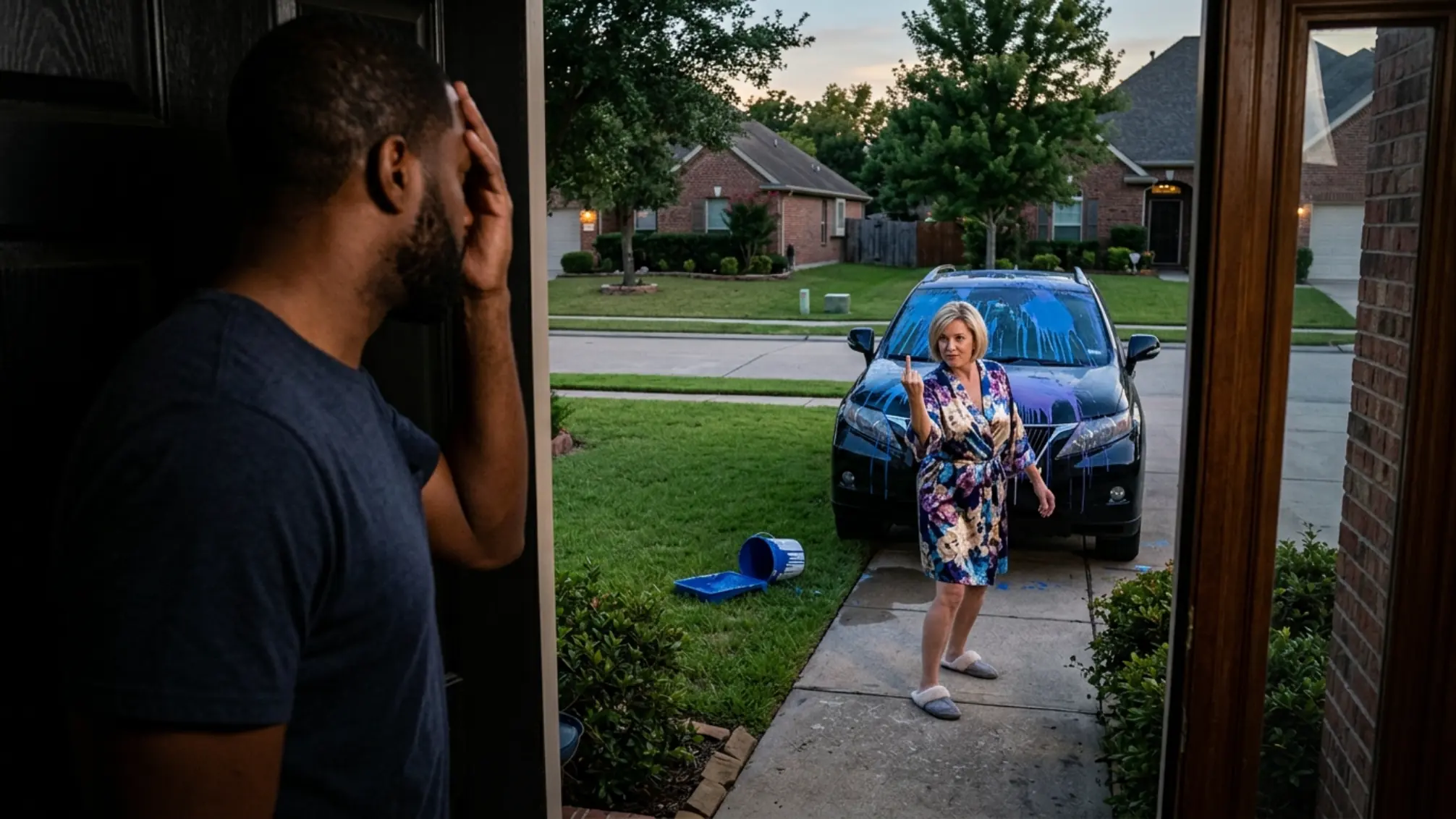
Then he heard a woman shout.
“Maybe now you’ll learn.”
Malcolm stopped.
He stepped into the shadow beside the open doorway and looked outside.
His breath caught.
Standing beside his black Mercedes sedan was Diane Whitmore, the fifty-nine-year-old president of the Briarwood Estates Homeowners Association. Her short blonde bob was slightly disheveled, and she was wearing a ridiculous but expensive-looking turquoise satin robe covered in large purple, cream, and coral flowers, tied tightly around her waist with soft gray slippers on her feet.
A blue plastic bucket sat beside the Mercedes.
White paint covered nearly the entire windshield.
It ran slowly over the glass in thick streaks, spilling across the hood and dripping toward the pavement.
Diane turned toward the house.
She saw Malcolm.
And instead of looking embarrassed, she smiled.
Malcolm opened the door completely.
“What the hell are you doing?”
Diane wiped a little paint from her fingers.
“You ignored three HOA notices.”
“So you poured paint on my car?”
“That windshield was a warning,” she snapped. “Next time I wreck the whole car.”
Malcolm stared at her.
“You vandalized my car and threatened me in broad daylight.”
Diane raised one hand.
She curled two fingers against her palm, crossed her thumb over them, and sharply tapped the side of her wrist twice.
It was an odd little gesture.
Malcolm had never seen it before.
Diane smiled wider.
“Good. Now show that video and find out who you just crossed.”
Malcolm instinctively lifted one hand to his head.
Not because he was frightened.
Because none of this made sense.
Six months earlier, Briarwood Estates had been the kind of neighborhood people competed to move into. Tree-lined streets curved around a small private lake. Every house had carefully trimmed landscaping, brick facades, and two-car garages.
Malcolm had purchased his home after building a successful commercial flooring company from almost nothing.
He was forty-one years old, divorced, financially comfortable, and happier living alone than most of his friends seemed to understand.
His house was not the largest in Briarwood.
But it was his.
That mattered to him.
Malcolm had grown up watching his mother rent apartments where landlords controlled almost everything. She had been told what could hang on the balcony, when repairs would be done, what parking space belonged to her, and how long guests could stay.
When Malcolm finally bought property, he promised himself he would never allow another person to make him feel like a visitor inside his own home.
That promise was exactly why he and Diane Whitmore had clashed.
Their first argument had been almost laughably small.
Malcolm installed a cedar planter beneath his kitchen window.
Three days later, Diane sent him an HOA violation because the wood stain was supposedly “inconsistent with the neighborhood architectural palette.”
Malcolm checked the governing documents.
There was no rule against it.
He emailed Diane.
She replied that the architectural committee possessed “broad aesthetic discretion.”
Malcolm asked her to identify the clause.
She stopped responding.
Two weeks later, he received a second violation.
His recycling bin had remained visible from the street for forty-three minutes after the permitted collection window.
Then came the lawn notices.
Then the driveway notice.
Then a complaint claiming his visiting nephew’s pickup truck was “commercial equipment.”
Malcolm paid none of the fines.
Instead, he requested records.
That was when Diane’s behavior changed.
The polite HOA emails became aggressive.
She began appearing outside Malcolm’s house during the afternoon, taking photographs from the sidewalk.
A security vehicle started driving slowly past his property several times a day.
Once, Malcolm stepped outside and asked the driver what he was doing.
The man simply rolled up his window and left.
Malcolm began documenting everything.
Dates.
Times.
Violation letters.
Photographs.
Security vehicle license plates.
He was not preparing for a dramatic confrontation.
He simply believed paperwork mattered.
Then, three weeks before Diane attacked his car, Malcolm received a notice claiming he owed $8,740 in unpaid HOA fines and administrative penalties.
He laughed when he first read it.
Then he noticed the final paragraph.
Failure to resolve the balance could result in lien enforcement.
That stopped being funny.
Malcolm hired attorney Rachel Monroe.
Rachel reviewed the fines and immediately found problems.
Several violations cited rules that did not exist.
Others had been issued on dates when photographs showed no violation.
One notice claimed Malcolm had parked on his lawn while he had been traveling in Chicago.
Another accused him of installing an unauthorized shed.
Malcolm did not own a shed.
Rachel sent the HOA a formal demand for records.
Diane refused.
That refusal eventually led to the Saturday morning when Malcolm opened his door and found the HOA president standing beside his paint-covered Mercedes.
Malcolm reached for his phone.
Diane laughed.
“Record all you want.”
“I already am.”
Her expression shifted slightly.
Malcolm had installed a doorbell camera months earlier.
It had captured everything.
Diane looked toward the small black lens beside his doorway.
Then she made the strange hand sign again.
Two fingers folded.
Thumb crossed.
Tap.
Tap.
Malcolm watched carefully.
Across the street, a gray SUV immediately started its engine.
Malcolm turned.
The vehicle had been parked near the curb beneath a tree.
He had barely noticed it.
Now it pulled away.
Slowly.
Diane followed his eyes.
For the first time, she looked worried.
“What was that?”
“Nothing.”
“You signaled that SUV.”
Diane grabbed the empty paint bucket.
“You’re paranoid.”
Malcolm stepped onto the porch.
“You came to my house in a floral bathrobe and dumped paint on my Mercedes. I think we passed paranoid five minutes ago.”
Diane pointed toward him.
“You should have paid the fines.”
“You should have read the bylaws.”
Diane turned and hurried toward her home three houses away.
Malcolm did not follow.
He photographed the paint.
He photographed the bucket.
Then he called the police.
Officer Marissa Cole arrived twenty-two minutes later.
She was initially skeptical when Malcolm described the strange hand signal.
Then he showed her the doorbell footage.
Diane could be seen clearly.
So could the gray SUV.
Officer Cole replayed the video twice.
“Do you recognize the vehicle?”
“No.”
“License plate visible?”
“Partially.”
Malcolm enlarged the frame.
The image was imperfect.
But the final four characters could be read.
Cole wrote them down.
“You said you’ve seen private security around here?”
“Yes.”
“Same vehicle?”
“No. Their security car is white.”
Officer Cole walked toward the Mercedes.
The paint was still wet.
“This isn’t house paint.”
Malcolm looked at her.
“What is it?”
“Looks like marking paint mixed with something thicker.”
“For what?”
“Couldn’t tell you.”
Cole photographed a spot where a small amount had fallen onto the driveway.
Then she noticed something near the front tire.
A bright orange mark had been sprayed onto the concrete.
It was shaped like a short line with two dots beneath it.
Malcolm frowned.
“That wasn’t there yesterday.”
Cole crouched.
“You sure?”
“Absolutely.”
The officer stood.
“Don’t remove it yet.”
By noon, photographs of Diane’s confrontation had already circulated through Briarwood’s private Facebook group.
The reaction surprised Malcolm.
Several neighbors contacted him privately.
Not because of the paint.
Because of the hand sign.
Janice Bell, a retired teacher who lived near the lake, called first.
“Malcolm, I’ve seen her do that.”
“When?”
“The morning they towed my daughter’s car.”
Malcolm sat forward.
“What?”
Janice explained.
Her daughter had visited from Raleigh six months earlier.
The vehicle had been parked legally in Janice’s driveway.
At 5:40 the next morning, a tow truck removed it.
Janice ran outside screaming that it was private property.
Diane stood across the street.
According to Janice, Diane made the exact hand gesture Malcolm had recorded.
Minutes later, the tow truck drove away.
The HOA later claimed Janice’s daughter had violated overnight parking restrictions.
No such restriction applied to private driveways.
Malcolm wrote everything down.
Then another neighbor called.
Then another.
By evening, Malcolm had heard seven stories.
The details differed.
The hand signal did not.
One homeowner had seen Diane make it before a landscaping crew cut down shrubs along his property line.
Another remembered it moments before an HOA security officer photographed the inside of her open garage.
A third said Diane used it while standing near a contractor who later placed temporary stakes across part of his backyard.
Malcolm called Rachel.
His attorney listened silently.
“That’s not random,” she finally said.
“I know.”
“The bigger question is what the signal means.”
Malcolm looked through his front window.
“Maybe it means someone else is watching.”
Rachel paused.
“Malcolm, don’t confront her again.”
“I wasn’t planning to.”
“I mean it. Document everything.”
“I will.”
“And send me that video tonight.”
The next morning, Malcolm walked the neighborhood.
He did not knock on doors asking for gossip.
He looked for marks.
It took less than twenty minutes to find another.
A faded orange line and two dots appeared on the curb outside Janice Bell’s property.
Another was painted near the driveway of Edward Santos, the man whose shrubs had been removed.
By lunchtime, Malcolm had photographed eleven.
All belonged to homeowners who had argued with the HOA.
That was not coincidence.
Rachel filed an emergency records request.
This time, she copied the HOA’s insurance carrier and management company.
The response came quickly.
Diane sent an email accusing Malcolm of “harassment, intimidation, and unauthorized surveillance.”
Rachel replied with one sentence.
Please preserve all HOA communications, contractor instructions, security footage, and vendor records effective immediately.
Within hours, things became stranger.
A man named Curtis Vane knocked on Malcolm’s door.
Curtis was forty-six, heavily built, with a shaved head and a company polo displaying the logo of Briarwood Community Compliance Services.
Malcolm recognized the company.
It was the HOA’s private security contractor.
Curtis remained on the porch.
“I’m not here officially.”
Malcolm folded his arms.
“Then why are you here?”
Curtis glanced toward the street.
“Because Diane is about to blame all of us.”
“All of you for what?”
Curtis looked directly at him.
“The marks.”
Malcolm said nothing.
Curtis continued.
“They’re target codes.”
“For what?”
“Different things.”
He explained.
One line with two dots meant vehicle enforcement.
A triangle meant landscaping.
A square indicated what Diane called “documentation priority.”
A short slash with a circle meant lien escalation.
Malcolm felt cold.
“You’re telling me she marked houses?”
“Yes.”
“Why?”
“To pressure owners.”
Curtis shook his head.
“She’d get angry at someone during an HOA dispute and add them to a list. Security would increase patrols around their property. Contractors would photograph things. The management office would start generating violations.”
“That’s selective enforcement.”
Curtis nodded.
“It got worse.”
He removed his phone.
There were screenshots.
Group messages.
Vendor instructions.
Photographs.
One message from Diane read:
Mark Hayes. He thinks he’s smarter than the board. Start finding violations.
Malcolm stared.
Another read:
Bell vehicle tomorrow morning. Use Signal B when clear.
Signal B.
The hand sign.
“That gesture?”
Curtis nodded.
“It means proceed.”
Malcolm sat down slowly.
“Why are you showing me this?”
“Because that video of her with the paint changes things. People are asking questions.”
Curtis looked toward the window.
“And because she told us this morning that if police investigate, we’re supposed to say you threatened her first.”
Malcolm’s jaw tightened.
“I never touched her.”
“I know.”
“Will you tell the police that?”
Curtis hesitated.
Then nodded.
Rachel moved quickly.
By Monday afternoon, she had forwarded the evidence to the HOA management company, the association’s insurance carrier, and investigators.
The HOA board called an emergency meeting.
Diane tried to cancel it.
The other board members refused.
More than eighty homeowners attended.
Malcolm sat near the back.
Diane entered wearing a navy blazer instead of a floral robe.
For the first fifteen minutes, she acted as though nothing serious had happened.
She called Malcolm’s accusations “an organized campaign of misinformation.”
Then Rachel stood.
She placed printed photographs across the table.
Orange curb marks.
Violation histories.
Vendor messages.
Screenshots.
Finally, she played the doorbell video.
Diane appeared on the large meeting-room television pouring paint across Malcolm’s windshield.
The room erupted.
Board member Peter Lawson raised both hands.
“Enough.”
Diane pointed at Malcolm.
“He provoked me for months.”
Malcolm remained seated.
Rachel answered.
“Did he force you to buy paint?”
Diane said nothing.
“Did he force you onto his property?”
Silence.
“Did he force you to make Signal B?”
Diane’s face drained.
Curtis Vane stood at the back of the room.
“You told us Signal B meant proceed.”
Every head turned.
Diane stared at him.
“You signed a confidentiality agreement.”
Curtis laughed bitterly.
“That agreement doesn’t cover illegal conduct.”
The room became completely silent.
Then Janice Bell stood.
“My daughter’s car.”
Curtis lowered his eyes.
“Yes.”
Edward Santos rose next.
“My shrubs?”
Curtis nodded again.
“Yes.”
A woman named Rosa Hernandez spoke from the second row.
“You fined me twenty-seven times after I challenged your pool renovation budget.”
Curtis looked toward Diane.
“She put you on documentation priority.”
Rosa’s face hardened.
Malcolm realized something extraordinary was happening.
The paint on his windshield had not created the scandal.
It had merely cracked open something that had existed for years.
Diane had turned HOA enforcement into a private weapon.
Residents who agreed with her received warnings.
Residents who challenged her received fines.
Contractors were instructed to watch specific homes.
Security patrols lingered near particular properties.
Tow companies received signals.
Landscaping vendors received coded markings.
And because each event looked small on its own, no one had understood the pattern.
Until now.
The board voted that night.
Four to one.
Diane was removed as HOA president pending a full investigation.
She shouted that the vote was invalid.
Rachel calmly read the removal provision from the bylaws.
Diane stormed out.
Malcolm thought that would be the end.
He was wrong.
Three days later, investigators executed search warrants involving records held by the management company and two contractors.
The evidence suggested more than selective enforcement.
There were financial issues.
Some towing fees had been partially redirected through “administrative coordination payments.”
Certain landscaping contracts included unexplained surcharges.
A company connected to Diane’s cousin had received thousands for neighborhood compliance consulting.
Malcolm’s $8,740 balance had been manufactured through repeated penalties generated after he asked for financial records.
Rachel filed suit on his behalf.
Other homeowners joined.
The HOA’s insurance carrier hired outside counsel and forced an independent audit.
The numbers were ugly.
Over four years, residents had paid hundreds of thousands of dollars in questionable charges, inflated vendor fees, and selectively imposed penalties.
Some had sold their homes after becoming exhausted by repeated HOA disputes.
One elderly couple had paid nearly $14,000 because they were afraid of a lien.
Another homeowner had refinanced to settle fines that should never have existed.
For Malcolm, that was worse than the paint.
A windshield could be replaced.
Fear changed where people lived.
Months passed.
Diane eventually entered court wearing a conservative gray suit.
She looked very different from the woman who had stood beside Malcolm’s Mercedes in a turquoise floral robe.
The hearing addressed several civil matters first.
Rachel presented the video.
Diane’s attorney argued that the confrontation had been emotional and isolated.
Then Rachel displayed the contractor messages.
The orange marks.
The enforcement lists.
The Signal B instructions.
The judge leaned forward.
“This was not isolated.”
“No, Your Honor,” Rachel replied.
The court invalidated Malcolm’s fines.
The lien threat disappeared.
He received compensation for damage to his vehicle and legal expenses, while broader claims concerning HOA practices continued separately.
Diane faced additional legal consequences connected to the evidence uncovered in the investigation.
Several contractors lost their Briarwood agreements.
The management company terminated employees who had participated in improper enforcement.
The HOA itself entered a period of independent oversight.
Most importantly, residents rewrote their governing procedures.
No violation could be issued without photographic evidence and a citation to the exact rule.
No contractor could tow a vehicle from private property without documented authorization.
Board members were prohibited from directing enforcement against individual residents outside formal procedures.
All financial contracts above a set amount required competitive bids.
And every homeowner gained easier access to association records.
Malcolm attended the meeting where the new rules were adopted.
Janice Bell sat beside him.
When the vote passed unanimously, she leaned toward him.
“All because she ruined your windshield.”
Malcolm shook his head.
“No.”
Janice looked confused.
Malcolm glanced around the room.
“All because she thought nobody would challenge her.”
A week later, Malcolm finally had the Mercedes professionally repaired.
The paint came off the bodywork.
The windshield had to be replaced.
When he brought the car home, he parked it in exactly the same spot.
Across the street, the orange marking had been removed from the pavement.
The security SUV no longer circled his property.
The coded lists were gone.
Diane’s house eventually went on the market.
Malcolm happened to be outside one afternoon when the moving truck arrived.
He did not walk over.
He did not celebrate.
He simply watched from his porch.
Diane stepped out carrying a box.
For a moment, she looked toward Malcolm.
Neither spoke.
Then, almost unconsciously, Diane raised one hand.
Malcolm’s eyes narrowed.
She froze before completing the old gesture.
Two fingers had already started to curl.
But there was nobody left waiting for her signal.
No tow truck.
No security contractor.
No employee watching for permission.
Diane lowered her hand.
Malcolm smiled faintly.
That was the part she had never understood.
Power was not a hand signal.
It was not a title on an HOA board.
It was not the ability to frighten neighbors with fines, contractors, liens, or threats.
Real power required accountability.
And once people stopped being afraid to ask questions, Diane Whitmore had none left.
Malcolm went back inside his house.
His own house.
No fake fine could change that.
No orange mark could change that.
And no woman standing in a floral robe with a bucket of paint would ever make him forget it again.