The first thing I remember about that afternoon is how ordinary my father looked.
He was standing beside my grill with a paper plate in one hand and a pair of tongs in the other, arguing with me about whether I had left the burgers on too long. He had taken off the jacket he wore when he arrived and folded it over the back of a patio chair. His sleeves were rolled to his forearms. There was a small gift bag on the table, a birthday card beside it, and the kind of easy smile on his face that made me feel, for the first time in weeks, that maybe I had been letting fear grow too large inside my own head.
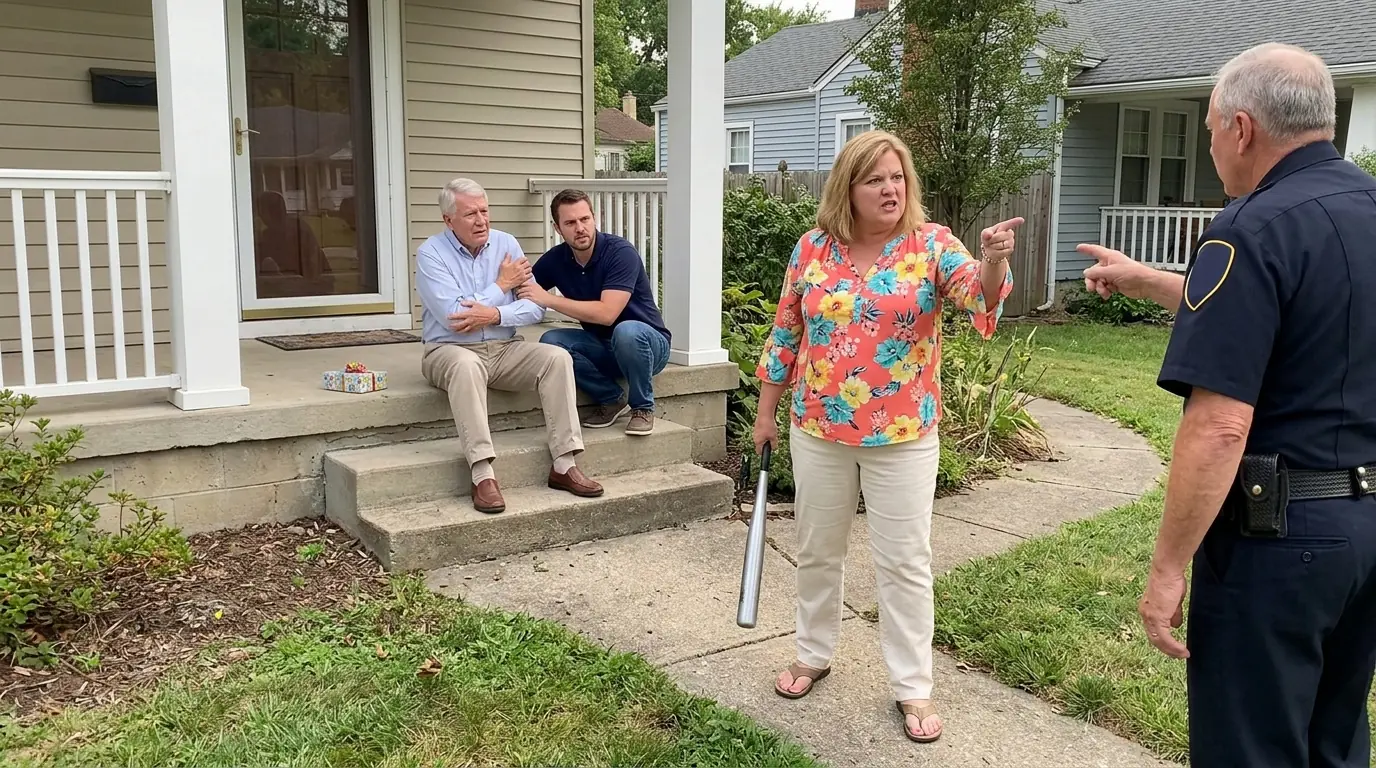
Then I looked across the street.
Karen was standing beside a parked car, perfectly still.
She was not pretending to check her mail. She was not talking to anyone. She was not even holding the clipboard she usually carried when she wanted the neighborhood to know she believed she had authority over something. She was simply watching my father.
I had seen her angry before. Everyone on our street had. I had seen her red-faced over a trash bin left at the curb an hour too long, furious over a child's bicycle leaning against a porch railing, triumphant after forcing a family to repaint a front door because she decided the shade of blue was "noncompliant."
This was different.
There was no anger in her face that afternoon.
There was patience.
My father followed my eyes toward the road. By the time he looked, Karen had turned away.
"Friend of yours?" he asked.
"Not exactly."
He glanced at me. "That sounds like a story."
"It is. I don't want to tell it today."
He accepted that without pushing. That was one of the things he had always been good at. People expected a judge to be constantly asking questions, constantly testing the facts in front of him. My father understood that there were moments when restraint told you more than interrogation.
He lifted the tongs. "Then your immediate problem is still these burgers."
I laughed.
Across the street, Karen turned back toward us.
If I had understood what she had learned two days earlier, I would not have laughed.
I would have called the police before the candles came out.
I would have asked my father to leave by the back road.
I would have taken every strange message, every late-night knock, every silent appearance at the end of my driveway, and treated them as parts of one plan instead of separate pieces of bad behavior.
But people are good at normalizing danger when it arrives one inch at a time.
That was how Karen had entered all of our lives in the first place.
When I moved into the neighborhood, she introduced herself before I had finished unloading the moving truck. She came across the street in a bright floral blouse covered in oversized pink and yellow flowers, white pants, spotless shoes, and the confident smile of someone who had never once considered that a stranger might not want her advice.