“You are not tearing into that ceiling!”
Karen Blake planted herself across the front steps.
Smoke rolled from the second-floor windows behind her.
The upper hallway was already disappearing into gray-black haze.
Captain Marcus Reed stopped three feet away.
Full turnout gear.
Helmet.
Air pack.
Gloves.
Radio crackling against his shoulder.
His crew waited behind him with a charged hose line.
“Ma’am, step back.”
Karen spread both arms wider.
“Put the fire out and leave the rest alone.”
Marcus looked past her.
Second-floor smoke had thickened.
One firefighter near the lawn pointed upward.
The ceiling line behind an upstairs window had begun to sag.
Marcus’s eyes narrowed.
“Ma’am.”
His voice became sharper.
“That ceiling is hiding something and it’s heating fast.”
Karen shook her head.
“There is nothing up there.”
Marcus stepped forward.
Karen grabbed his sleeve.
“Do not go into that hallway.”
Marcus looked down at her hand.
Then at her.
“Let go.”
She did not.
He pulled free.
Gave one signal.
Two firefighters moved past her.
Karen spun.
“No!”
For the first time, the anger cracked.
Something else appeared beneath it.
Fear.
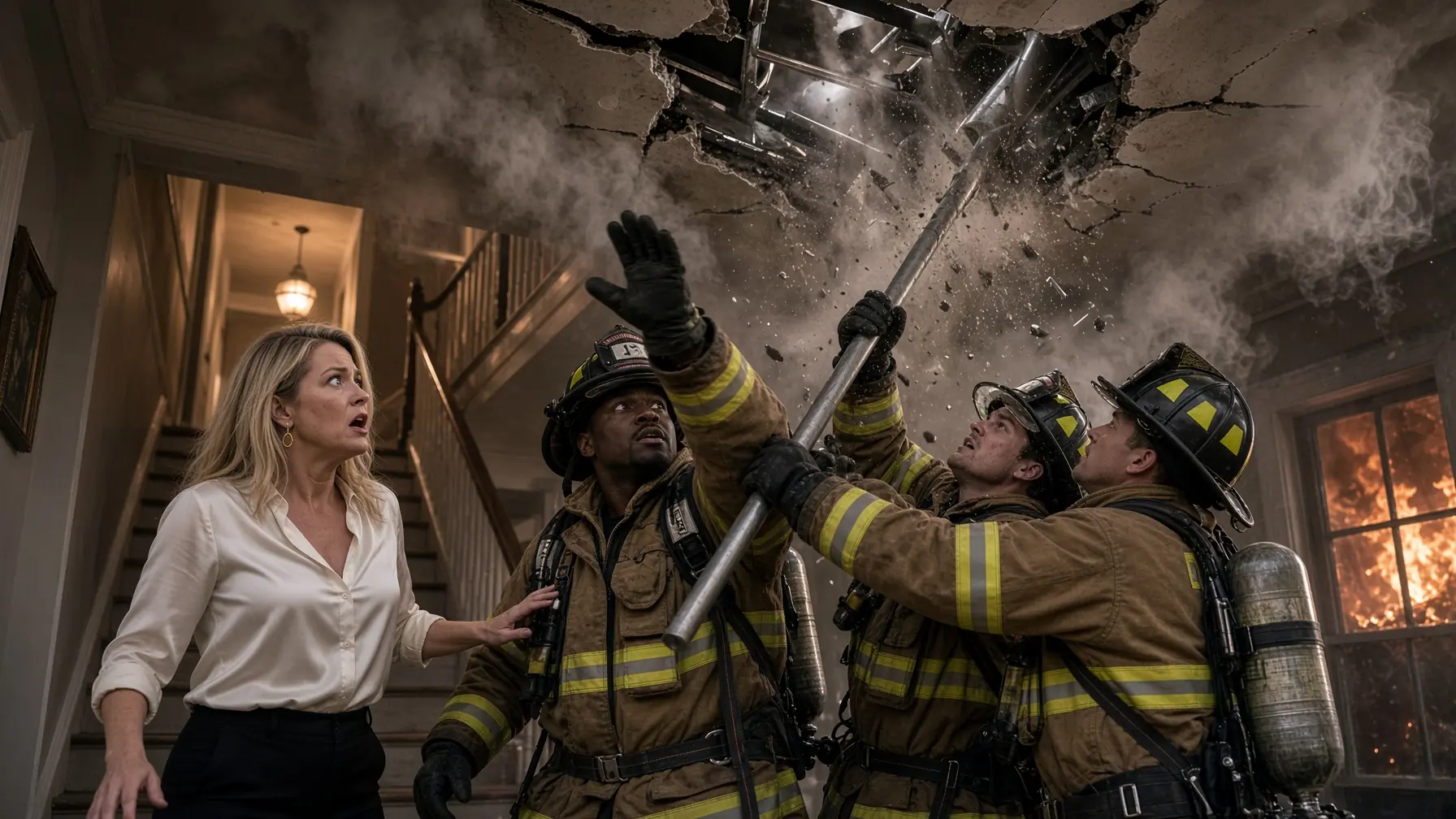
A firefighter reached the second-floor landing.
Looked up.
Pressed a pike pole against the sagging drywall.
Karen shouted from below:
“Leave it!”
The firefighter struck.
Plaster broke.
Insulation fell.
A second strike opened a larger section.
Something metallic reflected through the smoke.
Marcus moved to the foot of the stairs.
Looked up.
Then back at Karen.
“Then why is there a locked steel box built into your rafters?”
Karen stopped moving.
Completely.
Her eyes flicked upward.
Metal shifted somewhere above.
Her lips parted.
No words came out.
Marcus watched her face change.
Not confusion.
Recognition.
He turned back toward the stairs.
“Everybody out of that hallway until we know what that is.”
Karen finally found her voice.
“It’s nothing.”
Marcus looked at her.
“You've said that twice.”
A beat.
“And both times you looked terrified.”
The fire had started twenty-three minutes earlier.
At least that was when the first neighbor noticed smoke.
Karen lived in a quiet suburban development outside Richmond, Virginia.
Two-story colonial.
Cream siding.
Black shutters.
Immaculate front lawn.
Hydrangeas trimmed perfectly.
The kind of house Karen liked people noticing.
She chaired the neighborhood architectural committee.
Organized holiday decoration contests.
Corrected people when their garbage cans stayed visible from the street.
Once sent a three-paragraph email to a neighbor because his basketball hoop remained at the curb twenty minutes after sunset.
Everything about Karen’s life communicated control.
Then smoke appeared above her roof.
Mrs. Dawson from across the street called 911.
When the first engine arrived, Karen was already outside.
No visible burns.
No smoke inhalation.
No missing family members.
Her husband was traveling.
Her teenage daughter was at soccer practice.
The house was empty.
That should have made the operation simple.
Life safety first.
Then fire attack.
Then overhaul.
Instead, Karen began arguing before Marcus’s boots reached the walkway.
“The fire is downstairs.”
Marcus looked at the smoke from upstairs.
“No, ma’am.”
“I know my house.”
“Smoke has already moved through the second floor.”
“You don't need to tear anything apart.”
Marcus had heard that before.
Homeowners hated seeing firefighters damage walls.
They saw drywall.
Cabinets.
Ceilings.
Things they had paid for.
Firefighters saw concealed spaces.
Heat.
Extension.
A fire that disappeared behind walls did not stop existing because the wall looked expensive.
Marcus explained:
“If fire gets into the voids, we have to open them.”
Karen’s expression tightened.
“Not upstairs.”
That was when he first noticed something strange.
Not:
Please save my bedroom.
Not:
My mother’s photographs are upstairs.
Not:
There are valuables.
Just:
Not upstairs.
Marcus asked:
“What’s up there?”
“Nothing.”
Another answer too fast.
Then the ceiling began sagging.
And Karen stepped in front of the door.
The box was not removed immediately.
Marcus had no idea what it contained.
Could have been ordinary storage.
Could have been ammunition.
Could have been batteries.
Could have contained nothing dangerous at all.
But when heat is involved, unknown metal containers become problems.
Marcus ordered the crew out of the immediate area.
Fire attack continued from a safer position.
A thermal camera showed significant heat around the ceiling void.
Another team worked the exterior.
Karen remained on the lawn.
Silent now.
Watching the upstairs window.
A battalion chief arrived.