Some moments change the atmosphere of an entire room in a single second.
That morning inside the Grand Aurelia Hotel, it happened with a sound so sharp that even the pianist near the champagne lounge missed a note.
A thunderous bang cracked across the lobby when Victor Hale slammed both hands onto the marble reception desk.
The silver pen holder jumped, the crystal bowl of mints rattled, and every conversation beneath the chandeliers died at once.
“Get out before I call security!” he shouted.
Standing across from him was an elderly woman who looked painfully small against the hotel’s golden luxury.
Her name was Eleanor Whitmore, though no one in that lobby had cared enough to ask.
She wore a faded brown coat, shoes worn thin at the edges, and a small handbag clutched tightly against her chest.
Her gray hair was pinned carefully behind her ears, but a few loose strands trembled against her weathered face.
She had entered quietly, asked one question, and been treated like a stain on the marble floor.
The Grand Aurelia was one of the most expensive hotels in Boston.
Its lobby glowed with crystal chandeliers, towering white flowers, polished brass, and walls that reflected people who were used to being welcomed.
Guests sat in velvet chairs with coffee cups that cost more than some dinners.
Bellboys moved softly with designer luggage, and businessmen spoke in low voices about contracts, flights, and private dinners.
Everything about the hotel said wealth belonged here.
Eleanor did not look like wealth.
She looked like a woman who had walked through grief, rain, and years of silence just to stand at that desk.
Her hands were thin, but they held her handbag with fierce care.
Her back was slightly bent, but her eyes remained clear.
She had not come to beg.
Victor Hale leaned over the counter, his face red with anger and pride.
He was the hotel manager, young enough to think cruelty looked like confidence and polished enough to hide rot behind a tailored suit.
His black jacket fit perfectly, his tie was straight, and his gold name badge caught the chandelier light.
To wealthy guests, he smiled like a servant.
To anyone he considered beneath him, he spoke like a judge.
“I said leave,” Victor snapped, pointing toward the revolving doors.
“This is a private hotel. We don’t allow people to wander in and bother our guests.”
Eleanor did not step back.
She lifted her chin slightly and answered in a calm voice.
“I only asked for room 412.”
A few guests exchanged amused looks.
The young receptionist behind the desk glanced nervously from Eleanor to Victor.
Her name was Claire, and she had only worked at the hotel for six months.
She had heard stories about room 412, but only whispers.
It had been sealed long before she was hired.
Victor laughed.
It was not a pleasant laugh.
It was loud, cruel, and meant to invite the room to laugh with him.
“Room 412?” he repeated.
“You couldn’t afford a night in the parking lot, let alone a sealed room in this hotel.”
Several people chuckled.
A woman in diamonds lifted her hand to hide a smirk.
A businessman near the fountain whispered something to his wife, and she laughed softly into her coffee.
Someone near the staircase raised a phone and started recording.
Eleanor heard everything, but her face did not break.
Victor seemed encouraged by the crowd’s reaction.
He leaned closer, his palms still pressed against the marble.
“Look at yourself,” he said, his voice dripping contempt.
“Worn shoes, faded coat, shaking hands, and you think you can walk into the Grand Aurelia demanding a private room?”
Eleanor’s fingers tightened around her handbag.
She did not answer immediately.
Instead, she looked past him toward the grand staircase, where carved railings swept upward like something from another century.
For one brief moment, the noise of the lobby seemed to fade around her.
She remembered standing there forty years earlier in a blue dress, holding the hand of a young man with bright eyes and impossible dreams.
His name had been Arthur Whitmore.
Arthur had built the Grand Aurelia from a dying old building everyone else wanted to demolish.
He had believed forgotten places could become beautiful again if someone loved them enough.
He was not born rich, but he worked like a man trying to earn the future with both hands.
Eleanor had watched him sleep on office floors, negotiate loans, polish brass himself, and write welcome letters to the first guests.
Room 412 had been his private office before it became the heart of a secret.
Victor saw her silence and mistook it for weakness.
“What now?” he said with a dramatic sigh.
“Are you going to tell me your ghost husband reserved the room?”
More laughter scattered through the lobby.
Claire, the receptionist, did not laugh.
Something about Eleanor’s stillness made her skin prickle.
Eleanor slowly opened her handbag.
Her fingers trembled, but not from fear.
They trembled from age, memory, and the weight of finally arriving at a moment she had waited years to face.
Victor rolled his eyes and stepped back as if expecting dirty tissues or coins.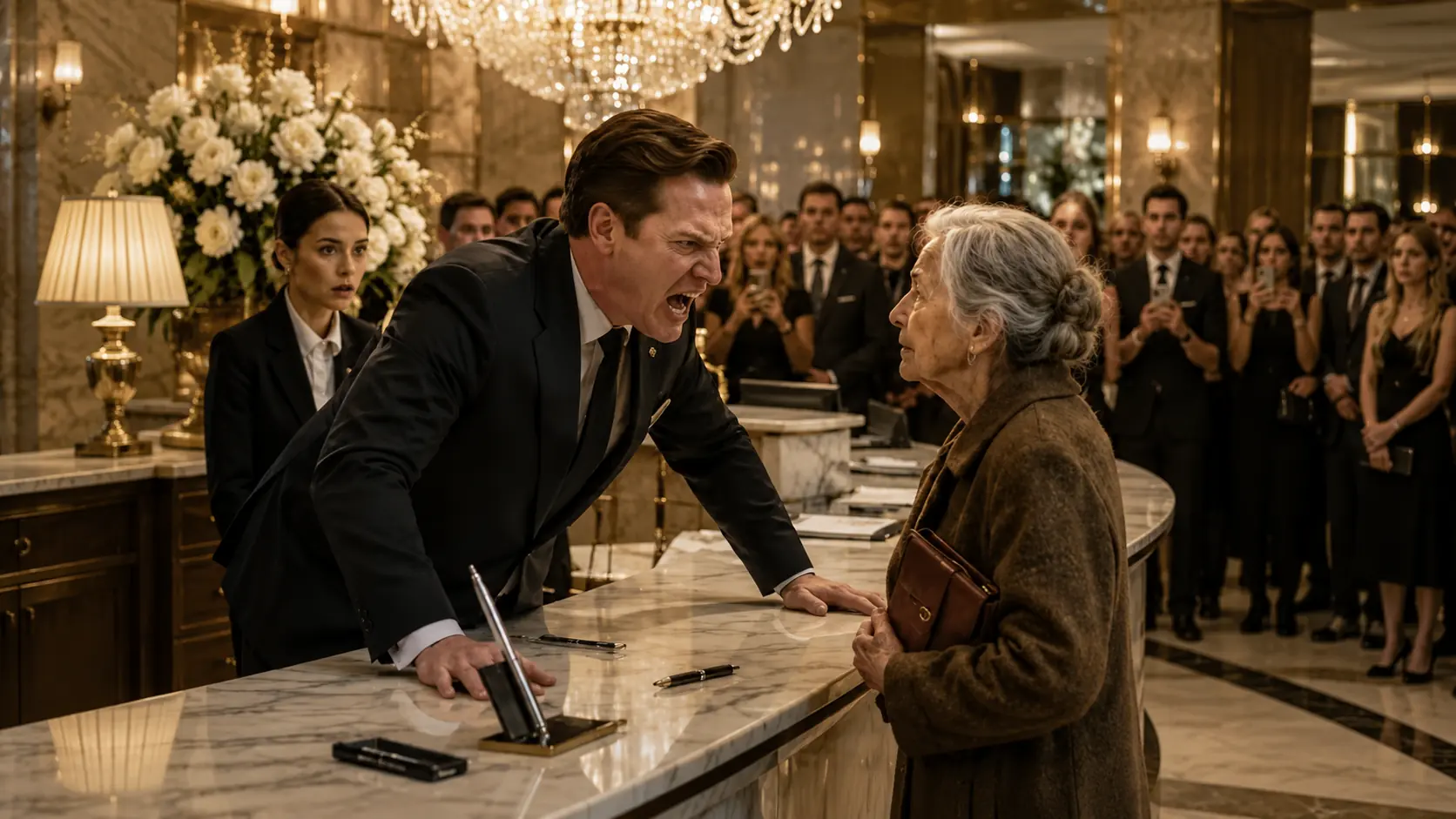
But Eleanor pulled out a brass key.
It was old and heavy, darker at the edges from time.
Attached to it was a faded metal tag stamped with one number.
412.
Claire saw it first.
The color drained from her face.
“Sir,” Claire whispered.
Victor frowned at her.
“What?”
Claire stared at the key like it had risen from the dead.
“That room…” she said, her voice barely audible.
“That room was sealed years ago.”
The laughter faded.
Guests leaned closer.
The woman with diamonds lowered her hand from her mouth.
The businessman near the fountain stopped smiling.
Even the pianist’s fingers slowed over the keys.
Victor snatched his gaze back to Eleanor.
“Where did you get that?”
Eleanor closed her fingers around the brass key.
“My husband left something there.”
Victor straightened his tie.
“That room belongs to the owner.”
Eleanor looked directly into his eyes.
“No,” she said softly.
“It belongs to me.”
A ripple of whispers moved through the lobby.
Victor’s expression stiffened, but he recovered quickly.
“You are either confused or trying to create a scene.”
Eleanor’s gaze did not move.
“I am here because your owner has been hiding behind locked doors and dead men’s signatures for twenty years.”
Victor’s face changed for one split second.
Only Eleanor noticed.
That tiny flicker told her she had not come too late.
He knew enough to be afraid.
He knew room 412 mattered.
He knew the truth had not died with Arthur.
Victor leaned close, lowering his voice.
“Listen to me, old woman. Whatever fantasy you carried in here, you will carry it back out before I make this ugly.”
Eleanor’s shoulders lifted with one slow breath.
“You already made it ugly when you screamed at a widow in the lobby of her husband’s hotel.”
Claire’s eyes widened.
Victor turned sharply toward the security desk.
“Get her out.”
Two guards near the entrance moved forward.
The crowd shifted, hungry for the next scene but unwilling to admit it.
Eleanor did not move.
She only raised the brass key higher.
Then the elevator doors opened.
A clear ding rang across the lobby.
Every head turned.
A tall woman dressed entirely in black stepped out, her posture calm and powerful.
Her dark hair was pulled back, her face was pale with controlled emotion, and behind her walked two lawyers carrying leather folders.
Victor’s face drained of color the moment he saw her.
The woman crossed the marble floor without looking at anyone else.
Her heels clicked steadily beneath the chandeliers.
She ignored the phones, the whispering guests, the frozen staff, and Victor’s trembling attempt to compose himself.
She stopped beside Eleanor and lowered her head with deep respect.
“Mother,” she said softly.
“We found the papers.”
The lobby fell into absolute silence.
Eleanor reached for her daughter’s hand.
The woman was Vivian Whitmore, Arthur and Eleanor’s only child.
For twenty years, she had searched through court records, trust filings, storage units, old bank archives, and hidden company transfers.
And now she had returned to the place her father had built.
Victor took one step back.
“Miss Whitmore,” he said, forcing a smile.
“This is highly inappropriate.”
Vivian turned her eyes on him.
“Inappropriate was watching my mother be humiliated in her own lobby.”
Victor swallowed.
“That is not what happened.”
A guest near the staircase lowered his phone slightly, as if the recording had become dangerous.
Vivian looked toward him.
“No, keep recording.”
The man froze.
Vivian’s voice remained calm.
“My mother was publicly insulted. The correction can be public too.”
Eleanor placed the brass key on the marble desk.
The sound was small, but everyone heard it.
Victor stared at it like it might burn through the stone.
One of the lawyers opened a leather folder and set several documents beside the key.
At the top of the first page was the name Arthur Whitmore.
Vivian spoke clearly.
“Twenty years ago, my father died before signing final transfer papers for this hotel.”
She turned toward the crowd.
“After his death, control of the Grand Aurelia passed to a private holding company run by his business partner, Malcolm Graves.”
A murmur passed through the lobby.
Victor looked toward the manager’s office, where an old portrait of Malcolm Graves hung on the wall.
Vivian continued.
“For years, we were told my father had sold his controlling interest before his death.”
Her jaw tightened.
“But the sale documents were forged.”
One of the lawyers placed another file on the desk.
“The original ownership records were hidden in room 412, my father’s private office, along with his signed statement explaining what he had discovered.”
Victor’s voice cracked.
“This is absurd.”
Eleanor looked at him.
“Then why did you keep room 412 sealed?”
He had no answer.
Claire stepped forward unexpectedly.
Her voice trembled.
“Mr. Hale ordered staff never to open that room.”
Victor spun toward her.
“Claire, be quiet.”
Vivian’s eyes sharpened.
“No. Let her speak.”
Claire looked frightened, but she continued.
“When I was hired, I was told room 412 had structural damage,” Claire said.
“But maintenance said there was nothing wrong with it.”
She pointed toward Victor.
“He told everyone it belonged to the owner’s private archive and anyone asking about it would be fired.”
The lobby turned toward Victor with new eyes.
The cruelty from minutes earlier now looked like panic in disguise.
Eleanor picked up the brass key.
“My husband gave this to me two weeks before he died.”
Her voice softened, but it carried.
“He said if anything happened to him, I should keep it safe until Vivian found the rest.”
She looked toward her daughter.
“It took longer than I hoped.”
Vivian squeezed her hand.
“But we found it.”
One lawyer stepped toward Victor.
“Mr. Hale, the court order was filed this morning.”
He opened a document and held it up.
“Until ownership is resolved, management authority over the Grand Aurelia transfers to the Whitmore estate’s legal trustees.”
Victor’s lips parted.
The lawyer continued.
“You are suspended effective immediately.”
Victor’s polished mask broke.
“You cannot suspend me in my own hotel.”
Eleanor’s eyes grew cold.
“You called it your hotel when you wanted to throw me out.”
She lifted the brass key slightly.
“Now the truth is asking you to leave.”
A wave of whispers rolled through the lobby.
The woman in diamonds lowered her eyes.
The businessman who had laughed earlier looked ashamed.
One of the bellboys stood straighter, as if something inside him had been waiting for this moment.
Claire slowly removed the manager’s access card from behind the desk and placed it on the marble surface.
Victor stared at her.
“You ungrateful little—”
Vivian stepped forward.
“Finish that sentence, and it will be included in the termination record.”
Victor stopped.
His face flushed red.
For the first time, he looked less like a powerful manager and more like a frightened employee in an expensive suit.
Eleanor watched him carefully.
She did not smile.
She did not enjoy his fear the way he had enjoyed her humiliation.
That was the difference between them.
Power had revealed his cruelty.
Pain had refined her dignity.
“Would you like me to start with the stolen hotel,” Eleanor asked quietly, “or my dead husband?”
The question held the whole lobby still.
Victor’s throat moved.
Vivian looked at him with open disgust.
One lawyer began making notes.
Victor stepped away from the desk.
“I followed instructions from ownership.”
Eleanor’s eyes narrowed.
“Ownership that may have been built on fraud.”
“I was not involved twenty years ago,” Victor said quickly.
“No,” Vivian replied.
“But you were involved today.”
That sentence landed harder than any accusation about the past.
Victor could pretend not to know what Malcolm Graves had done.
He could blame old documents, dead men, private trusts, and company lawyers.
But everyone had watched him slam his hands on the desk and threaten an elderly woman because she looked poor.
That belonged entirely to him.
The lawyers requested Victor’s keys, access card, and office password.
He resisted at first, then saw the phones recording and gave them up with shaking hands.
Security did not escort Eleanor out.
Instead, security escorted Victor toward the side office where he would collect his belongings under supervision.
The irony was not lost on anyone.
As he passed Eleanor, he stopped.
For a moment, it looked as if he might apologize.
But pride still had its claws in him.
He only whispered, “You should have called ahead.”
Eleanor looked at him sadly.
“And you should have been decent before you knew my name.”
Victor walked away.
The lobby remained quiet after he disappeared.
No one knew whether to speak, move, or pretend the last ten minutes had not changed everything.
Then Vivian turned to the guests and staff.
“My mother will be going to room 412 now.”
Her voice softened.
“Anyone who laughed at her may decide for themselves what kind of person they wish to be when the next old woman walks through those doors.”
No one answered.
Eleanor picked up her handbag and the brass key.
Vivian offered her arm, but Eleanor shook her head gently.
“I can walk.”
Her daughter nodded, though tears filled her eyes.
Together, with the lawyers behind them, they crossed the lobby toward the elevator.
Claire came around from behind the desk.
“Mrs. Whitmore,” she said.
Eleanor turned.
The young receptionist’s eyes were wet.
“I’m sorry I didn’t speak sooner.”
Eleanor studied her face.
“Next time, speak sooner.”
Claire nodded.
“I will.”
Eleanor gave her a small, tired smile.
“Then today was not wasted.”
The elevator carried them to the fourth floor.
The hallway was quieter than the lobby, lined with cream walls and gold-framed mirrors.
At the end of the corridor stood room 412, its door darker than the others, its brass number dull from neglect.
A thin strip of old tape crossed the frame, and a small sign read: Authorized Personnel Only.
Eleanor stopped in front of it.
Her hand trembled around the key.
Vivian stood beside her, breathing unevenly.
For years, they had chased rumors and fragments, never knowing whether Arthur’s final truth had survived.
Now the door stood inches away.
Eleanor touched the number 412 with two fingers.
“He loved this room,” she whispered.
Vivian’s voice was soft.
“Why?”
“Because from here, he could see the lobby.”
Eleanor smiled sadly.
“He said if you want to know whether a hotel has a soul, watch how people are welcomed when they think nobody important is looking.”
The key turned with a heavy click.
The air inside room 412 smelled of dust, old paper, and sealed time.
The furniture had been covered with white sheets.
A large desk stood near the window, facing the lobby balcony below.
On the wall hung a faded photograph of Arthur Whitmore and Eleanor on the hotel’s opening night.
Both of them were young, smiling, and unaware of how much grief the future would ask of them.
Eleanor stepped inside slowly.
Her fingers brushed the desk.
There, beneath a loose panel her husband had once shown her, was a metal box.
Vivian’s breath caught when one lawyer lifted it out and placed it on the desk.
Inside were signed statements, original shares, bank records, and a letter addressed to Eleanor.
She opened the letter with shaking hands.
“My dearest Ellie,” Arthur had written, “if you are reading this, then I was not able to finish the fight myself.”
Eleanor pressed one hand to her mouth.
Vivian began to cry silently beside her.
The letter explained everything: Malcolm Graves had attempted to force Arthur out, forged transfer documents, and threatened to bury the hotel in debt if Arthur resisted.
Arthur had hidden the proof in room 412 because he feared the people closest to him had already been bought.
The final line broke Eleanor.
“Do not let them turn our house of welcome into a palace of cruelty.”
She sank into the desk chair, holding the letter to her chest.
For the first time that day, the strength left her face.
Vivian knelt beside her mother and wrapped both arms around her.
They stayed like that for a long time.
Downstairs, the lobby changed while they were gone.
Guests who had laughed avoided one another’s eyes.
Staff whispered in corners, not with gossip now, but with shame and relief.
Claire stood behind the desk, staring at the spot where Eleanor had stood.
The brass pen holder Victor had rattled still sat crooked on the marble.
An hour later, Eleanor returned to the lobby with Vivian and the lawyers.
Her face looked tired, but something in her posture had changed.
The fragile old woman everyone had mocked now carried the authority of truth.
She stopped at the center of the lobby beneath the chandelier.
Every employee turned toward her.
“This hotel was built by my husband,” she said.
“And by every maid, bellboy, cook, clerk, carpenter, and doorman who believed hospitality meant dignity.”
Her eyes moved across the room.
“Today I was told I did not belong here because my coat was old and my shoes were worn.”
Several guests lowered their heads.
Eleanor continued.
“If wealth makes you forget kindness, then wealth has made you poor.”
The lobby was silent.
Vivian stood beside her, proud and heartbroken at once.
“This hotel will be reviewed from top to bottom. Anyone who built a culture of cruelty will be removed. Anyone who was afraid to speak will be heard.”
Claire wiped her cheek.
A bellboy near the luggage carts nodded once.
The pianist, still seated near the lounge, placed his hands quietly in his lap.
For the first time that morning, the hotel felt less like a palace and more like a place where human beings had been forced to remember themselves.
In the weeks that followed, the Grand Aurelia became headline news.
The Whitmore estate’s legal team exposed the forged documents and the fraud that had stolen control of the hotel for two decades.
Malcolm Graves, long retired and hiding behind lawyers, was dragged back into court.
Victor Hale’s suspension became termination after employee complaints surfaced by the dozens.
Room 412 was restored, not as a luxury suite, but as a memorial office to Arthur Whitmore and the hotel’s original promise.
Eleanor did not move into the hotel.
She kept her small apartment, her worn coat, and the handbag everyone had judged.
But every Friday afternoon, she visited the Grand Aurelia and sat in the lobby for one hour.
She watched the doors.
She watched the staff greet guests.
She watched whether people with old shoes were treated differently from people with diamonds.
One afternoon, a tired elderly man entered carrying a paper bag and looking lost.
A bellboy immediately stepped forward.
“Good afternoon, sir. How may I help you?”
The old man relaxed.
Eleanor saw it from her chair near the flowers.
Claire, now promoted to guest relations manager, saw Eleanor watching and smiled.
Eleanor gave a small nod.
Years later, people still told the story of the old woman with the brass key.
Some told it as revenge.
Some told it as a mystery about room 412.
Some told it because they loved the moment Victor Hale’s face turned pale.
But Eleanor never told it that way.
When asked what the story meant, she always answered the same.
“The key did not make me worthy,” she would say.
“The papers did not make me human. I was human when I walked in.”
Then she would look toward the revolving doors and add, “A good hotel knows that before it asks your name.”
And that was the lesson the Grand Aurelia never forgot.
An old woman in worn shoes walked into a palace of wealth and was told to leave.
She asked for a sealed room, raised a brass key, and uncovered a truth buried for twenty years.
But the deepest secret was not hidden in room 412.
It was hidden in the lobby, in the hearts of people who had forgotten that dignity should never depend on what someone can afford.