The Wyoming wind clawed against the walls of Gideon Ross’s small ranch cabin outside Sweetwater Crossing. Pale moonlight stretched across the empty hills, and an oil lamp flickered beside the bed, casting uneven light over the rough quilt and Clara’s trembling hands. They had been husband and wife for only six hours, yet Gideon already knew something was terribly wrong. Every time he shifted in his chair, Clara flinched as though movement itself promised pain.
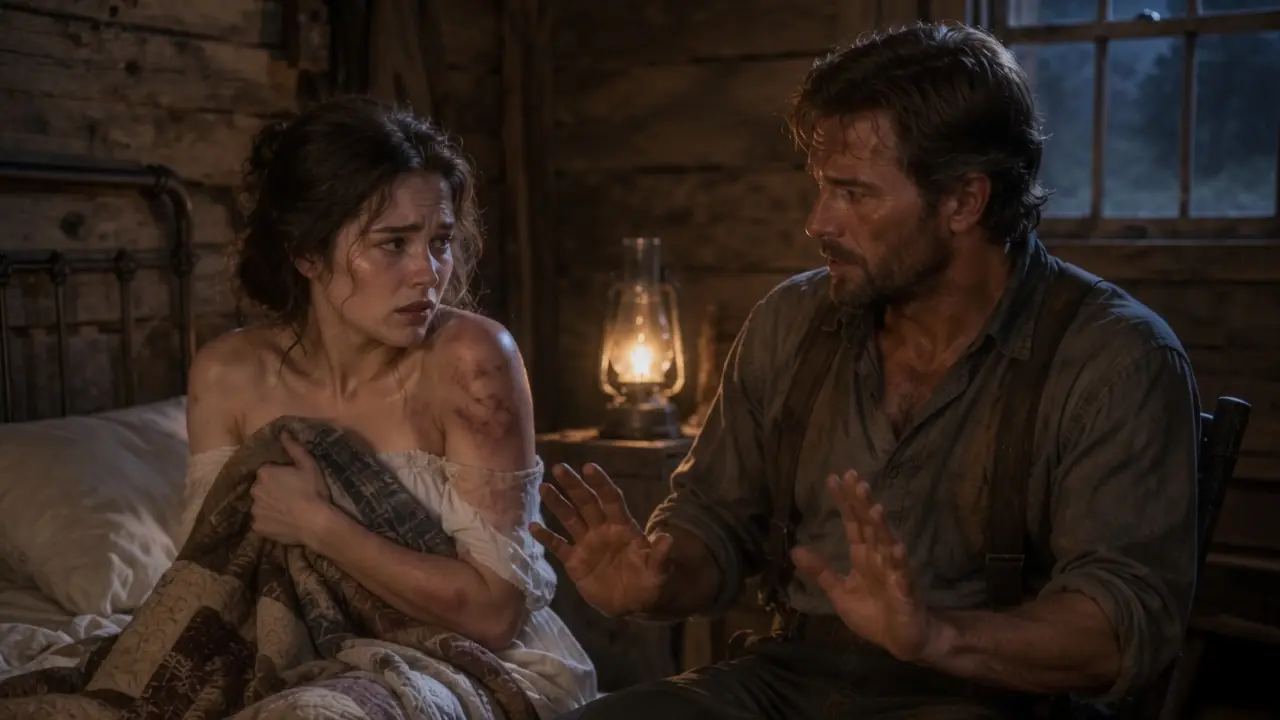
She sat at the edge of the narrow bed in a white nightdress that looked too thin for the cold. Her wedding ring rested loosely around her finger because she had eaten little during the long stagecoach journey from Missouri. Gideon had offered her stew twice that evening, but she had taken only three careful spoonfuls before claiming she was no longer hungry. Even gratitude seemed to frighten her, as if accepting kindness created a debt she could never repay.
Gideon was forty-two, broad-shouldered, sunburned, and marked by years of ranch work. An old bullet wound stiffened his left side during winter, and grief had settled into the quiet places of his face after his first wife died from fever seven years earlier. He had not expected to marry again, but loneliness changed shape when a man spent too many evenings eating across from an empty chair. Eventually, he placed a simple advertisement in the Cheyenne newspaper asking for an honest woman willing to build a peaceful life.
Clara’s response had arrived three weeks later in careful handwriting. She promised she could cook, sew, keep household accounts, care for chickens, and read aloud without stumbling. Her letter contained no questions about the size of Gideon’s ranch, the amount of land he owned, or whether he had money in the bank. Instead, she had written one sentence that remained inside him long after he folded the page.
“If you are kind, I will be grateful,” she had written. “If you are not, I will endure.”
That was not how hopeful women described marriage. It was how survivors measured danger. Gideon had read the line repeatedly, then sent enough money for Clara’s stagecoach ticket and promised she would have her own room until she decided otherwise. She never mentioned the promise in her reply.
Four days earlier, Gideon had met her at the Sweetwater Crossing station. Clara stepped down from the coach carrying a faded carpetbag and wearing a carefully mended blue dress. She was twenty-eight, though fear made her appear younger, and she kept her gaze fixed on the dusty ground. When Gideon greeted her respectfully, she answered without looking at him.
“Miss Whitlock?” he had asked.
“Clara,” she whispered. “Clara Whitlock.”
The stagecoach driver placed her bag beside Gideon’s wagon and muttered that she had barely spoken during the entire journey. Clara thanked him three times, even though he had handled her belongings roughly and complained about waiting while she stepped down. Gideon noticed the way she moved away whenever a man walked too close. He also noticed bruises around her wrist before she quickly pulled down her sleeve.
They married that afternoon inside the small white church at the edge of town. Reverend Samuel Price spoke gently, and his wife, Martha, stood beside Clara as a witness. Gideon made no promise he could not keep, and when the preacher told him he could kiss his bride, he touched only Clara’s forehead. Relief crossed her face so quickly that everyone except Gideon might have mistaken it for shyness.
Now, inside the cabin, the wedding day was over, and Clara’s fear had grown stronger. Gideon remained seated near the stove because each time he approached the bed, her breathing changed. He explained again that the adjoining room belonged to her and that she could lock the door from inside. Clara stared at the floor as though she had not understood the words.
“You do not have to stay in here,” Gideon said. “I can sleep in the chair, and you can take the bedroom.”
Her fingers tightened around the quilt. “A wife should stay with her husband.”
“A wife should feel safe in her own home.”
Clara looked at him then, but only for a moment. Suspicion moved through her eyes, not because she believed he was lying, but because she could not imagine why any man would give up something he believed marriage entitled him to. Gideon understood that promises alone would not undo whatever had taught her to expect cruelty. Trust would have to arrive slowly, through actions too consistent to misunderstand.
He stood to add wood to the stove. Clara recoiled before he had taken a full step, and the nightdress slipped slightly from her shoulder. The lamp flame moved, and Gideon saw pale lines crossing her skin. Some scars had faded white with age, while others remained dark, raised, and impossible to dismiss.
He froze.
Clara followed his stare and pulled the quilt against her body. Panic flooded her face. She began apologizing before Gideon could speak, her words tumbling over one another as though speed might protect her. “I’m sorry, I can cover them, I can do better, please do not send me away.”
“Stop apologizing,” Gideon said.
His voice came out harsher than he intended. Clara immediately fell silent and shrank against the headboard. Gideon slowly raised both empty hands where she could see them, then stepped backward until the space between them widened. He had once believed strength came from knowing when to use his fists, but that frightened woman taught him otherwise.
Clara’s lower lip trembled. “It hurts,” she whispered. “Please do not send me away. I can learn to be a better wife.”
Gideon lowered himself into the chair rather than returning to the bed. “Clara, you never have to earn kindness from me.”
Her eyes filled. “How can you still want me after seeing these scars?”
“I married your heart, not your wounds,” Gideon said. “I will wait until you choose to hold my hand.”
The room became quiet except for the wind against the windows. Gideon crossed to the washstand, soaked a clean cloth in cool water, and placed it on a stool within Clara’s reach. He did not touch her shoulder, inspect her bruises, or demand explanations. Then he returned to the chair and waited.
Clara stared at the folded cloth for nearly a minute. Finally, she reached for it and pressed it gently against the darkest bruise near her wrist. The simple act seemed to weaken something inside her, because she suddenly bent forward and began sobbing. Her grief sounded older than she was, like years of swallowed fear finally breaking free.
Gideon remained where he was. Every instinct told him to cross the room and hold her, but he understood that comfort given without permission could feel like another form of control. He kept his hands resting openly on his knees. When Clara’s breathing steadied, he asked only one question.
“Who did this to you?”
“No one,” she whispered.
Gideon did not challenge the lie. He simply waited, letting the silence belong to her instead of using it as pressure. Clara looked toward the door, then the window, as though the person responsible might somehow hear her from hundreds of miles away. At last, her voice became barely audible.
“My stepfather.”
Gideon’s jaw tightened. He forced his expression to remain calm because rage would only give Clara another angry man to fear. “What is his name?”
She opened her mouth, but a horse screamed outside.
Heavy hoofbeats thundered into the ranch yard. Clara dropped the cloth and pulled the quilt around herself as a man shouted Gideon’s name from beyond the cabin door. Gideon rose slowly, took the rifle from above the mantel, and placed it against the wall near his chair rather than carrying it toward the entrance.
“Stay here,” he said.
Clara grabbed his sleeve before he could step away. It was the first time she had touched him voluntarily. “Do not open it.”
Gideon looked at her hand around his arm. “Is it him?”
Clara nodded.
The voice came again, louder this time. “Gideon Ross, open this door before I break it down.”
Gideon crossed the room and stood beside the entrance. “State your name.”
“Silas Whitlock. I have come for my daughter.”
Clara’s fingers dug into the quilt. “I am not his daughter. My mother married him after my father died.”
Gideon placed his hand against the wooden door but did not release the lock. “Clara is my lawful wife. You have no business here.”
Silas laughed from the porch. “She stole private papers and ran before paying what she owes me. Hand her over, and I might forget you interfered.”
Gideon looked toward Clara. Her face had gone pale, but something else had appeared beneath the fear. She was listening carefully to Silas’s words, measuring the danger as though she had done it countless times before. Gideon understood that the papers mattered more to the man outside than Clara’s supposed debt.
“What papers?” Gideon asked.
“Family accounts that do not concern you.”
“Then bring a sheriff and a lawful order.”
Silas struck the door with his fist. Clara flinched so violently that the quilt fell from one shoulder. Gideon turned away from the entrance and crossed back to her, deliberately placing the locked door behind him. He lowered himself until they were at the same height.
“Clara, look at me.”
She struggled to raise her eyes.
“He does not enter unless you invite him,” Gideon said. “This is your home too.”
Silas shouted that Clara had always been a liar. He claimed she was unstable, ungrateful, and incapable of surviving without discipline. Every word sounded practiced, designed to make anyone listening question her before she could defend herself. Gideon recognized the method because cowardly men often used reputation as a weapon before truth arrived.
Clara’s carpetbag rested near the foot of the bed. She looked toward it, then back at Gideon. “The papers are inside the lining.”
“What do they prove?”
“That he forged debts against families who rented land from him.” Her voice shook, but she continued. “He took their livestock when they could not pay, even though most of the debt never existed.”
Gideon sat beside the bed but left a full arm’s length between them. “Why did you take the records?”
“My mother kept his accounts before she died. She discovered what he was doing and tried to tell the county judge.” Clara pressed the cloth against her wrist again. “After she died, I found the ledger hidden beneath the floor.”
Silas struck the door a second time.
Clara closed her eyes. “He knew I had seen it. He locked me inside the house until I promised never to speak. When your advertisement arrived, I thought marriage was the only road far enough away.”
Gideon felt the meaning of her letter settle heavily inside him. Clara had not traveled to Wyoming because she dreamed of romance or ranch life. She had come because a stranger’s name offered the only escape she could reach. He did not feel deceived.
He felt honored that she had trusted his unknown kindness more than the home she already knew.
A second voice sounded outside. “Silas, step away from the door.”
Gideon recognized Sheriff Amos Reed. Earlier that afternoon, the station keeper had quietly warned him that a stranger was asking where Clara had gone. Gideon had sent a ranch hand into town with instructions to bring the sheriff before nightfall. He had hoped the precaution would prove unnecessary.
Silas cursed. “This is a private family matter.”
“Not when you cross county lines carrying a weapon and threatening a married woman,” Amos replied.
Gideon opened the door only after the sheriff confirmed Silas had stepped away. Cold air rushed into the cabin. Silas Whitlock stood near the porch rail wearing a black coat, mud-covered boots, and the expression of a man unaccustomed to being denied. A revolver rested at his belt, but Amos’s rifle remained pointed toward the ground between them.
Silas looked past Gideon and saw Clara beside the bed. His face changed immediately. “Get your coat. We are leaving.”
Clara pulled the quilt higher.
Gideon stepped into the center of the doorway. “She is staying.”
“You have known her four days.”
“I know enough.”
Silas moved closer. “You know nothing about what she is.”
Gideon’s voice became quiet. “I know what you did to her.”
For the first time, uncertainty appeared in Silas’s eyes. He recovered quickly and claimed Clara injured herself during fits of temper. He said she invented stories to gain sympathy and had manipulated Gideon into marriage. Then he demanded the carpetbag.
Amos looked toward Clara. “Mrs. Ross, do you want this man inside your home?”
Her lips parted, but no sound emerged.
Silas smiled because he mistook silence for surrender. “You see? She knows better than to lie in front of the law.”
Gideon turned his back on Silas and faced Clara. He extended one hand but stopped before reaching her. “You do not have to speak for my sake.”
Clara looked at his open palm.
“You do not have to prove you deserve protection,” Gideon continued. “But if you want your voice heard, I will stand beside you while you use it.”
Clara stared at him for several breaths. Then she placed her trembling hand inside his. Gideon closed his fingers gently, giving her enough room to pull away whenever she wished.
“No,” Clara said.
Silas’s smile vanished.
She rose from the bed, wrapped the quilt around her shoulders, and stood beside Gideon. “I do not want him inside.”
Amos nodded. “That is clear enough.”
Silas stepped toward the porch, but the sheriff raised one hand. “Stay where you are.”
Clara pointed toward the carpetbag. “The original ledger is hidden beneath the lining. There are also letters from families whose land he took.”
Silas’s face twisted with fury. “You thieving little fool.”
Clara recoiled, but Gideon did not move in front of her. Instead, he remained at her side, allowing her to see that she was not hidden and no longer alone. She tightened her grip around his hand.
“My mother copied every false account,” Clara said. “She wrote the real numbers beside yours.”
Silas reached toward his revolver.
Amos drew first. “Do not make the worst decision of your life.”
The yard became still.
Silas slowly raised both hands. Gideon could feel Clara trembling beside him, but she did not release his fingers. Amos removed the revolver and ordered Silas to remain near the hitching post while Gideon brought the carpetbag to the doorway.
Clara opened the interior seam herself. She removed a leather ledger wrapped in cloth, then several letters bearing county seals and signatures. Amos examined the first pages beneath the oil lamp. His expression hardened as he recognized names belonging to families driven from their farms during the previous year.
“This is enough to hold him until Missouri authorities respond,” Amos said.
Silas began shouting that the papers belonged to him. He called Clara an ungrateful burden and promised she would crawl back when Gideon tired of her. Gideon felt her hand loosen, but before fear could pull her away, he turned toward her.
“Clara, listen to me.”
She looked at him.
“You will never crawl anywhere.”
The sheriff secured Silas’s wrists and placed him on the spare horse. Before leaving, Amos promised to return the following morning for Clara’s full statement. Silas continued calling her name until the wind carried his voice beyond the hills. The sound finally disappeared beneath the rhythm of retreating hoofbeats.
Gideon closed the door.
Clara stood in the center of the cabin holding the quilt around herself. The danger had passed, yet her body still waited for punishment. Gideon returned the rifle to the mantel and moved the chair farther from the bed.
“You can sleep now,” he said.
Clara watched him sit. “You are not angry?”
“At you?”
“I brought him here.”
“He followed you.”
“I married you because I needed somewhere to hide.”
Gideon leaned forward, resting his forearms on his knees. “People run toward shelter because they hope it is safe. That does not make the shelter a lie.”
Tears filled her eyes again. “You deserved a wife who wanted you.”
“I wanted an honest woman willing to build a life.” Gideon looked at the wedding ring on her hand. “Building does not happen in one day.”
Clara crossed the room slowly. She stopped in front of him, then extended her hand. Gideon looked up but waited.
“You said you would wait until I chose,” she whispered.
He placed his hand beneath hers.
Clara lowered herself into the chair beside him rather than returning to the bed. Their shoulders did not touch, but their fingers remained loosely joined. Gideon stayed awake until dawn, while Clara slept for the first time without placing a chair against the door.
Silas Whitlock remained in custody while officials in Missouri reviewed the ledger. The investigation uncovered forged contracts, stolen livestock, and several families forced from their land through false debts. Clara’s mother had preserved enough evidence to restore three farms and return money to seven households. Silas eventually faced trial in Missouri, far from the Wyoming ranch where his control had ended.
Clara gave her statement inside the Sweetwater Crossing courthouse. Gideon waited outside because she asked to speak without him in the room. When she emerged, her face was pale but steady. She walked directly toward him and placed her hand in his.
Life at the ranch did not become easy overnight. Clara still woke from nightmares, startled when doors closed too loudly, and apologized whenever she dropped a plate. Gideon never told her to forget what happened. He simply continued showing her that mistakes did not summon cruelty.
He knocked before entering every room she used. He asked before touching her shoulder, even after weeks had passed. When she burned the biscuits during her first attempt at breakfast, he scraped away the blackened edges and ate two without complaint. Clara watched him carefully, waiting for the anger that never arrived.
By spring, she began laughing.
It happened first when Gideon’s stubborn goat escaped the enclosure and followed him into the kitchen. He tried guiding the animal outside while maintaining his dignity, but the goat ate half of his shirt cuff. Clara laughed so suddenly that she covered her mouth in surprise.
Gideon stopped moving.
Clara’s smile faded. “Was that improper?”
“No,” he said softly. “I was only hoping to remember the sound.”
She turned away, but he saw color rise in her cheeks.
Their marriage grew through small choices. Clara chose to move her belongings into the larger bedroom, though Gideon continued sleeping in the adjoining room. She chose to sit beside him on the wagon during trips into town. Months later, she chose to rest her head against his shoulder while they watched the first snow of winter cover the pasture.
On the anniversary of their wedding, Gideon placed a small wrapped parcel beside her breakfast plate. Inside was a silver locket containing a miniature copy of the photograph Clara kept of her mother. The other side remained empty.
“I thought you might decide what belongs there,” he said.
Clara looked at him across the table. “May I choose now?”
Gideon nodded.
She removed a small photograph Reverend Price had taken of them outside the church. In it, Clara looked frightened, while Gideon stood carefully beside her without touching. She trimmed the picture until both faces fit inside the locket.
“That was not a happy day for you,” Gideon said.
“It was the first safe one.”
Clara closed the locket and crossed the kitchen. She stopped before him, her expression serious but no longer afraid. Then she lifted his hand and placed it against her cheek.
Gideon remained completely still.
“You may hold me,” she whispered.
He rose slowly and wrapped his arms around her. Clara tensed for one brief second, then softened against his chest. Gideon felt her tears soak through his shirt, but this time they did not carry only fear.
“I thought scars made me difficult to love,” she said.
“They only prove you survived long enough to find someone who could see beyond them.”
Clara looked up at him. “And what do you see?”
“My wife.”
She kissed him gently beneath the kitchen window while morning light spread across the Wyoming hills. There was no demand in the moment, no debt to repay, and no fear waiting behind affection. Clara chose him, and Gideon understood that freely given love was worth every day he had waited.
Years later, travelers passing through Sweetwater Crossing spoke of the Ross ranch as a place where frightened women could rest without explaining everything on the first night. Clara kept a spare room prepared with clean quilts, food, and a lock that worked from the inside. Gideon never asked questions until a guest was ready.
Above the doorway, Clara hung a small wooden sign she had carved herself.
It contained only four words.
Kindness is not a debt.