The letters had grown soft from being held too often.
Charlotte Reyes kept them tied with a faded blue ribbon in her lap as the train carried her farther west than she had ever been in her life.
There were six months of letters in that bundle, each one folded along the same careful creases, each one written in a tidy masculine hand that had once seemed as solid to her as a front door with a lock.
Daniel Whitcomb.
Even the name had comforted her.
It sounded steady. Dependable. Like a man who would rise before dawn, mend his own fences, speak plainly, and keep his promises because a promise was a thing with weight.
He had written to her from Millbrook, Montana, describing a ranch with low hills behind it and a creek that ran clear through August. He wrote of cattle, winter hay, hard work, and loneliness. He wrote that he wanted a wife, not a fancy woman, but a partner with a good heart and capable hands.
Charlotte had answered carefully at first.
She was twenty-three years old, orphaned, and living in a narrow boarding room in Lowell, Massachusetts. She had grown up among mill whistles, damp brick walls, and streets where sunlight arrived in thin strips between tall buildings. Her parents were gone. Her savings were small. Her future, if she stayed, was likely to be a life of long hours, aching fingers, and rented rooms that never truly belonged to her.
So she had done something bold.
Or desperate.
Perhaps both.
She had placed a small notice in a national gazette.
Young woman of good character and domestic skills seeks correspondence with an honest man of the West, matrimony as the object.
Several replies came.
One was too grand.
One was too eager.
One could not spell her name correctly though it had been printed clearly in the advertisement.
Daniel Whitcomb’s letter was the only one she kept.
He did not praise her beauty, because he had not seen it. He did not fill the page with poetry. He wrote about weather, chores, cattle prices, and the kind of life a woman could expect if she came west to marry him.
A difficult life, he admitted.
But an honest one.
That word had done more than any compliment could have.
Honest.
Charlotte wanted an honest life the way a starving person wants bread.
In his third letter, she had asked one shy question about the house. She had not meant to sound foolish, but she wanted to imagine it. The rooms. The table. The window where she might stand in the morning.
His answer had sealed her decision.
The kitchen window faces east. You will have the morning sun for your bread.
She had read that line until the ink seemed to sink into her heart.
An east-facing window.
Morning sun.
Bread rising on a table that belonged to her.
It was such a small promise, but small promises are often the ones lonely people believe most deeply. Large ones sound like dreams. Small ones sound like life.
The train rattled beneath her, wheels clattering over the iron rails with a rhythm that had followed her for three days. The green hills of the East had fallen away. The land outside the window had widened into plains, then begun to rise into dark mountain shapes that scraped the sky.
Montana felt too large.
Too wild.
Too indifferent to one young woman with a trunk, a bundle of letters, and a hope she had crossed half a country to reach.
For the first time, fear moved through Charlotte.
She opened Daniel’s final letter again.
I will meet the afternoon train in Millbrook on the 10th of June. I am a tall man, plain in dress, with dark hair. You will know me.
Today was the 10th of June.
The conductor called the stop in a bored voice.
“Millbrook. This is Millbrook.”
Charlotte stood too quickly, then forced herself to slow down. She smoothed the front of her gray traveling dress, adjusted her hat, and gathered her reticule. The letters were tucked safely inside it now, close enough for her to touch.
The train sighed to a stop.
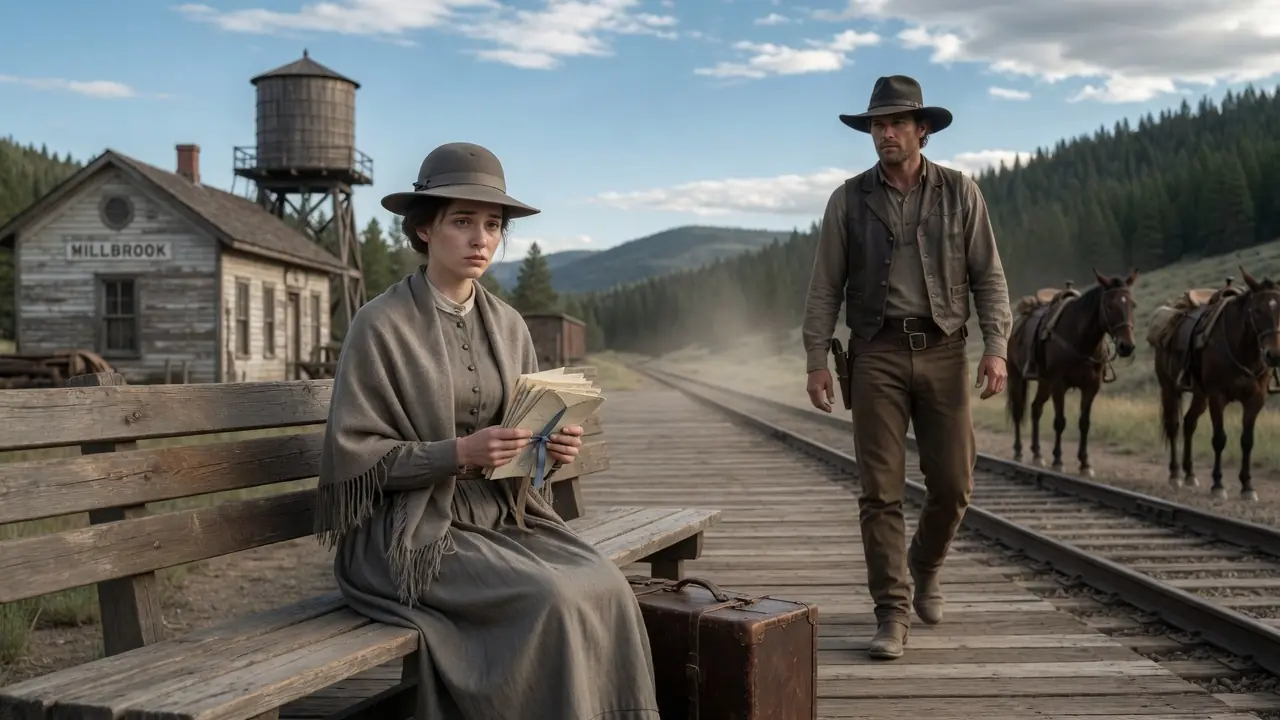
She stepped down onto the wooden platform.
The first thing she noticed was the air.
It was thin and cool, smelling of dust, pine, and distance. The second thing she noticed was the silence.
There were no crowds.
No waiting families.
No ranch hands leaning against posts.
Only a small station house, a water tower, one wooden bench, and mountains watching from far off like judges.
Charlotte stood still as the train groaned behind her. Steam rolled past her skirt. A porter set her trunk on the platform, tipped his cap, and climbed back aboard.
Then the train pulled away.
Its whistle cried once across the empty land.
Then even that sound vanished.
Charlotte was alone.
He was late.
That was all.
A thousand things could delay a man on a ranch. A horse could throw a shoe. A fence could break. A cow could calve badly. A creek crossing could flood. A wagon wheel could split.
She sat on the bench with her hands folded in her lap and composed herself to wait.
She was good at waiting.
Her whole life, in one way or another, had been waiting. Waiting for money to stretch. Waiting for illness to pass. Waiting for grief to grow less sharp. Waiting for someone to look at her and see more than a quiet girl with no family and no prospects.
The afternoon faded.
The sun lowered behind the mountain ridge, and the warmth left with it. Shadows lengthened across the platform. The station agent, an older man with tired eyes and a bent back, came out of the station house and looked at her once.
“Waiting on someone, miss?”
“Yes,” Charlotte said.
He nodded in a way that told her people waited for people often enough in Millbrook, and sometimes those people came.
Sometimes they did not.
Another hour passed.
The first star appeared.
The station agent finally locked the door, tipped his hat, and walked down the road toward the faint lights of town.
He did not ask again.
That kindness nearly broke her.
He was not coming.
The realization did not crash into her. It sank. Quiet and heavy. It settled in her stomach like a stone dropped into deep water.
Daniel Whitcomb was not coming.
Charlotte sat on the platform with her shawl pulled tight around her shoulders, staring at the dark road. The letters in her reticule no longer felt like bricks in a foundation. They felt like stones in a grave.
Six months of words.
Six months of hope.
Six months of lies.
She did not cry.
Not because she was not hurt.
Because tears seemed too expensive now.
She had spent everything to come here.
The sound of hooves came out of the dark.
Slow.
Steady.
Charlotte stiffened.
A rider appeared along the road, leading a pack mule loaded with supplies. He drew near the station, then stopped when he saw her.
For a moment, neither of them moved.
The rider sat tall in the saddle, broad-shouldered and still. His hat brim shadowed his face, but she could feel his attention. Not the rude stare of a man looking over a woman’s figure. Not the hungry glance she had learned to avoid in Lowell.
Just attention.
Measured.
Careful.
Then he dismounted.
His boots hit the dirt with a soft, solid sound. He walked toward her without hurry.
When he came into the lantern light still burning near the platform, she saw that he was perhaps thirty-five or thirty-six, with a weathered face, dark blond hair at his collar, and eyes the color of storm clouds seen from far away. He was not handsome in any polished way. He looked carved by work and weather.
“Ma’am,” he said.
His voice was low and rough, but not unkind.
“The last train’s gone.”
Charlotte’s hands tightened around her reticule.
“I know.”
He looked at her trunk. Then at the empty road. Then back at her face.
He did not ask who had failed her.
He did not ask whether she had been foolish.
He seemed to understand that some questions were knives, even when spoken gently.
“Town is a fair walk from here,” he said. “Road’s safe enough, but not a pleasant thing after dark.”
Charlotte swallowed.
“I was told someone would meet me.”
“I figured.”
The words held no judgment.
Only fact.
She looked away.
“He did not.”
The man nodded once.
“There’s a boarding house in town. Mrs. Gable runs it. Clean rooms. No nonsense.”
Charlotte looked toward the road. The town lights seemed very far away.
“My name is Nathaniel Cross,” he said. “I can take your trunk on the mule. I can walk you there.”
“I have very little money.”
“I did not ask.”
She looked up at him then.
He held her gaze for one second, then turned away and lifted her trunk as if it weighed nothing. He secured it on the mule with practiced hands, then took the reins.
He did not offer her his arm.
He simply started walking slowly enough that she could follow.
That, more than anything, made her trust him.
They walked in silence.
The night widened around them. The stars seemed impossibly bright. Somewhere in the distance, a coyote called, and Charlotte’s heart jumped.
Nathaniel did not look back at her fear.
He only said, “That sound carries farther than the animal. He is not near.”
She nodded, embarrassed by how much the simple explanation steadied her.
Millbrook was smaller than she expected. A general store. A saloon spilling piano music and laughter into the street. A smithy. A church. A few scattered houses with lamps glowing in the windows.
The boarding house stood near the end of the main road. It was a plain two-story building with a neat porch, white curtains, and a sign that read:
GABLE’S ROOMS FOR TRAVELERS
Nathaniel stopped at the gate.
The door opened before he knocked.
A stout woman in her fifties stood there, wiping her hands on an apron. Her gray hair was pinned tightly, and her eyes were sharp enough to cut thread.
“Nathaniel Cross,” she said. “Thought you were not due in town till next month.”
“Plans changed.”
Her eyes moved to Charlotte.
Nathaniel set the trunk on the porch.
“This lady needs a room.”
Mrs. Gable’s expression shifted. Not much, but enough. She saw the traveling dress. The pale face. The tight hands. The single trunk. A woman like Mrs. Gable needed only a few facts to understand the rest.
“Come in, dear,” she said. “You look all done in.”
Charlotte turned to Nathaniel.
“Thank you, Mr. Cross. I am in your debt.”
“No.”
He looked uncomfortable with the words.
“You are at Mrs. Gable’s.”
Then he said to the older woman, “Put her first week on my account.”
Charlotte opened her mouth.
He was already stepping away.
“Mr. Cross, I cannot—”
“You can sleep,” he said.
Then he mounted his horse, took the mule’s lead, and rode back into the dark.
Charlotte stood on the porch, watching him disappear.
Mrs. Gable touched her shoulder.
“Come in, child. The night has done enough.”
The room Mrs. Gable gave her was small but clean. A narrow bed, a patchwork quilt, a washstand, and one window looking over the quiet street.
Charlotte sat on the edge of the bed.
For a while, she did nothing.
Then she opened her reticule and pulled out Daniel Whitcomb’s letters.
She untied the blue ribbon.
One by one, she read them again.
Not because she believed them.
Because she needed to understand how a lie could sound so much like truth.
When she reached the line about the east-facing kitchen window, the tears finally came.
Hot.
Silent.
Humiliating.
She cried for the woman she had been on the train, holding those letters like a promise. She cried for the foolish hope of morning sun on bread. She cried for the little life she had imagined so clearly that its loss felt like death.
Then she wiped her face, tied the letters together again, and placed them at the bottom of her trunk.
The next morning, Mrs. Gable made coffee strong enough to put courage back into a person’s bones.
Charlotte came downstairs early, wearing a plain brown dress and the careful expression of someone determined not to be pitied.
Mrs. Gable said nothing about tears.
She put a plate of eggs in front of Charlotte and asked, “Can you mend?”
“Yes.”
“Can you keep accounts?”
“Yes.”
“Good. You can help me after breakfast.”
That was how Charlotte survived the first week.
Mrs. Gable was not merely the boarding house owner. She also served as Millbrook’s postmistress, which meant every letter, parcel, rumor, quarrel, apology, and piece of news passed through her hands sooner or later.
Charlotte helped sort mail, mend linens, copy invoices, and balance the boarding house accounts in the evenings. The work was simple, but it steadied her. Numbers were honest. Columns either balanced or they did not. Ink stayed where she put it.
No number had ever promised her an east-facing window and failed to meet a train.
She saw Nathaniel Cross only once that week.
He rode into town for supplies, tied his horse outside the general store, and carried two sacks of flour out over one shoulder. He did not look toward the boarding house. He did not seek thanks. He seemed to belong entirely to himself.
Charlotte watched from behind her curtain.
He moved like a man who had learned not to need much from the world.
On the seventh morning, Mrs. Gable knocked on Charlotte’s door.
“Mr. Cross is downstairs.”
Charlotte stood quickly.
“Has something happened?”
“That depends on what you call happening.”
Mrs. Gable’s mouth twitched, though her eyes remained serious.
“He is asking for you.”
Charlotte followed her downstairs into the small parlor.
Nathaniel Cross stood near the window with his hat in his hands. In daylight, he looked even more solid than he had that first night. His shirt was clean but worn at the cuffs. His boots were dusty. His face looked as though smiling was something it had once known but had not practiced lately.
“Miss Reyes,” he said.
“Mr. Cross.”
He glanced once at Mrs. Gable, who did not leave. That seemed to suit him fine.
“Mrs. Gable says you have a fine hand with numbers.”
Charlotte looked at the older woman, who lifted one brow as if to say, Do not pretend otherwise.
“I am competent,” Charlotte said.
“I am not.”
The blunt confession surprised her.
Nathaniel looked down at his hat.
“I can run cattle, mend fence, pull a calf, break a horse, and read weather better than most men. But my books are a disgrace. Have been since my father died.”
He looked back at her.
“I need someone to sort them. Receipts, accounts, sales, purchases. Three years of it, maybe more. I will pay a fair wage.”
Charlotte’s heart began to move faster.
“You are offering me work?”
“I am asking for help,” he said. “There is a difference, but both are true.”
Mrs. Gable folded her arms, watching both of them.
Nathaniel continued, “You can stay boarded here with Mrs. Gable, if she agrees. I will cover that and pay wages besides. My ranch is five miles out. I can drive you in the mornings and back at dusk until you are comfortable with the road.”
Charlotte could hardly speak.
A week ago, she had arrived in Millbrook expecting to become a wife.
Now this quiet rancher was offering her something far more precious.
A way not to disappear.
“Yes,” she said. “I will do it.”
Nathaniel nodded as if the matter were settled.
Mrs. Gable sniffed.
“Good. Maybe now those poor ledgers will stop looking like a wolf chewed them.”
Nathaniel said nothing, but color rose faintly up his neck.
The Cross ranch lay in a valley west of town, where a narrow creek ran through cottonwoods and the mountains stood watch beyond the pasture.
Charlotte saw the creek first.
Clear and cold.
Running exactly as Daniel Whitcomb’s letters had promised.
The irony twisted sharply inside her.
Nathaniel’s house was simple and sturdy, built of hewn logs with a wide porch facing the valley. It was clean in the way a man’s house is clean when he does not make messes but has forgotten softness. No curtains. No flowers. No extra chair by the stove. No little unnecessary things that make a place feel inhabited by the heart.
He showed her to a small room off the back of the house.
It had once been used for storage. Saddles, rope, old ledgers, crates, a dusty desk under a window. Nathaniel had cleared a path but not much else.
“It is not fit for company,” he said.
“I am not company,” Charlotte answered. “I am here to work.”
He looked at her.
Then nodded.
The ledgers were worse than he had warned.
Receipts were stuffed between pages. Figures ran into margins. Months were missing. Cattle sales were recorded on scraps of paper, feed purchases on the backs of envelopes, and one entire year’s expenses had been shoved into a cigar box.
For the first time since stepping off the train, Charlotte forgot to be ashamed.
She rolled up her sleeves.
By noon, she had made four piles.
By dusk, she had made a list.
Nathaniel came to the doorway as she was wiping ink from her fingers.
“Well?” he asked.
“It is not hopeless.”
His eyes flickered with something almost like relief.
“That bad?”
“Worse.”
For the first time, she saw the corner of his mouth move.
Not quite a smile.
But near enough.
Each morning after that, Charlotte came to the ranch just after sunrise.
At first, Nathaniel drove her in the wagon. After two weeks, she insisted she could walk when the weather was fair. He objected once. She looked at him over the top of her spectacles until he stopped.
On the third morning, she arrived to find a tin cup of coffee on the corner of her desk.
Hot.
Black.
No sugar.
Nathaniel was nowhere in sight.
She drank it slowly.
The next morning, it was there again.
And the next.
Neither of them mentioned it.
The coffee became part of the work, as steady as the scratch of her pen and the sound of Nathaniel’s boots on the porch when he came in for water.
He was a man of few words, but Charlotte began to learn his language.
A repaired step before she stumbled on it twice.
A fresh bottle of ink set beside her desk when hers ran low.
A hook installed near the door after she once hung her shawl over a chair.
A lantern trimmed and waiting when the days began to shorten.
No speeches.
No flourished promises.
Only care made visible by hands.
In return, Charlotte brought order.
She sorted three years of accounts into neat columns. She discovered two unpaid debts owed to Nathaniel by cattle buyers who had taken advantage of his poor record-keeping. She found he had been overcharged twice for feed. She wrote letters on his behalf, polite but firm, and money began coming back to him.
The ranch changed by inches.
So did the house.
Charlotte mended curtains she found folded in a chest and hung them. She organized the pantry. She baked bread once, using Mrs. Gable’s starter and flour from Nathaniel’s own supplies.
When Nathaniel came in that evening, he stopped in the kitchen doorway.
The smell filled the room.
Bread.
Butter.
Coffee.
Something in his face changed so suddenly that Charlotte looked away, as if she had seen grief unclothed.
“My mother used to bake on Fridays,” he said.
Charlotte said softly, “Then perhaps Fridays should have bread again.”
He stood there a moment longer.
“Yes,” he said. “Perhaps they should.”
In late August, after nearly two months of work, Charlotte finished the ledgers.
She carried the balanced books to Nathaniel on the porch at sunset. He had been mending a bridle, but set it aside when she approached.
“It is done,” she said.
He took the ledger carefully.
“All of it?”
“All of it.”
He opened the book, staring not at the numbers first, but at the neatness. The straight columns. The careful notes. The restored shape of his own affairs.
“I don’t know how to thank you,” he said.
“You paid me.”
“That is not the same.”
“No,” she admitted. “It is not.”
The silence that followed was different from the ones before.
The reason for her presence at the ranch had ended.
They both knew it.
Nathaniel closed the ledger.
“There are other things,” he said.
Charlotte looked at him.
“Other things?”
“The pantry.”
“I already organized the pantry.”
“The mending.”
“I am nearly done with that too.”
“The house could use…” He stopped, clearly aware that he was reaching.
Charlotte’s heart softened.
“Curtains in the front room,” she said.
His eyes lifted.
“Yes. Curtains.”
“And the storeroom shelves are poorly arranged.”
“They are.”
“And your correspondence with the feed supplier is still a mess.”
“Terrible mess.”
She looked toward the valley.
“I suppose I could stay a little longer.”
Nathaniel looked at the ledger in his hands.
“I would be grateful.”
It was not the word he meant.
She knew it.
So did he.
Autumn crept toward Millbrook.
The cottonwoods along the creek began to turn yellow. The mornings grew colder. Charlotte’s work at the ranch became less defined and more necessary.
She still kept the accounts, but she also cooked the evening meal. She mended shirts. She helped bottle fruit from Mrs. Gable’s garden. She brought a small pot of red geraniums from town and set it on Nathaniel’s porch.
He stared at it for a full minute the first time he saw it.
Then said nothing.
The next morning, Charlotte found the soil damp.
He had watered it.
She smiled all the way to her desk.
The ghost of Daniel Whitcomb faded.
Not entirely.
Some humiliations leave marks even after the pain thins.
But Charlotte no longer touched the letters in her trunk. She no longer wondered why he had not come. His absence had become less important than Nathaniel’s steady presence.
Then, one afternoon in September, the ghost returned wearing a name.
Charlotte was in Mrs. Gable’s parlor, helping sort mail, when the older woman lifted a letter and frowned.
“Sweetwater County,” Mrs. Gable murmured. “That’s far enough.”
She turned the envelope.
“Martha Whitcomb.”
Charlotte’s fingers went cold.
Mrs. Gable did not notice at first.
“That will be from her husband Daniel, I expect. He works railroad contracts out that way. Sends letters regular as clockwork. Funny thing, I have only heard that surname once before—”
She stopped.
Charlotte had gone white.
Mrs. Gable’s sharp face softened.
“Oh, child.”
Charlotte could not move.
Daniel Whitcomb.
A wife in Sweetwater County.
A real wife.
A real life.
The letters had not been written by a lonely rancher seeking a partner. They had been written by a married man amusing himself with a desperate woman’s hope.
The shame rose first.
Then something better.
Anger.
Clean.
Cold.
Clarifying.
Charlotte walked back to the ranch without feeling the road beneath her feet.
She found Nathaniel by the corral repairing a loose rail. He looked up, hammer in hand, and immediately set it down.
“What happened?”
She told him everything.
Not just what Mrs. Gable had said. All of it. The advertisement. The letters. The promise of the east-facing window. The train platform. The empty station. The humiliation she had carried like a stone in her pocket.
Nathaniel listened without interruption.
When she finished, his jaw was tight.
“That man committed fraud.”
“Yes.”
“We can write the sheriff in Sweetwater. Or the railroad company. Or his wife.”
Charlotte looked toward the creek.
For a moment, the idea tempted her. To expose him. To make him answer. To make someone else feel the shame he had placed on her.
Then she imagined the whispers.
The story spreading from town to town.
The foolish mail-order bride.
The woman who came west chasing a married man’s letters.
She closed her eyes.
“No.”
Nathaniel’s face hardened.
“He should be held to account.”
“He should,” she said. “But I do not want my life tied to his punishment.”
He studied her.
Charlotte’s voice steadied.
“I came here because of a lie. But not everything that came after was false.”
Nathaniel’s expression changed.
“I have work now. Friends. A place where I am useful. I will not hand him the power to turn this life into nothing but a story about what he did to me.”
Nathaniel looked at her for a long time.
Then he nodded.
Not because he agreed easily.
Because he respected her choice.
That evening, they sat on the porch as the first stars appeared.
The silence between them was full, not empty.
Charlotte felt something coming before he spoke.
“Charlotte.”
She turned.
Nathaniel sat with his elbows on his knees, hands clasped, looking out toward the dark valley.
“This house was quiet before you came.”
She waited.
“I thought I preferred it that way.”
A faint breeze moved through the geranium leaves.
“I was wrong.”
Her heart began to pound.
He looked at her then.
“I am not a man who writes pretty letters. I cannot promise you a life without hardship. This ranch is work. I am slow to speak and slower to understand some things I should have seen sooner.”
His voice grew rough.
“But I see you.”
Charlotte’s breath caught.
“I see your courage. Your good sense. The way you put broken things into order without making a show of it. I see how this house feels different because you are in it. Better.”
He stood, then seemed unsure what to do with his hands.
“You have no reason to stay now. The books are done. The pantry is sorted. The curtains are hung. The mending is nearly finished.”
A small smile touched her mouth through the tears gathering in her eyes.
“I could find more mending.”
“I hope you will not need excuses.”
He stepped closer.
“I would like you to stay as my wife. Not because you were left behind. Not because you need shelter. Not because I paid for a week at Mrs. Gable’s and feel responsible.”
He took a breath.
“Because I love you, Charlotte Reyes. Quietly, perhaps. Poorly said, certainly. But truly.”
The world seemed to narrow to the porch, the stars, and the man standing before her with no poetry but more truth than all the letters in her trunk.
Charlotte thought of Daniel’s east-facing window.
Then she thought of the coffee on her desk. The ink bottle. The repaired step. The watered geranium. The way Nathaniel listened when she spoke. The way he had offered justice, then honored her when she chose peace.
“Yes,” she whispered.
Nathaniel stared as if he had not heard.
Charlotte stepped closer.
“Yes, Nathaniel Cross. I will marry you.”
For the first time since she had known him, Nathaniel smiled fully.
It changed his whole face.
It made him look younger.
It made him look like a man coming home to himself.
They were married two months later in the small church in Millbrook.
Mrs. Gable stood beside Charlotte and cried openly, though she denied it afterward. Nathaniel wore his best suit and looked both terrified and certain. Charlotte wore a blue dress she had sewn herself, simple and clean and entirely her own.
The whole town came.
Not for gossip this time.
For joy.
After the ceremony, Nathaniel took her home in the wagon. The mountains stood blue against the horizon, the creek flashed silver through the cottonwoods, and smoke rose from the chimney of the house that no longer felt empty.
That evening, Charlotte stood in the kitchen.
The window faced east.
Of course it did.
She had not noticed at first. Not truly.
The next morning, sunlight poured through it and fell across the table where bread dough rested beneath a cloth. Charlotte stood in that light for a long moment, her hands dusted with flour, and began to laugh softly.
Nathaniel came in from the yard.
“What is it?”
She shook her head.
“Nothing.”
He looked at the window, then at the bread, then at her face.
Understanding came slowly, but it came.
“The morning sun,” he said.
Charlotte smiled.
“Yes.”
His face grew solemn.
“I am sorry another man lied to you about it.”
She reached for his hand.
“I am not.”
Nathaniel frowned.
“You are not?”
“No,” she said. “Because the lie brought me to the truth.”
Years passed.
The Cross ranch prospered, not quickly, but steadily, the way honest things do. Charlotte kept the books, and Nathaniel never again lost a receipt. They expanded the herd, repaired the barn, added two rooms to the house, and planted lilacs along the porch because Charlotte said every home needed something that bloomed for no reason but beauty.
Children came too.
First Benjamin, loud and fearless.
Then Clara, serious-eyed and watchful like her father.
Then little Rose, who laughed at everything and chased chickens as if they owed her money.
The house filled with noise.
Boots by the door.
Bread on the table.
Ink stains on Charlotte’s fingers.
Woodsmoke in Nathaniel’s coat.
Every morning, light poured through the east-facing kitchen window.
Five years after she arrived in Millbrook, Charlotte sat on the porch at sunset, mending one of Benjamin’s shirts while Clara arranged pebbles in a careful line at her feet. Nathaniel came from the pasture, tired and dusty, and sank into the chair beside her.
Benjamin rounded the corner chasing a hen with a stick.
“I’m going to catch her!”
“Benjamin Cross,” Nathaniel called, amusement low in his voice. “That hen has more sense than you. Leave her be.”
The boy stopped, grinned, dropped the stick, and ran to lean against his father’s knee. Nathaniel rested one broad hand on his son’s head.
Charlotte watched them.
Her husband.
Her children.
Her porch.
Her home.
The life she had once crossed the country trying to find had not been waiting with Daniel Whitcomb at the station.
It had ridden out of the dark on a tired horse, carrying supplies, asking no cruel questions, and walking beside her when she had nowhere to go.
Nathaniel reached over and tucked a loose strand of hair behind her ear.
“You are quiet,” he said.
“I am thinking.”
“Dangerous.”
She smiled.
“I was thinking about the day I arrived.”
His hand stilled.
“I remember.”
“So do I.”
“You looked like you might shatter if anyone spoke too sharply.”
“I felt that way.”
“You did not shatter.”
“No,” she said softly. “I suppose I did not.”
The last light faded over the valley.
Behind them, the house glowed bright through the windows. Inside, bread cooled on the table. A pot of stew waited on the stove. The rooms were full of life, full of proof that promises did not need pretty ink to be real.
Nathaniel took her hand.
“I am glad he did not come,” he said quietly.
Charlotte looked at him, surprised.
Then she followed his gaze toward the road that led to Millbrook station.
After a moment, she squeezed his hand.
“So am I.”
Because some abandonments are not endings.
Some are deliverance in disguise.
And sometimes the man who fails to meet you at the station only clears the road for the one who will walk you home.