The moment she walked into the Grand Oak Hotel, no one offered to help her with her bag.
She wasn’t greeted. No one behind the glossy mahogany front desk made eye contact.
At first, she thought they were simply busy, but as seconds turned into minutes, it became clear that they saw her. They just didn’t truly see her.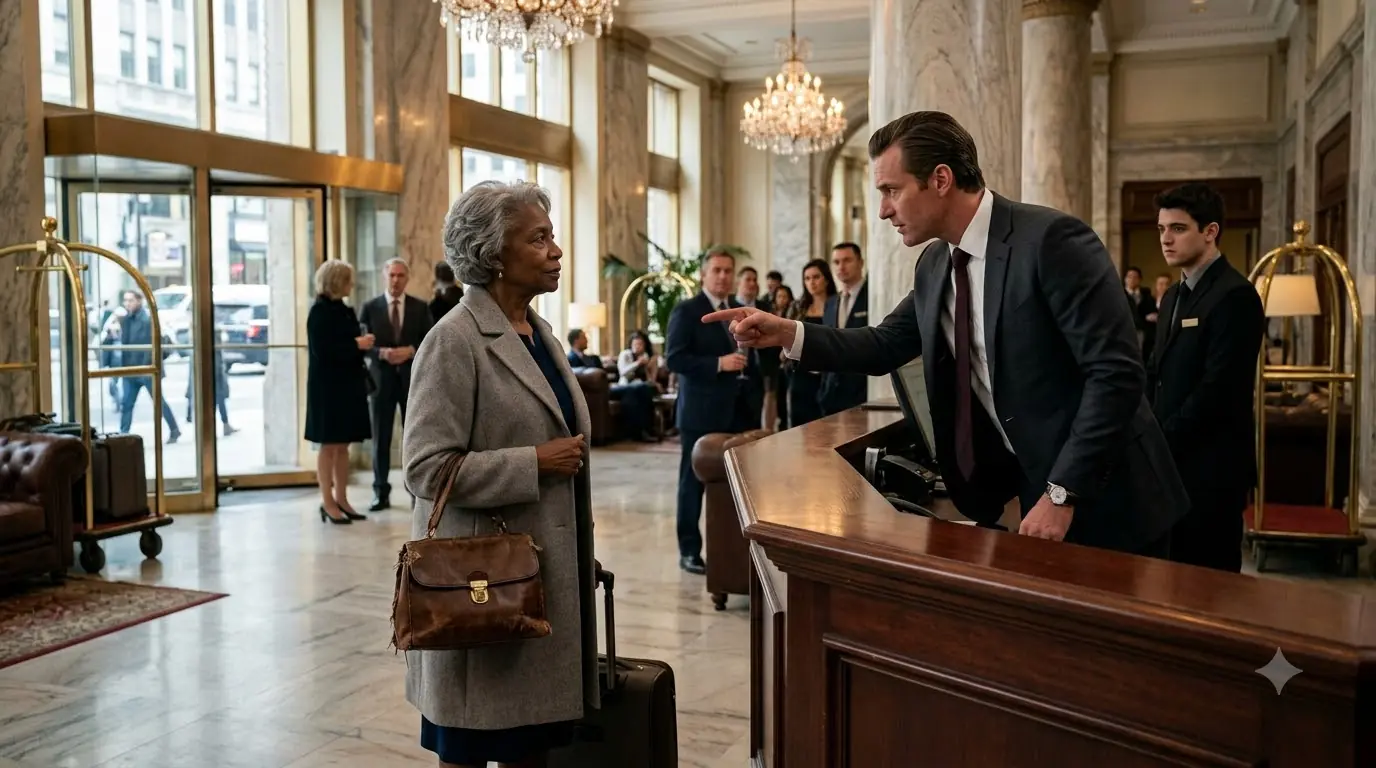
Estelle Morris was in her seventies. She wore a soft gray coat, and her shoes were simple but clean. Her handbag was old and worn at the seams, its gold clasp scratched from decades of use. To the hotel staff, she looked like someone who had wandered in from the wrong part of town.
At least, that was what they assumed.
“Excuse me,” Estelle said softly as she stepped toward the counter.
The young man behind the desk, no older than twenty-five, did not even hide his annoyance. He turned slowly and raised his eyebrows as though she had interrupted something important.
“Yes? Can I help you?”
“I have a reservation,” Estelle said calmly. “It’s under Morris. Estelle Morris.”
He tilted his head, clearly not expecting that. Then he tapped at the keyboard for a moment before frowning.
“I’m sorry. There’s nothing under that name.”
“I called last week,” Estelle said gently. “I was told the room would be set aside.”
He sighed.
“Do you have a confirmation number?”
“I wasn’t given one.”
He did not hide the smirk.
“Right. Well, without a confirmation number, there’s nothing I can do.”
Estelle nodded slightly.
“Could you check again, please? This hotel has always kept a suite for me this time of year.”
The young man scoffed under his breath but typed again. After a few seconds, he shook his head.
“Nope. Like I said, nothing. And we’re fully booked for the weekend.”
He leaned slightly against the counter.
“There’s a budget motel a few blocks east. Might be a better fit.”
Estelle blinked.
Her expression remained unchanged.
“A better fit?”
“Yeah,” he said, gesturing vaguely toward her coat. “This isn’t exactly casual. Most of our clientele are here for weddings, conferences, upscale events.”
“I see.”
Estelle did not argue.
She did not raise her voice.
She simply stepped away from the counter, reached into her handbag for her phone, and made a quiet call.
No one noticed.
No one cared.
From across the lobby, a man appeared wearing a sharp suit, his hair slicked back, a Bluetooth headset tucked into one ear. His name tag read:
DEREK LANCASTER
GENERAL MANAGER
He glanced toward the front desk and then noticed Estelle standing nearby.
“I’m sorry, ma’am,” he said, walking briskly toward her. “Can I ask you to step outside? We’re quite busy at the moment, and you seem to be lost.”
“Lost?” Estelle asked, raising one eyebrow.
“This isn’t a public gathering space,” Derek said, lowering his voice. “Our guests value privacy. We can’t have people hanging around.”
“I’m not hanging around,” Estelle replied.
Her voice was low.
Steady.
“Well, with all due respect, unless you’re a guest or you have a meeting here, I’m going to need to ask you to leave.”
There was no embarrassment in Estelle’s eyes.
Only clarity.
“I have business here.”
“Doing what?” Derek snapped. “Selling something?”
At that exact moment, a younger woman in a tailored suit hurried into the lobby.
Her eyes scanned the room until she spotted Estelle.
Then she rushed toward her, breathless.
“Mrs. Morris, I’m so sorry I’m late. Traffic was awful.”
Derek’s expression changed instantly.
“Wait.”
He looked from the woman to Estelle.
“You know her?”
The woman, clearly one of the hotel’s senior executives, nodded.
Derek frowned.
“Walkthrough of what?”
The woman turned toward him.
Her expression became cold.
“Of her property.”
Derek blinked.
“I’m sorry. What?”
The executive stared at him in disbelief.
“Estelle Morris. She co-founded this hotel. Her name used to be on the wall plaque in the East Wing before the remodeling.”
Derek’s jaw tightened.
Estelle turned toward him.
She remained as calm as she had been from the moment she entered.
“You were saying something about people like me not belonging here.”
Derek stammered.
“I… I didn’t know. No one told me.”
“You didn’t ask.”
The lobby fell silent.
Several guests had begun paying attention to the exchange. Nearby employees paused, pretending to arrange brochures or straighten furniture while listening to every word.
Estelle slowly looked around.
“It seems this place has forgotten its roots.”
Then she turned toward the young front desk clerk.
“Did you know this hotel was built with the goal of treating everyone with dignity?”
He said nothing.
“That was our mission from the first day.”
Derek tried to recover.
“Mrs. Morris, please allow us to make this right.”
Estelle raised one hand.
“You can’t fix what you refuse to see.”
Then she turned and walked toward the elevators with the young executive beside her.
The guests watched in stunned silence.
The woman they had ignored, dismissed, and spoken over was not a wanderer, a charity case, or somebody who had accidentally entered the wrong building.
She was one of the people who had built the foundation beneath their feet.
Estelle never needed to scream to be heard.
She only needed the truth.
And the truth had arrived right on time.
The elevator doors closed slowly behind Estelle and the executive. The muted click of metal echoed through the silence that had settled over the Grand Oak Hotel’s marble lobby.
Nobody spoke.
Not Derek.
Not the employees behind the front desk.
Not the guests standing with half-empty coffee cups and unfinished conversations.
Everyone had seen enough to understand the same thing.
They had judged a woman they did not know but somehow believed they understood.
Upstairs, Estelle moved along the sixth-floor hallway at a measured pace.
Beside her walked Clarissa, the executive who had arrived just in time to stop the situation downstairs from becoming even worse.
Clarissa carried a clipboard and a digital tablet.
She also carried guilt.
She had known Estelle for years. Once every year, without fail, for more than a decade, Estelle had returned to the Grand Oak for the same quiet walkthrough.
This time, Clarissa had failed to confirm her arrival.
She assumed Estelle might skip the visit.
Maybe she was getting too old.
Maybe the tradition would simply fade away.
Clarissa had not called to check.
That was her first mistake.
“I should have met you at the entrance,” Clarissa said quietly as they approached Suite 602.
It was the original founder’s suite, though it had since been renovated and renamed under new corporate branding.
“I didn’t think… I didn’t imagine anyone would treat you that way.”
Estelle stopped outside the door.
“You didn’t imagine it because you didn’t expect it could happen.”
Clarissa lowered her gaze.
“But it did.”
Estelle looked at the room key.
“Open the door.”
Inside, the suite had changed dramatically since Estelle’s previous visit.
Gone were the subtle floral tones she had personally chosen with Walter thirty-five years earlier. Gone were the antique lamps, the original hardwood furnishings, and the velvet armchairs that once reminded her of her grandmother’s parlor.
The room was now decorated in grayscale minimalism.
Sleek.
Expensive.
Cold.
It looked like a luxury magazine photograph.
But it did not feel like a story.
“It’s beautiful,” Clarissa said hesitantly.
“It’s hollow,” Estelle replied.
She walked toward the window and looked out over the city skyline.
It was a city she and Walter had once helped change, not because they began with great wealth, but because they began with a vision.
“This used to feel like home,” Estelle said.
Her eyes remained on the skyline.
“Now it feels like I need a password just to be seen.”
Downstairs, Derek Lancaster was no longer speaking.
He sat alone inside his office with the door closed, his hands clasped together and his elbows resting on the polished desk.
The desk suddenly felt less like a place of authority and more like a witness stand.
Outside the office, the young front desk agent who had dismissed Estelle stood uncertainly in the hallway.
His name was Nathan.
He kept touching the edge of his name tag, unsure whether he should knock or wait to be summoned.
Derek had already received a call from corporate.
Word had traveled much faster than he expected.
Apparently, one of the guests in the lobby had recognized Estelle’s name and posted a brief recording of the encounter.
The clip lasted less than fifteen seconds.
But it captured enough.
Most importantly, it captured Derek saying:
“We don’t allow people like you to linger here.”
People like you.
That was the phrase that would not leave him alone.
Not simply because of how ugly it sounded when played back.
But because it was exactly what he had meant.
He had not known who Estelle was.
But he had decided what she was.
Derek’s phone buzzed.
A message from the regional director appeared.
She’s not asking for press. But the board wants a written statement by tomorrow. And you better be honest.
Derek leaned back in his chair.
For the first time in his career, the office around him felt too large.
Upstairs, Estelle sat on the edge of the bed in Suite 602.
She was not angry in the way most people understood anger.
Her anger had always been quieter.
It did not explode.
It settled into her bones and made her back a little straighter.
She was not going to demand public apologies.
She was not going to threaten lawsuits.
She was not going to call reporters.
That was never her style.
What Estelle wanted was for the hotel to see itself.
And for the moment, she was giving it that opportunity.
Clarissa sat in a nearby chair.
Neither woman spoke for several minutes.
Eventually, Estelle broke the silence.
“I remember opening day.”
Her voice became distant.
“Walter was so proud. He wore a three-piece suit in the middle of August and shook the hand of every person who walked through those doors.”
Clarissa smiled faintly.
“One woman came in wearing overalls and muddy boots,” Estelle continued. “Do you know what he said to her?”
Clarissa shook her head.
“He said, ‘Welcome to the Grand Oak. You look like you’ve had a hard day. Let us make it easier.’”
Clarissa’s smile deepened.
“That sounds like Walter.”
“He believed the way you treat people who don’t look like they belong tells the truth about you. Anybody can be gracious to people they think are important.”
Estelle turned toward Clarissa.
“Does this place still believe that?”
Clarissa opened her mouth.
Nothing came out.
The silence became the answer.
Back downstairs, guests eventually resumed their conversations, but something remained unsettled in the air.
Nathan took an early break.
When he returned, he stood behind the front desk for several minutes without speaking.
Finally, he looked at the woman working beside him.
“Did you know who she was?”
“No,” his coworker replied.
She looked down at the keyboard.
“But it shouldn’t have mattered.”
That was the real moment.
Not the revelation that Estelle had founded the hotel.
Not Clarissa arriving in the lobby.
Not Derek’s embarrassment.
It was the realization that identity should never have been required for dignity.
They had judged Estelle by her handbag.
By the way her gray coat hung around her shoulders.
By the fact that she entered alone.
By the fact that she did not announce herself loudly enough to command respect.
And because of those assumptions, they had nearly thrown out a woman who helped create the floors beneath them.
A housekeeping supervisor heard what happened and whispered to her staff:
“She was the reason I got this job.”
Another employee looked surprised.
The supervisor nodded.
“Years ago, she used to walk through the hotel asking the cleaning staff how their children were doing. She remembered their names.”
The story began spreading through the Grand Oak before it ever reached the outside world.
Not through press releases.
Not through outrage.
Through guilt.
And memory.
By the next morning, Estelle was gone.
She packed quietly before sunrise.
Before leaving Suite 602, she placed a handwritten note on the nightstand.
Legacy isn’t in the nameplate.
It’s in how people remember being treated here.
E.M.
The morning staff found the note.
Eventually, it reached Clarissa.
She placed it inside an envelope and kept it in her office.
Two days later, Derek Lancaster submitted his resignation.
The hotel did not release a public statement about Estelle.
She did not request one.
She did not need to win in the public eye.
The point had already been made in the silence that followed her departure.
Weeks later, a small plaque appeared on the wall of the East Wing.
It was restored without ceremony.
It read:
IN HONOR OF ESTELLE MORRIS
FOUNDER
VISIONARY
GUEST
ALWAYS
Beneath it, in smaller letters:
Let no one ever be told they don’t belong again.
The weeks after Estelle’s departure were not marked by chaos.
They were marked by reflection.
There was no major press conference.
No corporate spectacle.
Instead, employees whispered in back hallways.
They spoke over breakroom coffee.
Housekeepers talked while stocking linen carts.
Front desk clerks spoke between arrivals.
The people who had watched Estelle leave the Grand Oak with nothing but her suitcase and her dignity now carried something far heavier.
The weight of realization.
A new assistant manager named James had started only a month before Estelle’s visit.
One afternoon, he sat alone in the employee lounge reading the hotel’s archived website.
The history had always been there.
Three paragraphs explaining how Estelle and her late husband Walter had opened the hotel in the 1980s with a modest inheritance and the dream of creating a place where every person entering the building would feel that they belonged.
James read the final sentence twice.
“We didn’t build it for the elite. We built it for the everyday person who walks in after a hard day needing to feel human again.”
The sentence felt very different now.
On the sixth floor, Maria, one of the housekeeping staff, stopped at the end of the hallway with her mop in hand.
She remembered Estelle from years earlier.
Maria had been new then.
She did not know Estelle was a founder.
She only remembered that Estelle asked about her mother, who had been in the hospital.
They had spoken about it once.
Only once.
The next time Estelle visited, months later, she still remembered.
No one else had.
Now Estelle’s name moved through the hotel like mist.
Some employees said it with respect.
Others could barely say it at all.
Clarissa, haunted by her own failure, decided to begin restoring what had been lost.
She ordered the original brass nameplate that once hung near the East Wing elevators to be remounted.
She found the only candid photograph the hotel still possessed of Estelle and Walter together.
They were sitting in the garden behind the hotel.
Both were smiling in the middle of a laugh.
Paper coffee cups in their hands.
Clarissa had the photograph enlarged and framed.
She did not hide it in an administrative hallway.
She placed it in one of the main guest corridors.
But the most important change did not come from plaques or photographs.
It came through eyes.
Posture.
The way employees began greeting guests.
Not with a memorized corporate script.
With sincerity.
For the first time in years, the Grand Oak seemed to be looking at people again.
Change, however, rarely stays hidden forever.
One afternoon, a travel blogger arrived at the hotel.
She was known for reviewing luxury experiences but always booked secretly so hotels could not prepare special treatment for her.
She arrived late in the day wearing a hoodie and carrying a duffel bag.
Nothing about her appearance suggested a luxury traveler.
That was intentional.
She wanted to see how the Grand Oak treated guests who did not advertise wealth.
What she found surprised her.
A bellhop offered her water before she even checked in.
The concierge asked whether she needed dinner recommendations but did not automatically direct her toward the expensive rooftop restaurant.
At the front desk, Tanya, a recently promoted employee, greeted her warmly.
The following morning, Tanya remembered her name without looking at a computer.
The blogger noticed everything.
She wrote about the service.
She posted the review.
But it was the final paragraph that captured public attention.
“I later learned this hotel was once co-founded by Estelle Morris, who recently returned only to be mistaken for someone who didn’t belong. She didn’t raise her voice. She didn’t storm out. She walked in as the woman who helped build the place and walked out having quietly changed it. That’s what leadership looks like.”
The post spread rapidly.
News outlets began calling.
Some asked for interviews with Estelle.
She declined every request.
She did not want to become a symbol.
She wanted the Grand Oak to become itself again.
Still, the effects spread beyond anything she intended.
Hospitality professionals began discussing the incident in training seminars.
The phrase “She built the place” began circulating online as a way of describing overlooked elders and women whose contributions had been forgotten or underestimated.
People shared stories of their own mothers and grandmothers.
Women dismissed in public.
Women ignored in workplaces.
Women treated as though they did not belong until someone discovered who they were or what they had accomplished.
One comment read:
“My grandmother was the first Black nurse in her county. They once made her wait outside the staff lounge. Now the building bears her name.”
Another read:
“We forget that the people who built the walls often walk them in silence, watching us tear down the values they laid brick by brick.”
Inside the Grand Oak, Clarissa called a staff meeting.
No formal memo.
No executives standing behind podiums.
Just chairs placed in a circle.
Front desk clerks.
Housekeeping supervisors.
Waitstaff.
Kitchen staff.
Bellhops.
Concierge employees.
For some, it was the first time they had ever had a real conversation with people outside their own department.
Clarissa stood in the middle of the circle.
“I know what happened to Mrs. Morris wasn’t all of our doing,” she began. “But what allowed it to happen is our responsibility.”
She looked around the room.
“I failed her because I didn’t make sure people knew who she was.”
Clarissa paused.
“But that is only part of the failure.”
Several employees looked up.
“The larger failure is that anyone here believed they needed to know who she was before treating her with dignity.”
Nobody moved.
“We forgot what this place was built to represent.”
Clarissa pointed toward the framed photograph of Estelle and Walter.
“This isn’t about guilt.”
She paused.
“It’s about memory.”
The room remained silent.
“And memory is how places like this keep from becoming hollow.”
A few employees nodded.
Others looked down at their shoes.
Some simply listened.
But something shifted that afternoon.
After that meeting, the hotel’s training materials were rewritten.
Every employee, regardless of role or seniority, would learn the story of Estelle and Walter Morris during orientation.
The hotel’s official mission statement was updated as well.
One sentence was added:
EVERYONE DESERVES DIGNITY.
Meanwhile, Estelle remained quiet.
Letters began arriving at her home.
Cards.
Flowers.
Small gifts.
She answered almost none of them.
Then, on a rainy afternoon, someone knocked at her door.
Estelle opened it.
Tanya stood outside.
Rain had soaked through her blazer.
In one hand she carried a folder.
In the other, a small bouquet of daisies.
“I’m sorry to show up without calling,” Tanya said, slightly out of breath. “But I needed to see you.”
Estelle looked at her for a moment.
Then stepped aside.
Tanya entered.
They sat by a window while thunder rolled somewhere in the distance.
Tanya placed the folder in Estelle’s hands.
Inside was a copy of the Grand Oak Hotel’s revised employee handbook.
The first page read:
IN HONOR OF ESTELLE MORRIS, WHOSE SILENCE WAS NEVER A WEAKNESS, BUT A MIRROR.
Estelle read the sentence slowly.
“I didn’t ask for this.”
Tanya nodded.
“I know.”
She looked toward the floor.
“But we needed it.”
They remained quiet for a moment.
Then Estelle looked at Tanya.
“You could have looked away like everyone else.”
Tanya swallowed.
“I almost did.”
She admitted it without excuses.
“But watching you stand there… not defending yourself, not begging anyone to believe you, just knowing you were right…”
She shook her head.
“It made me realize silence isn’t always the absence of strength.”
Estelle waited.
“Sometimes it’s the loudest thing in the room.”
A faint smile appeared on Estelle’s face.
“You’re learning.”
Tanya eventually stood to leave.
Before reaching the door, she turned back.
“The hotel feels different now.”
Estelle watched her.
“Not just because there are new rules,” Tanya said. “People are looking each other in the eye again.”
Estelle nodded.
“That’s all Walter and I ever wanted.”
Three months later, the Grand Oak Hotel organized a small private reception in the East Garden.
It was the same garden where the only candid photograph of Estelle and Walter had been taken decades before.
The invitation list was intentionally short.
No media.
No influencers.
No corporate spectacle.
Only hotel employees, their families, and several longtime community members who remembered when the Grand Oak had been nothing more than a dusty construction lot surrounded by warehouses.
Clarissa personally wrote Estelle’s invitation.
She did not know whether Estelle would accept.
They had barely spoken since Tanya’s visit.
The card contained only a few lines:
We’ve made the changes.
But we’d be honored if you would come see them yourself.
Estelle did not respond.
Then, on the morning of the reception, before the sky had fully brightened over the city, a taxi stopped outside the Grand Oak.
Estelle stepped out.
She wore a freshly pressed cream coat.
Her silver hair was wrapped in a silk scarf.
There was no entourage.
No assistant.
No photographer.
Only a leather-bound notebook tucked beneath one arm.
Clarissa spotted her from across the lobby.
She nearly dropped her coffee.
Then she hurried over, breathless just as she had been months earlier.
“You came.”
Estelle smiled.
“You asked.”
Clarissa tried to speak again, but Estelle gently raised one hand.
“I’m not here for a speech.”
Clarissa stopped.
“I just want to see whether the soul came back.”
So they walked.
The first place Estelle visited was not the marble ballroom.
Not the penthouse suite.
Not the luxury restaurant.
She asked to see the staff lounge.
The place where tired housekeepers, bellhops, kitchen workers, and front desk employees sat during short breaks between long shifts.
It had been repainted.
The lighting was softer.
The old furniture, pieces that had looked like leftovers from guest-room renovations, had been replaced with comfortable chairs and tables.
On one wall hung a framed sentence:
EVERYONE DESERVES DIGNITY, FROM THE LOBBY TO THE LOADING DOCK.
Estelle stopped in front of it.
She said nothing.
Later, they returned to the front desk.
Nathan was gone.
He had not been fired.
Two weeks after Estelle’s visit, he resigned.
In his place stood a trainee named Grace.
She was an immigrant mother raising two children.
Estelle watched her greet one guest wearing an expensive tailored suit.
Then another carrying a battered backpack.
Grace’s voice did not change.
Her smile did not change.
Her posture did not change.
She greeted both guests as though each one mattered.
When somebody asked a question, Grace leaned forward.
Not to inspect them.
To listen.
Estelle noticed.
She noticed everything.
Tanya joined them in the lobby and walked with Estelle through the rest of the hotel, explaining the changes that had been made.
She spoke with pride.
But without ego.
She sounded like somebody who had learned that leadership had less to do with titles and more to do with moments.
Eventually Tanya said:
“I want to show you something.”
She led Estelle into the East Wing.
At the far end of the corridor was a small alcove that had been unused for years.
Long ago, it had served as a coat check.
Now it had been transformed.
Two comfortable armchairs.
A shelf filled with poetry and short story collections.
A stained-glass window depicting an oak tree.
Beneath the window sat a plaque.
THE ESTELLE ROOM
FOR THOSE WHO WERE TOLD THEY DIDN’T BELONG AND STAYED ANYWAY.
Estelle slowly reached toward the plaque.
Her fingertips touched her name.
They remained there.
Not because of vanity.
Because of memory.
The name itself did not matter.
What mattered was that the space had become something different.
Not ceremonial.
Quiet.
A place for pause.
For breath.
For restoration.
“You didn’t need to do this,” Estelle said.
Tanya shook her head.
“We did.”
She looked around the alcove.
“We needed something that reminds us every single day to see people.”
Outside, the garden reception had begun.
Children ran between hedges while laughter echoed across the lawn.
Small white lights had been strung through the tree branches.
A jazz trio played quietly near one corner of the garden.
The gathering felt nothing like the corporate galas the Grand Oak had hosted in recent years.
There were no velvet ropes.
No photographers.
No rehearsed networking.
It felt like something Estelle had not felt in this hotel for a very long time.
Human.
As Estelle entered the garden, Clarissa walked toward a microphone.
“Before we close today’s gathering, I want to thank someone who reminded us that legacy isn’t always loud.”
She looked toward Estelle.
“Sometimes it is patient.”
The crowd became quiet.
“And if we are lucky, sometimes it gives us a second chance.”
Clarissa gestured toward her.
Some people applauded.
Others simply stood.
Estelle did not walk to the microphone.
Instead, she slowly moved toward the center of the lawn.
Then she turned toward the employees and their families.
“I won’t give a speech,” she said.
Her voice was soft.
But everyone heard it.
“Because this place was never supposed to be about speeches.”
The garden became completely quiet.
“It was about how we made people feel when they arrived.”
Estelle paused.
“And how they carried that feeling when they left.”
She looked across the faces around her.
Housekeepers.
Managers.
Kitchen workers.
Front desk employees.
Children.
Families.
People who had worked there for twenty years and people who had started only weeks earlier.
“I hope when you leave today, you remember one thing.”
She paused again.
“Buildings are made of stone.”
Her eyes moved toward the hotel.
“But belonging…”
She looked back at them.
“Belonging is made of people.”
That was all.
Estelle smiled.
Then she stepped away.
No spotlight.
No curtain call.
No long declaration.
Only truth.
The kind that settled into a place and remained long after the gathering ended.
That evening, as the sun disappeared behind the skyline, Estelle sat alone inside the quiet alcove that now carried her name.
She opened the leather-bound notebook she had brought with her.
Then she began writing.
Not about herself.
About Grace.
About Tanya.
About Clarissa.
About Maria from housekeeping.
About the people who had taken the lesson she once carried alone and chosen to carry it together.
Estelle did not need to build another hotel.
She did not need another plaque.
She did not need strangers across the country to know her name.
She needed only one thing.
To know that the hotel she and Walter had built had found its way home again.
And now it had.