Elaine Reed had never crossed an ocean.
For most of her sixty-five years, travel had meant city buses, crowded commuter trains, or the aging blue sedan she had driven until the engine finally failed. She had spent her life working as a school cafeteria manager in Baltimore, raising her son alone after her husband died when Marcus was eleven. Every dollar that might have carried her somewhere beautiful had instead paid for uniforms, schoolbooks, rent, or the emergencies that seemed to arrive whenever life became quiet.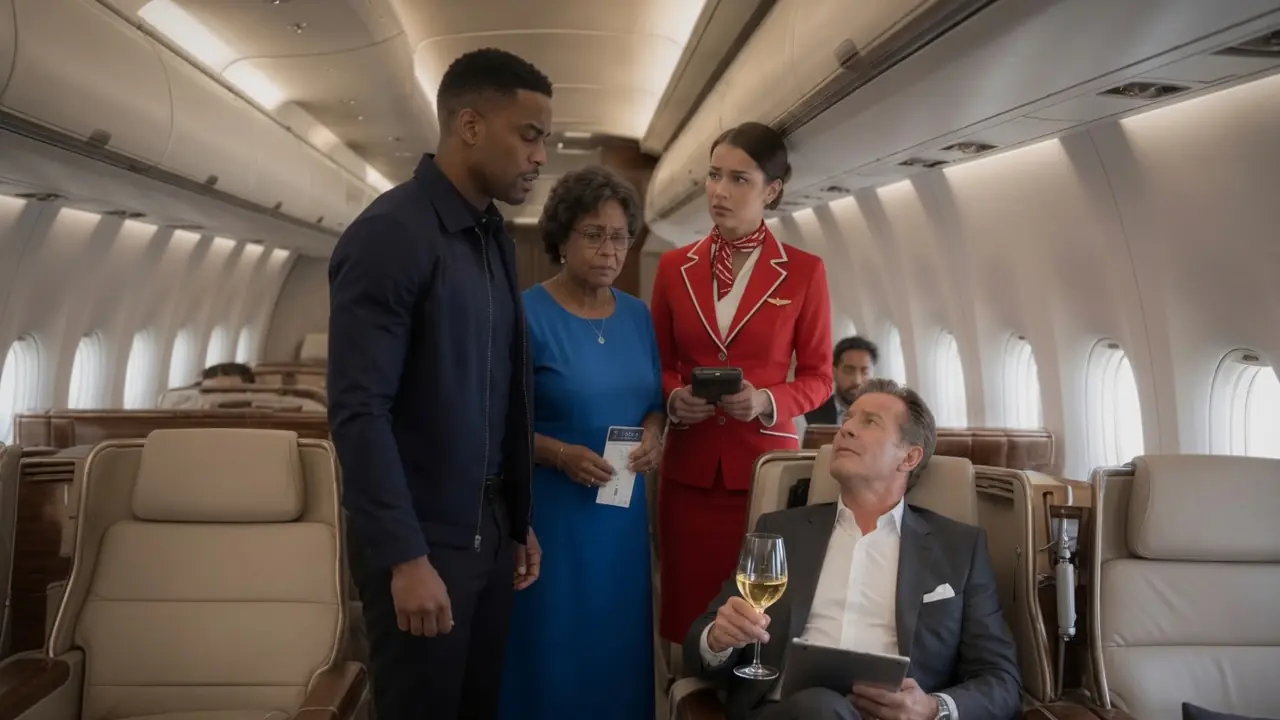
Marcus had never forgotten any of it.
He remembered his mother waking at four-thirty every morning, tying a scarf over her hair, and leaving their apartment before sunrise. He remembered her pretending she had already eaten whenever the groceries ran low. Most clearly, he remembered the old postcard of Paris she kept beside her bed, showing the Seine beneath a violet evening sky.
“When I retire,” Elaine used to say, “I’m going to stand beside that river and see whether it’s really as beautiful as the picture.”
Retirement came, but the trip did not. Elaine’s pension was modest, the roof of her small townhouse needed repairs, and she insisted Paris was too expensive for a woman who had spent her life counting every dollar. Marcus stopped arguing with her and began saving in secret.
He had built a successful cybersecurity firm after years of military service and night classes. The company paid him well, but Elaine still treated every gift as though accepting it might somehow take food from his table. He knew she would refuse the trip if he asked, so he presented it as a completed decision on the morning of her sixty-fifth birthday.
He placed a narrow blue envelope beside her breakfast plate.
Elaine opened it carefully and stared at the two tickets inside. At first, she thought they were brochures. Then she noticed their names, the destination, and the words FIRST CLASS printed across the top.
“Marcus,” she whispered, “what did you do?”
“I kept a promise you made to yourself forty years ago.”
She shook her head before he finished. “This must have cost too much.”
“It cost less than what you gave up for me.”
Elaine pressed the tickets against her chest and began to cry.
Three weeks later, Marcus drove her to Washington Dulles International Airport before dawn. Elaine wore a simple lavender dress beneath a dark blue cardigan, pearl earrings her husband had given her, and comfortable black shoes. Her brown handbag was old but carefully polished, and inside it she carried the Paris postcard that had followed her through six homes.
She seemed almost frightened by the size of the terminal. Marcus stayed close as she watched families hurry toward security, flight crews pull rolling cases, and departure boards change above them. Every few minutes, she touched the passport in her handbag to make certain it had not disappeared.
At the airline lounge, Elaine hesitated outside the glass doors.
“Are you sure we’re allowed in there?” she asked.
Marcus smiled. “Mom, your ticket says first class.”
“That doesn’t always mean people think you belong.”
The comment disturbed him, but Elaine moved forward before he could answer.
Inside, several employees welcomed them politely. Elaine sat beside a window overlooking the runway and drank tea from a white porcelain cup. She watched aircraft lift into the morning sky with the expression of a child witnessing something impossible.
Marcus photographed her but did not post the picture. He wanted the day to belong to her rather than to strangers online. Elaine noticed and told him to stop making her look important.
“You are important,” he said.
“To you.”
“That’s enough.”
Their flight was scheduled to depart at ten-thirty. When boarding began, a gate agent invited first-class passengers forward, and Elaine checked her boarding pass four times as they approached the aircraft. Seat 2A was a window seat she had chosen from the seating chart herself.
“I want to see the clouds,” she had explained.
Marcus’s seat, 2C, was directly across the aisle. He had selected it so Elaine could enjoy the window while still being able to speak to him during the flight. The arrangement had seemed perfect until they entered the cabin.
A man was already sitting in 2A.
He appeared to be in his late fifties, with silver-streaked hair, a dark tailored suit, and a heavy gold watch. His leather briefcase occupied the space beneath Elaine’s seat, while his coat had been placed in the overhead compartment above it. A glass of orange juice rested on the arm beside him.
Elaine checked the number above the row.
“Excuse me,” she said gently. “I believe that is my seat.”
The man did not look up from his tablet. “No, it isn’t.”
Elaine glanced at Marcus, then held out her boarding pass. “It says 2A.”
The man finally looked at her. His eyes moved over the lavender dress, old cardigan, and worn handbag before settling on her face. He did not examine the boarding pass.
“There has obviously been a mistake,” he said. “Speak to the flight attendant.”
Marcus stepped closer. “There is no mistake. That is my mother’s seat.”
The man lifted his orange juice and took a slow drink. “Then your mother can sit somewhere else.”
A flight attendant named Sofia Bennett approached from the galley. She was thirty-two, with dark hair secured neatly behind her head and a handheld passenger device in one hand. Her smile remained professional as she asked whether there was a problem.
“This gentleman is sitting in my mother’s assigned seat,” Marcus said.
Sofia checked both boarding passes. Elaine was assigned to 2A, and Marcus to 2C. The man occupying the seat was Richard Vance, assigned to 3D on the opposite side of the cabin.
“Mr. Vance,” Sofia said, “your seat is behind this row. I’ll be happy to help move your belongings.”
Richard did not stand. “I requested a forward window seat.”
Sofia checked her device again. “Your confirmed seat is 3D, an aisle seat.”
“I changed it with someone at the gate.”
“There is no change recorded.”
Richard sighed as though everyone around him were wasting his valuable time. “Then record it now.”
Elaine touched Marcus’s arm. “It’s all right. I can sit somewhere else.”
“No,” Marcus replied. “You chose this seat.”
Richard looked at Elaine with open irritation. “Because your mother looks like she belongs in the back with the bargain passengers, I took this seat before she embarrassed the entire cabin.”
The nearby conversations stopped.
A woman across the aisle lowered her phone. An older couple in row three stared at Richard in disbelief. Sofia’s expression changed, although her voice remained controlled.
“Mr. Vance, that statement is unacceptable. You need to move to your assigned seat immediately.”
Richard leaned back and crossed one leg over the other. “I paid twelve thousand dollars for this ticket.”
“So did we,” Marcus said.
Richard gave him a dismissive smile. “I doubt that.”
Marcus felt anger tighten his chest. During his years in the military, he had learned that the most dangerous moment in a confrontation was often the one when pride demanded immediate action. He forced himself to remain still.
“This is my mother’s seat,” he said. “Move.”
Richard laughed. “You think raising your voice changes anything?”
“I haven’t raised my voice.”
“Then perhaps you should lower your expectations.”
Elaine stood between them, clutching her boarding pass. The joy she had carried onto the aircraft had disappeared from her face. She no longer looked like a woman beginning the trip of her dreams; she looked like the cafeteria worker who had learned to make herself smaller whenever wealthy parents spoke over her.
Marcus recognized that expression and hated it.
Sofia asked another flight attendant to contact the purser. Richard responded by pulling a black membership card from his wallet and placing it on the armrest. He announced that he was one of the airline’s highest-status passengers and flew internationally at least twice each month.
“My company spends hundreds of thousands of dollars with this airline,” he said. “You should consider that before disrupting my trip over a seat she cannot appreciate.”
Elaine looked at him. “Why would you think I cannot appreciate it?”
Richard gestured toward her clothing. “Because people like you usually spend the entire flight asking how everything works.”
Several passengers began recording.
Richard noticed the phones but seemed encouraged rather than embarrassed. He believed the videos would show an important businessman being harassed by an unreasonable family and inexperienced crew. He straightened his jacket and spoke more loudly.
“I am traveling to Paris to close a three-hundred-thousand-dollar consulting agreement,” he said. “Touch me or delay this aircraft, and I will make certain both of you regret it.”
Marcus held up Elaine’s boarding pass. “Your contract has nothing to do with her seat.”
“My contract is worth more than your entire family.”
Elaine inhaled sharply.
Marcus took one step forward, but she tightened her hand around his wrist. She had stopped him from fighting schoolyard bullies when he was thirteen, and the same touch still carried authority decades later.
“Please,” she whispered. “Don’t let him ruin this for you.”
“This trip is for you.”
“Then let us sit somewhere else.”
Marcus looked into her eyes. “If you move because you choose kindness, that is one thing. If you move because he thinks you are beneath him, I will not allow it.”
Richard shook his head. “Listen to yourself. You’re turning a seating issue into a moral speech.”
“You turned it into one when you judged her before reading the ticket.”
The purser, Daniel Cho, arrived and asked Richard to move. Richard refused again and demanded to speak to the captain. Daniel explained that the captain was completing preflight procedures and that seat disputes were handled by the cabin crew.
Richard lifted his phone. “Then I’ll call the airline’s executive office.”
“You may contact them from the terminal,” Daniel said. “If you continue refusing crew instructions, you will be removed from the aircraft.”
Richard’s face changed. Until then, he had treated the dispute as a performance he expected to win. Now he appeared personally offended that an employee had challenged his authority.
“You cannot remove me,” he said.
Daniel’s answer was calm. “Yes, sir. We can.”
Richard turned to the passengers recording him. “You’re all watching discrimination against a paying customer.”
A woman in 1D laughed once. “We’re watching you steal an elderly woman’s seat.”
Her name was Nadia Laurent, though Richard had not recognized her. She wore a plain gray suit and had boarded without assistants. To him, she was simply another passenger whose opinion did not matter.
Nadia was the executive director of the Global Infrastructure Leadership Summit in Paris.
Richard’s company, Vance Strategic Solutions, had spent six months pursuing a consulting agreement with the summit’s development council. The contract would pay three hundred thousand dollars for advisory work involving transportation projects in three European cities. Richard believed the signing ceremony in Paris was a formality.
Nadia had personally approved the final ethics review.
She had also recognized Richard the moment he entered the cabin, but she had decided not to introduce herself. The summit required consultants to follow a conduct policy covering discrimination, harassment, and public behavior that could damage partner institutions. She wanted to see whether the polished man from the interviews behaved with the same respect when he believed nobody important was watching.
He had answered that question quickly.
Nadia raised her phone and sent a message to the summit’s legal counsel. She attached a short video showing Richard refusing the seat, insulting Elaine, and boasting that his contract made him untouchable. Within two minutes, the counsel replied that the behavior appeared to violate three provisions of the unsigned agreement.
Richard remained unaware.
He called his assistant and loudly instructed her to contact the airline’s chairman. He claimed the crew had surrendered control of the cabin to two aggressive passengers and demanded compensation. When his assistant asked what had happened, he said an elderly woman was trying to take the seat he needed for work.
“It is her assigned seat,” Sofia corrected.
Richard covered the phone. “Nobody asked you.”
Elaine looked toward the windows. The clouds outside had begun to brighten as the morning rain cleared. She had imagined watching the aircraft leave the runway from that seat, but now she seemed ready to surrender the view simply to stop the attention.
Marcus noticed her fingers trembling.
“Mom, sit in my seat for a moment,” he said.
Elaine sat in 2C while Marcus remained in the aisle. He removed his phone but did not record Richard. Instead, he photographed the boarding pass, the occupied seat number, and the cabin crew’s written incident report.
Marcus’s company handled cybersecurity compliance for transportation firms. He understood that facts preserved calmly were often more powerful than anger. Richard mistook that calmness for weakness.
“You should be grateful they let her into first class at all,” Richard said.
Sofia stared at him. “Sir, that is your final warning.”
Richard smiled. “What will you do? Cancel an international flight because an old woman wants a window?”
“No,” Daniel said. “We will remove the passenger refusing a lawful crew instruction.”
Daniel contacted the cockpit.
The captain, Thomas Hale, had flown commercial aircraft for twenty-seven years. He listened as the purser described the seat theft, discriminatory remarks, and repeated refusal to move. He then contacted ground operations and requested airport security.
Before leaving the cockpit, Captain Hale received an unusual message through the airline operations desk. The Global Infrastructure Leadership Summit had called the airline’s corporate office after seeing the recording. Summit representatives confirmed that Richard Vance was traveling to sign a contract and asked that a written notification be delivered to him before departure.
Captain Hale read the message twice.
In the cabin, Richard finally stood, but not to move to 3D. He stepped into the aisle and pointed at Marcus.
“If you want the seat so badly, pay me for it.”
“It already belongs to her.”
“Everything has a price.”
“Not dignity.”
Richard smirked. “Dignity does not buy first-class tickets.”
Elaine rose slowly from Marcus’s seat. Her sadness had given way to something quieter and stronger. She looked directly at Richard.
“I served meals to children for thirty-six years,” she said. “Some were wealthy, some had nothing, and some arrived hungry because nobody fed them at home. I never once decided which child deserved food by looking at their clothes.”
Richard rolled his eyes. “That has nothing to do with me.”
“It has everything to do with you. You saw my dress and decided my ticket meant less than yours.”
For the first time, several passengers applauded.
Richard’s face reddened. He turned toward Daniel and demanded that the applause stop. Daniel informed him that airport security was on its way.
Then the cockpit door opened.
Captain Hale stepped into the first-class cabin wearing his dark uniform and cap. The passengers fell silent immediately. Richard adjusted his jacket, apparently believing the captain had come to support him.
“Captain,” Richard began, “I’m pleased someone with authority has finally arrived.”
Captain Hale looked at Elaine first. “Mrs. Reed, I apologize for the treatment you have experienced aboard my aircraft.”
“Thank you,” she said.
He then faced Richard. “Mr. Vance, you have refused multiple lawful instructions from the cabin crew. You will leave this aircraft with security.”
Richard stared at him. “Do you know who I am?”
“Yes, sir. I have also received a message concerning your business in Paris.”
Richard’s confidence returned. “Then you understand why I cannot miss this flight.”
Captain Hale unfolded a document printed by the operations desk. “The Global Infrastructure Leadership Summit has informed the airline that your consulting agreement has been canceled following review of recorded conduct aboard this aircraft.”
The cabin became completely still.
Richard’s mouth opened, but no words emerged.
Captain Hale continued. “The agreement was valued at three hundred thousand dollars. Summit representatives state that your conduct violates their discrimination and ethics requirements.”
Richard looked around wildly. “That’s impossible. The contract is already approved.”
Nadia stood from seat 1D.
“It was approved pending my final signature,” she said. “I am Nadia Laurent, the summit’s executive director.”
Richard seemed to shrink where he stood.
Nadia held up her phone. “I watched you take a seat that was not yours, insult Mrs. Reed, threaten the crew, and claim our contract placed you above consequences. Our organization does not hire consultants who behave ethically only when they recognize the people watching.”
Richard stepped toward her. “Ms. Laurent, this is a misunderstanding.”
“No,” Nadia replied. “It is the clearest understanding I have had of you.”
He began offering explanations. He said he had been exhausted, the gate agent had promised him a better seat, and Marcus had acted aggressively. Every passenger nearby had recorded enough to contradict him.
Airport security officers entered the cabin.
Richard looked toward Elaine. “Tell them this got out of control. I’ll give you the seat.”
Elaine shook her head. “It was always my seat.”
“I’ll apologize.”
“You are apologizing to your contract.”
The words struck harder than shouting could have.
Security instructed Richard to collect his belongings. As he removed his coat and briefcase, the gold watch that had seemed like a symbol of authority now looked strangely ordinary. Passengers watched him walk down the aisle he had expected others to clear for him.
At the aircraft door, Richard turned back.
“You destroyed my company,” he said to Marcus.
Marcus answered quietly. “My mother asked you for the seat she purchased. Everything after that was your decision.”
Richard was escorted into the terminal.
The crew delayed departure by twenty-two minutes while his checked luggage was removed. During that time, Sofia cleaned the window table, replaced the orange juice, and helped Elaine settle into 2A. She offered champagne, but Elaine requested tea.
Marcus sat across the aisle and watched his mother place the old Paris postcard beside the window.
When the aircraft began moving, Elaine reached for his hand. Her eyes filled with tears as the runway passed beneath them. A moment later, the plane lifted into the bright sky.
“The clouds,” she whispered. “They really do look different from above.”
Marcus smiled. “Was the seat worth fighting for?”
She considered the question.
“The view was,” she said. “But so was the lesson.”
During the flight, Nadia visited their seats and formally introduced herself. She apologized for not intervening sooner, explaining that she needed the crew to manage the confrontation safely while she contacted legal counsel. Elaine thanked her but asked whether Richard’s contract had truly been canceled or whether the announcement had only been meant to frighten him.
“It is canceled,” Nadia said. “The contract gave him influence over projects affecting thousands of ordinary travelers. His behavior showed us what he would do with that influence.”
Marcus asked whether the videos would be released publicly.
“Only if your mother agrees,” Nadia replied. “Her humiliation should not become entertainment.”
Elaine looked surprised by the question. She requested that the summit use the recording for internal ethics training but not publish her face. Nadia accepted without hesitation.
The airline later refunded Elaine’s ticket and offered both travelers unlimited upgrades for a year. Marcus declined the upgrades but asked the airline to strengthen its policy against seat intimidation and status-based pressure. Elaine accepted the refund only after directing the money to a school meal program.
Richard’s company attempted to challenge the cancellation. His attorneys argued that the summit had acted on an incomplete video and that the incident was unrelated to his professional qualifications. The summit responded with recordings from nine passengers, statements from the crew, and Richard’s own repeated claim that his contract made him more important than Elaine.
Two other potential clients withdrew from negotiations after reviewing the evidence. Richard’s board placed him on administrative leave and opened an investigation into earlier complaints from junior employees. Several staff members then reported that he routinely humiliated assistants, drivers, hotel workers, and anyone he believed could not affect his career.
The flight did not destroy Richard’s future.
It revealed the habits with which he had already been destroying it.
Marcus and Elaine arrived in Paris the following morning. She stood beside the Seine beneath a pale evening sky, holding the old postcard next to the real view. The river was wider than she had imagined, and the city lights trembled across the water.
Marcus took one photograph.
This time, Elaine allowed him to keep it.
A year later, she returned to the airport for another trip, wearing the same lavender dress. A gate employee recognized her name from the confidential training case but treated her no differently from anyone else. The employee checked her boarding pass, confirmed her seat, and welcomed her aboard without asking whether she was wealthy or important.
That was exactly what Elaine wanted.
She never believed Richard should have respected her because Nadia Laurent happened to be watching. She never believed he should have moved because Marcus was successful or because a captain might punish him. He should have moved for the simplest reason of all.
The seat was hers.
And no amount of money made his dignity more valuable than hers.