The hammer struck iron with a clean, ringing blow that silenced the frightened gelding for half a second.
Martha Hale held the animal’s hind leg between her powerful thighs and drove another nail through the horseshoe. Sweat darkened the collar of her work shirt, and loose strands of brown hair clung to her flushed cheeks. The gelding kicked once, but Martha shifted her weight and steadied him without anger.
“Quit your fussing,” she muttered. “It’s only a nail, you great fool.”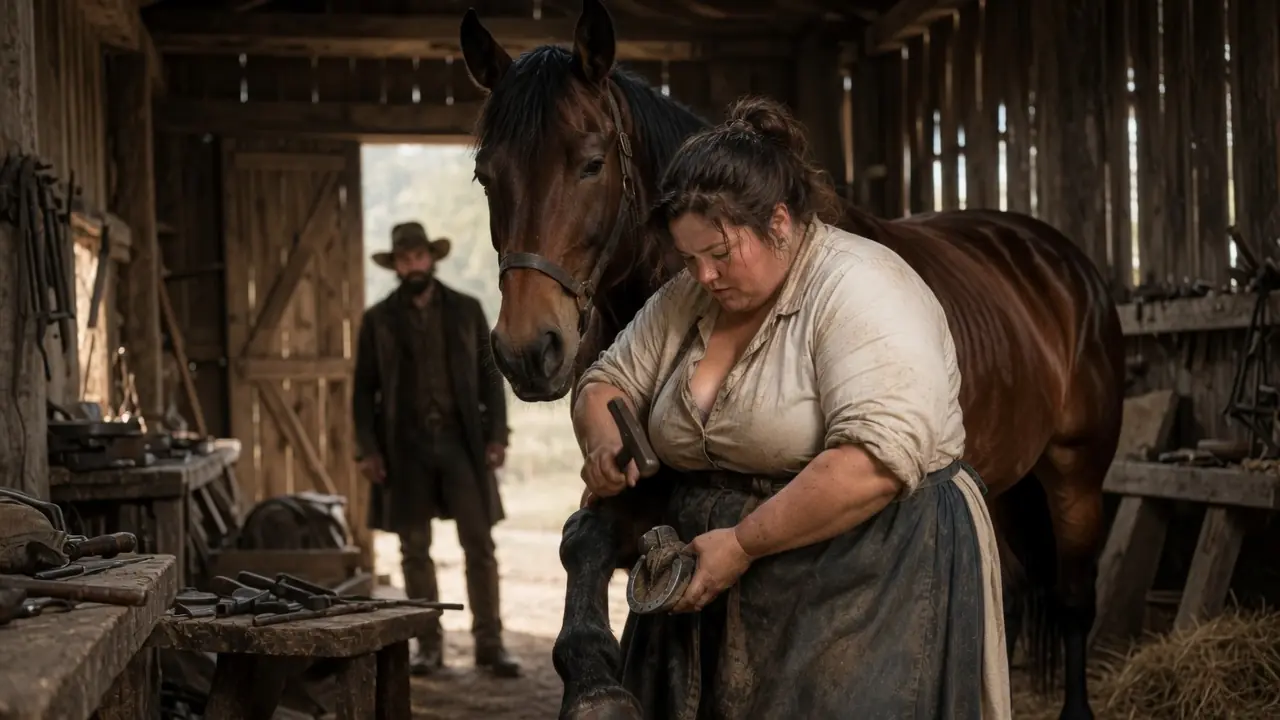
The horse released a nervous breath.
By the time Martha lowered his hoof, the animal stood calmly enough to rest its muzzle against her shoulder. She scratched the white mark between his eyes and stepped back to inspect the shoe. It sat perfectly level.
A man’s voice came from the stable entrance.
“You buying something,” Martha asked without turning, “or just blocking my light?”
The stranger remained silent.
Martha wiped her hands on her leather apron and faced him.
He was taller than nearly every man in Red Bluff, with a weathered brown coat, heavy boots, and a beard touched with gray. A rifle rested across his back, while scars marked two fingers on his left hand. He looked less like a traveler than a piece of the wilderness that had walked into town.
“My name is Caleb Ward,” he said. “I need three mules.”
Martha studied him.
She knew the name.
Caleb lived somewhere beyond Bear Tooth Pass, nearly two days into the mountains. He came down once each year to trade pelts, purchase flour, salt, coffee, and ammunition, then disappeared before winter closed the trails. Children claimed he slept beside wolves, while miners said he had killed three men with one rifle shot.
Martha suspected most of those stories were nonsense.
“Three good mules will cost forty dollars,” she said.
“I have forty.”
“My brother owns the stable, but he’s drunk behind the saloon. If you want animals worth taking into the mountains, you deal with me.”
Caleb nodded.
That was the beginning.
Martha led him into the corral behind the stable and showed him two strong brown mules and a slate-gray animal called Amos. Caleb examined their legs, teeth, backs, and hooves with the careful attention of someone whose life depended upon the animals beneath him.
He paused beside Amos.
“The gray favors his left front.”
“Only on stone,” Martha answered immediately. “The hoof wall grows faster on the inside. Most men shoe him evenly and twist his stride.”
Caleb looked at her.
“What do you do?”
“Trim the inside lower and give him more heel support.”
“Does it hold on ice?”
“Better than any mule in this town.”
Caleb lifted the hoof again and examined her work.
“You know mountain ground.”
“I know horses.”
“That is not the same thing.”
“No,” Martha said. “It is better.”
The corner of his mouth moved, though Martha could not decide whether he was amused.
She folded her thick arms.
“Forty dollars. Take them or leave them.”
Before Caleb could answer, laughter drifted from the stable doorway.
Martha’s younger brother, Joel, leaned against the frame with two miners beside him. His face was red from whiskey, and his shirt was half untucked. Although the livery legally belonged to him, he rarely touched a horse unless someone paid him first.
“Careful, mountain man,” Joel called. “She’ll sell you the whole stable if you stand there long enough.”
One miner grinned.
“Maybe she’s trying to sell herself.”
The other man laughed.
Martha kept her eyes on Caleb.
Joel stepped into the yard.
“She’s been waiting years for some blind fool to carry her away.”
“Go back to the saloon,” Martha said.
“This is my stable.”
“You haven’t worked in it since Tuesday.”
“I own it.”
“You inherited it.”
“That means the same thing.”
Martha’s jaw tightened.
Their father had taught her every part of the business. She had cleaned stalls at eight, trained colts at twelve, and shoed her first horse before Joel could lift a hammer. Yet when their father died, the deed passed to his son.
Martha inherited a sewing box and their mother’s Bible.
Joel inherited everything she had kept alive.
One of the miners looked Martha over.
“She’s strong enough to carry you up the mountain, Ward.”
The laughter came again.
Caleb slowly lowered Amos’s hoof.
Then he faced Joel.
“Why do you let this town work her into the ground while you drink away everything she earns?”
Joel’s smile vanished.
“That is family business.”
“No,” Caleb said. “It is cowardice performed in public.”
The stable became quiet.
Martha stared at him.
Nobody in Red Bluff defended her. Some people appreciated her skill, and nearly every rancher trusted her with valuable horses. Yet even the grateful ones joined the jokes because Martha’s broad body, rough hands, and plain face made cruelty feel harmless to them.
Joel stepped closer.
“You looking for trouble?”
“I was looking for mules.”
Caleb turned toward Martha.
“Now I am considering something else.”
She narrowed her eyes.
“What?”
“You want out of Red Bluff?”
Martha almost laughed.
“Where would I go?”
“My place.”
The miners exchanged glances.
Joel snorted.
“You need a blacksmith?”
“I need a partner.”
Martha’s expression hardened.
“I don’t work for promises.”
“I’m not offering employment.”
Caleb looked directly into her pale blue eyes.
“I don’t need a pretty bride. I need a woman strong enough to survive the mountains beside me.”
Nobody moved.
Martha heard the nervous gelding shifting inside the stable and the distant pounding of the stamp mill beyond town. Joel’s face slowly changed from confusion to disbelief.
“You’re proposing to her?” he asked.
Caleb ignored him.
Martha’s voice came out lower than she intended.
“Are you offering me work… or marriage?”
“Both.”
The miners burst into laughter.
Joel doubled over, slapping one hand against his leg.
“The mountain man finally lost his mind.”
Caleb did not look away from Martha.
“I have a cabin, six horses, traps, a sawmill, and eighty acres of high meadow. I can hunt, build, and survive a winter. But last year I broke two fingers and nearly froze because there was nobody close enough to help.”
“That sounds like a poor reason to marry.”
“It is an honest one.”
Martha glanced toward the men laughing behind him.
“And what do you expect in exchange?”
“Equal work. Equal decisions. Half of anything we build after the wedding.”
“What about children?”
“If they come, they come. If not, the mountains will remain standing.”
“What about love?”
Caleb considered the question.
“I don’t know you well enough to lie about that.”
The laughter behind him weakened.
Martha removed her apron.
“Give me until sunset.”
Caleb nodded.
“I’ll be at the feed store.”
He purchased the mules before leaving, paying the full forty dollars without bargaining. Then he walked away as though he had not just changed the direction of Martha’s life.
Joel stared at her.
“You cannot be considering this.”
“Why not?”
“He lives like an animal.”
“He works.”
“He probably smells worse than you.”
Martha turned so quickly Joel stepped back.
For years, she had accepted his insults because leaving would mean surrendering the only work she loved. Now, for the first time, a door had opened.
It might lead to hardship.
It might lead to danger.
But it did not lead back into Joel’s stable.
“You will not speak to me that way again,” she said.
Joel laughed uneasily.
“What are you going to do?”
“Leave.”
“You have nothing.”
Martha looked around the stable.
Every repaired saddle, straight fence board, calm horse, and balanced shoe carried evidence of her labor. Yet Joel’s name remained on the deed, the bank account, and every sales record.
He had always counted on that.
“You are right,” Martha said. “None of this belongs to me.”
She removed the farrier tools their father had given her personally and placed them inside a heavy leather roll. Then she collected her clothes, three books, two blankets, and the small silver thimble that had belonged to her mother.
At sunset, she found Caleb near the feed store.
The entire town seemed to know what had happened.
Men stood outside the saloon pretending not to watch. Women lingered near the mercantile windows, whispering behind gloved hands. Even the preacher had appeared, perhaps expecting to prevent an immoral arrangement.
Martha stopped before Caleb with one bag and her tools.
“I have conditions.”
He removed his hat.
“Name them.”
“I own half of what I help build.”
“Yes.”
“You never sell my horses without asking.”
“Agreed.”
“You do not strike me.”
Caleb’s expression changed.
“No.”
“If you drink away our money, I leave.”
“I drink coffee.”
“If you discover you only wanted a servant, I come back to Red Bluff and tell everyone exactly what kind of man you are.”
Caleb glanced toward the watching crowd.
“That may be worse than death.”
Martha almost smiled.
“One final condition.”
He waited.
“You never call me grateful because you married me.”
Caleb’s voice softened.
“I expect to be the grateful one.”
The preacher married them the following morning.
The town gathered outside the church, not to celebrate but to witness what many considered a mistake. Martha wore a plain brown dress. Caleb wore the same coat he had arrived in, cleaned with a stiff brush but still marked by mountain travel.
When the ceremony ended, someone shouted that Caleb should purchase a larger wagon.
Laughter rolled through the crowd.
Martha’s face burned.
Caleb stopped on the church steps.
He turned toward the townspeople.
“You laugh because you judge a woman by how little space she occupies.”
The street quieted.
“I judge her by whether she can stand when the mountain tries to kill us.”
He took Martha’s tool bag in one hand.
“By spring, we’ll know which judgment mattered.”
They left Red Bluff before noon.
The journey into the mountains took nearly two days. Martha rode Amos, whose stride remained steady over stone exactly as she had promised. Caleb led the pack mules, saying little but checking the animals frequently.
The trail climbed through pine forest, crossed a shallow river, then narrowed along a ridge where the land fell sharply on both sides. Martha’s body, so often treated as evidence of clumsiness, gave her balance and endurance. She moved steadily, never complaining when the cold deepened or the trail turned rough.
Caleb noticed.
“You’ve ridden mountain paths before?”
“No.”
“You ride like you have.”
“I listen to the horse.”
He nodded.
“That is what most men forget.”
His cabin stood in a high valley surrounded by pine-covered slopes. It was larger than Martha expected but poorly organized. Bundles of dried herbs hung beside rifle parts, sacks of flour rested too close to a leaking window, and a bearskin covered a table because one leg had broken.
Martha entered slowly.
“Where do you keep the clean dishes?”
Caleb pointed toward a shelf.
“Those are all dirty.”
“They are less dirty than the others.”
She looked at him.
“You survived here alone for ten years?”
“Nine.”
“That explains nothing.”
Their marriage began with work.
Martha repaired the table leg, moved the flour, cleaned the stove, and placed every tool where it could be found quickly. Caleb added a second room to the cabin without being asked, giving her a private place until they knew whether sharing one felt right.
He did not mention the decision.
Martha noticed anyway.
They divided the labor according to ability rather than custom. Caleb hunted and cut timber. Martha managed the animals, forged shoes in a small stone workshop, and discovered that the gray mule’s corrected gait allowed him to carry heavier loads through snow.
She also improved the cabin roof, repaired the smoke vent, and taught Caleb how to preserve leather against mountain damp.
He taught her which clouds announced snow, how to find a trail after wind covered it, and how to recognize the silence that came before an avalanche.
At night, they ate across from each other.
At first, their conversations remained practical.
Then stories entered.
Caleb told her that his younger brother died during the war. After returning home, Caleb discovered that towns felt too crowded and grief felt easier beneath open sky. He had chosen solitude because the mountains asked no questions.
Martha told him about her father, who praised her strength when she was a child but still believed the stable could belong only to Joel.
“He loved me,” she said.
“But not enough to trust you with what you built.”
“No.”
Caleb stared into the fire.
“Love without fairness leaves strange wounds.”
Winter arrived early.
Snow buried the high meadow in November, but their preparation held. Martha had insisted on doubling the stored hay and moving firewood inside before the first storm. Caleb had argued that the usual amount was sufficient.
He admitted she was right on the third day of continuous snow.
Martha smiled.
“Say it again.”
“No.”
“I may never hear it otherwise.”
“You were correct.”
“Louder.”
“The wind has taken my voice.”
Their partnership grew into affection without either naming it.
Caleb began leaving the final cup of coffee for Martha. She stitched fur inside his gloves after noticing his damaged fingers became stiff in the cold. When he returned late from checking traps, she stood outside the cabin until his figure appeared between the trees.
One night, a frightened mare went into difficult labor.
Caleb held the lantern while Martha worked for nearly two hours. Her arms shook with exhaustion, but she remained calm until the foal finally breathed. When the mare stood and touched her nose to the newborn, Martha sat heavily against the stall wall.
Caleb knelt beside her.
“You saved them.”
“She did most of it.”
“The mare?”
“Yes.”
“What did I do?”
“You held the light.”
He smiled.
Martha looked at him.
Nobody had ever watched her with that expression before. There was no mockery, pity, or surprise that someone like her could possess gentleness.
Only admiration.
Caleb touched her cheek with the back of two fingers.
Martha did not move away.
Their first kiss happened inside the stable beside a newborn foal.
It was awkward, brief, and more honest than any romance Martha had imagined while listening to other women discuss dances. When Caleb pulled back, he looked almost frightened.
“Was that unwelcome?”
“No.”
“Should I do it again?”
“Not while the mare is watching.”
By January, the mountains disappeared beneath snow.
Red Bluff experienced a colder winter than anyone remembered. The river froze thick enough to support wagons, supply roads vanished, and several ranches ran dangerously low on hay.
Then the blizzard came.
It began with a gray line across the western sky and reached the valley before nightfall. Wind screamed between buildings, snow erased streets within minutes, and temperatures dropped hard enough to freeze exposed skin.
A stagecoach carrying six passengers left Red Bluff shortly before the storm.
The driver believed he could reach a mining camp before the worst weather arrived. Instead, the coach overturned near Black Pine Ridge, throwing one horse into a ravine and trapping the passengers miles from shelter.
Among them were Joel Hale, the preacher, two miners, a mother with a young daughter, and a traveling salesman.
The same people who had laughed when Caleb married Martha.
Red Bluff sent a search party, but the wind forced them back. Two men suffered frostbite before reaching town. Nobody knew whether the passengers remained alive.
At the mountain cabin, Martha heard the distress bell near midnight.
Caleb had installed it months earlier along the lower trail, connecting it to a rope that travelers could pull during emergencies. The bell rang once, then twice through the storm.
Caleb stood.
“Someone is on the ridge.”
“You cannot see ten feet outside.”
“They will die before morning.”
Martha began pulling on her coat.
“You are not coming.”
She looked at him.
“I know the horses better.”
“The trail is nearly gone.”
“Then you need someone who can read their footing.”
Caleb did not waste time arguing.
They selected Amos and two mountain horses. Martha fitted each animal with sharpened winter shoes, adding extra heel caulks for ice. She loaded blankets, rope, hot stones wrapped in cloth, and a small barrel of broth onto a sled.
They entered the storm together.
Snow struck their faces like thrown sand. Caleb led through the trees while Martha watched the animals, changing direction whenever Amos resisted a drift that looked safe. Twice, the mule warned them away from hidden drops.
After two hours, they found the overturned coach.
The driver was dead.
The passengers had sheltered beneath a torn canvas near a rock wall. Joel’s left leg was trapped beneath part of the wagon, while the young girl had stopped shivering—a sign Martha recognized as dangerously advanced cold.
The preacher stared at her.
“Martha?”
She ignored his surprise.
“Caleb, get Joel free. I need the child.”
The mother held her daughter tightly.
“She won’t wake.”
Martha opened her coat and pressed the child against her own chest, wrapping both of them in blankets. Her size, mocked for years, became warmth the girl desperately needed.
“Stay with me,” Martha whispered. “You don’t get to sleep yet.”
The miners watched silently.
Caleb lifted the broken axle enough for Joel to pull free. His leg was badly bruised but not broken. When he recognized Martha, shame moved across his face.
“You came for me?”
“I came because the bell rang.”
The road back to Red Bluff was impossible.
Their only chance was Caleb’s cabin.
They placed the child and injured passengers on the sled, tied ropes around everyone capable of walking, and began the climb. The storm worsened.
Halfway up the ridge, one horse slipped.
Martha moved before anyone else. She wrapped the lead rope around her waist, planted both boots, and pulled while Caleb pushed the animal from below. The miners joined them, and together they brought the horse back onto solid ground.
Joel stared at his sister.
The woman he had called too large, too rough, and unwanted was stronger than every laughing man in the group.
They reached the cabin shortly before dawn.
Martha treated frostbite, warmed the child slowly, splinted Joel’s leg, and fed everyone broth in small amounts. Caleb kept the fire alive and repaired gaps where the wind forced snow through the wall.
For three days, the blizzard trapped them together.
Nobody laughed.
The preacher watched Martha lift hay bales, calm frightened horses, prepare food, and check each injured person throughout the night. The miners saw Caleb follow her instructions without embarrassment or resistance.
Joel remained quiet.
On the second evening, he found Martha alone in the stable.
“You saved my life,” he said.
“You are my brother.”
“I did not treat you like a sister.”
“No.”
His eyes filled with shame.
“I thought because the stable belonged to me, the work belonged to me too.”
“You thought my labor did not count because my name was not on the deed.”
“Yes.”
Martha continued cleaning a horse’s injured leg.
“I cannot change what I did.”
“No.”
“What can I do?”
“Stop expecting forgiveness to make you comfortable.”
Joel lowered his head.
Martha’s voice softened slightly.
“Then return to Red Bluff and become a man our father would recognize.”
When the storm ended, a rescue party reached the cabin.
The story traveled faster than the survivors.
By the time Martha and Caleb returned to Red Bluff in spring, nobody gathered to laugh. Townspeople stood along the street in silence as they rode past.
The preacher approached first.
“I owe you an apology.”
Martha looked at him.
“For which sermon?”
He accepted the rebuke.
“For every word I used to make cruelty sound righteous.”
One miner removed his hat.
The others followed.
Joel had changed during the winter. He stopped drinking, repaired the livery, and placed Martha’s name on half the deed before she returned. When he offered it to her, she read the document carefully.
“I no longer need the stable,” she said.
“I know.”
“Then why give it to me?”
“Because it was always half yours.”
Martha accepted the share but hired a young widow to manage her interest. The woman received wages, authority, and a path toward ownership—things Martha had been denied.
She returned to the mountains with Caleb.
They expanded the cabin, opened a winter waystation for travelers, and bred mules suited to high trails. Ranchers came from three territories to purchase animals shoed by Martha Hale Ward.
Nobody called her unwanted again.
Years later, children in Red Bluff heard the story of the blizzard. They were told that the mountain man chose the one bride no other man wanted, and that she became the only person strong enough to save a coach filled with those who mocked her.
Martha disliked that version.
Caleb had not chosen a woman nobody wanted.
He had recognized the woman nobody else deserved.
One evening, they stood outside their cabin while snow touched the high peaks. Caleb placed one arm around her waist.
“Do you regret leaving Red Bluff?”
Martha looked toward the stable, the grazing mules, and the light shining through their cabin window.
“No.”
“Do you regret marrying a man you met beside a nervous gelding?”
“Occasionally.”
He smiled.
Martha rested her head against his shoulder.
The town believed Caleb had saved her from loneliness.
The truth was more balanced.
He gave her a place where strength was not treated as ugliness.
She gave him a home where solitude no longer felt like survival.
Their marriage began because Caleb needed someone capable of facing the mountains beside him.
It lasted because Martha discovered he was strong enough to stand beside her without ever asking her to become smaller.