Some lives were not stolen in a single terrible moment. They disappeared slowly, one bruise, one cruel word, and one silent surrender at a time, until the person living that life could no longer remember what kindness felt like. By the time anyone in Sweetwater Crossing truly noticed Abigail Hale, she had already learned how to make herself invisible. She lowered her eyes, softened her footsteps, and breathed so quietly that even pain seemed embarrassed to acknowledge her.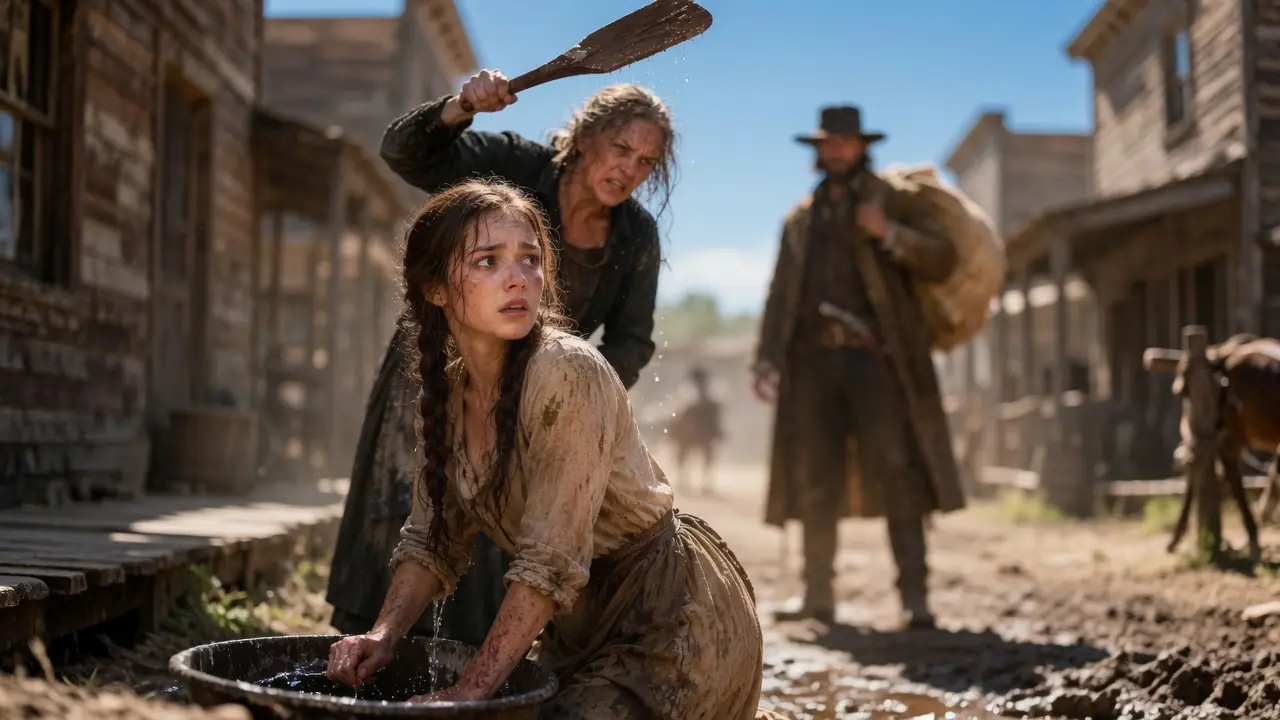
The willow paddle was never the worst of it. Bruises changed color, cuts closed, and the burning from lye soap eventually faded from her cracked hands. The worst part was always the silence after Martha struck her, those stretched seconds when Abigail stood perfectly still and wondered whether her mother had finished or was merely catching her breath. That uncertainty had trained her body to fear stillness as much as noise.
On Tuesday afternoon, Abigail knelt behind Martha Hale’s boarding house with both sleeves rolled above her elbows. She scrubbed a stranger’s petticoat across a battered washboard while blood from her split knuckles vanished into gray water. The alley smelled of boiled cabbage, horse manure, gin, and summer dust. Sweat ran beneath her collar and burned against the welt crossing her shoulder.
“You’re leaving grease spots,” Martha said behind her.
Abigail pressed harder against the cloth. “I’ll clean it again.”
“You always say that.”
The wet paddle struck her shoulder blade and threw her forward. Her face nearly entered the washtub, but she caught the wooden rim and stopped herself. Dirty water soaked the front of her patched dress, and the sharp edge cut her palm.
She did not cry.
Martha hated tears because she believed they accused her. She hated silence because she believed it challenged her. Nothing Abigail did could prevent the next blow, but keeping quiet sometimes shortened the beating. That was the closest thing to control she possessed.
Her mother leaned over her, breathing cheap gin across Abigail’s cheek. “Your father was weak, and he left me his weak little burden.”
Gravel shifted at the entrance to the alley.
Martha straightened.
A large man stood between the two wooden buildings, blocking part of the afternoon sun. Everyone in Sweetwater Crossing knew Cole Mercer by sight, though few knew more than his name. He came down from the northern mountains once each month to sell pelts, purchase flour and cartridges, and disappear again before anyone became comfortable enough to ask questions.
Cole carried a burlap sack across one shoulder and wore a weathered brown coat despite the summer heat. A dark beard covered most of his face, and an old revolver rested openly at his hip. He looked less like a visitor than a piece of the wilderness that had learned to walk upright. His gray eyes moved from Martha’s paddle to the blood in the wash water.
“You’re making quite a racket,” he said.
Martha forced a laugh. “Mind your own business.”
Cole did not look at her. His attention remained on Abigail, who was still kneeling with one hand curled around the washtub. He studied her bruised cheek, thin shoulders, and the way she kept waiting for permission to rise. There was no pity in his expression, only a quiet calculation that frightened Martha more than anger might have.
“She looks ready to collapse,” Cole said.
“She collapses when I say she can.”
Cole lowered the burlap sack and reached inside his coat. Martha stepped backward when he removed a leather pouch, but he tossed it onto the dirt between them. The pouch landed with the heavy sound of metal.
“Three gold eagles,” he said. “Worth more than she’ll earn you in five years.”
Martha stared at the pouch before kneeling to untie it. Three gold coins gleamed against the leather. Greed replaced suspicion so quickly that Abigail felt ashamed, though she did not understand why her mother’s ugliness still had the power to shame her.
“For what?” Martha asked.
Cole nodded toward Abigail. “Her.”
The alley became silent.
Abigail forgot the pain in her shoulder. She had heard of girls sold into kitchens, saloons, and distant farms, but she had never believed Martha would value her enough to negotiate. The thought brought no comfort. Being sold was merely another kind of sentence.
Martha examined Cole with a cruel smile. “You want this one? She’s skinny, frightened, and barely useful.”
“I’m not buying a painting.”
“She eats more than she earns.”
“I said three coins.”
Martha bit one of the gold pieces and laughed. “Take her.”
Abigail’s stomach turned.
Cole looked directly at her. “Get your things.”
She almost told him she owned nothing. Instead, she rose slowly and removed a threadbare shawl from a rusty nail beside the back door. Martha entered the boarding house without saying goodbye, already hiding the gold inside her dress. Abigail stood in the alley with wet clothing clinging to her legs, waiting for Cole to tell her how to walk.
He lifted his burlap sack. “Can you ride?”
“A little.”
“That means no.”
“I can learn.”
Cole looked toward the street. “You’ll ride in the wagon.”
She followed him because she had nowhere else to go.
The wagon stood near the trading post, loaded with flour, salt, coffee, lamp oil, and winter supplies. Two strong horses shifted beneath their harnesses while townspeople watched from shaded porches. No one asked why Abigail was leaving with the mountain man. Some looked relieved, as though the sight of her bruises had become an accusation they were tired of avoiding.
Cole placed a folded blanket on the wagon seat before Abigail climbed up. He did not help her, perhaps because he noticed how she recoiled whenever his hand moved near her. Once she was seated, he climbed beside her and took the reins. Martha never came outside.
The town disappeared behind them.
For the first hour, Cole said nothing. The wagon followed a narrow road toward the northern hills while cottonwood trees gave way to pine and stone. Abigail sat with both hands clasped in her lap, waiting for instructions. She expected him to explain the work she owed, the rules she would follow, and the punishment for disappointing him.
Instead, he stopped beside a stream.
He filled a tin cup and placed it on the wagon bench between them. “Drink.”
Abigail stared at it. “Is it for me?”
“No, I carried it up here for the horses to admire.”
She looked at him quickly, uncertain whether he was mocking her. Cole’s mouth shifted slightly beneath his beard. It took Abigail several seconds to understand that he had attempted a joke.
She drank carefully.
They continued climbing until the air became colder. Wind slipped through the wet fabric of Abigail’s dress, and she began shivering despite her efforts to hide it. Cole noticed, stopped the wagon, and removed a heavy buffalo-hide coat from behind the seat. He held it toward her without stepping closer.
“Put that on.”
“I’ll dirty it.”
“I’m not hauling a frozen corpse.”
Abigail accepted the coat. It smelled of pine smoke, leather, and clean wool. The weight surrounded her like a wall against the cold, and she hated how close the comfort brought her to tears.
They reached Cole’s cabin near sunset.
It stood in a clearing beneath steep mountain ridges, built from heavy logs and stone. A small barn leaned against the tree line, and smoke rose from the chimney. No neighboring house was visible, but the isolation felt different from the locked rooms Martha used. The mountain seemed quiet rather than watchful.
Cole carried the supplies inside while Abigail remained beside the wagon. She did not know whether she was permitted to enter. After several trips, he stopped in the doorway and looked at her.
“You planning to sleep with the horses?”
“No.”
“Then come inside.”
The cabin contained one large room and a smaller sleeping room behind a wooden partition. A stove stood near the center, with a table, two chairs, a narrow bed, and shelves holding tools, books, and jars of dried herbs. Everything was plain but clean. No paddle hung from the wall, and no bottles of liquor stood beside the stove.
Cole placed bread, dried meat, and beans on the table. Abigail remained near the entrance until he pointed toward a chair. She sat on its edge without removing the buffalo coat.
He cooked without asking for help.
That confused her more than anything else. Martha had never allowed Abigail to sit while food was prepared, even when she was ill. Cole stirred beans, cut bread, and placed a full bowl before her. When Abigail did not eat, he sat across from her and began his own meal.
“What do you want me to do?” she finally asked.
“Eat.”
“After that?”
“Sleep.”
She looked toward the single bed.
Cole followed her gaze. “That room is yours. The door locks from inside.”
“Where will you sleep?”
“Here.”
“But this is your cabin.”
“It has been for eighteen years. One night in a chair won’t kill me.”
Abigail’s hands tightened around the spoon. “Why did you pay for me?”
Cole took another bite before answering. “Because Martha would not let you leave for free.”
“That does not answer me.”
“It answers enough for tonight.”
She ate because hunger eventually overcame fear. Cole did not watch her bowl or complain when she finished everything. He gave her a clean shirt to sleep in and placed extra blankets inside the smaller room. Then he showed her the wooden bar that secured the door.
Abigail locked it the moment he stepped away.
She did not sleep.
She lay beneath the blankets wearing Cole’s oversized shirt and listened to every sound beyond the wall. The chair creaked twice. Firewood shifted in the stove. Once, Cole crossed the room to add another log, but his footsteps stopped well before her door.
Morning arrived with no shouting.
Abigail opened the door slowly. Cole was gone, but the stove still burned, and a pot of coffee rested near the heat. A tin bowl, bread, and two boiled eggs waited on the table. No note or demand explained what she owed.
She carried the bowl toward the washstand.
Her numb fingers lost their grip.
The bowl struck the floor with a deafening clang.
The cabin door opened at that exact moment, and Cole entered carrying firewood. Abigail did not see his face. Her body moved before thought could interfere.
She dropped to her knees and covered her head with both arms.
“Please,” she whispered. “I’ll clean it. Just don’t hit me.”
The firewood slipped from Cole’s arms and landed softly near the door. He did not approach. First, he removed his gun belt and placed it on a high shelf. Then he lowered himself to one knee several feet away and raised both empty hands.
“Look at me.”
Abigail remained curled toward the floor.
“No one will hurt you under my roof.”
She lifted her face slowly.
Cole’s expression was not angry. If anything, he looked wounded by something she had done without touching him. His gaze moved toward the carved bone pendant hanging from her neck.
The pendant had slipped free of Cole’s shirt during the fall. It was shaped like a small hawk with one wing longer than the other. Abigail reached for it instinctively.
Cole’s face changed.
“Where did you get that?”
“My father made it.”
“What was his name?”
“Thomas Hale.”
Cole sat back as though she had struck him.
Abigail clutched the pendant. “You knew him?”
Cole stared at the small carving for a long moment. Then he stood, moved to a wooden chest beneath the window, and removed an old leather pouch. Inside lay another bone hawk, larger but carved with the same uneven wing.
“Thomas made this for me,” Cole said.
Abigail forgot to be afraid.
“He said he made two,” Cole continued. “One for the man whose life he saved and one for the child he hoped would remember him.”
“My father died when I was six.”
“I know.”
Cole sat on the floor rather than the chair, leaving the distance between them unchanged. He told Abigail that sixteen years earlier, he had been guiding a trapping party through the Missouri hills when a flash flood swept him from a crossing. Thomas Hale, then working as a freight driver, entered the water and pulled him from beneath a fallen tree.
Cole had been unconscious for two days.
Thomas stayed until he woke, then refused payment. He carved the hawk while sitting beside Cole’s campfire and said every man should carry proof that someone once chose not to leave him. They parted with a promise that Cole would repay the kindness if their roads ever crossed again.
“Why didn’t you help him?” Abigail asked.
“By the time I found Sweetwater Crossing, he had been dead nearly ten years.”
Cole had come to town asking about Thomas. Martha told him her husband had died from fever and that their daughter had left with relatives. Cole believed her until he saw Abigail behind the boarding house, wearing Thomas’s pendant and carrying his eyes.
“You recognized me in the alley?”
“I recognized the carving.”
Abigail’s voice shook. “Then the gold was payment for my father?”
“No.”
She looked at the fallen bowl. “You paid Martha for me.”
Cole’s expression hardened. “I did not buy you.”
“She said I belonged to you.”
“Martha would have said anything for those coins.”
“Then what did you buy?”
“Your freedom.”
The words felt too large to understand.
Cole reached for a clean blanket and slid it across the floor toward her. “The door is not locked. The wagon is outside. When the mountain road clears, I will take you anywhere you choose.”
Abigail touched the blanket but did not lift it.
“What if I choose to stay?”
“Then you stay.”
“What must I do?”
“Nothing today.”
She looked at him with suspicion. “People do not give away gold for nothing.”
“Your father gave me my life for nothing.”
“That was different.”
“No,” Cole said. “It was the same kind of debt.”
He began gathering the fallen firewood. Abigail watched him stack each piece beside the stove without blaming her for the bowl. When he finished, he poured another breakfast serving and placed it on the table.
Then he went outside.
The days that followed were quieter than any period Abigail could remember. Cole rose before dawn, tended traps, repaired fences, and cut wood without ordering her to follow. He left food within reach and never questioned how much she ate. Each night, he slept in the chair while she locked herself inside the smaller room.
On the fourth morning, Abigail asked whether she could cook.
Cole nodded. “If you want.”
She made biscuits and burned the bottoms. When she apologized, Cole scraped away the blackened edges and ate three. He said they were better than the rocks he usually baked, though Abigail suspected he had exaggerated.
A week later, she washed the cabin windows.
Cole returned from checking traps and found her balanced on a stool. He did not shout that she might fall. He simply held the stool steady and warned her about a loose board. Abigail nearly cried from the ordinary gentleness of it.
She began asking about her father.
Cole remembered Thomas as a laughing man who sang badly and carried peppermints in his coat. He remembered that Thomas spoke often of a daughter who loved yellow flowers and could outrun every boy in their neighborhood. Abigail had forgotten the running but remembered the peppermints.
Martha had told her Thomas considered her a burden.
Cole answered without hesitation. “That is a lie.”
“How can you be certain?”
“Because a man does not carve half the night while talking about a burden.”
Each truth restored something small inside her.
One evening, Abigail found an old newspaper folded beneath a stack of kindling. The article described Thomas Hale’s death in a wagon accident near a river crossing. A line near the bottom stated that several freight records disappeared after the crash.
Abigail read the article twice.
“My father did not die from fever.”
Cole looked up from sharpening a knife. “No.”
“You knew?”
“I learned after reaching town.”
“Why didn’t you tell me?”
“I was waiting until you were strong enough to ask.”
Anger rose inside her, unfamiliar and frightening. “You decided what I could bear, just like everyone else.”
Cole placed the knife on the table. “You are right.”
His immediate admission took the force from her anger.
He explained that Thomas had worked for a freight company partly owned by Martha’s second husband before Martha married him. Thomas discovered that supplies intended for mining camps were being diverted and sold twice. Three days after threatening to report the missing shipments, his wagon went over a ravine.
The official report called it an accident.
Cole believed otherwise.
“Did Martha know?” Abigail asked.
“I think she knew enough to keep quiet.”
Before they could continue, a rifle shot echoed from the valley below.
Cole crossed to the window.
Three riders moved through the trees toward the cabin. Martha rode in front wearing a black dress and carrying the willow paddle across her saddle. Beside her was Deputy Harlan Pike, a broad man known in Sweetwater Crossing for collecting favors more eagerly than evidence.
The third rider was a stranger carrying a coil of rope.
Abigail’s body began shaking.
Cole put on his gun belt but did not draw the revolver. “You can lock yourself in the room.”
“She will burn the cabin if I hide.”
“Then what do you want to do?”
No one had ever asked Abigail that question during danger.
She looked toward the chest containing Thomas’s matching pendant and the newspaper report. Fear pressed against her ribs, but beneath it was anger that had waited years for permission to exist.
“I want to hear what she says.”
Cole nodded. “Then stand where she can see you.”
The riders stopped in the yard.
Martha dismounted first. “There she is.”
Deputy Pike raised a paper. “Cole Mercer, you are accused of purchasing, abducting, and unlawfully holding Abigail Hale.”
Cole stepped onto the porch. “Martha accepted gold and told her to leave.”
“A mother cannot legally sell her daughter,” Pike said.
“Then she committed the crime.”
Martha pointed toward Abigail. “That girl is unstable. He confused her and turned her against me.”
Abigail flinched when Martha lifted the paddle.
Cole noticed but remained beside her rather than stepping in front. “You came for the gold or for the girl?”
“For my daughter.”
“You never called me that before,” Abigail said.
Martha stared at her.
The words had escaped quietly, but once spoken, they gave Abigail enough strength for another. She stepped closer to the porch rail.
“You called me burden, fool, and punishment.”
Martha’s face tightened. “Get on the horse.”
“No.”
The single word seemed to surprise everyone.
Deputy Pike unfolded the paper. It was not a judge’s order, only a statement signed by Martha claiming Abigail had been taken against her will. Cole asked whether Pike had questioned a witness, examined Abigail’s injuries, or investigated the gold.
Pike’s eyes moved toward Martha.
She reached into her dress and produced one coin. “I gave it back.”
“You kept two,” Abigail said.
Martha’s gaze snapped toward her.
Abigail remembered waking during the journey and seeing Martha hide two coins beneath a loose floorboard before returning the empty pouch to a cupboard. She had been too frightened to understand its importance then. Now she described the exact location.
Deputy Pike’s confidence weakened.
Martha struck Abigail before anyone expected it.
The willow paddle cracked across Abigail’s arm. Cole moved instantly, catching Martha’s wrist before she could swing again. He twisted the paddle free and threw it into the dirt.
The stranger reached for his rope.
Cole drew his revolver but kept it pointed toward the ground. “One more move, and you explain yourselves to a federal marshal.”
Martha laughed. “There is no marshal here.”
A fourth horse appeared between the trees.
Sheriff Elias Boone rode into the clearing with Reverend Samuel Price beside him. Cole had sent word through a trapper two days earlier after learning someone in town was asking about the mountain road. Boone dismounted and ordered Deputy Pike to surrender his weapon.
Pike protested that he was acting lawfully.
Sheriff Boone took the unsigned paper from him and read it. “You crossed county lines without authority.”
Martha began shouting that Abigail belonged to her household. Boone looked at the bruises on Abigail’s arm, then at the discarded paddle.
“No grown woman belongs to another person,” he said.
Abigail stepped forward. “She knows what happened to my father.”
Martha’s fury became fear.
Cole brought out the newspaper article, Thomas’s freight notes, and the matching pendants. Reverend Price revealed that Thomas had once entrusted a sealed statement to the church, asking that it be opened if anything happened to him. Martha had taken the church record box after Thomas’s funeral and claimed it contained private family papers.
The record box was still beneath the boarding house floor.
Sheriff Boone sent Pike back to town under guard while he detained Martha and the stranger. Before being placed on the horse, Martha looked at Abigail with the same hatred that had controlled her childhood.
“You will crawl back when he tires of you.”
Abigail’s knees weakened.
Cole did not answer for her.
He stood beside her and waited.
Abigail looked at her mother. “I would rather sleep in the snow than return to your house.”
Martha’s face went blank.
For the first time, Abigail had struck something no paddle could protect: the certainty that fear would always bring her daughter back.
The search of the boarding house uncovered Thomas’s sealed statement, missing freight receipts, and two of Cole’s gold coins beneath the floor. Martha had known Thomas planned to expose the stolen supplies. She had warned the men involved and later testified that Thomas had been drinking before the accident.
He had not been drinking.
The wagon brake had been cut.
Martha had not held the knife, but her silence and false statement helped bury the truth. Deputy Pike had accepted money to prevent questions and had agreed to retrieve Abigail before she spoke publicly.
Both faced trial.
Abigail testified inside the Sweetwater Crossing courthouse. Her voice shook through the first questions, but she never lowered her eyes. Cole sat in the back row rather than beside her because she had asked to speak without anyone appearing to guide her answers.
When she finished, Judge Barrett asked where she wished to live.
Abigail looked toward Cole.
He did not nod, smile, or influence her.
“I choose the mountain cabin,” she said. “For now.”
The judge recorded her decision.
Life did not become simple after Martha’s conviction. Abigail still dropped to the floor when metal struck wood too loudly. She hid bread beneath her mattress and apologized whenever she used too much soap. Some nights, she woke convinced the cabin door had opened.
Cole never told her to forget.
He added another lock to her room and gave her the only key. He showed her where every weapon was stored and taught her how to load the rifle. When she asked why he trusted her with it, he said freedom meant nothing if she remained defenseless.
By autumn, Abigail no longer locked the bedroom door every night.
She learned to tend traps but decided she disliked killing animals. Instead, she grew herbs, repaired clothing, and kept careful accounts for Cole’s trading business. Her numbers were better than his, and within months she discovered two merchants had been underpaying him for pelts.
Cole confronted them with her records.
They paid the difference.
One winter evening, Abigail placed Thomas’s pendant beside Cole’s matching carving on the table. The two hawks faced each other across the wood.
“My father saved you once,” she said.
“Yes.”
“You saved me.”
Cole shook his head. “I opened a road. You walked it.”
“What happens when the debt is paid?”
“There was never a debt.”
She looked toward the cabin walls, the stove, and the room that had become hers. “Then why are you still here?”
Cole’s expression softened. “Because this is my home.”
Abigail swallowed. “And me?”
“That is your choice.”
She crossed the room and held out her hand.
Cole looked at it as though it were something sacred. Then he placed his palm beneath hers, careful and still.
“I choose to stay,” Abigail said.
Years later, travelers passing through the northern mountains found a larger cabin beside Cole’s original one. A wooden sign near the road offered food, shelter, and safe passage to women escaping violent homes. No one was asked to explain everything before receiving a bed.
Abigail kept clean clothes, warm quilts, and spare keys in every room. Cole repaired wagons, guided travelers through the mountain passes, and sat outside whenever a frightened guest needed distance from men. Neither spoke of rescue as ownership.
Above the hearth hung two carved bone hawks.
Beneath them, Abigail had placed the willow paddle Sheriff Boone returned after the trial. She had broken it in half and burned one piece. The remaining piece stayed on the wall as proof that the object which once controlled her could no longer reach her.
Some lives disappeared slowly.
Abigail rebuilt hers the same way.
One choice, one safe morning, and one freely given kindness at a time.