The first potato hit the wooden bin with a dull thud.
Then another.
Then another.
By the time the farm woman arrived at the packing house shortly after eight that morning, an entire twenty-foot produce bin had already been marked with a white sign painted in thick black letters.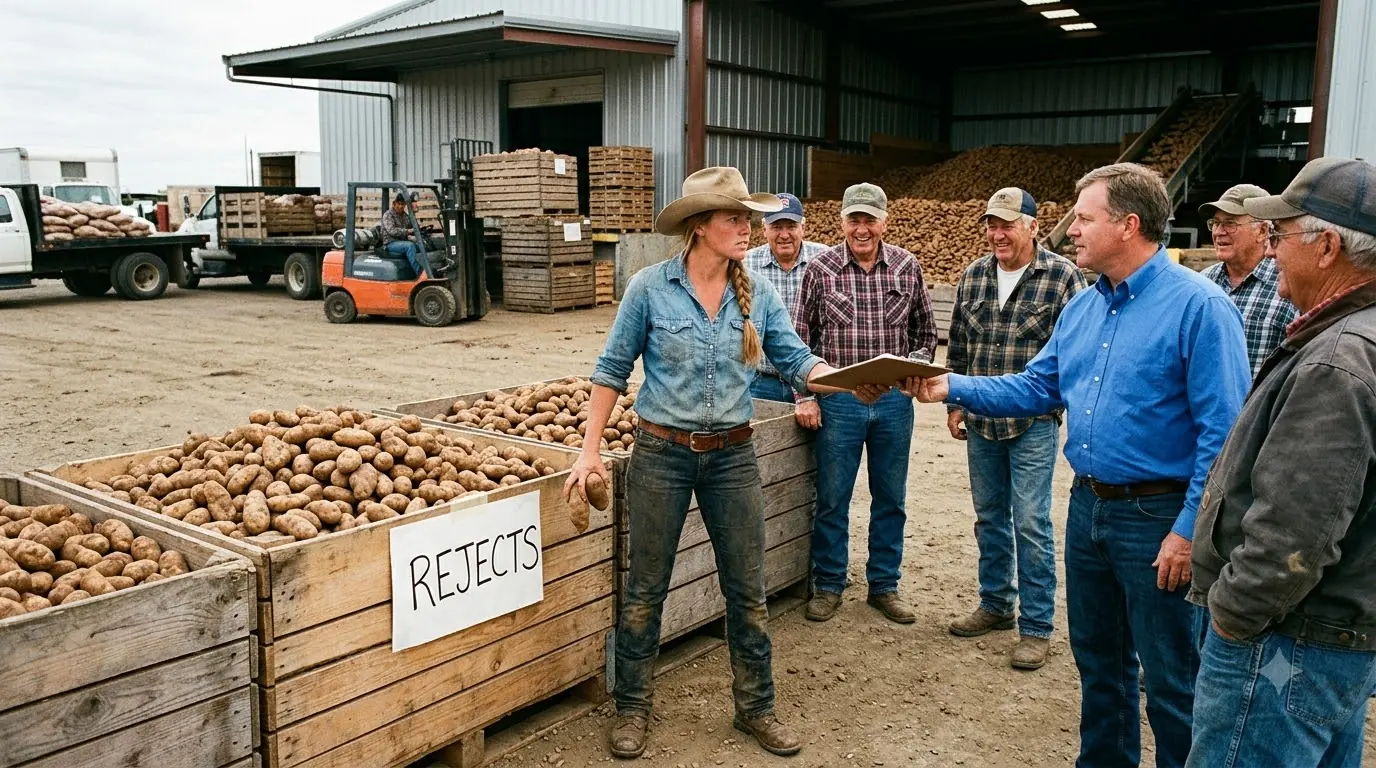
REJECTS
She stopped walking.
For several seconds, she simply stared.
The potatoes inside looked ordinary to her.
Some were round.
Some long.
Some slightly twisted.
Several had shallow scars caused by soil pressure.
Others had forked at one end.
A few looked almost comical, with two lobes joined together like someone had pressed separate potatoes into the same mold.
But they were sound.
Firm.
Healthy.
Clean beneath the dirt.
Perfectly edible.
The farm woman picked one up.
She turned it in her hand.
Nothing rotten.
Nothing soft.
No disease.
No deep cuts.
No serious bruising.
Just ugly.
Behind her, forklifts moved pallets beneath the loading dock.
Packing-line motors hummed inside the building.
Workers shouted numbers across the warehouse floor.
Flatbed trucks backed toward receiving bays.
Wooden crates filled with potatoes stood in long rows beneath the Idaho morning sun.
Most of those potatoes looked exactly the way grocery stores liked them.
Smooth.
Consistent.
Easy to stack.
Easy to photograph.
Easy to sell.
The farm woman looked again at the rejected bin.
Then she saw the second one.
And the third.
Her stomach tightened.
A middle-aged packing-house manager approached holding a clipboard.
He wore a bright blue button-down shirt, khaki work pants, clean boots, and the satisfied expression of someone delivering bad news he did not personally have to pay for.
“Morning.”
The farm woman looked toward him.
“Morning.”
She pointed toward the bins.
“What’s this?”
The manager glanced casually.
“Cull load.”
“How much?”
He checked his clipboard.
“Still counting.”
“How much so far?”
“Thirty-two tons.”
Her face changed.
The manager noticed.
“We’re not done.”
She looked toward the unloading area.
Another truck from her farm waited with its bed tilted.
Potatoes rolled slowly toward the inspection line.
Workers selected some.
Rejected others.
The farm woman stepped closer.
“Why?”
The manager shrugged.
“Appearance.”
She stared.
“Appearance?”
“Shape.”
“Skin.”
“Size variation.”
He tapped the clipboard.
“Retail grade.”
The farm woman held up the potato in her hand.
“This is healthy.”
“Didn’t say it wasn’t.”
“Then why reject it?”
“Because supermarkets don’t want it.”
She looked toward the enormous bins.
“They’re rejecting thirty-two tons because they’re shaped wrong?”
“Fifty, probably, once we finish.”
The farm woman turned back sharply.
“Fifty?”
The manager nodded.
“Maybe a little under.”
Her chest tightened.
Fifty tons.
She calculated immediately.
Seed.
Fuel.
Water.
Labor.
Equipment.
Storage.
Transportation.
Harvest crew.
Every acre had cost money before producing a single dollar.
Fifty tons was not a cosmetic inconvenience.
It was a financial wound.
The farm woman had taken over much of the family operation three years earlier after her father’s health began failing.
The farm was not enormous.
Not tiny either.
Large enough to require serious machinery.
Small enough that a bad crop decision could still be felt personally.
She had spent all spring watching expenses.
A pump failed in May.
A tractor transmission needed work in June.
Then irrigation costs climbed.
The harvest was supposed to stabilize everything.
Yield had been strong.
Quality looked excellent.
She had expected a good year.
Now fifty tons were sitting beneath a sign that said REJECTS.
A group of older farmers nearby watched.
One laughed when a worker tossed another oddly shaped potato into the pile.
The packing-house manager heard him.
He smiled.
The farm woman looked toward the group.
One farmer lifted a misshapen potato.
“This one looks like it tried growing around a rock.”
Laughter.
Another said:
“Maybe sell it as modern art.”
More laughter.
The woman tightened her jaw.
She had known most of those men for years.
They were not enemies.
But agricultural communities could be merciless when someone had a visible mistake.
Especially a younger farmer.
Especially one who had insisted on running her own operation instead of handing decisions to older men who believed experience automatically belonged to them.
The packing-house manager tapped the rejected bin.
“Don’t take it personally.”
She looked at him.
“You’re rejecting fifty tons.”
“I’m not rejecting you.”
“That distinction doesn’t pay my bills.”
The manager gave a short laugh.
“You’ll survive.”
The farm woman stared at him.
“How do you know?”
He stopped smiling slightly.
She continued.
“You know my operating costs?”
“No.”
“My crop insurance?”
“No.”
“My loan schedule?”
“No.”
“Then don’t tell me what I’ll survive.”
The surrounding laughter faded.
The manager looked annoyed.
He flipped a page on his clipboard.
“These are standard specifications.”
“Who wrote them?”
“Retail buyers.”
“Which ones?”
“All of them.”
“That isn’t an answer.”
The manager sighed.
“You want store names?”
“Yes.”
He looked at her as if the question were absurd.
The woman pointed toward the potato in her hand.
“This has the same starch.”
“Yes.”
“Same flavor?”
“Probably.”
“Same nutritional value?”
“Probably.”
“So the difference is shape.”
“Yes.”
“Then say it.”
The manager frowned.
“Say what?”
“You’re throwing away good food because it’s ugly.”
Several workers nearby went quiet.
The manager looked toward them.
Then back.
“This isn’t a charity.”
“I know.”
“We pack what sells.”
“I know.”
“Consumers want attractive produce.”
The farm woman looked at the mountain of rejected potatoes.
“Consumers want potatoes.”
“They want both.”
The manager slapped the clipboard lightly against the bin.
“Look, I don’t make the market.”
“You participate in it.”
“So do you.”
He pointed toward her trucks.
“You grew them.”
That sentence landed harder than he intended.
The woman looked at him.
For a moment, she almost responded emotionally.
Then something shifted.
Instead of anger, calculation appeared.
She looked back toward the rejected bins.
Thirty-two tons already.
Probably fifty when unloading finished.
Enough potatoes to fill multiple trucks.
Enough to lose money.
Or enough to become something else.
The thought arrived quietly.
Not fully formed.
Just a question.
What else could a potato become?
Everyone in Idaho knew the obvious answers.
Frozen fries.
Chips.
Mashed potatoes.
Starch.
Animal feed.
Dehydrated flakes.
But those markets were already controlled by enormous processors.
She would never compete on scale.
The manager seemed to read her silence incorrectly.
He softened his voice.