“Get away from this jet—you look like hired help who wandered onto the wrong tarmac.”
Captain Richard Vale delivered the insult loudly enough for the flight attendant, two ground workers, and the security officer near the terminal doors to hear it. He stood beside the stairs of a white Bombardier Global 7500, one hand pointing toward the private aviation building as though removing unwanted people from the runway was part of his daily authority. Behind him, the aircraft’s polished fuselage carried no obvious company name, only a discreet tail number and a silver emblem shaped like a rising star.
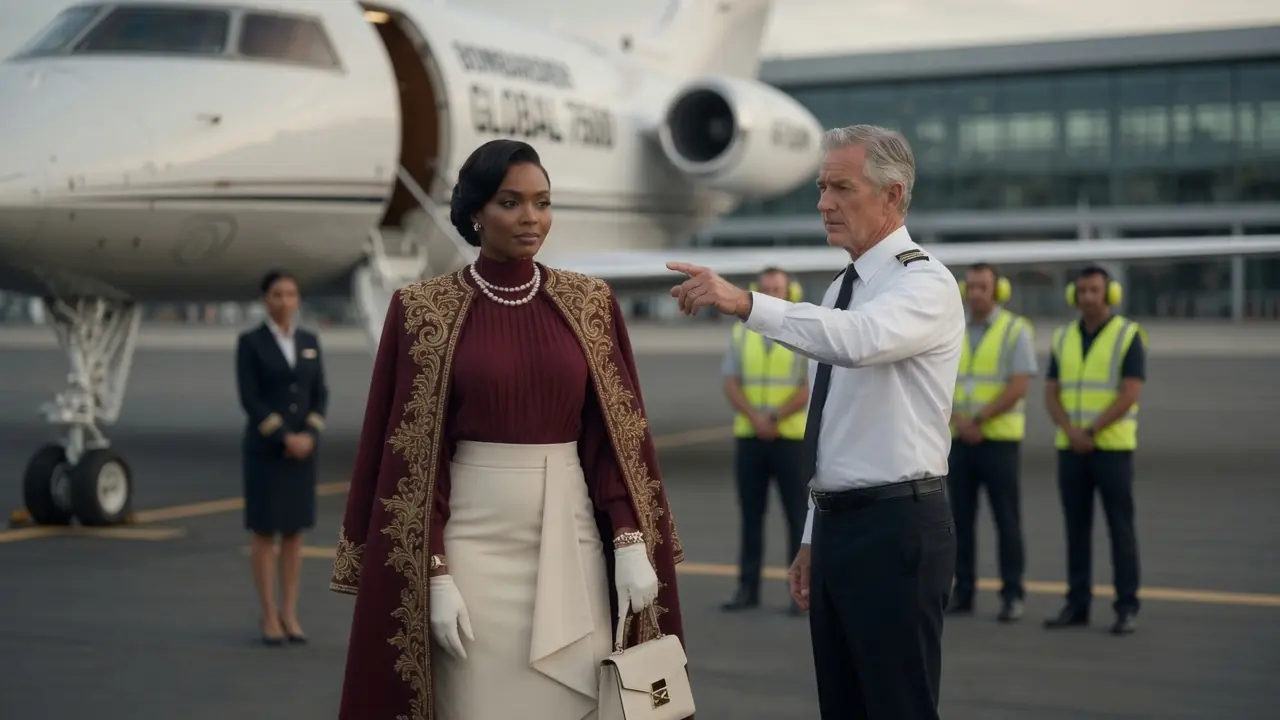
Naomi Preston did not move.
At forty-one, Naomi had spent nearly two decades entering rooms where strangers underestimated her before learning what she controlled. Her dark skin was flawless beneath the clear afternoon sky, and her hair had been arranged into an elegant sculpted updo. She wore a burgundy high-neck pleated blouse beneath a structured cape embroidered with intricate gold details, an ivory asymmetrical skirt, burgundy knee-high boots, white gloves, layered pearls, and a gold Rolex her late mother had given her after Naomi closed her first billion-dollar acquisition.
Nothing about her clothing resembled service staff.
That did not matter to Richard.
He saw a Black woman carrying a small ivory handbag and decided she could not possibly belong near an aircraft valued at more than seventy million dollars. He did not ask for identification, verify the passenger manifest, or contact operations. He simply stepped between Naomi and the stairs and treated his assumption like proof.
Naomi looked past him toward the aircraft door. A blonde flight attendant named Elise Morgan stood at the top of the stairs in a navy uniform, watching with a faint smile she tried unsuccessfully to hide. First officer Daniel Cross remained near the nose of the jet, pretending to inspect a document while clearly listening. The ground workers exchanged glances but said nothing.
Naomi extended her phone toward Richard. “My departure is scheduled for two thirty.”
Richard did not examine the screen. “The passenger has not arrived.”
“She has.”
He laughed. “That costume doesn’t make you wealthy. It only makes your desperation look expensive.”
Elise lowered her face, but Naomi saw her shoulders move with silent laughter.
Naomi checked her Rolex.
“You have five minutes to discover whose aircraft you are guarding.”
Richard stepped closer. “I have flown billionaires, royalty, and cabinet officials. I know what private ownership looks like.”
Naomi met his eyes. “Apparently, you only know what you expect it to look like.”
Richard motioned toward the nearby security officer. “Remove her before she delays the departure.”
The officer hesitated. His name badge read MARCUS HILL, and unlike Richard, he appeared uncomfortable rather than entertained. He approached slowly without touching Naomi.
“Ma’am, could I see your identification?”
“Of course.”
Naomi opened her handbag and removed a black passport case. Before handing it over, she looked directly at Richard.
“You could have asked that first.”
Richard folded his arms. “Security will determine whether the document is real.”
Marcus opened the passport. His expression changed when he saw the name.
NAOMI ELAINE PRESTON.
He looked toward the aircraft, then back at her.
Richard noticed the hesitation. “Well?”
Marcus lowered his voice. “Captain, this is the passenger listed on the flight request.”
“That is impossible.”
Naomi took back her passport. “You have four minutes.”
Richard snatched the printed passenger sheet from Daniel and scanned it. The manifest listed N. PRESTON, accompanied by two executives scheduled to arrive separately. Richard had assumed the initials belonged to Nathaniel Preston, the elderly chairman whose photograph still appeared on several outdated corporate websites.
Nathaniel Preston had been Naomi’s father.
He had died three years earlier.
Since then, Naomi had served as chairwoman and chief executive of Preston Meridian Group, an international corporation involved in medical technology, renewable energy, logistics, and aviation finance. The company employed more than eighty thousand people and owned a fleet of six private aircraft through an aviation subsidiary.
The jet behind Richard was the newest one.
Naomi had approved its purchase personally.
Richard studied her face as though the information might rearrange itself if he stared long enough. “Anyone could use that name.”
Naomi removed her phone and called one number.
“Gabriel,” she said when the line connected. “Activate ownership verification on aircraft November-Seven-Papa-Mike. Send corporate aviation counsel and security to the tarmac.”
She paused while listening.
“Yes. Full crew hold.”
Richard’s confidence slipped. “Who are you calling?”
“The person who hired the company that hired you.”
His face tightened. “You cannot place a crew on hold without operational authority.”
Naomi checked her watch again. “Three minutes.”
Elise descended two steps from the aircraft. “Captain, perhaps we should contact dispatch.”
Richard turned sharply. “Stay aboard.”
Naomi looked toward her. “You may want to come down now. It will save security the trouble.”
Elise’s smile disappeared. “I didn’t say anything to you.”
“You laughed while your captain humiliated a passenger.”
“I was reacting to the situation.”
“You were enjoying it.”
Daniel finally approached from the front of the jet. He was younger than Richard, perhaps thirty-four, with the uneasy expression of a man realizing silence had become participation.
“Ms. Preston,” he said, “I apologize for the misunderstanding.”
Naomi looked at him. “When did you understand?”
Daniel said nothing.
“When he insulted my clothes?” she continued. “When he threatened to have me dragged away? Or only after my name appeared on the manifest?”
Richard stepped between them. “Enough. I am responsible for the safety of this aircraft, and I will not be intimidated on my own ramp.”
Naomi’s expression became almost calm enough to frighten him.
“This is not your aircraft.”
A black SUV entered the restricted lane near the hangar. Behind it came a second vehicle carrying three people in dark business clothing. Both stopped beside the marked safety boundary, and four members of corporate security stepped out.
Naomi checked her Rolex.
“Two minutes and twelve seconds.”
Richard looked toward Marcus. “Do not let them approach without verification.”
Marcus did not move. “Their credentials were cleared by airport operations.”
The first person to reach Naomi was Gabriel Shaw, Preston Meridian’s chief of corporate security. Beside him walked aviation attorney Laura Bennett and Malcolm Pierce, the president of Preston Flight Services. Malcolm had personally signed Richard’s employment contract fourteen months earlier.
Richard’s face lost its remaining color.
Malcolm stopped before Naomi. “Ms. Preston, are you unharmed?”
“I am.”
“Were you denied boarding?”
“I was ordered off the tarmac, insulted, and threatened with physical removal.”
Malcolm looked toward Richard. “Captain Vale?”
Richard straightened his shoulders. “The individual failed to identify herself appropriately.”
Naomi held up her passport case. “He refused to examine my identification until security asked.”
“I was following protocol.”
Laura opened a tablet. “Protocol requires greeting the listed passenger, confirming identity privately, and contacting flight operations if there is uncertainty. It does not authorize insults, public humiliation, or discriminatory assumptions.”
Richard pointed toward Naomi. “She arrived without an escort.”
Malcolm stared at him. “She owns the aviation subsidiary.”
“She was dressed—”
Richard stopped too late.
Naomi tilted her head. “Finish the sentence.”
No one spoke.
Her Rolex marked four minutes and forty-eight seconds since the first insult.
Laura turned the tablet toward Richard. On the screen appeared the aircraft registration, ownership chain, operating agreement, and executive authorization list. The Bombardier belonged to Preston Meridian Aviation LLC, wholly controlled by Preston Meridian Group.
At the top of the authorization list appeared Naomi’s photograph and signature.
Laura spoke clearly enough for everyone to hear.
“Naomi Preston is the beneficial owner’s chief executive, principal flight authority, and sole person empowered to approve this aircraft’s crew assignments.”
Five minutes after Richard ordered her away, the truth stood between them in black letters.
Richard looked toward the jet as if seeing it for the first time.
Naomi removed one white glove finger by finger. “Now you know whose plane you were standing beside.”
He swallowed. “Ms. Preston, I apologize for the confusion.”
“You are apologizing because the ownership record frightened you.”
“No. I recognize that my language may have been inappropriate.”
“May have been?”
“I was protecting a high-value aircraft.”
“You believed I had no value.”
Richard glanced toward Malcolm. “You know my safety record.”
“I also know your employment agreement contains a conduct clause,” Malcolm replied.
Richard’s voice rose. “You cannot dismiss a captain over one misunderstanding.”
Naomi looked toward the flight attendant and first officer. “This was not one person’s mistake.”
Elise descended the remaining stairs. “I never refused her service.”
“You watched,” Naomi said.
“I didn’t know who you were.”
“That is the entire problem.”
Elise opened her mouth, then closed it.
Naomi turned toward Daniel. “You had the manifest.”
“I only saw the initials.”
“You heard Captain Vale call me hired help.”
Daniel looked down. “Yes.”
“And you remained silent.”
“Yes.”
“Why?”
He hesitated before answering. “I did not want to challenge the captain publicly.”
Naomi nodded once. “Then you prioritized rank over judgment.”
Richard stepped forward. “Do not punish the crew for my decision.”
Naomi looked at him. “You encouraged their silence because you mistook authority for correctness.”
She turned toward Gabriel.
“Remove the entire flight crew from active duty pending investigation. Collect badges, aircraft keys, company devices, and access credentials.”
Richard’s expression collapsed. “You cannot do this five minutes before departure.”
“I just did.”
Corporate security moved toward the stairs. Elise protested that her personal luggage remained aboard, while Daniel quietly handed over his airport badge and tablet. Richard refused to surrender the aircraft key card.
Malcolm extended his hand. “Captain.”
“I have a contract.”
“You have a suspended contract.”
“I am the most experienced Global 7500 captain in this operation.”
Naomi glanced toward the jet. “Experience without character is only a more efficient way to cause damage.”
Richard’s fingers tightened around the card. “You are destroying three careers because your feelings were hurt.”
Naomi’s voice remained level.
“You threatened to have security drag the owner of this aircraft from her own departure because you decided her skin, clothing, and lack of an escort made her inferior. If I had been an employee, your conduct would still deserve investigation.”
Richard looked toward the ground workers, perhaps hoping someone would support him. Neither man met his eyes. They had witnessed everything and understood that any defense would expose their own silence.
He finally surrendered the key card.
Security escorted Richard, Elise, and Daniel toward the terminal. Richard attempted to walk with dignity, but every employee on the tarmac had heard the confrontation. His shoulders remained stiff while his face carried the humiliation he had intended for Naomi.
Before entering the security vehicle, he turned back.
“This aircraft will not depart today without me.”
Naomi looked toward Malcolm. “How long until the reserve crew arrives?”
“Twenty-three minutes.”
Richard said nothing else.
Naomi boarded her jet at three minutes past three. The new crew greeted her professionally, confirmed the revised flight plan, and asked whether she preferred to delay the departure further. She declined.
Her destination was Chicago, where Preston Meridian’s board was preparing to vote on a major acquisition. The delay cost less than an hour.
The incident cost much more.
Inside the cabin, Naomi sat near the window while Gabriel briefed her. Richard had been employed through Preston Flight Services after leaving another aviation company under what his résumé described as a voluntary transition. Elise had joined the crew six months later, and Daniel transferred from charter operations the previous spring.
No previous formal complaints appeared in their files.
Naomi did not trust the absence.
“Review every flight report, staff complaint, passenger survey, and security recording connected to that crew,” she said. “Include caterers, cleaners, drivers, and ground workers.”
Gabriel nodded. “How far back?”
“Everything.”
The first findings arrived before Naomi landed.
A Black ground technician had reported Richard for referring to him as “the baggage boy” despite his aviation maintenance certification. The complaint disappeared after a supervisor marked it resolved without interviewing witnesses. A female mechanic claimed Richard refused to accept her safety inspection until a male colleague repeated the same conclusions.
Elise had been accused twice of treating passengers’ assistants and domestic employees with open contempt. Daniel had filed no complaints, but internal messages showed he knew about several incidents and advised coworkers not to “create problems with the captain.”
The crew’s behavior toward Naomi had not begun on the tarmac.
It had simply reached someone with enough authority to force an answer.
The following morning, Naomi entered Preston Meridian’s Chicago boardroom wearing a simple charcoal suit instead of the elaborate clothing Richard had mocked. Every director had already seen a security summary of the incident.
One board member asked whether suspending the entire crew had been excessive.
Naomi placed three complaint files on the table.
“What happened to me lasted five minutes,” she said. “What happened to employees around them lasted years because no one important was watching.”
The room became quiet.
Preston Meridian had grown so quickly that many private services were outsourced through layers of contractors. Pilots, drivers, security officers, caterers, and ground staff often worked under companies that reported polished summaries rather than uncomfortable truths. Senior executives saw satisfaction scores, not the humiliations hidden beneath them.
Naomi ordered an independent review of the entire corporate aviation division.
Investigators interviewed pilots, mechanics, cabin crews, dispatchers, cleaners, and passengers. They discovered that Richard had cultivated a reputation for professionalism around wealthy travelers while treating employees and unfamiliar guests according to appearance and status.
He referred to caterers as “tray carriers,” mocked accents, and once demanded that a wheelchair user prove she was a passenger rather than someone’s dependent. Supervisors knew he was difficult but protected him because clients praised his smooth flights and punctual departures.
Elise had copied his behavior because proximity to powerful people made her feel powerful as well. She treated assistants warmly when their employers were present and dismissively when they were alone. Daniel disagreed privately but remained silent because he hoped Richard would recommend him for promotion.
Their choices were different.
The damage was connected.
A week after the tarmac incident, Richard attended a formal disciplinary hearing with an attorney. He wore a dark suit instead of his captain’s uniform and insisted that race played no role in his decision.
“I saw an unidentified woman approaching a restricted aircraft,” he said.
Laura Bennett replayed security footage showing Naomi walking from a cleared executive vehicle through a checkpoint where her identification had already been verified. Richard could be heard asking whether “Mr. Preston” was late before Naomi even reached him.
“You were expecting the owner’s representative,” Laura said.
“I was expecting a man.”
“That expectation was your error.”
Richard argued that Naomi’s unusual outfit contributed to the misunderstanding. Laura displayed photographs of other passengers who had boarded Preston aircraft wearing jeans, sportswear, ceremonial clothing, and even riding boots.
None had been described as hired help.
Then Gabriel played the clearest recording.
“That costume doesn’t make you wealthy,” Richard’s voice said. “It only makes your desperation look expensive.”
Richard listened without expression.
Naomi sat across the table. “What safety purpose did that sentence serve?”
He looked toward his attorney.
She did not answer for him.
Richard finally spoke. “None.”
“Why did you say it?”
“I was frustrated.”
“With what?”
“With being challenged.”
“By someone you believed was beneath you.”
He looked down.
The review board terminated Richard’s employment for discrimination, misconduct, attempted physical removal of an authorized passenger, and violation of command standards. His record was forwarded to the contracting company and professional aviation associations responsible for future placements.
Elise was also dismissed after investigators confirmed repeated mistreatment of employees and passengers. Daniel received a lengthy suspension rather than termination because he cooperated fully, acknowledged his silence, and provided evidence regarding earlier complaints.
Naomi required him to complete leadership and ethics training before flying again.
Some executives criticized that decision from opposite directions. A few believed Daniel should have been fired with the others, while some argued none of the crew deserved such severe consequences.
Naomi explained the distinction.
“Richard initiated abuse and used command to sustain it. Elise participated willingly. Daniel failed to intervene, then accepted responsibility and helped expose the pattern. Accountability should examine conduct, not simply create matching punishments.”
Daniel returned to work nine months later in a lower position. On his first assignment, a ground employee questioned a maintenance entry before departure. The new captain dismissed the concern and tried to continue boarding.
Daniel stopped the process.
He requested a second inspection, which revealed a damaged sensor cable. The delay prevented a possible in-flight systems failure.
When asked why he challenged the captain, Daniel gave a simple answer.
“I learned what silence costs.”
Naomi’s review transformed Preston Meridian Aviation. Every crew member received authority to report disrespect or safety concerns outside the normal command chain. Contractors could no longer close complaints without independent confirmation, and performance reviews included treatment of ground workers, assistants, cleaners, and service personnel.
The company also introduced anonymous passenger testing.
Executives, auditors, and hired evaluators traveled without visible status to observe how employees treated people they believed lacked influence. Naomi disliked the idea of kindness becoming another examination, but she understood that systems often revealed their true character only when workers believed no powerful person was present.
Six months later, she returned to the same private terminal.
She wore a plain brown coat, black trousers, and comfortable flats. Her hair was pulled back simply, and no security team walked beside her. The Bombardier Global 7500 waited under clear morning light with a different crew preparing the stairs.
Captain Marisol Vega approached first.
“Good morning, Ms. Preston.”
Naomi smiled. “You recognized me.”
“I reviewed the manifest.”
Marisol then turned toward an elderly catering worker pushing a heavy cart nearby. One wheel caught in a crack, causing several trays to shift. Instead of ignoring him, Marisol helped steady the cart and asked whether maintenance had been notified about the damaged pavement.
She did not know Naomi was watching.
That mattered more than the greeting.
Naomi boarded without incident.
Inside the cabin, she found a handwritten card placed near her seat.
Welcome aboard. Every person on this aircraft is responsible for dignity as well as safety.
The sentence had become part of the aviation division’s new crew standard. Naomi read it twice, then looked through the window toward the workers loading baggage beneath the aircraft.
Five minutes had changed the division.
Not because Naomi was a billionaire.
Not because the jet belonged to her.
The change happened because Richard revealed how easily authority could become cruelty when no one expected consequences. He saw Naomi’s dark skin, elaborate clothing, and lack of an obvious escort, then built an entire judgment before asking one professional question.
Her ownership records exposed his mistake.
The investigation exposed his character.
One year later, Preston Meridian held its annual aviation conference inside a large maintenance hangar. Pilots, dispatchers, mechanics, flight attendants, ground crews, and security staff gathered beneath the wings of several aircraft.
Naomi stood before them wearing the burgundy cape Richard had once called a costume.
She had considered choosing something less memorable. Then she decided the clothing deserved to return without apology.
“The first time I wore this beside our Global 7500,” she said, “a captain decided it proved I did not belong.”
The audience remained silent.
“He was wrong about my identity, but that was not his greatest failure. His greatest failure was believing humiliation would have been acceptable if I truly had been a cleaner, assistant, caterer, or stranger.”
Several ground workers nodded.
Naomi continued.
“Private aviation often speaks about exceptional service. Service is not exceptional when it appears only after someone recognizes wealth. Character is what remains before the passenger’s name is known.”
After the speech, Marcus Hill approached her near the hangar doors. He was the security officer who had asked for her passport on the tarmac.
“I’ve thought about that day often,” he said.
“You handled the identification properly.”
“Only after he had already insulted you.”
“You hesitated before touching me.”
“I knew something was wrong.”
“But you almost followed his order anyway.”
Marcus nodded. “I was afraid of challenging the captain.”
Naomi looked toward the assembled crews. “Fear explains silence. It does not repair what silence allows.”
“I know.”
He told her he had since become a security training supervisor. Every new officer now learned that rank did not remove the responsibility to question discriminatory commands.
Naomi offered her hand.
Marcus shook it.
The gesture lasted only a second, but it reminded her of the hand Richard refused.
His rejection had been intended to establish distance between someone he considered powerful and someone he considered insignificant. Five minutes later, the ownership records reversed that hierarchy, and he apologized only because he realized the woman before him controlled his career.
Naomi never accepted that apology.
She did not need his regret after the truth became expensive.
What mattered was the system built afterward—the complaints reopened, the workers finally heard, and the standard that required every person approaching the aircraft to be treated with dignity before wealth, title, or ownership was confirmed.
Richard had ordered Naomi Preston away from her own plane.
He believed the jet, the crew, and the tarmac belonged more naturally to him than to the Black woman standing before him.
Then Naomi checked her Rolex and made one call.
Five minutes later, the aircraft remained where it was.
The entire crew did not.