At four-thirty in the morning, Clara Whitlock opened the kitchen door and stepped barefoot into snow cold enough to burn.
She had only meant to check the sky.
Instead, she stood frozen beneath the porch roof with one hand gripping the doorframe and the other pressed against the wool shawl over her chest.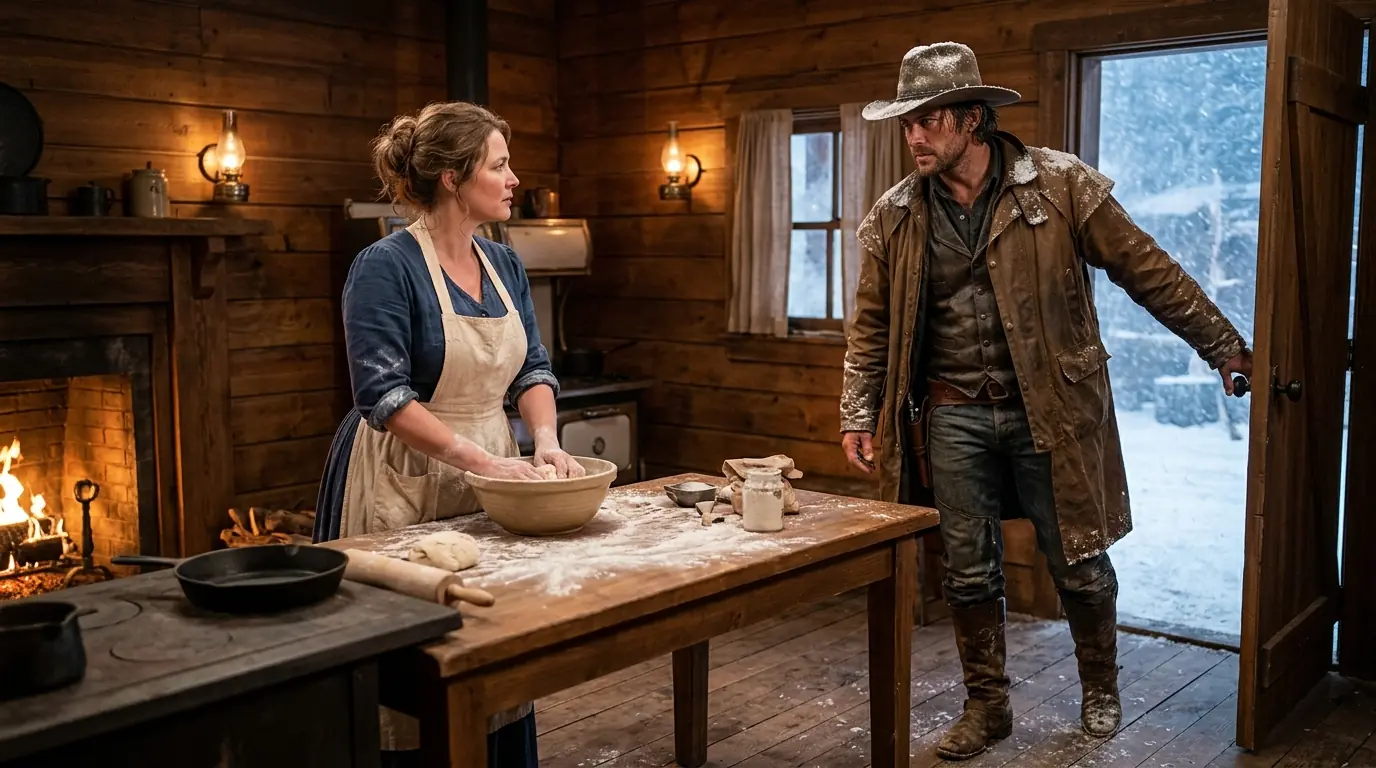
The northwestern horizon was almost black.
Not ordinary darkness.
Not cloud cover.
Something heavy.
Something moving.
The horses knew it too.
From the barn came the dull pounding of hooves against stall boards, followed by a nervous whinny that carried across the frozen yard.
Clara closed her eyes.
She had seen a sky like that twice.
The first time, she had been nineteen and newly married in Wyoming.
Her husband James had stood beside her on the porch, his hand wrapped around hers while she told him the temperature was falling too quickly.
Three hours later, the storm came hard enough to tear half the south roof from their barn.
The second time had been in Idaho, years after James was dead.
No husband then.
No hand around hers.
Only another ranch manager who laughed when the cook told him the horses were warning him.
That storm killed cattle.
Clara opened her eyes.
“Not again,” she whispered.
Then she stepped back inside.
She had lived long enough to understand a painful truth.
Sometimes people did not listen.
But the weather did not care whether they believed you.
So Clara started preparing.
She lit the main stove.
Measured flour.
Worked lard into the dough.
Started biscuits.
Then eggs.
Her hands moved automatically while her mind counted everything else.
Fourteen ranch hands.
Four horses near the main barn.
Forty-seven cattle in the eastern pasture.
Four cords of split firewood stacked against the south barn wall.
Enough flour for nine days if rationed carefully.
Enough salt pork for perhaps twelve.
Beans for longer.
Coffee for six days if the men drank normally.
Three oil lamps in the supply room.
Two in the main house.
One loose window latch upstairs.
A bunkhouse roof Roy Hatch had been promising to repair for two months.
Water.
That one worried her most.
If the temperature fell the way she expected, the east pipes might freeze.
Clara looked toward the staircase.
Roy was asleep upstairs.
Roy Hatch.
Forty-four years old.
Tall.
Strong.
Capable.
Stubborn enough to argue with a mountain if he thought the mountain had crossed his fence line.
He owned enough of Blackstone Ranch to speak like a man responsible for everything on it, though technically the property belonged to an absentee investor in Boston.
Roy had run it for twelve years.
Clara had worked for him eleven months.
In those eleven months, he had spoken directly to her perhaps ten times.
Most conversations were short.
“Coffee’s weak.”
“Need more biscuits.”
“Pete doesn’t eat peanuts.”
“Gravy could use salt.”
Once, when Clara had burned her wrist removing a pan from the oven, Roy had noticed the bandage.
He asked what happened.
She told him.
He nodded.
That had been the longest conversation they had shared.
Yet Clara knew nearly everything about him.
Not because she wanted to.
Because she watched.
Roy checked fence lines personally after heavy rain.
He rubbed the scar along his jaw whenever worried.
He read business ledgers after midnight when money was tight.
He never ate breakfast before everyone else had food.
He pretended not to like sweet things but always took the last spoonful of blackberry preserves.
And when a ranch hand was injured, Roy became angry at the injury as if pain itself had broken ranch rules.
He was not cruel.
That almost made his blindness worse.
Cruel men were easy.
You knew where you stood.
Roy simply did not see her.
Clara finished the first tray of biscuits.
Then she made a decision.
She would warn him once.
After that, she would stop trying to convince him and start doing what needed doing.
At six, the ranch hands began entering the kitchen.
Boots.
Cold air.
Laughter.
Hats hung on hooks.
Coffee poured into tin cups.
Roy entered first.
His dark hair was still damp from washing, and he wore a brown work shirt with the sleeves rolled to his forearms.
He sat at the head of the long table and opened the ranch ledger.
“Mr. Hatch.”
Nothing.
Clara placed bacon onto a platter.
“Mr. Hatch.”
He looked up.
“What?”
“There’s a blizzard coming.”
Pete Galloway stopped buttering a biscuit.
Someone chuckled.
Roy frowned.
“When?”
“Tonight. Maybe before midnight.”
Roy looked toward the window.
The morning beyond it was cold but clear enough near the ranch.
“Forecast from where?”
“My eyes.”
A few men laughed.
Clara ignored them.
“The temperature dropped eight degrees since midnight.”
Roy leaned back.
“You’ve been measuring?”
“Yes.”
“The horses are restless. Wind changed twice. Clouds are building northwest.”
Roy closed the ledger.
“Clara.”
His voice was not mocking.
It was patient.
That hurt more.
“We get November storms.”
“This isn’t a normal November storm.”
“You certain?”
“Yes.”
“How certain?”
She held his gaze.
“Certain enough that I would move the cattle before noon.”
That silenced the table.
Roy’s expression changed.
Moving nearly fifty head was work.
Hard work.
Work that cost time.
“What makes you think the eastern pasture isn’t safe?”
“No shelter.”
“There’s tree line.”
“Not enough.”
Clara set the platter down.
“The southern canyon has three rock walls and opens east. Put them there.”
Pete smiled.
“My grandmother predicted storms with her knees.”
A few men laughed again.
Clara looked at Pete.
“Your grandmother may have paid attention.”
His smile faltered.
Roy rubbed his jaw.
There it was.
The scar.
He was thinking.
For one hopeful second, Clara thought he might listen.
Then he reopened the ledger.
“I’ll keep an eye on it.”
That was dismissal dressed as courtesy.
Clara nodded.
“Yes, sir.”
She turned back toward the stove.
Walt Decker arrived after breakfast.
Walt was sixty-two, with crooked knuckles, deep crow’s-feet, and enough years working Montana cattle to know when men were wrong without enjoying it.
Clara poured him coffee.
“You heard?”
He nodded.
“Sky looks ugly.”
“Twelve hours,” Clara said.
“Maybe less.”
Walt wrapped his hands around the cup.
“What needs doing?”
Five words.
Simple words.
Clara stopped moving.
Nobody had asked her that since James.
She looked at Walt.
“Cattle first.”
He nodded.
“Tell Roy you’re checking the eastern pasture.”
“And then?”
“Move them gradually toward the canyon.”
Walt’s mouth twitched.
“That’s insubordination dressed as routine work.”
“Yes.”
He almost smiled.
“What else?”
“Firewood inside.”
“Water stored.”
“Bunkhouse roof repaired.”
“Oil lamps filled.”
“Blankets moved downstairs.”
Walt studied her.
“You planned all this before sunrise.”
“I planned it while baking biscuits.”
“Always knew biscuits were dangerous.”
That made Clara smile despite herself.
Walt stood.
“I’ll get Pete and Sam.”
Clara caught his sleeve.
“Walt.”
He turned.
“Be careful.”
He looked at her hand.
Then at her face.
“I intend to survive long enough to see Roy apologize.”
Clara released him.
“That could take decades.”
“Then I better stay healthy.”
By noon, half the cattle were already moving south.
Roy noticed.
Of course he noticed.
He appeared in Clara’s kitchen while she stood on a chair checking the top pantry shelf.
“What’s Walt doing?”
“Checking pasture drainage.”
“Moving cattle?”
“So it seems.”
Roy looked toward the window.
Then at the row of water pots Clara had filled.
“What are those?”
“Water.”
“I know they’re water.”
“Then we agree.”
“Why are they on my kitchen floor?”
Clara climbed down.
“If the pipes freeze, we’ll need them.”
“The pipes aren’t freezing.”
She folded the inventory paper.
“All right.”
Roy stared at her.
“You’re doing this anyway.”
“Yes.”
“After I told you the storm wasn’t serious.”
“No.”
His eyebrows lifted.
“You didn’t tell me it wasn’t serious.”
“You told me you’d keep an eye on it.”
“So?”
“So I kept both eyes on it.”
For three seconds, neither moved.
Something unexpectedly hot passed between them.
Not anger.
Not exactly.
Roy’s gaze dropped to the flour on Clara’s cheek.
Then immediately returned to her eyes.
Clara noticed.
Of course she noticed.
She noticed everything.
Roy cleared his throat.
“Focus on supper.”
Clara nodded.
“Yes, sir.”
He walked away.
She waited until his footsteps disappeared.
Then muttered:
“Stubborn bastard.”
From the pantry doorway, Pete said:
“I heard that.”
Clara turned.