Caleb Morgan noticed the silence before he noticed the food.
Morgan Ranch had never been quiet at supper. Even when the dining room stood nearly empty, there were always boots scraping across floorboards, men arguing about cattle prices, someone complaining about a broken fence, or a ranch hand announcing that he was riding into town because he could no longer tolerate another plate of beans.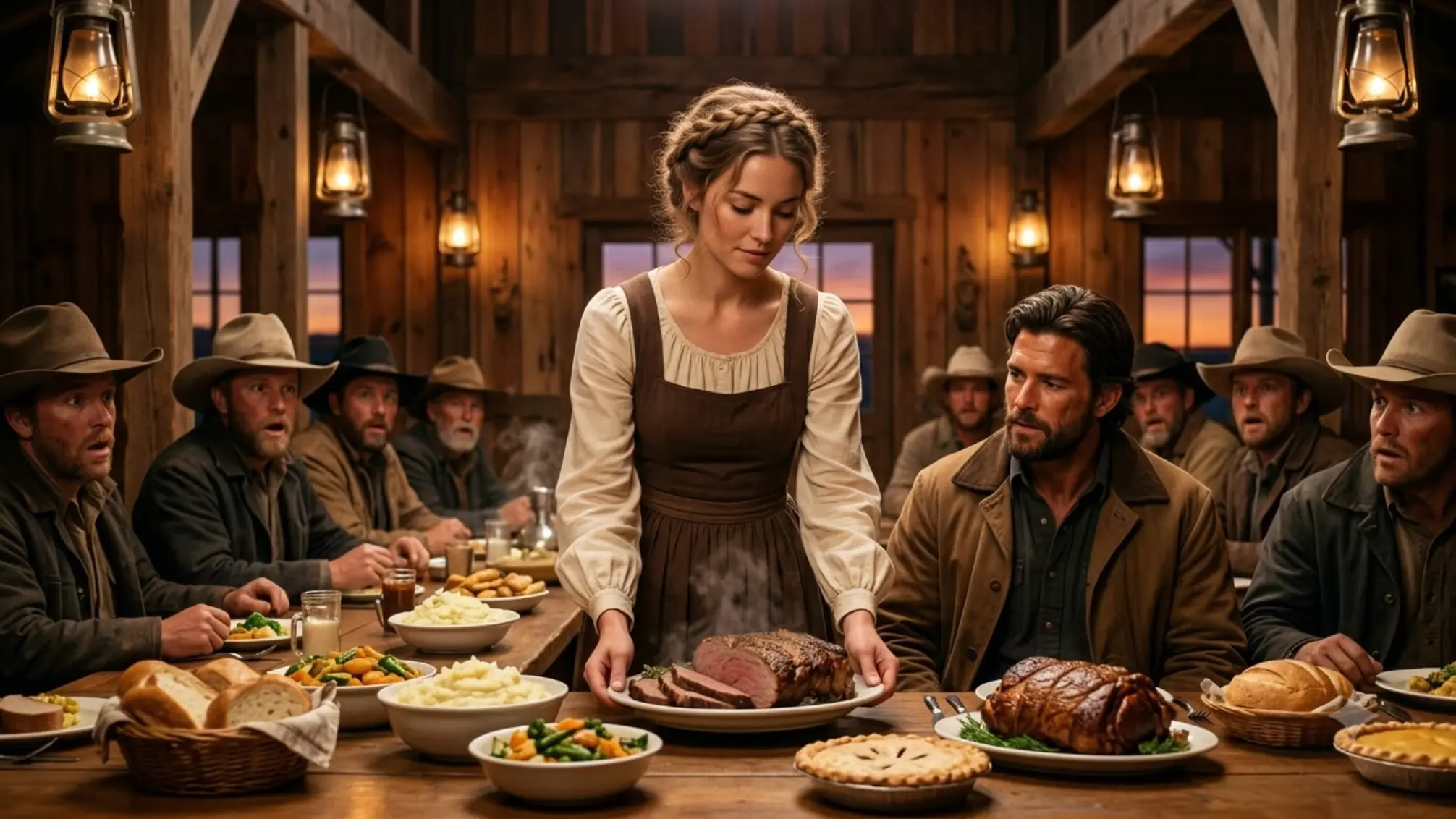
That evening, twenty-three men stood motionless around the long wooden table.
Every one of them was staring at Caleb’s new wife.
Eliza Hart stood at the center of the room with her sleeves rolled neatly below her elbows and a faint flush across her cheeks from the kitchen heat. Her dark-brown hair had been pinned into a loose braided crown, a few soft curls escaping near her temples, and her simple cream blouse and fitted brown apron looked almost too delicate for a working cattle ranch.
In her hands rested an enormous platter of roasted beef.
Steam curled gently upward.
Caleb looked from Eliza to the table.
Fresh bread.
Mashed potatoes whipped until they looked almost impossibly smooth.
Carrots, onions, and squash seasoned with herbs from a garden Caleb had nearly forgotten existed.
Two golden pies rested near the window.
And at the center of everything sat a roast covered in rich brown gravy that smelled better than anything Caleb remembered eating inside his own house.
Eliza placed the platter down.
“Dinner is ready.”
No one moved.
Eliza looked around.
“Gentlemen?”
That finally broke the spell.
A ranch hand named Wade Sutton slowly removed his hat.
Wade was forty-six, built like an old fence post, and had worked for the Morgan family since Caleb was sixteen. He distrusted anything he considered fancy, including clean shirts, furniture with cushions, and food requiring more than one cooking pot.
He stared at the roast.
“Ma’am,” he said carefully, “is that actually ours?”
Several men laughed.
Eliza smiled.
“Unless another ranch misplaced a roast in our kitchen.”
The laughter grew louder.
Caleb noticed something immediately.
They were laughing with her.
Not at her.
That was different.
Wade cautiously sat.
The other men followed.
Within seconds plates began moving from hand to hand.
Caleb remained standing.
Eliza glanced toward him.
“Aren’t you hungry?”
He looked at the table again.
“I’m trying to understand what happened to my kitchen.”
“Your kitchen?”
Her eyebrow lifted slightly.
Caleb almost smiled.
“Our kitchen.”
“That sounds better.”
He pulled out a chair.
Eliza moved toward the end of the table.
Caleb stopped her.
“You’re not sitting there.”
She looked confused.
“That’s where I sat yesterday.”
Yesterday had been different.
Yesterday the men had barely spoken to her.
Yesterday she had been Caleb Morgan’s strange new bride, a woman he had brought back from town after a courtship so short that even he occasionally wondered whether they had both lost their minds.
Tonight she had performed a miracle.
Caleb pulled out the chair beside him.
“Sit here.”
Every ranch hand noticed.
Eliza hesitated.
Then she sat.
Wade cut himself a piece of beef.
He tasted it.
His chewing stopped.
The man beside him stared.
“Well?”
Wade took another bite.
Then another.
“Wade?”
He ignored them.
Instead, he pulled the platter closer.
Immediately six hands reached across the table.
“Hold on!”
“You had your chance!”
“Pass that down here!”
Within moments the quiet dining room erupted.
Men reached for bread.
Someone demanded potatoes.
Someone else nearly started an argument over gravy.
A ranch hand named Tommy Reid tasted the vegetables and looked personally betrayed.
“I’ve eaten carrots my whole life.”
Eliza smiled.
“I’m glad to hear it.”
Tommy pointed his fork toward the bowl.
“Those ain’t carrots.”
Several men laughed.
“What are they, then?”
“I don’t know.”
He took another bite.
“But carrots have never tasted like that.”
Even Caleb laughed.
Eliza lowered her eyes, trying to hide a smile.
He noticed.
He had noticed many things about her during the previous three weeks.
Eliza listened more than she spoke.
She remembered names after hearing them once.
She never complained.
She did not seem impressed by his acreage, his cattle, his bank account, or the fact that people in three counties called him one of Montana’s wealthiest ranchers.
Most importantly, she seemed almost uncomfortable whenever anyone praised her.
Caleb had not yet decided why.
The first time he met her had been inside Peterson’s General Store in Helena.
He had gone there for harness buckles.
She had been arguing with the shopkeeper over flour.
Not angrily.
Firmly.
The man had tried charging an elderly woman twice the marked price because she could not read the chalkboard clearly.
Eliza had quietly corrected him.
When he refused, she removed the difference from her own purse.
Caleb watched the entire exchange.
She never looked around to see whether anyone had noticed.
That was what interested him.
Beautiful women had approached Caleb Morgan for years.
Some were sincere.
Others saw Morgan Ranch before they saw Caleb.
He had grown tired of trying to determine which was which.
Eliza did not appear to care.
During their second conversation, she asked him whether he liked reading.
During the third, she asked whether his workers had Sundays free.
During the fourth, she told him his coat needed mending.
No woman had ever attempted to impress him by criticizing his coat.
He proposed six weeks later.
Their marriage surprised everyone.
Including Eliza.
Caleb had been clear.
“I’m not promising some grand romance.”
Eliza had answered, “That is fortunate. I wouldn’t know what to do with one.”
He nearly laughed.
She continued.
“I want honesty.”
“I can give you that.”
“And respect.”
“That too.”
“Then perhaps affection can decide for itself whether it wishes to arrive.”
Caleb had liked that answer.
So they married.
Now, watching Eliza quietly refill Wade’s potatoes while twenty-three ranch hands behaved like starving men at a hotel banquet, Caleb wondered whether affection had arrived before either of them noticed.
The following evening, nobody rode into town.
Caleb noticed because the hitching rail remained full.
At six o’clock every man on the property found some excuse to remain near the bunkhouse.
At six fifteen, Wade wandered suspiciously close to the kitchen window.
At six twenty, Tommy appeared beside him.
Caleb caught them both.
“What are you doing?”
Wade immediately straightened.
“Checking the foundation.”
Caleb stared at him.
“The foundation.”
“Yes.”
“From the kitchen window.”
“Best angle.”
Tommy nodded seriously.
“Very important angle.”
Caleb folded his arms.
“What are you smelling?”
Wade looked offended.
“Nothing.”
Tommy inhaled deeply.
“Chicken.”
Wade elbowed him.
Caleb walked away before they saw him smile.
Dinner was chicken baked with rosemary, potatoes crisped in a cast-iron pan, beans cooked with onion, and biscuits that disappeared so quickly Eliza barely managed to sit down.
The following night she served stew.
Then pork.
Then meat pies.
By the end of the week, not one ranch hand had gone into town for supper.
The owner of Molly’s Café noticed.
So did everyone else.
“Your men sick?” the blacksmith asked Caleb when he rode through town.
“No.”
“Broke?”
“No.”
“Then why ain’t they eating at Molly’s?”
Caleb adjusted his hat.
“My wife cooks.”
The blacksmith laughed.
Caleb did not.
The man stopped laughing.
“That good?”
Caleb looked toward Morgan Ranch in the distance.
“Apparently.”
News traveled.
By the second week, neighboring ranch hands invented reasons to visit Morgan property around supper.
A missing horseshoe.
A question about grazing boundaries.
A borrowed wrench.
Wade began chasing them away.
“You don’t work here.”
One cowboy protested.
“I came to see Caleb.”
“At six twenty-five?”
“Important business.”
“What business?”
The cowboy glanced toward the dining hall.
“Beef-related.”
Wade pointed toward the road.
“Town’s that way.”
Eliza eventually discovered what was happening.
She found Wade standing near the gate arguing with three men from the Carson spread.
“What’s wrong?”
“Nothing.”
The visitors removed their hats.
One smiled.
“Evening, Mrs. Morgan.”
“Good evening.”
Wade stepped between them.
“They’re leaving.”
Eliza looked toward the wagon they had brought.
One of the men held a wooden crate.
“What’s that?”
The cowboy looked hopeful.
“Apples.”
Eliza stared.
“For me?”
“Yes, ma’am.”
“Why?”
He glanced at Wade.
Wade groaned.
“Because they want pie.”
Eliza laughed so suddenly that every man relaxed.
“You brought thirty pounds of apples?”
The cowboy nodded.
“We were hoping.”
Eliza considered the crate.
Then looked toward the dining hall.
“There are three empty chairs.”
Wade looked horrified.
“Mrs. Morgan.”
She smiled sweetly.
“Would you like pie tonight, Wade?”
He stopped.
“That’s unfair.”
“Three chairs.”
Wade reluctantly opened the gate.
The story spread by morning.
After that, Eliza established rules.
Visitors could eat if they brought something useful.
Vegetables.
Fruit.
Flour.
Coffee.
Preserves.
Nobody paid money.
Caleb watched his wife turn supper into an informal exchange system that benefited half the valley.
The ranch garden expanded.
A neighboring widow began supplying eggs.
A shepherd traded cheese.
Two brothers who owned an orchard delivered apples and pears.
Eliza somehow persuaded men who had once considered vegetables an insult to spend Sunday mornings helping enlarge the garden.
Caleb found Wade planting onions.
He stopped his horse.
Wade looked up.
“Don’t.”
“I didn’t say anything.”
“You were going to.”
Caleb smiled.
“I was just admiring the foundation.”
Wade threw dirt at his boot.
But something else was changing.
The men stayed longer at the table.
They talked.
Not only about work.
Tommy admitted he had a younger sister in Idaho he had not written to in almost a year.
Wade began teaching two younger ranch hands to read account ledgers.
A quiet worker named Samuel mentioned that his mother had become ill.
Three men volunteered to cover his shifts so he could ride home.
Caleb noticed accidents decreased.
Arguments decreased.
Drinking decreased.
Productivity increased.
He did not understand how mashed potatoes had accomplished what years of ranch rules had failed to do.
One evening, he said so.
Eliza stood washing dishes.
Caleb picked up a towel.
She looked at him.
“What are you doing?”
“Helping.”
“You own twelve thousand cattle.”
“They can wait.”
“They’re probably offended.”
“They’ll recover.”
He dried a plate.
“I think you did something to my men.”
Eliza smiled.
“Poison?”
“They’re happier.”
“That sounds inconvenient.”
“They work better.”
“Terrible.”
“They fight less.”
“Should I apologize?”
Caleb watched her.
“I mean it.”
Her smile faded into something gentler.
“A table does that.”
“What?”
“Gives people somewhere to belong.”
She returned a plate to the cupboard.
“My mother used to say people speak differently after someone feeds them.”
Caleb leaned against the counter.
“You learned from her?”
Eliza stopped.
Only for a second.
But Caleb saw it.
“Yes.”
“Was she a cook?”
“She was many things.”
Eliza continued washing.
Caleb sensed the conversation had reached a closed door.
He did not force it open.
Weeks passed.
Summer faded slowly toward autumn.
Caleb and Eliza developed a rhythm neither had expected.
He rose before sunrise.
She usually woke shortly afterward.
Sometimes they drank coffee together on the porch without saying anything.
She asked about cattle.
He asked what she needed from town.
He began leaving wildflowers beside the kitchen window.
She pretended not to know he was responsible.
He pretended to believe her.
Their marriage remained careful.
They slept in adjoining rooms.
Caleb had told her the arrangement could remain that way until she chose otherwise.
Eliza never forgot that.
He never mentioned it again.
One rainy evening, the ranch hands crowded around the table while wind struck the windows.
Eliza served beef stew and bread.
Caleb watched her move between chairs.
Beautiful was too simple a word.
He had thought she was beautiful the day they met.
Now he knew the way she frowned when calculating ingredients.
The way she tucked loose hair behind her ear.
The way her entire face changed when she laughed.
The way she always served herself last.
That bothered him.
When she finally sat, Caleb pushed his untouched bowl toward her.
She frowned.
“What?”
“You haven’t eaten enough.”
“I’m fine.”
“That isn’t food.”
She looked at her plate.
There was half a biscuit and several vegetables.
“I was busy.”
“Eat.”
The room went quiet.
Eliza looked amused.
“Was that an order, Mr. Morgan?”
Twenty-three men suddenly became fascinated by their bowls.
Caleb realized his mistake.
“No.”
“Good.”
She slid his stew back.
“I don’t take orders particularly well.”
Wade coughed into his sleeve to hide a laugh.
Caleb glared.
Wade concentrated harder on his dinner.
Caleb lowered his voice.
“Then consider it concern.”
Eliza’s expression softened.
She took the bowl.
“Concern I can accept.”
That night she ate beside him.
Neither noticed how closely their shoulders rested until everyone else had left.
Caleb looked at her.
Eliza looked at him.
For several quiet seconds, neither moved.
Then she smiled.
“Good night, Caleb.”
“Good night, Eliza.”
She walked upstairs.
Caleb remained at the table wondering how a practical marriage had become the most complicated thing he had ever wanted.
The answer began revealing itself three days later.
A stagecoach arrived unexpectedly.
A woman stepped down.
She was nearly sixty, beautifully dressed, silver-haired, and carrying an expensive leather case.
Eliza saw her through the kitchen window.
The bowl in her hands slipped.
It did not break.
Caleb caught it.
“Eliza?”
She was staring outside.
The older woman entered the house without waiting to be invited.
“Eliza Hart.”
Eliza went pale.
“Mrs. Beaumont.”
Caleb looked between them.
“You know each other.”
Mrs. Beaumont smiled.
“Quite well.”
Eliza wiped her hands on her apron.
“What are you doing here?”
“Looking for you.”
“You found me.”
“Eventually.”
Caleb stepped closer.
“Perhaps someone should explain.”
Mrs. Beaumont studied him.
“You must be the husband.”
“Eliza’s husband.”
The distinction seemed to please her.
She removed her gloves.
“My name is Adelaide Beaumont.”
Caleb recognized it.
Everyone did.
Beaumont House in Denver was one of the finest hotels in the region.
Politicians stayed there.
Railroad executives.
Wealthy cattlemen.
Caleb had attended one dinner there years earlier.
The food had been legendary.
He slowly turned toward Eliza.
Mrs. Beaumont smiled knowingly.
“Now you understand.”
Caleb did not.
Not entirely.
Eliza sighed.
“I worked there.”
Mrs. Beaumont laughed.
“Worked there?”
She looked at Caleb.
“Your wife ran my kitchen.”
The room went silent.
Wade, who had entered through the back door carrying a sack of potatoes, stopped completely.
Eliza closed her eyes.
Mrs. Beaumont continued.
“She was twenty when I hired her.”
Caleb stared.
“Ran the kitchen?”
“At twenty-two.”
Wade whispered, “I knew those carrots weren’t ordinary.”
Eliza looked embarrassed.
Caleb looked fascinated.
Mrs. Beaumont opened her leather case.
“I have been searching for you for four months.”
“Why?”
“Because you disappeared.”
“I resigned.”
“You vanished.”
“I left a letter.”
“A six-line letter.”
“It was clear.”
Mrs. Beaumont stared at her.
“You were offered partnership.”
Caleb’s eyes shifted toward Eliza.
“Partnership?”
Mrs. Beaumont nodded.
“Twenty percent of Beaumont House’s dining operation.”
Wade dropped the potatoes.
Everyone looked at him.
“Sorry.”
Eliza crossed her arms.
“I didn’t want it.”
Mrs. Beaumont’s voice softened.
“I know.”
“Then why come?”
“Because you still deserve to know what happened.”
She removed papers from the case.
“The investors approved your proposal.”
Eliza froze.
“What proposal?”
“The training kitchen.”
Caleb watched Eliza’s face.
Something changed.
Hope appeared.
Then fear.
Mrs. Beaumont continued.
“Women with nowhere to work. Widows. Immigrants. Girls leaving difficult homes. You wanted us to train them properly and place them in restaurants throughout Colorado.”
Eliza looked down.
“They rejected it.”
“They did.”
Mrs. Beaumont placed the papers on the table.
“Until three months after you left.”
Eliza stared.
“They approved it?”
“They copied nearly every detail.”
Anger flickered across Caleb’s face.
“Without her?”
Mrs. Beaumont nodded.
“But I refused to let them attach another name.”
She turned toward Eliza.
“The program is waiting.”
Eliza did not touch the papers.
Caleb finally understood.
Her cooking had never been merely a domestic talent.
It had been a profession.
A future.
Something she had abandoned.
That evening, after Mrs. Beaumont went to the guest room, Caleb found Eliza sitting alone on the porch.
He sat beside her.
For a while neither spoke.
Finally he asked, “Why didn’t you tell me?”
Eliza stared across the dark fields.
“Would it have changed anything?”
“Yes.”
She looked at him.
“How?”
“I would have known who I married.”
Her expression tightened.
Caleb immediately regretted the wording.
“That came out wrong.”
“It sounded clear.”
“I mean I would have understood you better.”
Eliza looked away.
“People understood me too well in Denver.”
“What happened?”
She was quiet for a long time.
Then she answered.
“My mother cooked in boardinghouses.”
Caleb listened.
“She could turn almost nothing into something worth sitting down for. After she died, I worked in kitchens.”
Eliza folded her hands.
“I was good.”
“You still are.”
“I became very good.”
There was no arrogance in the statement.
Only fact.
“Mrs. Beaumont promoted me. Some men hated taking instructions from a woman younger than them. Some customers wanted to meet the chef until they learned the chef was me.”
Caleb’s jaw tightened.
“I kept working.”
“What changed?”
“I started wanting something else.”
“The training program.”
She nodded.
“I saw too many women begging for respectable work and being told there wasn’t any.”
“So you designed one.”
“Yes.”
“And they rejected it.”
“They laughed at it.”
Caleb said nothing.
“One investor told me women belonged in kitchens only when someone else owned the kitchen.”
Eliza’s voice remained calm.
“That was the day I resigned.”
“And came here.”
“Eventually.”
“Why marry me?”
She turned toward him.
“You asked.”
Caleb smiled faintly.
“That simple?”
“No.”
She looked back toward the fields.
“You were the first man I met in years who did not ask me what I could do for him before asking what I wanted.”
Caleb’s smile disappeared.
“You wanted a home.”
“I thought I did.”
“Thought?”
Eliza looked toward the dining hall.
Voices drifted through the window.
Wade was arguing with Tommy over leftover pie.
“I still do.”
Caleb waited.
“But maybe I want more than one kind of home.”
He nodded slowly.
“Then build both.”
She looked at him.
“What?”
“Take the offer.”
Her eyes widened.
“You want me to leave?”
“No.”
“Caleb.”
“I want you to stop assuming marriage means becoming smaller.”
The words silenced her.
He continued.
“If you want Denver, go.”
“And the ranch?”
“It will still exist.”
“And us?”
Caleb looked directly at her.
“I’ll still exist.”
She almost smiled.
“You say that confidently.”
“I own twelve thousand cattle. Confidence is necessary.”
“Arrogance too?”
“Apparently.”
She laughed softly.
Then grew serious.
“What if I don’t want Denver anymore?”
“Then don’t go.”
“What if I want to build something here?”
Caleb glanced toward the dining room.
Twenty-three ranch hands had stayed after supper.
Two were repairing chairs.
Another was peeling apples because Eliza had promised pie tomorrow.
“Seems to me you already started.”
That sentence changed everything.
Eliza did not return to Beaumont House.
Instead, she negotiated.
Mrs. Beaumont returned to Denver carrying a new proposal.
Six weeks later, money arrived.
Not charity.
Investment.
Eliza converted an unused bunkhouse into a training kitchen.
She hired three women first.
Clara Jensen, a widow with two children.
Rosa Delgado, whose family had recently moved north from New Mexico.
Mary Bell, seventeen, quiet and painfully shy, whose father had died the previous winter.
Eliza paid them.
Caleb insisted.
“If they work, they get wages.”
Eliza smiled.
“That was already the plan.”
“Good.”
Within months, Morgan Ranch became known for something besides cattle.
Travelers stopped.
Ranchers came.
Railroad workers began ordering boxed meals for long routes.
Eliza trained women in baking, preservation, inventory, budgeting, and kitchen management.
The ranch hands became unwilling participants.
Wade was appointed official bread tester.
He claimed the title carried tremendous responsibility.
Tommy volunteered for pie duty.
Nobody knew what pie duty involved.
Apparently mostly eating pie.
Caleb watched everything grow.
He also watched Eliza change.
She laughed more.
She gave orders without apologizing.
She began designing an extension to the kitchen.
She started keeping her own accounts.
And one evening, nearly a year after their marriage, she walked onto the porch carrying two cups of coffee.
Caleb was repairing a saddle strap.
She sat beside him.
“Caleb.”
“Hm?”
“I have a problem.”
He immediately put the leather aside.
“What happened?”
She handed him coffee.
“Nothing happened.”
“That’s usually when problems begin.”
Eliza smiled.
“I received a letter.”
“From Beaumont?”
“No.”
“Then?”
“Helena.”
He waited.
“A restaurant wants me to become a partner.”
Caleb nodded.
“That sounds good.”
“They want an answer.”
“Give them one.”
“I did.”
He looked at her.
“What did you say?”
“No.”
Caleb frowned.
“Why?”
Eliza looked toward the converted training kitchen.
Light glowed through the windows.
Inside, Clara and Rosa were laughing while preparing tomorrow’s bread.
“I already have what I wanted.”
Caleb followed her gaze.
“Here?”
“Here.”
She turned toward him.
“But that isn’t my problem.”
“What is?”
Eliza took a breath.
“I think I’m in love with my husband.”
Caleb stopped moving.
She looked almost nervous.
The woman who could command a kitchen full of workers and stare down suppliers twice her age suddenly looked uncertain.
Caleb slowly set his coffee aside.
“That does sound serious.”
Eliza’s mouth opened.
Then she laughed.
“You’re impossible.”
“I’ve been told.”
“I am trying to tell you something.”
“I heard you.”
“And?”
Caleb leaned closer.
“I fell in love with my wife months ago.”
Eliza blinked.
“You never said.”
“You never asked.”
“That is the worst excuse I’ve ever heard.”
“I was giving affection time to decide whether it wished to arrive.”
She stared at him.
Then remembered.
Their conversation before the wedding.
Her own words.
Caleb smiled.
Eliza shook her head.
“You remembered that?”
“Every word.”
Her eyes filled.
Caleb reached for her hand.
“May I?”
She placed her fingers into his.
“Yes.”
He held them gently.
“Mrs. Morgan.”
“Yes?”
“I believe affection has made its decision.”
She smiled through tears.
“So do I.”
Inside the dining hall, something crashed.
Wade shouted.
Tommy blamed the cat.
There was no cat.
Eliza laughed against Caleb’s shoulder.
And for the first time since she had arrived at Morgan Ranch, the enormous house no longer felt like a place she had entered because she needed somewhere to belong.
It belonged to her too.
Years later, people throughout Montana still told stories about Eliza Morgan’s first supper.
The details became increasingly ridiculous.
Some claimed fifty men had been present.
Others insisted the roast weighed forty pounds.
Wade maintained until his final days that he knew immediately Eliza was a genius.
Nobody allowed him to forget that he had once predicted she could not boil water.
The training kitchen expanded into a proper school.
Women traveled from several states to learn there.
Some opened bakeries.
Some managed hotel kitchens.
Some remained at Morgan Ranch.
Eliza refused to name the school after herself.
Instead, a wooden sign above the entrance read:
THE HEART TABLE
Caleb asked about the name.
Eliza explained.
“A kitchen feeds people.”
She looked toward the long dining hall table where ranch hands, workers, children, neighbors, and travelers now ate together.
“But a table gives them somewhere to return.”
Caleb took her hand.
That long wooden table remained inside Morgan Ranch for decades.
Its surface became scratched.
Its edges became worn.
Children carved initials underneath despite repeated warnings.
Coffee stained one corner permanently.
No one replaced it.
Because that table marked the place where Morgan Ranch changed.
Not because a millionaire rancher brought home a beautiful bride.
Not because the food became famous.
Not even because Eliza eventually created a business successful enough to employ dozens of women.
Morgan Ranch changed because one quiet woman understood something everyone else had overlooked.
Men who worked from sunrise until their hands ached did not only need wages.
They needed somewhere to sit.
Someone to notice when they were tired.
A reason not to spend every evening somewhere else.
Caleb had built the strongest ranch in the valley.
Eliza taught him how to build a home inside it.
And whenever visitors asked Caleb when he first knew marrying Eliza Hart had been the best decision of his life, he never mentioned their wedding.
He never mentioned her beauty.
He never mentioned the expanding business.
He always returned to that first evening.
Twenty-three hardened ranch hands standing speechless.
Eliza lowering an enormous roast onto the table.
And Caleb watching the quiet woman everyone had underestimated smile softly and say four simple words.
“Dinner is ready.”