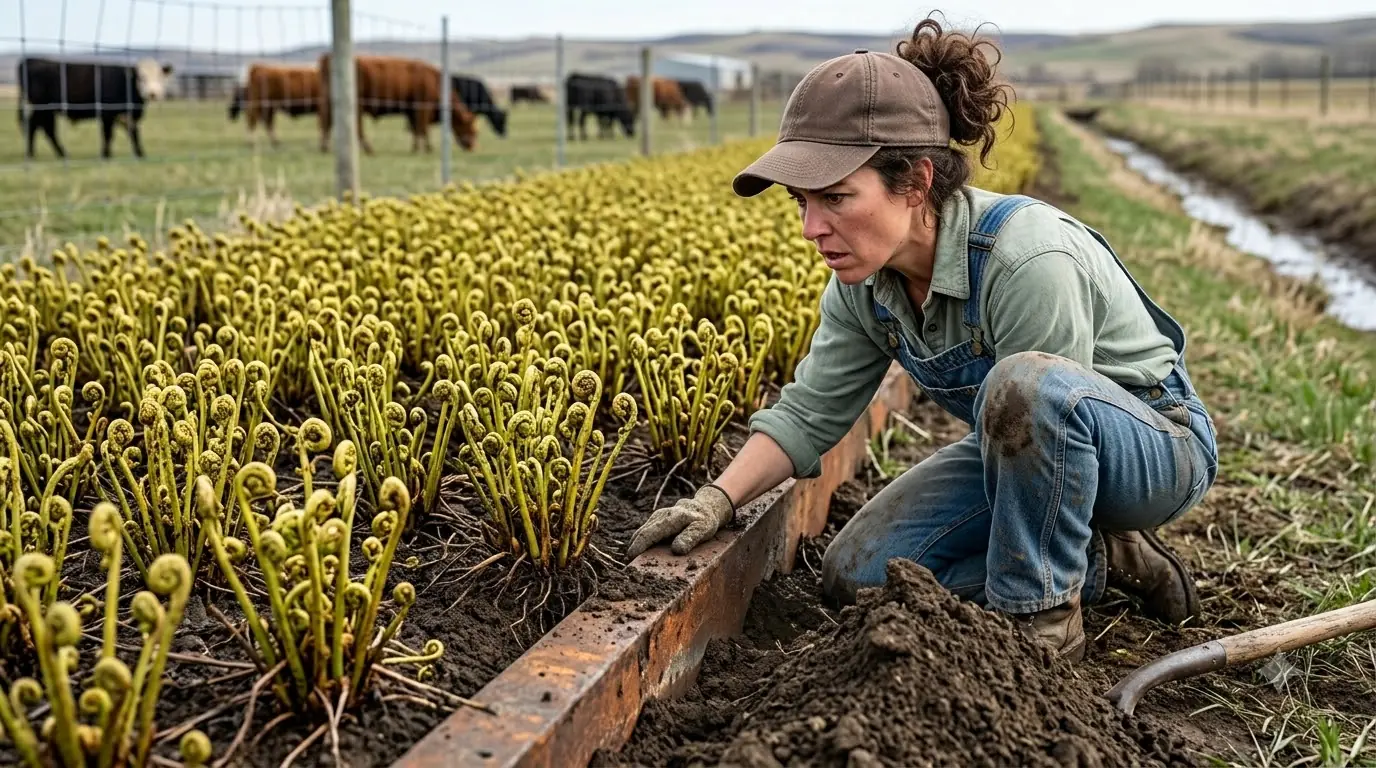
By the third week of April, nearly six acres of Colleen Bartos’s pasture had turned a color she had never seen there before.
Not the tender green of new grass.
Not the dull gray-green of thistle.
Not quackgrass.
This was paler.
Thicker.
Almost waxy.
The plants came up in tight clusters, packed together as if somebody had walked across the field years ago and deliberately chosen where each patch should grow.
Colleen stood near the edge of the largest cluster one cold morning with her phone in one hand and a spade in the other.
Thirty beef cattle grazed behind a temporary electric fence she had moved twice already that week.
They wanted nothing to do with the pale plants.
That worried her more than anything.
Cattle would nibble almost anything unfamiliar at least once.
These animals approached the clusters, sniffed, then stepped around them.
Colleen lifted her phone again.
She had taken more than fifty photographs.
Leaf surfaces.
Stems.
Roots visible near the soil.
Wide shots.
Close-ups.
Three plant identification apps had given her three different answers.
One called it a common pasture weed.
Another suggested a cultivated forage legume.
The third identified something that did not even grow naturally in Alberta.
“Helpful.”
She locked the phone.
The plants stretched from the old drainage ditch in an irregular band.
Three days earlier, her veterinarian had mentioned another rancher whose cattle developed mild digestive problems after grazing near something that looked similar.
Nothing catastrophic.
No dead animals.
No frantic midnight emergency.
But enough.
Until Colleen knew what she was dealing with, the herd was staying out.
That decision was already costing her.
She owned only twenty-five acres.
Six acres mattered.
Every time she moved the temporary fence, thirty cattle worked the remaining ground harder.
By June, if she still had no answer, she would either buy extra feed or reduce the herd.
Neither appealed to her.
Colleen looked down.
One pale cluster grew beside her boot.
For nearly a week, she had resisted digging.
Today she had run out of patience.
She pushed the spade into the soil.
The ground was heavier than expected.
Winter moisture still sat below the surface.
She worked around the plant instead of chopping through it.
Once.
Twice.
Then deeper.
The blade stopped.
Clink.
Colleen froze.
Not stone.
Too thin.
Too sharp.
Metal.
She lowered herself onto one knee.
Brushed away dark soil with a gloved hand.
A rust-colored edge appeared beneath the roots.
Narrow.
Flat.
Straight.
Colleen cleared another handful.
The metal continued.
Not downward.
Across the pasture.
In roughly the same direction as the drainage ditch.
She sat back.
For a moment, she forgot the plant.
She had owned this land for six years.
She knew where water pooled after heavy rain.
Which fence posts leaned after frost.
Which corner produced weak hay.
Which patch stayed wet two weeks longer than the rest.
She could stand at the kitchen window and tell when a cow was moving wrong.
Yet beneath a plant she could not identify, in ground she had crossed hundreds of times, was a buried strip of metal she had never known existed.
Then she noticed something that tightened her chest.
The pale plants appeared to be following it.
Six years earlier, when Colleen was thirty-two, she had walked away from a career selling agricultural equipment.
It had been a good job.
Good money.
Company truck.
Expense account.
She knew dealerships from Red Deer to Lethbridge and could talk hydraulic pressure, baler capacity, tractor financing, and warranty claims with men twice her age.
But eventually agriculture from the sales side stopped being enough.
She spent years talking to farmers about rainfall.
Feed costs.
Calving seasons.
Fuel.
Debt.
Windows of opportunity so narrow a broken bearing could ruin an entire week.
And slowly she started wanting stakes of her own.
Not a thousand acres.
Not some fantasy ranch stretching to the horizon.
Just enough ground that mistakes had her name on them.
Twenty-five acres outside a small central Alberta town came up for sale.
Old pasture.
Basic barn.
Simple house.
A drainage ditch through the northeast corner.
Nothing special.
Colleen bought it.
Over six years, she built a modest operation.
Thirty beef cattle.
Hay sales to two neighboring farms.
Enough income to keep going if she watched every dollar.
Not glamorous.
Not easy.
Hers.
That was why the pale plants bothered her so badly.
They represented something she could not account for.
The first shoots appeared in early April near the ditch.
Only a few.
Colleen barely noticed.
Spring always revealed surprises.
Broken wire.
Washouts.