Evan Cole boarded the first-class cabin quietly, holding his boarding pass in one hand and a slim leather laptop case in the other. He wore a navy hoodie, dark jeans, and clean sneakers, the kind of clothes he preferred when traveling without cameras, assistants, or company security around him. To anyone who cared to check, his name sat clearly on seat 2A. To anyone who judged first and checked later, he looked like a man who had wandered into the wrong section of the plane.
The flight from Los Angeles to New York was full of executives, investors, influencers, and private wealth dressed in the careful confidence of people used to being served quickly. The first-class cabin was bright and polished, with cream leather seats, walnut trim, and quiet passengers already settling into their little kingdoms. Evan had spent the morning finalizing a rescue package for Whitmore Industries, a once-powerful manufacturing company now begging for emergency investment. He wanted six hours in the air to read quietly before facing another room full of desperate men pretending not to be desperate.
Then he saw his seat.
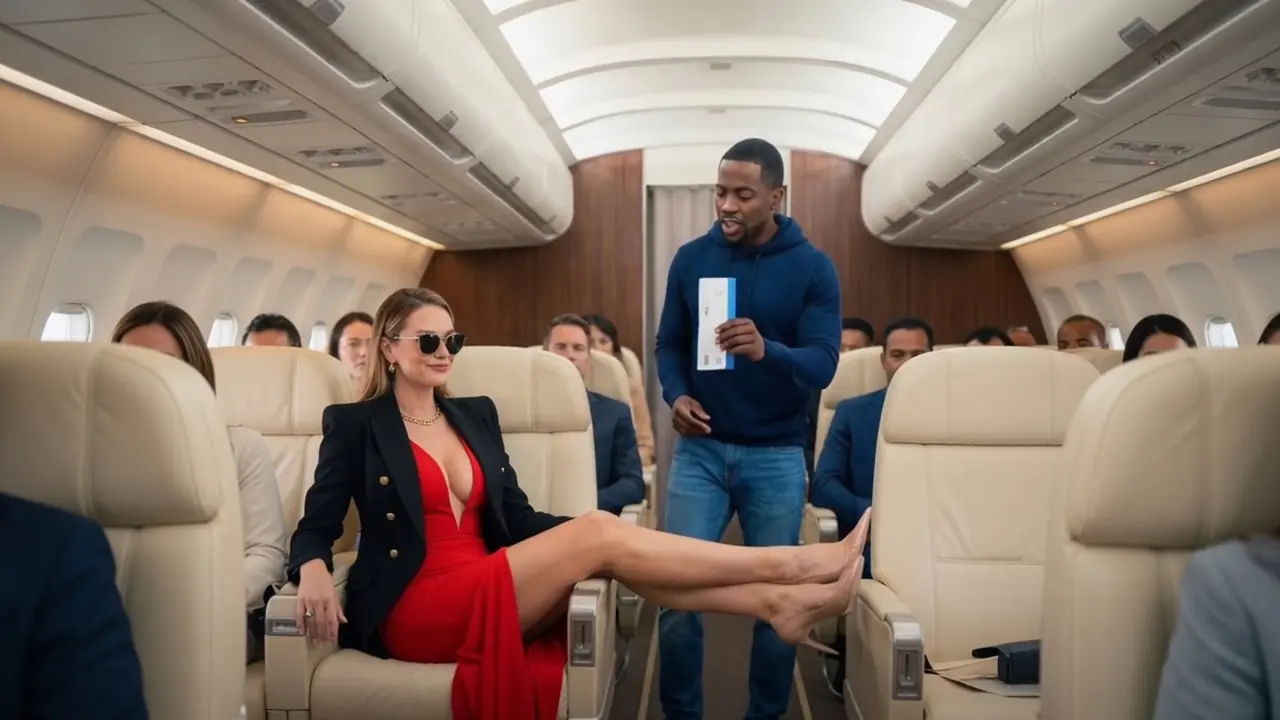
A woman in dark sunglasses sat across from it with her body angled like the aisle belonged to her. Her name, he would soon learn, was Darla Whitmore. She wore a black designer blazer over a fitted pale pink dress, gold jewelry at her throat, and the relaxed smile of someone who had never had to wonder whether a room would welcome her. Her bare legs were stretched across Evan’s assigned seat, her heels resting directly on the cushion where he was supposed to sit.
Evan stopped beside the row. “Excuse me.”
Darla did not move right away. She looked at him over the rim of her sunglasses, eyes traveling from his hoodie to his sneakers, then back to his face. The inspection was slow enough to be intentional. She smiled, not warmly, but as if he had arrived to amuse her.
“Yes?” she said.
Evan held up his boarding pass. “That’s my seat.”
Darla glanced at the pass without leaning forward enough to read it. “I don’t think so.”
“You don’t think the boarding pass is correct?”
“I think you’re confused.” She shifted slightly but kept her legs across the seat. “Coach is behind the curtain.”
A few passengers nearby looked up. One man in a gray suit lowered his newspaper. A woman across the aisle paused with a glass of sparkling water halfway to her mouth. Evan felt the cabin listening, waiting to see if he would shrink or fight.
He did neither.
“My seat is 2A,” he said calmly. “Your legs are on it.”
Darla gave a soft laugh. “Sweetheart, these seats are for people who pay for them.”
Evan’s expression did not change. “Then we agree. I paid for mine.”
Her smile sharpened. “With miles?”
The insult floated through the cabin, small but poisonous. Evan had heard versions of it before in hotel lobbies, boardrooms, private clubs, and financial conferences where people assumed a Black man in casual clothes must be staff, security, entertainment, or lost. He had learned long ago that anger could be useful, but only after patience had collected enough evidence.
A flight attendant named Rebecca Lane stepped forward with a professional smile that looked suddenly strained. “Is there a problem here?”
Evan handed her the boarding pass. “Seat 2A.”
Rebecca checked it, then looked at the seat. “Ma’am, I’ll need you to move your legs so Mr. Cole can sit down.”
Darla’s eyebrows lifted. “Mr. Cole?”
“Yes,” Rebecca said carefully. “This is his assigned seat.”
Darla finally removed her sunglasses enough for Evan to see her eyes clearly. They were cold, irritated, and more offended by correction than by her own rudeness. “I’m sure there are other empty seats somewhere.”
“Then upgrade him elsewhere.” Darla leaned back again. “I’m comfortable.”
The man with the newspaper stopped pretending to read. A young tech founder in the row behind Evan slowly removed one earbud. The energy in the cabin shifted from curiosity to discomfort, but still no one spoke. People often loved justice after someone else started it.
Evan looked at Rebecca. “Please call the lead attendant.”
Darla laughed again, louder this time. “Oh, now we’re making demands?”
“I’m asking to sit in the seat I purchased.”
“No,” she said, lifting her chin. “You’re making a scene because you don’t like being told no.”
Evan looked down at her legs still stretched across his seat. “Darla, move your legs before your arrogance costs more than this ticket.”
Her face froze. “How do you know my name?”
Evan’s eyes moved briefly to the designer luggage tag hanging from her tote bag. Darla Whitmore. The last name had already caught his attention, but he had not reacted until now. Whitmore was the name printed across the proposal in his laptop case, the company whose debt his firm had spent two weeks analyzing, the company whose CEO had sent three urgent messages that morning asking for mercy.
Darla’s husband was Richard Whitmore.
Richard Whitmore was waiting in New York to ask Evan Cole for one final chance.
Darla did not know that. She only saw a man in a hoodie asking her to give up the seat she had decided he did not deserve. That ignorance made her bold.
She sat forward, sunglasses now in one hand. “Listen to me carefully. I don’t know what game you’re playing, but I fly this route often. I know what belongs in first class.”
“And I don’t belong?” Evan asked.
Her mouth curled. “You said it, not me.”
Rebecca’s face tightened. “Ma’am, please.”
Darla snapped her eyes toward the attendant. “Do not lecture me. I will scream for security if I have to. I will tell them this man is harassing me.”
A hush fell across the cabin.
That was the moment Evan’s patience ended.
Not loudly. Not emotionally. Not with the kind of outburst Darla seemed to be begging for so she could turn herself into the victim. His calm became colder, and everyone nearby felt it.
“Say that again,” he said.
Darla blinked. “Excuse me?”
“Say clearly, in front of every passenger here, that you intend to lie to security because I asked for my seat.”
Her lips parted, but no words came.
Evan took out his phone. “Actually, don’t. I’ve heard enough.”
Darla looked at the phone, then back at him. “Who are you calling?”
“The man who should have taught you that arrogance is expensive.”
Before she could answer, Evan tapped a number and raised the phone to his ear. Richard Whitmore answered on the second ring, voice anxious and overly warm.
“Mr. Cole. I didn’t expect to hear from you until landing.”
Darla’s face changed.
Evan held her stare. “Richard, are you married to Darla Whitmore?”
There was a pause. “Yes. Why?”
“She’s currently occupying my first-class seat with her legs across it, refusing to move, and threatening to call security if I continue asking to sit down.”
The cabin became absolutely still.
Darla stood so quickly her heels slipped off the cushion and dropped to the floor. “Evan Cole?”
Evan did not answer her. He listened as Richard Whitmore breathed once, sharply, on the other end of the line.
“Mr. Cole,” Richard said, his voice suddenly thin, “I am so sorry. There must be some misunderstanding.”
“No,” Evan said. “There was judgment. There was threat. There was an attempt at public humiliation. But there was no misunderstanding.”
Darla reached toward him. “Mr. Cole, wait. I didn’t realize—”
Evan pulled the phone slightly away and looked at her. “That’s the problem, Darla. You didn’t realize who I was, so you showed me who you are.”
Her face flushed. A few passengers murmured softly. Rebecca stood frozen beside the aisle, still holding Evan’s boarding pass like a document in a courtroom.
Richard’s voice came through the phone again. “Please, Mr. Cole. My wife can be difficult when she’s stressed. I’m sure she didn’t mean—”
Evan’s eyes hardened. “Do not insult me by explaining her character as stress.”
Another pause.
Richard lowered his voice. “Evan, we need this meeting.”
“I know.”
“Whitmore Industries has twelve thousand employees.”
“I know that too.”
“If we don’t secure your capital package, we won’t make payroll beyond the quarter.”
Evan looked at Darla. Her confidence had drained so quickly that she seemed almost smaller in the seat she had tried to steal. Her sunglasses were now clutched in one trembling hand. She looked toward the other passengers and realized, maybe for the first time, that everyone who had watched her humiliate him was now watching her unravel.
“Then you should have married someone who understood the cost of respect,” Evan said.
Darla whispered, “Please.”
Evan ended the call.
For several seconds, no one moved. The hum of the aircraft ventilation sounded suddenly loud. Rebecca finally found her voice.
“Mr. Cole,” she said softly, “I’m very sorry.”
Evan nodded once. “Thank you.”
Darla stepped backward. “I’ll move. Of course, I’ll move. This was just a mistake.”
Evan looked at the cushion where her heels had been. “Rebecca, is there another seat available in the cabin?”
Rebecca checked her tablet, hands moving quickly. “The only available seat is in business class. A passenger missed the connection.”
Darla’s eyes widened. “Wait. You don’t expect me to move.”
Evan slid his boarding pass into his pocket. “No, Darla. I expect you to learn.”
“This is my seat,” she said weakly.
“No. That was the seat you were assigned.” Evan’s voice stayed quiet. “You decided assignments didn’t matter when you thought mine could be ignored.”
Rebecca looked uncertain. “Mr. Cole, airline policy—”
Evan lifted a hand gently. “I won’t ask you to break policy. I’ll take the business-class seat if necessary.”
Darla’s relief came too early.
Then Evan turned to her. “But the funding offer is suspended until I decide whether Whitmore Industries is led by people capable of respecting those they need.”
Darla looked as if he had slapped the air from the cabin. “You can’t punish my husband’s company because of me.”
“I’m not punishing them because of you,” Evan said. “I’m reassessing risk because you just revealed the culture surrounding its leadership.”
Her mouth opened, but no sound came.
The lead flight attendant arrived, followed by the purser. After a quiet conversation with Rebecca and a review of the boarding pass, Darla was politely but firmly instructed to remove herself from Evan’s seat. Another passenger offered to switch with Evan so he could remain in first class without sitting where Darla had put her shoes, but Evan declined. He accepted a different first-class seat that the crew arranged after a brief reshuffle, while Darla sat stiffly across the aisle with her face turned toward the window.
No one spoke to her.
Evan settled into his new seat, opened his laptop, and began working as if nothing had happened. But inside, the anger moved slowly, controlled and heavy. Not because Darla had insulted him personally. He had survived worse. What disturbed him was how easily she had reached for power she did not have, how quickly she had threatened a false accusation when words failed her.
That kind of arrogance did not live alone. It came from rooms where people laughed along. Dinners where no one corrected the joke. Companies where leadership confused polish with worth and silence with agreement.
Two hours into the flight, Darla rose from her seat. Rebecca noticed immediately, but Darla lifted both hands slightly as if to show she meant no harm. She walked toward Evan and stopped beside his row.
“Mr. Cole,” she said quietly.
Evan did not look up from his laptop. “Return to your seat.”
“I want to apologize.”
“Then apologize to the cabin first.”
Her face tightened.
He looked up then. “You humiliated me in public. Do not ask for private forgiveness because public accountability feels uncomfortable.”
Darla’s cheeks reddened. She glanced around. Several passengers were pretending not to listen, badly.
She took a breath. “I apologize for what I said earlier. I was rude and unfair.”
Evan’s expression did not change. “Name it.”
Darla swallowed. “I judged you because of how you looked.”
“And?”
She looked down. “Because you’re Black.”
The cabin went still again, but this time the silence held something different. Not shock. Recognition.
Evan nodded once. “Continue.”
“I threatened to call security because I wanted to scare you away from a seat that was yours.” Her voice trembled now. “I was wrong.”
Rebecca stood near the galley, her eyes sharp. The passenger with the newspaper finally folded it completely and set it down.
Evan closed his laptop. “Do you understand why your husband’s company is in danger?”
Darla nodded quickly. “Because of what I did.”
“No,” Evan said. “Because what you did may not be an exception. It may be evidence.”
She frowned, confused.
“If the spouse of the CEO behaves this way toward a man she thinks has no power, I need to know how Whitmore Industries treats workers, vendors, drivers, receptionists, contractors, and anyone else your social circle believes is beneath you.”
Darla’s eyes filled with tears, but Evan did not soften for them. Tears after consequence were not always remorse. Sometimes they were grief over losing control.
“I can tell Richard to fix it,” she whispered.
Evan leaned back. “Richard should have wanted to fix it before I was involved.”
She had no answer.
When the plane landed in New York, Darla did not rush off first. She sat frozen until most of the cabin had emptied. Evan walked past her without stopping. At the door, Rebecca touched his arm lightly.
“Mr. Cole,” she said, “I’m sorry we didn’t step in faster.”
Evan looked at her. “You stepped in. Next time, step in before the person being insulted has to carry the room alone.”
Rebecca nodded, ashamed but grateful. “Yes, sir.”
In the terminal, Evan’s driver waited near baggage claim, but Richard Whitmore stood beside him. Richard was tall, silver-haired, and dressed in a suit expensive enough to signal strength but wrinkled enough to reveal panic. His phone was in his hand, and his face looked older than it had in video meetings.
“Evan,” Richard said, stepping forward. “Please.”
Evan stopped. “Mr. Whitmore.”
The use of the formal name made Richard flinch.
“I owe you an apology,” Richard said.
“No. Your wife does. You owe me answers.”
Richard glanced toward Darla, who had just entered the terminal behind them, pale and quiet. “She told me what happened.”
“Did she tell you everything?”
Richard hesitated.
Evan’s mouth tightened. “That hesitation is the reason we are not meeting today.”
“Evan, please. Thousands of people depend on this deal.”
“I know,” Evan said. “That’s why I won’t sign it carelessly.”
Richard lowered his voice. “What do you want?”
“Full access.”
Richard blinked. “To what?”
“Employee complaints. Vendor payment records. Diversity audits. Executive conduct reports. Board minutes. Severance agreements. Anything that tells me whether Darla’s behavior was personal arrogance or a symptom of rot around your leadership.”
Richard looked physically shaken. “That level of review will take weeks.”
“Then you should hope your company survives weeks.”
Darla stepped closer, voice small. “Mr. Cole, please don’t do this because of me.”
Evan turned to her. “Darla, when you placed your heels on my seat, you thought you were making one man stand. Now twelve thousand employees may have to stand in the truth your family avoided.”
She covered her mouth with one hand.
Richard’s eyes flashed with sudden anger, but not at her. At Evan. “That’s unfair.”
Evan stepped closer. “Unfair is a word people discover quickly when consequence reaches them.”
The anger left Richard’s face because he knew, deep down, that Evan was right. He had spent months asking Cole Capital to trust him with hundreds of millions of dollars. Trust was not built on spreadsheets alone. It was built on judgment. On character. On what leaders allowed around them.
“I’ll open the records,” Richard said finally.
“Good.”
“And if the review satisfies you?”
“Then I consider a revised rescue package.”
“Revised?”
Evan looked at Darla, then back at him. “There will be conditions.”
Richard nodded slowly. “What conditions?”
“Independent oversight. Worker protections. Vendor repayment schedule. Leadership ethics review. And you step down as CEO within six months if the audit shows a pattern of discrimination or intimidation.”
Richard’s face went pale. “That could end my career.”
Evan picked up his laptop case. “No, Richard. Your career is ending if you cannot prove your company deserves saving.”
He walked away before Richard could answer.
Over the next week, Whitmore Industries became the center of a quiet storm. Evan’s team entered the records with precision. They interviewed employees, reviewed complaints, and followed paper trails that executives had buried under polite language. The findings were worse than Evan expected.
There were vendors unpaid for months while executive bonuses cleared on time. There were plant supervisors accused of mistreating workers who spoke up. There were hiring practices that favored family friends, golf club acquaintances, and people who looked like the board. There were employees with good ideas ignored for years because they did not have the right title, accent, neighborhood, or last name.
Darla Whitmore had not created the culture alone. She had simply carried it onto the plane and placed her heels on it.
Richard tried to manage the crisis privately at first. He called Evan three times in two days. Evan did not take the first two calls. On the third, he answered and listened as Richard’s voice cracked with exhaustion.
“I didn’t know it was this bad,” Richard said.
Evan stood at the window of his New York office, looking down at the city. “That is not the defense you think it is.”
“I trusted my people.”
“You trusted comfort.”
Richard went silent.
Evan continued, “Your company is asking for rescue. Rescue requires truth. If you only wanted money to keep pretending, call someone else.”
“There is no one else.”
“I know.”
That was the problem. Evan knew the employees needed help. He knew families depended on the paychecks, towns depended on the plants, and suppliers depended on Whitmore surviving. He also knew that saving a company without changing its leadership would only preserve the damage in cleaner language.
So he made the offer brutal and clear.
Cole Capital would provide emergency funding, but only under a restructuring agreement. Richard would remain temporarily, then transition out. An independent board would oversee ethics and labor reforms. Overdue vendors would be paid first, before executive bonuses. Darla would resign from all public-facing company charity boards and issue a public apology for her conduct on the flight, not as a performance, but as part of a larger acknowledgement of the culture that had allowed arrogance to become normal.
Richard fought the terms for two days.
Then payroll came due.
He signed.
The public announcement shook the business world. Reporters called it a stunning intervention. Analysts praised Evan’s discipline. Some commentators accused him of making a personal insult into corporate punishment. Evan ignored them. People who had never been publicly judged for existing in the wrong seat were always eager to explain the proper size of consequence.
Darla’s apology came on a Thursday morning.
She stood beside Richard in a conference room at Whitmore headquarters, cameras pointed at her face. She looked different without the sunglasses and polished cruelty. Smaller, but not redeemed. Redemption took longer than embarrassment.
“I judged a man on a flight because of his race, clothing, and my own arrogance,” she said, reading from a page, then lowering it. “That man was Evan Cole. But the truth is, it would have been wrong no matter who he was. I threatened him, tried to humiliate him, and used privilege like a weapon. I am sorry.”
Evan watched the video once.
Then he closed it.
The better apology came later, from someone else.
A week after the restructuring began, Evan visited one of Whitmore’s factories in Ohio. He walked the floor in safety glasses and a hard hat, listening to workers who had spent years unheard. One woman named Marisol Vega, a machine operator with twenty-one years at the company, stopped him near the end of the tour.
“Mr. Cole,” she said, “I heard what happened on that plane.”
Evan removed his safety glasses. “I’m sure a lot of people did.”
She nodded. “Darla Whitmore walked past people like us for years like we were furniture. Her husband smiled and let it happen.” Her eyes grew wet, but her voice stayed firm. “When you made them look at us, that meant something.”
Evan looked across the factory floor at workers moving between machines, at people whose lives had almost been crushed under executive pride. “It should not have taken me being insulted.”
“No,” Marisol said. “But it did take someone with power deciding not to ignore it.”
That sentence stayed with him.
Months passed. Whitmore Industries changed slowly, painfully, but visibly. Some executives left. New managers rose from places the old leadership had ignored. Vendors were paid. Worker complaints were reviewed. Darla disappeared from the society pages for a while, then reappeared quietly at community events where she no longer stood at the front of every photo.
Evan did not become friends with Richard Whitmore. He did not need to. Business did not require friendship. It required accountability.
One year after the flight, Evan boarded another first-class cabin on the same route to New York. He wore another hoodie, darker this time, with jeans and the same calm expression. He found seat 2A open, clean, and waiting.
Rebecca Lane was working the flight again. When she saw him, she smiled with real warmth and a little nervousness.
“Welcome aboard, Mr. Cole.”
“Good to see you, Rebecca.”
She glanced at his seat. “No issues today.”
Evan smiled faintly. “That’s a good start.”
As he sat down, a young Black boy boarding with his mother paused in the aisle and looked at him. The boy’s eyes moved from Evan’s hoodie to the first-class seat, then back to Evan’s face with quiet curiosity.
His mother gently nudged him forward. “Come on, baby.”
But the boy whispered, not quietly enough, “Mom, he looks like me.”
Evan turned and smiled.
The mother looked embarrassed. “I’m sorry.”
“No need,” Evan said.
The boy looked at him again. “Are you famous?”
Evan chuckled. “No.”
“Are you rich?”
His mother closed her eyes. “Malik.”
Evan smiled wider. “I own a company.”
Malik’s eyes widened. “A big one?”
“Big enough.”
The boy grinned like someone had opened a window in his imagination. “Cool.”
As they moved down the aisle, Evan settled into his seat and looked out the window. He thought about Darla’s heels on the cushion, her threat, her certainty that first class could tell her who mattered. He thought about Richard’s panic, the workers in Ohio, Marisol’s words, and the boy who had just seen a version of himself where he had not expected one.
When Rebecca offered him sparkling water, he accepted it with thanks. The cabin filled around him. People placed bags overhead, adjusted jackets, opened laptops, and prepared for the small temporary world of flight.
No one questioned his seat.
No one asked if he belonged.
Evan leaned back as the aircraft pushed away from the gate. The runway stretched ahead, bright under the morning sun.
Darla Whitmore had tried to make him stand in shame.
Instead, she had forced an entire company to sit in truth.
And Evan Cole, the Black CEO she thought did not belong in first class, had done more than keep his seat.
He had made sure the next person who looked like him could take theirs without asking permission.