Evan Cole had never cared much about looking rich. He owned tailored suits, expensive watches, and a penthouse office overlooking downtown Chicago, but most days he still dressed like the kid who had once slept on a borrowed couch while building his first company from a cracked laptop. That morning, he boarded the first-class cabin wearing a navy hoodie, dark jeans, and clean sneakers, with a slim leather folder under one arm. Inside the folder was a signed term sheet worth two hundred million dollars.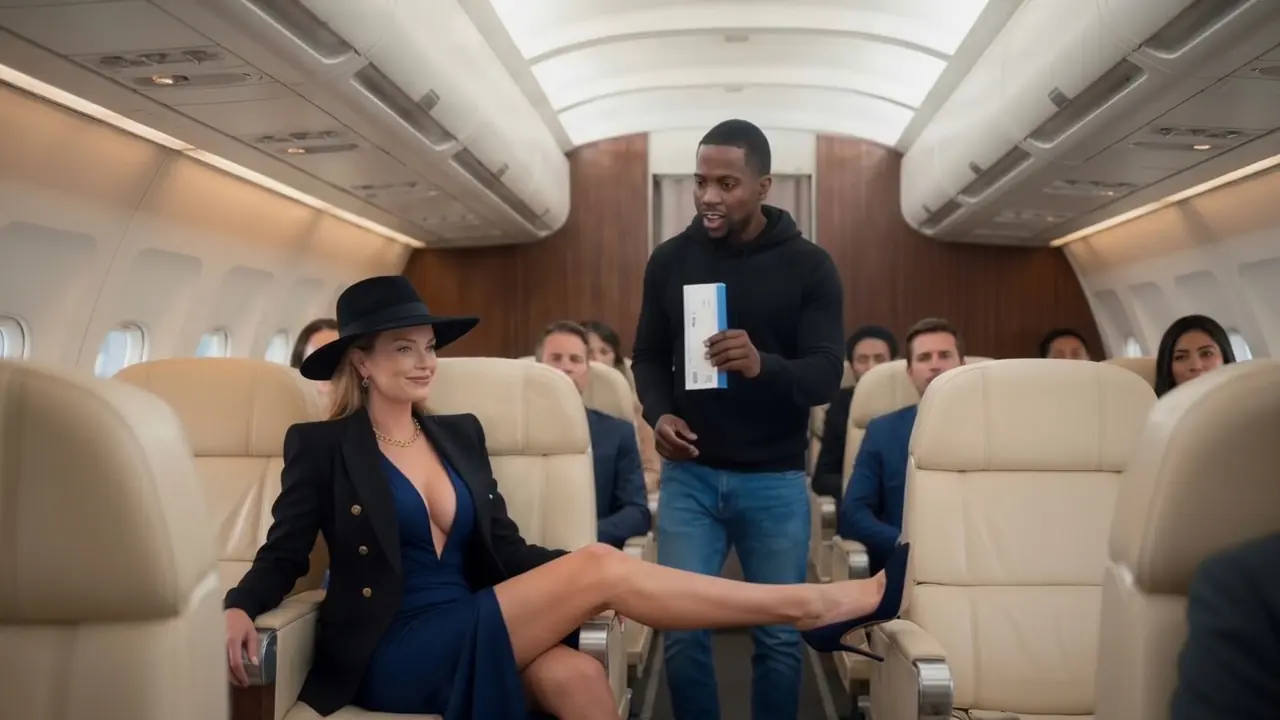
The flight from New York to Chicago was supposed to be simple. Land by noon, meet with Preston Whitmore and his board by two, sign the emergency funding agreement by four, and save Whitmore Logistics from collapsing before the banks lost patience. Evan had spent three weeks studying the company’s numbers, debts, contracts, and weak spots. The business was damaged, but not dead, and he believed it could survive with the right discipline.
The name Whitmore still carried weight in shipping and distribution circles. Preston Whitmore’s grandfather had built the company with trucks, warehouses, and old-fashioned promises sealed by handshakes. But Preston had inherited more pride than judgment, expanding too quickly, borrowing too heavily, and trusting public image more than operational truth. By the time he called Evan Cole, the company had only ninety days before creditors began pulling it apart.
Evan did not rescue companies because he felt sorry for rich families. He rescued businesses when workers, suppliers, and communities still had something worth saving. Whitmore Logistics employed nearly eight thousand people across five states, including warehouse crews, drivers, mechanics, dispatchers, and office staff who had done nothing wrong except trust leaders who smiled too confidently. Evan’s funding could protect those jobs, restructure the debt, and force Preston to share control.
That was the plan when Evan stepped into the first-class cabin and checked his boarding pass. Seat 2A. Window. He preferred the window because he liked silence before difficult meetings, and because looking down at the world helped him think more clearly. But when he reached row two, a woman in a red dress and black blazer had stretched her legs across his seat as if the aircraft had been built around her comfort.
She wore dark sunglasses though they were inside the plane. Her gold necklace caught the overhead light, and her expensive handbag occupied the armrest like another passenger. One heel rested on the edge of Evan’s seat cushion. Her face carried the lazy confidence of someone used to other people moving before she ever needed to ask.
Evan stopped beside the row. “Excuse me. I believe that’s my seat.”
The woman did not move. She tilted her head slightly, eyes hidden behind her sunglasses. “This row is taken.”
Evan glanced at his boarding pass again, though he already knew the seat was his. “Seat 2A?”
She smiled without warmth. “I said it’s taken.”
The first-class cabin had grown quiet in that particular way public spaces do when people sense trouble but hope someone else will handle it. A man across the aisle lowered his newspaper. A woman in row three looked down at her phone, though she was clearly listening. Evan kept his voice level because he had learned long ago that calm often unsettled arrogant people more than anger.
“My boarding pass says 2A,” he said, holding it where she could see it. “I’ll just need you to move your legs.”
The woman finally removed her sunglasses, slowly, as if revealing herself were a favor. Her eyes traveled from his sneakers to his hoodie to his face. The assessment took less than two seconds, but Evan recognized the conclusion immediately. She had decided he did not belong.
“This is first class,” she said. “Are you sure you didn’t wander up from the back?”
A few passengers shifted uncomfortably. Evan felt the old familiar heat rise behind his ribs, not from embarrassment, but from recognition. He had heard versions of that sentence in hotel lobbies, boardrooms, private clubs, and restaurants where people looked at his clothes before his credentials. He had built an empire partly because men and women like her had spent years underestimating him.
“I’m sure,” he said.
She laughed softly. “This is first class, not a budget bus. Men dressed like you don’t belong here.”
Evan let the words settle in the cabin. Sometimes silence was the only way to make everyone hear what someone had really said. The flight attendant, Natalie, appeared near the galley with professional concern already on her face. She looked at Evan’s boarding pass, then at the woman in red.
“Ma’am,” Natalie said gently, “seat 2A is assigned to Mr. Cole.”
The woman’s expression sharpened. “I am sitting in 2B. I need space.”
“I understand,” Natalie replied. “But you cannot use another passenger’s assigned seat.”
The woman’s mouth tightened. “Do you know who I am?”
Evan looked toward the window. He almost smiled. That question was rarely asked by people who were certain their name was enough. Natalie remained polite.
“I’m happy to assist you with your seating, ma’am, but Mr. Cole needs access to his seat.”
The woman turned back to Evan. “What is your name again?”
“Evan Cole.”
“Evan.” She said it like a clerk’s name she intended to forget. “Listen carefully. My husband is Preston Whitmore. We fly first class everywhere. I don’t know how you got this seat, whether it was points, luck, or some airline mistake, but I am not being cramped because a man in a sweatshirt wants to play important.”
The name Whitmore moved through Evan’s mind like a door clicking open. Preston’s wife. Darla Whitmore. He remembered seeing her in a charity gala photograph beside Preston, smiling beneath chandeliers while employees protested layoffs outside one of their warehouses. The file had noted her influence over Preston, her expensive public lifestyle, and her habit of treating company resources like family property.
Evan looked at her more carefully now. She had no idea who he was beyond the hoodie and boarding pass. That ignorance might have been funny if eight thousand jobs were not waiting on the meeting he was flying to attend. He felt the weight of the folder beneath his arm.
“That’s interesting,” Evan said. “Preston Whitmore.”
Darla’s smile returned. “Yes. So now you understand.”
“I understand more than you think.”
She leaned back, still blocking his seat. “Good. Then find somewhere else to sit before I call security.”
Natalie stepped in. “Ma’am, there is no need for that.”
Darla ignored her. “No, there absolutely is. I am tired of airlines letting anyone into first class and expecting real customers to tolerate it.”
That word hung there. Real customers. Evan heard a man in row four exhale sharply, and someone behind him whispered, “Wow.” Darla either did not notice or did not care. People like her often mistook discomfort for agreement if no one challenged them quickly enough.
Evan lowered his boarding pass. “Mrs. Whitmore, you are sitting beside the seat assigned to the person your husband has been begging to meet all week.”
Her smile faltered for half a second, then returned colder. “My husband doesn’t beg men like you for anything.”
Evan opened the leather folder and removed the top page. The Cole Meridian Capital logo sat at the top, followed by the Whitmore Logistics emergency financing agreement. Darla stared at it without understanding at first. Then her eyes moved to the signature line.
Evan Cole, Chairman and CEO.
The color did not leave her face all at once. It drained slowly, like a bad thought spreading through her body. Her legs slipped off the seat. For the first time since he had arrived, she sat upright.
Evan’s voice stayed calm. “Then call him now, because the lifeline keeping his company alive just watched you steal its seat.”
No one spoke.
Darla looked at the paper, then at him, then back at the paper. Her hand moved toward her phone, hesitated, then grabbed it from her handbag. Evan stepped slightly aside, allowing Natalie to stand between them if needed. He was not angry in the way Darla expected. He was worse than angry. He was evaluating.
The call connected quickly. “Preston,” Darla said, her voice suddenly too bright. “Something strange is happening on the plane.”
Evan could hear only Preston’s muffled voice through the phone, but Darla’s face told him enough.
“There’s a man here claiming to be Evan Cole,” she said. “He’s in a hoodie.”
A pause.
Darla’s eyes widened.
“No, I didn’t know,” she whispered.
Another pause.
Her voice dropped. “Preston, I didn’t—”
Then she stopped speaking entirely. Evan imagined Preston Whitmore standing in his office, surrounded by lawyers and board members, realizing that the wife he had allowed to treat the world like a servants’ entrance had just humiliated the one investor with enough power to save him. Darla lowered the phone slowly.
Preston’s voice came through faintly, panicked and sharp. “Darla, apologize. Now.”
Darla swallowed. “Mr. Cole—”
Evan held up one hand. “Please don’t apologize because your husband recognized me.”
Her mouth opened, then closed.
Natalie gestured carefully toward the seat. “Mr. Cole, you’re welcome to sit now.”
“Thank you,” Evan said.
Darla moved her handbag from the armrest and pulled her legs fully under her seat. Evan placed his folder in the side compartment and sat down by the window. The cabin remained silent, but the silence had changed. It no longer protected Darla. It exposed her.
As the plane prepared for departure, Darla sat rigid beside him, sunglasses now resting uselessly in her lap. Evan buckled his seatbelt and opened a report on his tablet. He could feel her wanting to speak, wanting to repair what could not be repaired with charm. For fifteen minutes, she said nothing.
When the aircraft lifted above New York, Darla finally turned slightly toward him. “Mr. Cole, I made an assumption.”
“Yes.”
“I was tired. It has been a stressful week.”
“I’m aware.”
She blinked. “You are?”
“I know your husband’s company is sixty-two million dollars past due with three key suppliers. I know two distribution contracts are threatening termination if inventory failures continue. I know your payroll pressure hits next month.” He turned the page on his tablet. “Stressful is a generous word.”
Her lips tightened. “Then you understand why my family is under pressure.”
Evan looked at her. “I understand the workers are under pressure. I understand drivers are afraid their routes will disappear. I understand warehouse crews are wondering whether they should look for other jobs before Christmas. I understand suppliers have been waiting months for payment while your family maintained its public image.”
Her cheeks flushed. “You don’t know what it’s like.”
“No,” Evan said. “I know exactly what it’s like when leadership mistakes comfort for survival.”
Darla looked away first.
During the flight, Evan reviewed the term sheet again. The deal had been difficult from the start. Preston wanted money without accountability, rescue without surrender, and praise for accepting discipline only after he had no other choice. Evan had planned to approve the funding anyway because the company itself still mattered. But Darla’s behavior had revealed something the spreadsheets could not measure.
Culture.
The word was often misused in boardrooms, but Evan took it seriously. A company’s culture was not what its mission statement said. It was how power behaved when it thought no consequence was coming. Darla Whitmore had believed she could shame a stranger because he looked less important than her. If that attitude lived at the family table, Evan wondered how deeply it had seeped into the business.
Halfway through the flight, Preston called Evan directly. Evan let the call go to voicemail. Darla noticed, of course. Her fingers twisted around a napkin.
“Mr. Cole, my husband is trying to reach you.”
“I saw.”
“This deal matters to many people.”
“I know.”
“Then please don’t make a business decision because of a misunderstanding on a plane.”
Evan turned toward her fully. “Mrs. Whitmore, you keep calling it a misunderstanding because that sounds accidental. It wasn’t. You understood the seat was mine. You understood I had a boarding pass. You understood the flight attendant confirmed it. You refused to move because you thought I lacked the power to make refusal expensive.”
Her face went pale again.
He continued, “That is not a misunderstanding. That is character revealed under mild inconvenience.”
Darla’s eyes filled, though Evan could not tell whether the tears came from shame or fear. “I was wrong.”
“Yes.”
“I am sorry.”
He studied her for a moment. “What are you sorry for?”
She stiffened, unprepared.
“For taking your seat,” she said.
“That was the smallest part.”
Darla looked down.
Evan returned to his tablet. “Think longer.”
The rest of the flight passed heavily. Darla did not order champagne when the attendant offered drinks. She sat with both hands folded in her lap, occasionally checking her phone as messages arrived from Preston. Evan worked quietly, making notes in the margin of the deal file. Some numbers could be saved. Some leaders could not.
When the plane landed in Chicago, Darla stood quickly, as if movement might outrun consequence. Evan waited until the aisle cleared. Natalie quietly thanked him for his patience, and he thanked her for handling the situation professionally. Darla heard that too.
At the gate, Preston Whitmore was waiting with two executives and a woman Evan recognized as the company’s general counsel. Preston was tall, polished, and sweating through the collar of a very expensive shirt. He rushed toward Darla first, then seemed to remember himself and turned to Evan.
“Mr. Cole,” Preston said, extending a hand. “I am deeply sorry.”
Evan looked at the hand, then shook it once. “Good afternoon, Preston.”
Preston’s eyes darted toward Darla. “My wife told me there was an incident.”
“She created one.”
Darla flinched.
Preston forced a strained laugh. “Yes, well, she can be strong-willed.”
Evan’s expression did not change. “No. She was cruel.”
The word landed hard. The executives behind Preston looked away. Darla’s lips parted, but she did not defend herself. Maybe she knew there was no room left for performance.
Preston lowered his voice. “Can we discuss this in the lounge?”
“We can.”
They walked to a private airport conference lounge where coffee, water, and untouched pastries waited on a side table. Evan placed his leather folder on the table and remained standing. Preston sat, then stood again when he realized Evan had not.
“Mr. Cole,” Preston began, “I want to assure you Darla’s behavior does not reflect Whitmore Logistics.”
Evan opened the folder. “That’s exactly what I need to determine.”
Preston swallowed. “My employees are good people.”
“I believe that.”
“My leadership team is committed to the turnaround.”
“I’m less certain of that.”
Darla sat in the corner, hands clasped tightly in her lap. She looked smaller without the first-class seat beneath her, smaller without an audience she could control. Evan did not enjoy seeing her afraid. He had never needed humiliation to feel powerful. But accountability often felt like humiliation to people unused to receiving it.
Preston leaned forward. “Evan, please. This funding is the only thing standing between us and a disaster.”
“No,” Evan said. “That’s not true.”
Preston blinked.
“The only thing standing between you and disaster should have been responsible management years ago. My funding is not a lifeline for your pride. It is a tool to protect workers from the consequences of your mistakes.”
The room went quiet.
Evan slid the original term sheet across the table, then placed a second document beside it. “This was the deal I intended to sign today.”
Preston stared at the papers. “Was?”
“Yes.”
Darla’s breath caught.
Evan tapped the second document. “This is the revised offer.”
The general counsel reached for it first and scanned quickly. Her eyebrows lifted. Preston snatched it from her. As he read, his face changed from confusion to shock to anger barely held in place.
“This removes my controlling authority.”
“It does.”
“You’re requiring an independent CEO.”
“Yes.”
“And Darla’s access to company funds, aircraft privileges, corporate accounts, and advisory influence is terminated immediately?”
Evan looked at Darla. “Correct.”
Darla went still.
Preston’s voice rose. “This is extreme.”
“No,” Evan said. “Extreme is asking an investor to trust family leadership while your wife publicly demonstrates the exact arrogance that helped put the company in danger.”
Preston slammed the paper down. “You cannot judge my company by one airplane seat.”
“I’m not. I’m judging it by debt, supplier distrust, inflated executive expenses, delayed payroll planning, and leadership culture.” Evan’s voice remained controlled. “The airplane seat simply clarified the pattern.”
Preston looked toward his executives for support. None came. The general counsel stared at the revised terms like a woman realizing they were harsh but survivable. The chief financial officer, pale and exhausted, finally spoke.
“Preston,” he said quietly, “we should consider it.”
Preston turned on him. “You’re serious?”
The CFO’s voice shook but held. “Without this capital, we miss supplier payments by the end of the month. If accepting oversight saves the company, we owe the employees that.”
Darla whispered, “Preston.”
He ignored her.
Evan closed the folder. “You have until six tonight. If you decline, Cole Meridian walks. I will not fund business as usual.”
Preston’s face twisted. “And if I accept, you take my company.”
“No,” Evan said. “I save the company from being treated like your family’s inheritance toy.”
The words were harsh, but no one in the room could honestly call them false.
Evan left the lounge and went to his Chicago office. He did not take calls from Preston for two hours. Instead, he called his own team, explained the revised terms, and asked for additional worker protection clauses. Severance guarantees if restructuring became necessary. Supplier payment timelines. A board seat for an employee representative. Expense restrictions on executive travel.
At five-thirty, Preston arrived at Cole Meridian’s office with his general counsel and CFO. Darla did not come. Evan noticed but did not ask.
Preston looked like a man who had aged five years in one afternoon. His tie was loosened, and the old confidence had been replaced by something more useful. Fear, perhaps. Or humility beginning its uncomfortable work.
“I’ll sign,” Preston said.
Evan did not smile. “You understand the terms?”
“I understand I don’t like them.”
“That’s not what I asked.”
Preston looked through the glass wall toward Evan’s staff moving confidently through the office. “Yes. I understand.”
“And Darla?”
Preston’s jaw tightened. “She is no longer connected to company accounts or operations. Effective immediately.”
“Good.”
They signed just before six.
News of the Whitmore restructuring broke the next morning. Business reporters framed it as a bold rescue. Industry analysts called it aggressive but necessary. Employees called it a relief, though many did so quietly at first because trust did not return in a single press release. Evan insisted the first public statement mention workers before shareholders.
Darla Whitmore’s name did not appear in any announcement.
Three weeks later, Evan visited one of Whitmore’s largest warehouses outside Indianapolis. He walked the floor in work boots and a navy jacket, speaking with drivers, loading crews, mechanics, and dispatchers. Some knew who he was. Others only knew he was the investor who had forced changes. A forklift operator named Luis told him payroll had landed on time for the first time in months.
“That matters,” Luis said.
“I know,” Evan replied.
Near the end of the visit, Preston joined him by the loading bay. The winter air was cold, and trucks rumbled in organized lines beyond the open doors. Preston looked tired, but the defensiveness had faded.
“My grandfather used to walk the floors,” Preston said. “I stopped doing that.”
Evan looked at him. “Why?”
Preston gave a humorless smile. “Because offices are more comfortable.”
“That’s how companies start dying.”
“I know that now.”
Evan said nothing.
Preston shifted. “Darla wanted me to ask you if she could apologize in person.”
Evan watched a driver secure a load. “Does she know what she’s apologizing for yet?”
Preston’s face tightened with shame. “She’s starting to.”
“Then let her keep starting.”
Months passed. Whitmore Logistics did not recover overnight, but it stabilized. Executive spending was cut. Supplier relationships improved. An independent CEO took over operations while Preston remained on the board under strict limits. Workers who had feared sudden layoffs began seeing repairs, clearer schedules, and managers who suddenly remembered names.
Evan never told the airplane story publicly. He did not need to. But inside Whitmore, rumors spread anyway. People heard that a first-class insult had nearly cost the company its rescue. Some versions exaggerated the scene, making Evan colder, Darla crueler, Preston more pathetic. The truth was sharp enough without decoration.
One evening, nearly six months after the flight, Evan found a handwritten letter waiting at his office. It was from Darla Whitmore. He almost set it aside unread, then opened it because accountability deserved witnesses too.
Mr. Cole, the letter began, I used to think embarrassment was the same as regret. It is not. I was embarrassed on that plane because I was caught. I have become regretful because I have finally begun to understand how many people I treated as scenery in a life built by other people’s work.
Evan read on.
Darla wrote that she had begun volunteering, at first because Preston insisted she needed perspective, then because she had found it harder than expected to look workers in the eye. She wrote that she had met a warehouse clerk whose husband nearly lost health insurance during the company crisis. She wrote that she had no right to ask forgiveness from Evan, but she wanted to name what she had done without softening it.
I judged you by clothing, she wrote. I used my husband’s name as a weapon. I treated your dignity like an inconvenience. I am sorry for all of it, not because you were powerful, but because you should not have needed to be powerful to be treated with respect.
Evan folded the letter and placed it in his desk drawer. He did not call her. He did not send reassurance. Some apologies were not invoices requiring payment. Some were only beginnings.
A year after the flight, Whitmore Logistics held its first annual employee summit under the new structure. Evan attended reluctantly, preferring work to ceremonies, but the employee representative had asked him to speak. The event was held in a renovated warehouse with simple banners, folding chairs, and hundreds of workers in company jackets.
Preston spoke first, shorter than he used to. He admitted mistakes without blaming markets, weather, or bad luck. He thanked employees for staying when leadership had given them reasons to leave. Then he introduced Evan.
Evan walked to the microphone in a dark suit this time, though his sneakers remained. A few people smiled at that. He looked out at drivers, warehouse crews, dispatchers, supervisors, mechanics, accountants, and families. These were the people the term sheet had really been for.
“I’m often asked why Cole Meridian invests in troubled companies,” Evan began. “The answer is not because every company deserves saving. Some don’t. But workers should not be punished automatically for leadership’s pride.”
The room grew still.
“A company is not its logo. It is not its executive offices. It is not the people who sit in first class and assume comfort proves worth.” Evan paused. “A company is the people who show up before dawn, load trucks, answer calls, fix machines, solve problems, and keep promises they did not personally break.”
Applause began slowly, then grew.
Evan continued, “This company survived because people here were worth fighting for. Never let anyone tell you otherwise.”
Afterward, a woman from the dispatch team approached him. She was in her fifties, with tired eyes and a strong handshake. “Mr. Cole, my son kept his health insurance because payroll didn’t collapse.”
Evan nodded. “I’m glad.”
“No,” she said. “I need you to understand. He has asthma. We were scared.” Her eyes filled. “So thank you.”
Evan thought of the first-class cabin, Darla’s legs across his seat, her voice telling him he did not belong. Then he thought of this woman’s son breathing easier because a deal had been rewritten rather than abandoned. That was why power mattered. Not to prove the arrogant wrong, though sometimes that happened. Power mattered because it could protect people who were never invited into the room where decisions began.
On his flight home that night, Evan boarded first class again wearing a hoodie. The flight attendant greeted him warmly and pointed him toward his seat. No one was sitting in it. No one blocked his way.
He placed his bag overhead and sat by the window. Outside, runway lights stretched into the dark like small steady promises. He thought about how many people believed dignity had to be defended loudly to exist. Evan had learned differently. Sometimes dignity was simply holding your boarding pass, standing still, and letting the truth arrive.
As the plane lifted above Chicago, his phone buzzed with a message from Preston.
Good summit today. Thank you for forcing the harder deal. We needed it.
Evan looked at the message for a moment, then replied.
Your employees needed it. Keep earning it.
He set the phone down and looked out at the city lights below. Somewhere down there, trucks were moving, warehouse doors were closing, workers were heading home, and families were making plans because a company had survived its own arrogance. Evan closed his eyes, finally allowing himself to rest.
The seat had been just a seat.
But the way Darla Whitmore took it had revealed the truth.
And the way Evan Cole refused to be moved had changed the future of an entire company.