Amos Whitaker stepped into Westward Farm Equipment at 9:17 on a Tuesday morning, wearing cracked boots, a faded John Deere cap, and the same canvas jacket he had owned since the Reagan years. The showroom in Scottsdale, Arizona, shone around him like a place built for men with clean hands and easy credit. Green tractors sat beneath white ceiling lights, their paint polished, their tires black and spotless, their price tags tucked neatly behind glass. Amos paused just inside the door, holding a worn leather folder under one arm and looking at the largest tractor on the floor.
It was a John Deere 8 Series, tall, powerful, and new enough to make the whole room smell faintly of rubber and factory paint. Amos looked up at it the way a farmer looks at rain after a hard season, not with greed, but with memory. He had run old tractors most of his life, repaired them in the dust, cursed them in winter, and thanked them when they started anyway. This one was more machine than he needed, but he had not come for himself.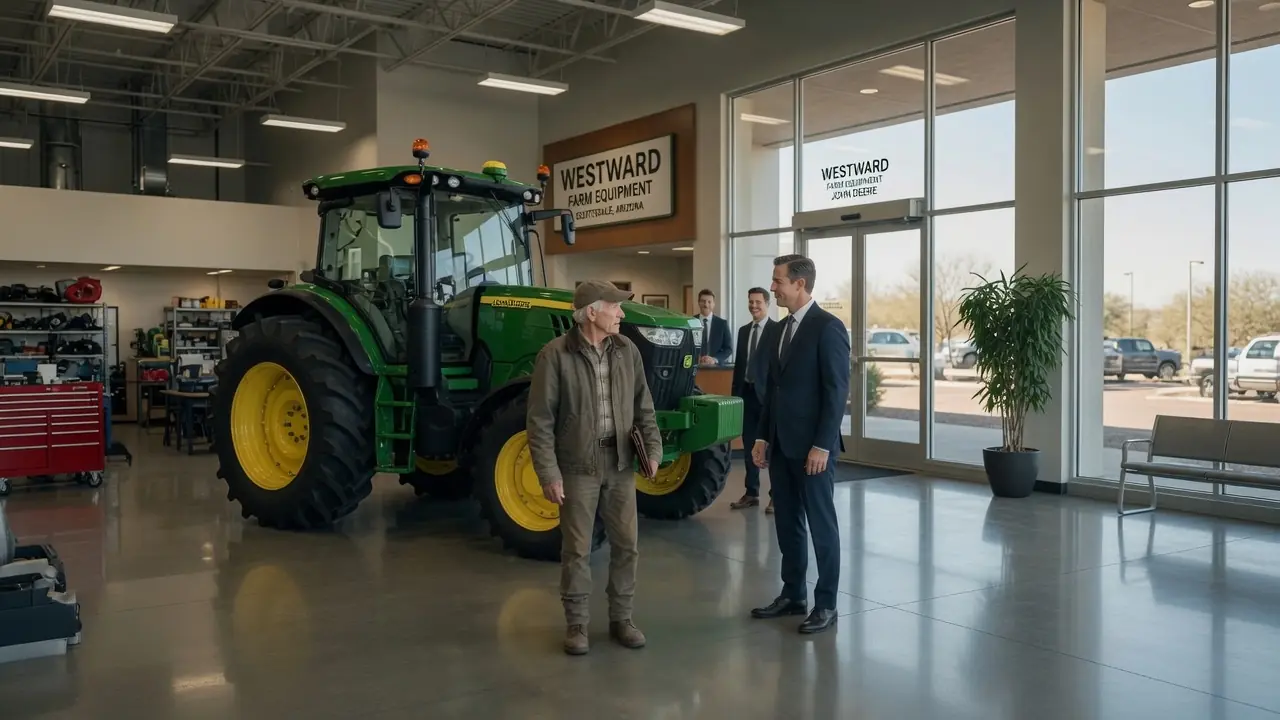
His grandson, Caleb, had just taken over eighty acres outside Casa Grande after his father walked away from farming for good. The boy was twenty-two, stubborn, and full of the dangerous optimism that made old men worry and smile at the same time. Amos had promised to help him find a tractor that could carry him through his first real season. He had not promised a new John Deere, but he had come willing to listen.
Behind the reception desk, a young salesman in a white shirt noticed him and immediately looked away. Another salesman leaned against a counter, smiled into his coffee, and whispered something that made the first one laugh. Amos heard the laugh. He had lived long enough to know when laughter was being aimed at him.
Preston Vale stepped out from behind a glass office with the bright confidence of a man who believed expensive floors belonged beneath his shoes. He was thirty-eight, handsome, neatly groomed, and wearing a navy jacket over a shirt with no tie. His hair was shaped carefully, his shoes shone, and his smile arrived before his manners did. He looked at Amos once, from cap to boots, and decided the old man was either lost or looking for the parts counter.
Amos did not notice the judgment at first. His eyes were still on the tractor. “Excuse me,” he said calmly. “I’d like to see that John Deere.”
Preston stopped beside him, his smile sharpening. “You can’t afford it.”
The sentence landed hard enough to quiet the salesman behind the counter. Amos turned slowly, not angry yet, only surprised by how plain the insult had been. He had been dismissed by bankers, inspectors, cattle buyers, and men in county offices who thought age made a person soft. But something about being told he could not even look at a machine in a building sitting on land he knew better than anyone made his chest go still.
“You sure about that?” Amos asked.
Preston gave a small laugh. “Look at yourself.”
Amos looked down at his own jacket, the scuffed cuffs, the dust on his jeans, the boots darkened by years of irrigation mud and oil. Then he looked back at Preston. “You judge every man by his boots?”
“No,” Preston said, smirking now. “I judge by who can afford what he’s touching.”
For a moment, Amos did not speak. He thought of his late wife Ruth, who used to tell him that pride was loudest in men who had never survived real loss. He thought of his grandson waiting at the farm, hoping Grandpa Amos would come back with advice, maybe a brochure, maybe a number they could work toward. He thought of all the farmers who had walked through places like this and been made to feel poor before anyone asked what they needed.
Then Amos opened the leather folder.
Preston’s eyes flicked toward it, amused. “What’s that? Loan paperwork?”
“No,” Amos said quietly. “A deed.”
Preston’s smile faded just a little.
Amos turned the first page toward him. “You should’ve checked whose land this dealership sits on.”
The second salesman stopped smiling.
Preston stared at the paper, then at Amos. “What did you just say?”
Amos closed the folder gently. “I said you should have checked the deed.”
The showroom went silent, except for the faint hum of air conditioning and the distant clank of tools from the service bay. Preston’s face hardened, but uncertainty had entered his eyes. He looked toward the wall above the offices, where black letters read WESTWARD FARM EQUIPMENT — SCOTTSDALE, ARIZONA. The sign had been painted there long before Preston became general manager, long before he learned to speak to customers as if their worth could be estimated by clothing.
“That land belongs to Westward Holdings,” Preston said.
Amos nodded. “The building does. The land under it belongs to me.”
Preston laughed once, but it sounded forced. “That’s not possible.”
“It’s not only possible. It’s recorded.”
The receptionist behind the counter looked down at her computer and began typing quietly. Preston noticed and snapped, “Marcy, don’t.”
She stopped, but the damage had been done. Everyone in the showroom now understood there was something to check. Amos placed the folder back under his arm and glanced once more at the tractor.
“I came here to look at equipment for my grandson,” Amos said. “You made sure I saw something else first.”
Preston stepped closer. “Sir, if there has been some misunderstanding—”
“There has,” Amos said. “You misunderstood who walked through your door.”
Preston’s face flushed. “You can’t just walk in here and threaten a dealership.”
“I didn’t threaten anything.” Amos turned toward the glass doors. “I asked to see a tractor.”
He walked out slowly, leaving dust from his boots on the polished floor. No one stopped him. Preston stood beside the John Deere, his hands tense at his sides, while the old farmer crossed the parking lot toward a battered 1991 Ford Ranger with sun-faded paint and a dented tailgate. When Amos opened the driver’s door, Preston saw the small metal plaque on the truck’s dashboard through the windshield.
Whitaker Farms, established 1948.
That night, Preston stayed late in his office. He called the property management company that handled Westward Farm Equipment’s lease, but the woman who answered said she could not discuss land ownership without authorization. He called the dealership owner, Martin Sloane, who was attending an equipment conference in Dallas. Martin did not sound worried at first.
“An old man said he owns the land?” Martin asked. “Preston, every week someone claims something.”
“He had documents.”
“Everyone has documents.”
“He knew the structure. He said Westward Holdings owns the building, not the ground.”
The silence on the other end lasted too long.
Preston sat straighter. “Martin?”
Martin sighed. “The original ground lease was with Whitaker Land Trust. It goes back decades. We bought the dealership assets and building rights, but not the dirt.”
Preston felt his stomach tighten. “Why didn’t I know that?”
“Because you sell tractors, Preston. You don’t read lease files.”
“What happens if the lease ends?”
“It renewed automatically every ten years, unless there was a breach.”
Preston looked through the glass wall at the dark showroom. The John Deere’s green hood caught the security light like a sleeping animal. “What kind of breach?”
“Don’t worry about it tonight.”
That was the sentence that made Preston worry more.
By morning, three black cars pulled into the dealership parking lot at 8:43. Amos arrived behind them in the same Ford Ranger, wearing the same cap and carrying the same leather folder. He stepped out slowly, not theatrical, not pleased, not angry in the way Preston expected. Two lawyers got out of the first car, followed by a woman in a gray suit with silver hair and a hard briefcase.
Preston was already waiting near the front desk, sleepless and pale beneath his tan. Marcy stood behind the counter with her lips pressed together. The two salesmen who had laughed the day before suddenly found reasons to straighten brochures.
Amos entered first.
Preston forced a smile. “Mr. Whitaker.”
Amos nodded. “Mr. Vale.”
The woman in the gray suit stepped forward. “I’m Carolyn Reeves, counsel for Whitaker Land Trust. We are here to deliver formal notice.”
Preston swallowed. “Formal notice of what?”
Carolyn opened her briefcase and removed a thick packet. “Notice of lease violation, unauthorized expansion, unpaid easement fees, and improper use of restricted water access under the 1986 ground agreement.”
Preston stared at her. “I need Martin Sloane here.”
“He has been notified.”
Carolyn placed the packet on the reception desk. “Westward Farm Equipment expanded its rear service yard across a restricted irrigation easement three years ago. The dealership also paved over the inspection corridor without approval and connected to an old agricultural water line that remains under Whitaker ownership.”
Marcy’s eyes widened.
Preston shook his head. “That can’t be right.”
Amos spoke quietly. “I walked that line with my father when I was eleven. It ran water to alfalfa before Scottsdale decided dirt was worth more than crops. I know where every buried pipe sits.”
Preston looked at him now, really looked at him. The old jacket, the cracked boots, the weathered cap—all the things he had used as evidence of worthlessness suddenly became evidence of memory. Amos was not a man outside the modern world. He was a man who remembered what had been under it before glass offices and paved lots covered the ground.
Carolyn continued. “The trust has the right to terminate the ground lease unless the violations are cured, damages paid, and a revised agreement is signed.”
Preston’s voice lowered. “Terminate means what exactly?”
“It means,” Carolyn said, “that Westward may own this building, but it cannot legally keep operating on land it no longer has permission to occupy.”
The showroom seemed to tilt.
Preston looked toward the service bay, the offices, the parts room, the rows of machines outside, and finally the green John Deere on the floor. He had spent years believing the dealership was power. But buildings, inventory, and polished machines meant nothing if the ground under them could be pulled away by a man he had mocked for wearing old boots.
Amos walked past him and stopped beside the tractor. This time, no one blocked him. He placed one rough hand on the green hood, feeling the cool metal beneath his palm.
“This is a fine machine,” Amos said.
Preston said nothing.
“My grandson would have liked to learn about it yesterday.”
Carolyn glanced at Amos. “Mr. Whitaker, would you like to proceed with the termination demand today?”
Preston’s head snapped up. “Wait.”
Amos turned.
Preston’s face had changed. The arrogance was still there, but fear had cracked it open. “Mr. Whitaker, what happened yesterday was inappropriate.”
Amos waited.
Preston’s jaw tightened, as if apology had to be dragged out of him with chains. “I spoke out of turn.”
Amos looked at him for a long moment. “No. You spoke exactly from where your heart was standing.”
That hit harder than Preston expected.
The older salesman near the counter lowered his eyes. Marcy looked away. Carolyn remained still, watching the exchange like a judge who had already heard enough.
Preston took a breath. “I judged you unfairly.”
“Yes.”
“I apologize.”
Amos did not answer immediately. He looked around the showroom at the tractors, the banners, the clean desks, the service schedules, the farmers who would eventually walk through those doors hoping not to be treated like beggars for asking questions. Then he looked back at Preston.
“An apology to me is easy,” Amos said. “I am seventy-eight. I’ve been insulted by better men and survived worse mornings. What bothers me is how many farmers you’ve made feel small before they signed papers they didn’t understand.”
Preston said nothing.
Amos lifted his leather folder. “Yesterday, I came to see whether I could help my grandson buy a tractor. Today, I came to decide whether this dealership deserves to stay on my land.”
Martin Sloane arrived twenty minutes later, sweating through a linen shirt and pretending the situation was not as bad as it was. He shook Amos’s hand too eagerly, called him “sir” three times in one sentence, and asked to speak privately. Amos refused.
“Anything you can say about this land, you can say where your employees can hear it,” he said.
So Martin stood in the middle of the showroom while Carolyn reviewed the violations. The paved service yard had crossed the easement. The water line had been used without compensation. The lease required written permission for expansion. None had been obtained. Martin blamed a contractor, then an office mistake, then a former operations manager no longer employed.
Amos listened without expression.
When Martin finished, Amos said, “Do you know why my father leased this land instead of selling it?”
Martin blinked. “No.”
“Because he said land remembers ownership even when people forget gratitude.” Amos looked toward the tractor. “He did not mind progress. He minded men who thought progress gave them permission to stand on someone else’s ground and look down.”
Martin’s face reddened. “Mr. Whitaker, we want to make this right.”
“Then start with yesterday.”
Martin looked at Preston.
Preston swallowed. “What do you want me to do?”
Amos nodded toward the showroom. “Call the staff together.”
Within five minutes, every employee available stood near the reception desk: salesmen, service writers, mechanics, parts clerks, finance staff, and Marcy from the front counter. Preston stood in front of them with a face that looked carved from humiliation. Amos stood nearby, silent.
Preston cleared his throat. “Yesterday, Mr. Whitaker came into this dealership and asked to look at a John Deere. I judged him by his clothes and told him he couldn’t afford it.”
No one moved.
“I embarrassed him in front of staff,” Preston continued. “And I did it because I forgot what this business is supposed to respect.”
His voice faltered, but Amos did not help him.
Preston forced himself to finish. “A farmer does not owe us clean boots before we show him a machine. He does not owe us proof of wealth before we answer a question. I was wrong.”
The silence afterward was heavy.
Then one of the older mechanics, a man named Luis, crossed his arms. “Good.”
Preston looked at him, startled.
Luis shrugged. “Somebody needed to say it.”
A few employees lowered their heads to hide smiles. Martin did not look amused, but Amos did. Only a little.
Carolyn then moved to business. The dealership would pay back easement fees, restore inspection access, compensate for water use, and sign a revised ground lease with stricter conduct and community service provisions. Martin agreed faster than pride wanted but slower than fear required. Amos insisted on one additional term.
Westward Farm Equipment would sponsor an annual equipment education day for small farmers, young farmers, and 4-H students, with no sales pressure and no credit screening at the door.
Martin hesitated. “That is unusual.”
Amos looked at Preston. “So was yesterday.”
Martin signed.
After the lawyers left, Amos stayed. He walked back to the John Deere and stood beside it again. Preston approached carefully, no microphone, no smirk, no polished insult ready on his tongue.
“Would you still like to see it?” Preston asked.
Amos looked at him. “You asking because I own the land, or because I walked through the door?”
Preston took the blow without flinching. “Because you walked through the door.”
Amos studied him, then nodded once. “Then show me.”
For the next hour, Preston explained the tractor properly. He showed Amos the cab, the controls, the hydraulic options, the financing terms, the used alternatives, and the maintenance requirements. Amos asked direct questions, the kind of questions that revealed experience sharper than any credit score. Preston answered them honestly, and when he did not know something, he called a service manager instead of pretending.
By noon, Caleb arrived from Casa Grande. He came in wearing work jeans, nervous eyes, and the same Whitaker caution with hope hiding beneath it. Amos introduced him to Preston without mentioning the insult. Caleb climbed into the tractor cab with wonder on his face, touching the steering wheel like it was both dream and danger.
“Too much tractor for eighty acres,” Amos said.
Caleb looked disappointed but nodded. “I figured.”
Preston surprised them both. “For your ground, maybe look at something smaller. We have a used 5 Series coming in next week. Enough power for what you’re doing, easier to maintain, and it won’t bury you in payments.”
Amos looked at Preston sharply.
Preston looked back. “Debt doesn’t make a farmer stronger.”
Amos almost smiled. “You learn fast when the ground moves under you.”
Caleb did not fully understand what had happened, but he understood enough to know his grandfather had won something without raising his voice. They left the dealership with brochures, numbers, and an appointment to see the used tractor when it arrived. As Amos opened the Ranger’s door, Preston stepped outside.
“Mr. Whitaker?”
Amos turned.
“I am sorry,” Preston said again. This time there was no audience.
Amos nodded slowly. “Then be different when I’m not here to catch you.”
Preston lowered his eyes. “I will try.”
“Trying is for weather,” Amos said. “Men choose.”
Then he climbed into the old Ranger and drove away with Caleb beside him.
Over the next months, Westward Farm Equipment changed in ways customers noticed before employees admitted. Salesmen greeted old trucks as quickly as new ones. Farmers in dusty jeans were offered coffee before credit talk. The first equipment education day brought fifty-two people, including teenagers, widows managing inherited acreage, small growers, and old men who had avoided dealerships for years because they were tired of being treated like problems.
Amos attended but did not speak much. He sat in the back row with his cap in his hands while Preston gave a session on choosing the right tractor for the right acreage. At one point, Preston said, “Never let a salesman talk you into buying pride when what you need is a machine.” Several farmers looked at Amos. Amos only looked out the window toward the land beneath the building.
Caleb bought the used 5 Series that spring. Not with drama, not with a giant bow, not with a speech. He signed carefully, paid a fair down payment, and drove it home himself while Amos followed in the Ford Ranger. When they reached the farm, Caleb parked beside the old shed and sat in the cab for a long time.
“You think I did right?” Caleb asked.
Amos leaned against the fender. “You bought what the farm needs, not what your pride wanted. That’s usually right.”
Caleb looked at him. “That salesman treated you better today.”
“He learned the rent was due.”
Caleb laughed, but Amos did not.
Then the old man added, “The trick is treating people right before you find out what they own.”
Years later, people in Scottsdale still told the story of the morning lawyers walked into Westward Farm Equipment. Some told it like a revenge tale, with Amos as the old farmer who humbled the arrogant salesman. Others told it as a business lesson about ground leases and hidden ownership. Amos never liked either version much.
To him, the story was simpler.
An old farmer walked into a dealership and asked to see a tractor.
A salesman saw boots instead of a man.
And by the next morning, everyone learned that the ground beneath their feet had been holding the truth the whole time.