“You never served—get out before I drag you through that door.”
The sheriff’s hand closed around the dishwasher’s shoulder in front of a crowded roadside diner in Milhaven, Texas. Families had just returned from the town’s veterans memorial service, and every booth was filled with local ranchers, former soldiers, county workers, and children still carrying small American flags. Behind the counter, the quiet woman stood in a worn olive jacket, faded jeans, dusty military boots, and a plain white apron, looking more like a stranded traveler than anyone who belonged at a ceremony honoring American heroes.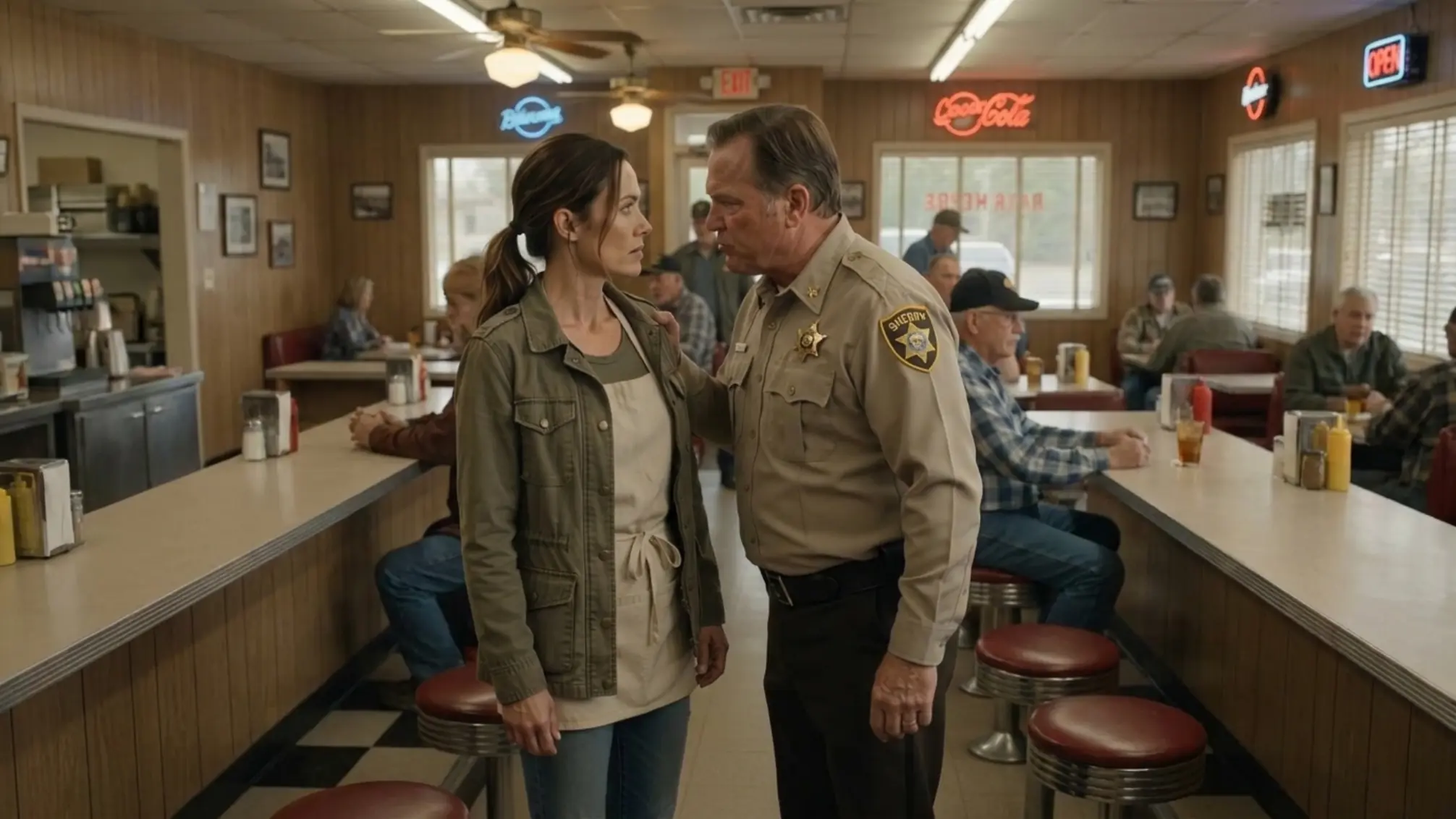
She did not step back.
“Take your hand off me,” she said.
The sheriff leaned closer, allowing his polished badge and decorative ribbons to catch the overhead light.
“You’re no hero,” he sneered. “You’re a broke dishwasher begging for attention.”
The woman’s gray-green eyes moved past him toward the entrance.
“Then ask the SEAL commander behind you why he just saluted me.”
The sheriff turned.
A silver-haired man stood beside the diner’s front door with his shoulders squared and his right hand raised in a formal salute. He had commanded American special operations teams for almost three decades, and every veteran in the room recognized the unmistakable weight in his posture. He was not saluting the sheriff, the town officials, or the flag outside.
He was saluting the woman in the apron.
The sheriff’s fingers released her shoulder.
The diner became so quiet that the ticking clock above the kitchen window suddenly sounded loud. A coffee cup stopped halfway to an elderly veteran’s mouth, and a teenage busboy froze beside the counter holding a stack of clean plates. The local men who had mocked the woman during her nine days in town stared at her as though the person they had watched washing dishes had vanished and someone far more dangerous had taken her place.
Nothing about her expression changed.
Nine days earlier, the same woman had entered the diner carrying a gray nylon pack over one shoulder. She was thirty-eight, white American, lean and athletic, with lightly weathered skin, dark-brown hair pulled into a loose ponytail, and the controlled movements of someone who never wasted energy. Her jacket was worn at both elbows, her boots were coated with Texas dust, and she asked the seventy-one-year-old diner owner whether the dishwasher position advertised in the window was still available.
The owner studied her for several seconds.
“You have somewhere to sleep?”
“I’ll manage.”
“The job pays eight dollars an hour. Six in the morning until two, sometimes later.”
“That’s enough.”
The diner owner had seen desperate people before, but the stranger did not seem desperate. She seemed deliberate. Even while asking for work, her eyes briefly tracked the counter, the rear exit, the kitchen doorway, the occupied booths, and the large window facing the town square.
The owner pointed toward the kitchen.
“You can start now.”
That should have been the end of it.
Instead, the sheriff rose from his corner booth.
He was a broad fifty-two-year-old white American man with short graying hair, ruddy skin, cold blue eyes, and the confident posture of someone who had gone years without being challenged. His tan uniform was spotless, his polished boots looked untouched by real work, and five rows of ribbons decorated his chest. Most represented administrative service, but he wore them as though each ribbon had been earned under enemy fire.
“I know this type,” he announced.
The customers turned toward him.
“They walk in from the highway, find the kindest person in town, and take advantage of her. Two weeks later, they disappear with money, tools, or whatever they can carry.”
The new dishwasher met his gaze without answering.
The sheriff mistook her silence for embarrassment.
“This town takes care of people who have earned their place,” he continued. “Veterans, families, working Americans. You don’t look like you’ve contributed much anywhere.”
Several men laughed because the sheriff expected them to.
The dishwasher said only, “I need the job.”
The diner owner handed her an apron.
The sheriff returned to his booth, irritated that his humiliation had failed to produce the reaction he wanted. He had spent years controlling Milhaven through small performances of public authority. People obeyed not because every order was lawful, but because resisting him meant becoming the next person he embarrassed in front of neighbors.
The dishwasher understood that immediately.
She had entered Milhaven for reasons no one in the diner could have guessed. The job advertisement was real, but her need for employment was not. Her military file identified her only as a former Army medical-support specialist because nearly everything important had been sealed behind federal classifications.
Her actual service history belonged to another world.
She had spent fourteen years inside United States Naval Special Warfare, eventually becoming one of the first American women assigned to a Tier-One operational unit. She had completed dozens of classified missions across four combat theaters, evacuated wounded teammates under fire, and led reconnaissance operations in places that did not appear on ordinary maps. After leaving active service, she began working as a civilian investigator on cases involving stolen veterans’ benefits and corrupt military contractors.
Milhaven was one of those cases.
Nine local veterans had applied for supplemental federal benefits during the previous three years. Their medical records were valid, their service histories were documented, and their applications should have moved through the county system without difficulty. Instead, six files disappeared after reaching the sheriff’s administrative office.
The missing money was not accidental.
A separate investigation had connected the sheriff to a county resource-management company receiving inflated contracts from public funds. Investigators suspected that veterans’ paperwork was being delayed deliberately so county officials could redirect administrative reimbursements and pressure desperate applicants into paying unofficial “processing assistance” fees.
The former SEAL needed evidence from inside the community.
So she washed dishes.
Nobody watched the woman standing at the sink. Customers spoke freely near her because they considered her invisible. County workers discussed delayed applications over breakfast, contractors mentioned unexplained payments during lunch, and the sheriff bragged about keeping “ungrateful veterans” under control while drinking coffee ten feet from where she worked.
Every night, she recorded what she had heard.
During the day, she revealed nothing.
The teenage busboy was the first person to notice that she did not move like an ordinary dishwasher. She always stood with her back near a wall and kept both exits within sight. When a customer dropped a steak knife, her body lowered instantly before her mind seemed to recognize the harmless sound.
She recovered so quickly that most people missed it.
The busboy did not.
He also noticed the calluses on her hands. They were not the soft cracks caused by soap and hot water. They formed in thick bands across her fingers, with heavier skin between her thumb and forefinger.
One morning, he asked where she had learned to fold towels with such precise corners.
“Work,” she answered.
“What kind?”
“The kind that liked clean towels.”
She returned to the sink.
The busboy knew she was avoiding the question, but he also understood that pressing harder would make her speak less, not more. He began quietly watching her instead. What he saw only deepened the mystery.
Three days after she arrived, a pickup truck lost control near the diner and crashed into a ditch. The driver suffered a badly injured arm and began slipping into shock. Before anyone else reached him, the dishwasher was already kneeling beside the vehicle.
She checked his breathing and pulse, stabilized his neck, and built a field splint from a board, cloth, and a piece of roadside wood. Her movements were quick but unhurried, each action following an exact sequence. When paramedics arrived, they left her splint in place.
A deputy asked whether she was a doctor.
“No.”
“Then where did you learn that?”
“Army medical support.”
The answer reached the sheriff by afternoon.
He visited the diner and ordered a background check. The public file confirmed military service but offered almost no details. An unusual series of federal redaction codes appeared where assignments and awards should have been.
The deputy conducting the search called a contact inside the federal records system.
The woman on the other end became quiet after seeing the codes.
“Where did you find this person?”
“She’s washing dishes in Milhaven.”
“Leave her alone.”
“What do the codes mean?”
“They mean you should stop asking questions.”
The deputy considered warning the sheriff.
Fear won.
The sheriff continued treating the dishwasher like a homeless fraud. He pressured the commercial-property owner next door to complain that she was sleeping in the diner’s storage room. When the owner threatened a code inspection, she packed her belongings in less than one minute and prepared to leave.
The diner owner stopped her.
“You can sleep in the back booth.”
“I don’t want trouble for you.”
“You are not the trouble.”
The sheriff heard about the arrangement and became furious. Each time the woman survived one attempt to drive her away, his need to humiliate her grew stronger. Her calmness disturbed him because it denied him the emotional victory he expected.
He wanted anger, fear, or pleading.
She gave him nothing.
A group of local men began testing her as entertainment. One demanded that she donate thirty dollars to the veterans memorial fund, assuming she was too poor to pay. She placed the money on the table without complaint and continued taking their order.
Another man brought a malfunctioning handgun into the diner and challenged the former military medic to identify the problem.
She glanced at it from several feet away.
“Recoil spring is backward.”
The gun-shop owner disassembled the weapon.
She was correct.
“How did you know?”
“Lucky guess.”
Nobody believed her.
The sheriff decided the woman was either lying about her military history or hiding something criminal. The possibility that she had served at a level beyond his understanding never entered his mind. In his world, real heroes looked like him: loud, decorated, publicly respected, and constantly reminding others of their authority.
The dishwasher looked tired.
Therefore, he decided, she could not be important.
The one man who recognized the truth arrived the day before the memorial service. The retired SEAL commander entered the diner in civilian clothing and ordered pot roast from a rear booth. He had been invited to speak at Sunday’s ceremony because he was one of the most respected military officers ever to come from the county.
He noticed the dishwasher immediately.
She turned too cleanly, watched reflections in the glass instead of staring directly, and positioned herself where she could see every entrance. Those were not habits learned in a hospital kitchen. They belonged to someone who had spent years surviving rooms where the wrong blind spot could kill an entire team.
The commander did not confront her.
He watched for forty minutes, paid for his meal, and returned to his motel. From there, he placed one secure telephone call.
The answer confirmed what his instincts had already told him.
The woman washing dishes at the roadside diner had once served under his wider command structure. Her missions remained classified, but her reputation did not. Operators who knew her record described her as one of the most disciplined reconnaissance leaders in modern American special operations.
She was also in Milhaven under federal authority.
The commander understood that exposing her prematurely could damage the investigation. He said nothing when he returned for the memorial service the following morning. He simply watched the sheriff stand onstage and deliver a speech about honor.
The sheriff spoke proudly about sacrifice and community.
Then he looked directly toward the dishwasher standing near the edge of the crowd.
“Not everyone who enters this town has earned the right to stand among those who served.”
The commander’s expression hardened.
The woman remained silent.
After the ceremony, the crowd moved into the diner for lunch. The commander sat at the counter while the dishwasher poured his coffee. They did not greet one another by name.
“How long?” he asked quietly.
“Nine days.”
“What did you find?”
“All six missing benefit applications. Two county officials. One contractor. The sheriff signed four authorizations.”
“Federal team?”
“Outside.”
The commander looked toward the front window.
“When do they move?”
“When he gives them the final piece.”
The final piece arrived sooner than expected.
One of the sheriff’s friends falsely accused the dishwasher of mishandling memorial-fund money. The receipt was inside the register, but the sheriff did not care. He used the accusation as another opportunity to attack her character in front of the crowded diner.
“You have no home here, no history here, and no right handling money meant for American veterans.”
“The donation is documented.”
“This isn’t about documentation.”
“It usually is when someone is lying.”
Several customers reacted.
The sheriff rose from his stool.
“You think wearing old military boots makes you one of them?”
“No.”
“You think staying quiet makes you dangerous?”
“No.”
“You think anyone in this town believes you’re a hero?”
“I never asked them to.”
The answer embarrassed him more than an insult would have.
He stepped behind the counter and ordered her to leave. When she refused, he grabbed her shoulder and pulled her toward the door. The seam of her work shirt tore beneath his hand.
Part of the tattoo on her upper arm became visible.
The eagle, anchor, trident, pistol, and classified unit designation were unmistakable to anyone familiar with Naval Special Warfare.
The retired commander stood and saluted.
The sheriff turned toward him, still holding a piece of torn fabric.
The commander spoke in a calm voice that reached every corner of the diner.
“You just put your hands on a former Tier-One operator with thirty-six confirmed combat missions across four theaters.”
The sheriff stared at the dishwasher.
The commander continued.
“She received classified commendations for saving American lives under enemy fire. Your ribbons came from office assignments. Hers cannot legally be shown to you.”
The sheriff released her completely.
“I didn’t know.”
The former SEAL pulled the torn fabric over her shoulder.
“That’s the point.”
His face tightened.
“What is?”
“You believed I deserved humiliation when you thought I was nobody.”
The front door opened.
Two federal investigators entered in civilian clothing. They positioned themselves on either side of the entrance while the woman removed her apron and placed it on the counter in a perfectly folded rectangle.
The sheriff looked from her to the investigators.
“What is this?”
“The veterans’ benefit applications,” she said. “All six were received by your office.”
“That isn’t true.”
“Your signature appears on four intake forms.”
“Anyone could copy a signature.”
“We have the original documents.”
The sheriff glanced toward his deputy.
The deputy lowered his eyes.
The former SEAL continued.
“We also traced county mining-reserve contracts to a company controlled by your brother-in-law. The county paid fourteen percent above market value, and part of those payments entered an administrative account connected to the missing veterans’ applications.”
“You have no authority here.”
One federal investigator stepped forward.
“We have a warrant.”
The sheriff looked around the diner for support.
The men who had once laughed at his insults now avoided his eyes. The elderly veterans watched him with expressions more painful than anger. For years, some of them had trusted his office with medical claims, disability forms, and records of injuries they rarely discussed even with family.
He had turned their service into an opportunity for profit.
The sheriff pointed at the former SEAL.
“She came here under false pretenses.”
“I applied for a real job,” she answered. “I washed every dish you left behind.”
The diner owner folded her arms.
“She was the best worker I had.”
The former SEAL placed several photocopied forms on the counter.
“You delayed wounded veterans for years. I needed nine days to prove it.”
The sheriff’s authority disappeared without handcuffs or raised voices. The federal investigators asked him to accompany them to the county office while they secured administrative records. He attempted to order his deputy to block the search.
The deputy did not move.
“You heard me.”
“I heard you for eight years,” the deputy replied. “That’s the problem.”
The sheriff left between the investigators.
No one saluted him.
The federal review lasted seven weeks. All nine veterans’ benefit applications were reopened, and the six obstructed cases received priority processing. Several applicants were awarded back payments covering the years they had been forced to wait.
The contracting investigation produced criminal charges against the sheriff and two county officials. Records proved they had redirected administrative funds, falsified processing dates, and benefited from overpriced resource contracts. The sheriff’s decorative ribbons and public speeches could not protect him from his own signatures.
The woman remained in Milhaven for one more day.
She finished the lunch cleanup, wiped the counter, and folded her apron. The diner owner found her gray pack resting beside the front door.
“You’re leaving.”
“The assignment is complete.”
“You could stay.”
The former SEAL looked around the room where she had slept, worked, listened, and waited.
“I don’t stay anywhere long.”
The teenage busboy approached from the kitchen.
“Are you really a hero?”
She adjusted the pack on her shoulder.
“No.”
He looked confused.
“The commander said—”
“I did my job.”
“You saved those veterans.”
“They earned those benefits before I arrived.”
The boy looked at the challenge coin she had placed beside the apron.
“Will you come back?”
For the first time in nine days, her expression softened.
“I’m working on it.”
She walked outside.
The diner bell rang once behind her, and the Texas wind carried dust across the parking lot. The silver-haired commander waited beside an unmarked truck at the far end.
“Three new assignments,” he told her. “You can refuse all of them.”
She placed her pack in the truck.
“Where?”
He handed her a folded page.
She read the locations.
“Which one needs someone invisible?”
“All three.”
The former SEAL looked back through the diner window. The busboy stood behind the counter folding a towel with precise corners. The elderly veterans were reading letters that finally promised movement on their cases.
She circled one location.
“Give me three days.”
The truck pulled onto the highway and headed west.
Back in Milhaven, the story spread quickly. People repeated the moment the commander stood and saluted the homeless-looking dishwasher, but the diner owner remembered something different.
She remembered the woman arriving without asking for recognition.
She remembered the sheriff deciding her worth from her worn clothes.
And she remembered that the former SEAL never demanded an apology after the truth came out.
Months later, the diner owner placed the challenge coin on a shelf above the register. Beneath it, she added a small handwritten card:
Service Does Not Need to Look Important.
The sheriff had spent years presenting himself as Milhaven’s protector. He wore polished boots, displayed ribbons, delivered memorial speeches, and loudly explained what sacrifice meant.
The former SEAL washed dishes.
One of them used veterans to build authority.
The other used her anonymity to return what veterans had earned.
And when the truth finally entered that crowded diner, the sheriff learned too late that the quietest person in the room had already documented every lie he told.