Clare Donovan had built her life around schedules that rarely failed.
Her mornings began at five-thirty, her meetings were arranged in fifteen-minute blocks, and her assistants knew never to leave empty space between appointments unless she requested it. At forty-one, she was the chief executive of Donovan Medical Logistics, a national company that supplied emergency equipment to hospitals throughout the Midwest. People often described her as disciplined, but those who feared her preferred the word cold.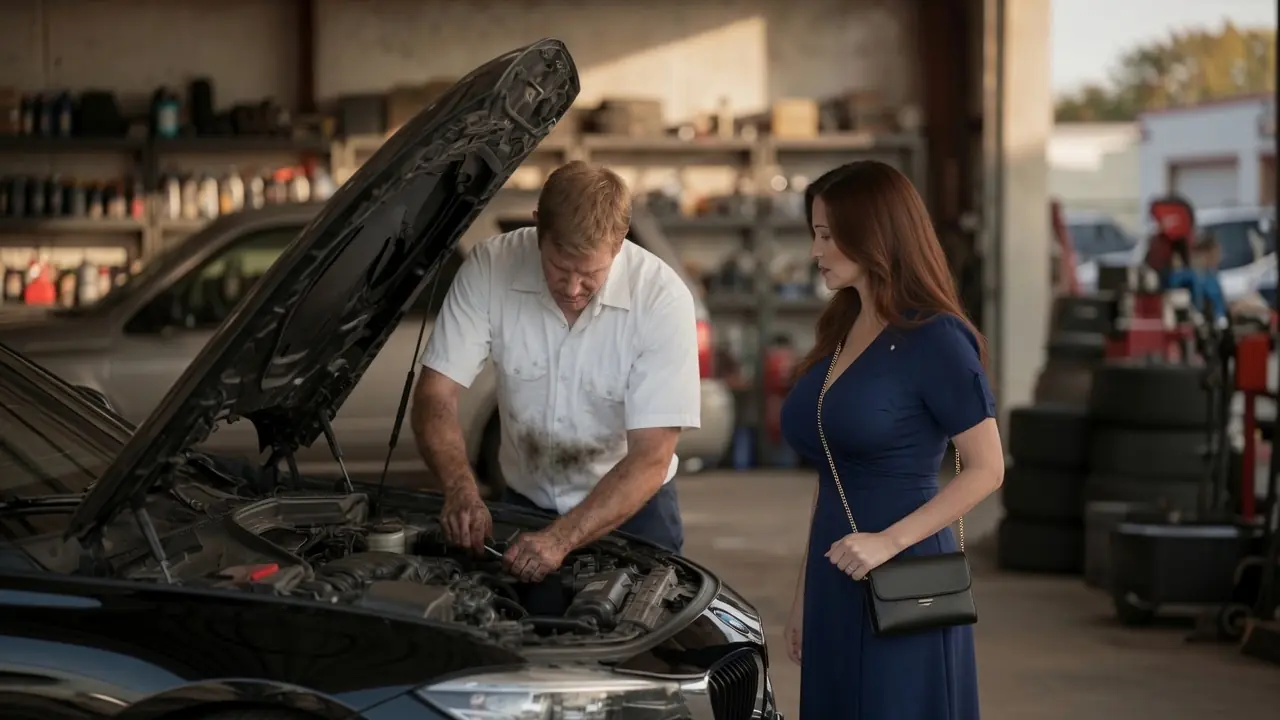
Clare did not object to either description.
Control had carried her through a childhood filled with unanswered questions and an adulthood in which everyone seemed to want something from her. Investors wanted stronger numbers, competitors wanted her contracts, and distant acquaintances wanted access to her name. She had learned to keep her private life small enough that nobody could use it against her.
That Wednesday afternoon, however, control abandoned her outside a grocery store in Westfield, Ohio.
Clare had been driving her black BMW X5 toward Columbus after inspecting a regional warehouse when the dashboard flashed three warnings at once. The engine lost power, the steering became heavy, and a burning smell entered through the vents. She guided the BMW into the parking lot of Miller’s Grocery before the engine shut down completely.
Rain tapped against the windshield while Clare tried the ignition twice. The starter clicked, the dashboard flickered, and then everything went silent. Her phone showed less than ten percent battery, and the nearest BMW service center told her the earliest tow would arrive in four hours. She had a board call in ninety minutes and a dinner with investors that evening.
Clare stepped out beneath a small umbrella and opened the hood, although she knew almost nothing about engines.
A handwritten sign across the street read BENNETT AUTO REPAIR. The garage looked unimpressive beside the modern shopping plaza, with faded gray siding, two service bays, and an old pickup parked near a stack of tires. Clare hesitated before crossing the road because she had spent years learning that desperation made people careless. Still, the rain was growing heavier, and her phone battery had fallen to six percent.
Inside the garage, Luke Bennett was replacing brake pads on a delivery van.
He was thirty-eight, broad-shouldered, and dressed in a blue work shirt darkened by grease around the sleeves. A small radio played near the workbench, and a child’s drawing of a red car hung beside the tool cabinet. Luke looked up when Clare entered and immediately noticed the expensive coat, wet shoes, and impatience in her expression.
“My BMW died across the street,” Clare said. “Can you look at it?”
Luke wiped his hands on a cloth. “I can take a look, but I won’t know how long it’ll take until I see what failed.”
“I have an important call in less than ninety minutes.”
“Cars don’t usually check calendars before breaking.”
Clare stared at him, unsure whether he was joking. Luke picked up a diagnostic case, pulled on a rain jacket, and followed her across the street. He did not ask who she was, what she did, or whether she could afford the repair.
At the BMW, Luke connected a portable scanner beneath the dashboard while Clare stood beside the open driver’s door. The device returned several voltage faults that suggested a charging failure, but the battery was less than a year old. Luke checked the terminals, traced the wiring beneath the housing, and smelled the same burned plastic Clare had noticed.
He removed a protective panel and found a melted electrical connector near the charging-control module.
“How bad is it?” Clare asked. “Can you get my BMW running again today?”
“It’s a burned electrical plug, but I can repair it,” Luke replied. “The wire is still good behind the damaged section.”
“How long?”
“Maybe forty minutes if I have the right connector.”
Clare checked her watch. “Do whatever is necessary.”
Luke glanced toward her. “I was already planning to.”
He returned to the garage, found a compatible heat-resistant connector, and brought the BMW across the street with a portable booster. Clare followed him into the service bay, where she sat on a metal chair instead of the cleaner waiting room because she wanted to watch. Luke noticed but said nothing.
As he worked, Clare’s phone died.
She asked to borrow a charger, and Luke pointed toward a small shelf near the office. Beside the charger stood a framed photograph of a red-haired woman holding a little girl on her shoulders. The woman’s smile was open and bright, but there was something in her eyes that made Clare stop.
She had seen those eyes before.
Not in a person, but in the mirror.
“Is that your wife?” Clare asked.
Luke’s hands slowed. “Her name was Rachel.”
“I’m sorry.”
“She died three years ago.”
Clare looked again at the photograph. Rachel had copper-colored hair, while Clare’s was dark brown, yet the shape of their faces seemed strangely alike. Clare dismissed the thought as fatigue and plugged in her phone.
Luke cut away the burned connector and began fitting the replacement.
“You travel far for work?” he asked.
“I came from a warehouse inspection.”
“What company?”
“Donovan Medical Logistics.”
The tool in Luke’s hand stopped moving.
Clare noticed immediately. “Is something wrong?”
Luke looked at her more carefully. “What did you say your name was?”
“Clare Donovan.”
He lowered the tool.
For several seconds, Luke simply stared at her, and Clare felt the familiar wall rise inside her. She had seen this reaction many times after people recognized her name. Sometimes it led to investment proposals, sometimes charitable requests, and sometimes stories designed to create an emotional debt.
“Why did you stop working?” she asked.
Luke stepped away from the BMW. “Because my late wife wrote your name on a letter.”
Clare’s expression hardened. “You expect me to believe that?”
“I didn’t say you had to believe anything.”
“My name is public. Anyone could have found it.”
Luke’s face tightened. “Rachel wrote the letter before your company became national.”
Clare stood. “Finish the car. Whatever family story you are preparing to tell me, I’m not interested.”
Luke did not argue. He returned to the repair and worked in silence until the new connector was secured, insulated, and tested. The BMW started immediately, and the voltage stabilized at the correct level.
Clare reached for her wallet.
“How much?”
“Seventy-five for the part and labor.”
“That is not enough.”
“It is what the job cost.”
She placed two hundred dollars on the workbench. Luke took seventy-five and pushed the rest back. The refusal irritated her more than an inflated bill would have because it denied her the clean ending she wanted.
As Clare turned toward the BMW, Luke walked into the small office.
He returned carrying a sealed cream envelope and an old photograph. Across the front of the envelope, written in faded blue ink, were the words: For Clare Donovan, if she ever finds us.
Luke placed both items on the BMW’s hood.
Clare did not touch them.
“My wife spent fifteen years searching for the sister taken from her family as a baby,” Luke said. “She believed that sister was you.”
“That is impossible.”
“I thought so too.”
“I was adopted through a legal agency in Cincinnati. My parents never hid that from me.”
“Rachel wasn’t searching for a woman who didn’t know she was adopted. She was searching for a baby her mother was told had died.”
Clare’s eyes moved toward the photograph.
It showed a teenage Rachel sitting beside an older woman on the steps of a modest house. Around Rachel’s wrist was a thin silver bracelet with a small blue enamel bird. Clare’s breath caught.
She owned the matching bracelet.
It had been included with the belongings her adoptive parents received when they brought her home. For years, it had been the only object connecting her to the woman who gave birth to her. The adoption file described it as a personal keepsake, but no one had explained why it looked like half of a set.
Clare picked up the photograph with trembling fingers.
“Where did she get this?”
“Her mother gave it to her when she was twelve.”
“My birth records mention a bracelet exactly like this.”
Luke nodded toward the envelope. “Then open the letter.”
Clare looked at him sharply. “You have never opened it?”
“No.”
“Your wife died three years ago, and you kept a sealed letter addressed to a stranger?”
“She asked me to.”
“That makes no sense.”
“It made sense to Rachel.”
Luke explained that Rachel had discovered Clare’s identity only six months before she died from an aggressive heart condition. By then, Clare had become a visible executive, surrounded by lawyers, assistants, and security. Rachel had tried to contact her twice, but both letters were returned by Donovan corporate offices as unverified personal solicitations.
A private investigator advised Rachel that Clare had previously faced false relatives seeking money.
Rachel feared that one more emotional letter would be treated as another scheme. She decided to preserve everything she had learned and let Clare choose whether to believe it if their paths ever crossed. Before entering the hospital for her final surgery, she gave Luke the sealed envelope.
Clare broke the seal.
The first page began with four words.
Dear Clare, my sister.
Clare sat on the metal chair because her knees no longer felt steady.
Rachel’s letter described their mother, Marianne Hale, who had grown up in Dayton under the control of her wealthy father, Charles Hale. Marianne became pregnant with Rachel at nineteen and refused to surrender her, even after Charles cut off financial support. Three years later, Marianne gave birth to another daughter during a period when she was ill and struggling to keep their small family together.
Charles arranged the second child’s adoption without Marianne’s informed consent.
He told Marianne the baby had died after complications. Then he paid a private agency to place the infant with Edward and Helen Donovan, a prosperous Cincinnati couple who had spent years trying to adopt. The Donovans had been told the birth mother voluntarily surrendered all rights and requested no future contact.
The infant was named Clare.
Rachel learned the truth when Marianne became seriously ill decades later and confessed that she had never believed the story of the baby’s death. Marianne remembered hearing her child cry and seeing a nurse carry her from the room. She had spent years requesting records, only to be told they were lost, sealed, or unavailable.
After Marianne died, Rachel continued the search.
She obtained a copy of a hospital payment ledger showing that Charles Hale had paid legal fees to an attorney connected to the adoption agency. She found an unsigned surrender form, a nurse’s written objection, and correspondence proving the Donovans had never been told the truth.
Rachel ended the letter by saying she did not want Clare’s money, reputation, or guilt.
She wanted only one chance to tell her younger sister that she had been loved before anyone took her away.
Clare reached the final page and saw that the ink had blurred in several places.
If you are reading this, I may not have survived long enough to meet you. Please do not blame Luke for waiting. I asked him to protect my daughter from becoming part of a public fight until you chose to know us. Her name is Emma, and she has your eyes.
Clare folded the letter slowly.
“Where is Rachel’s daughter?”
“At school.”
“How old is she?”
“Eight.”
Clare looked toward the photograph of Rachel and the little girl. “Does she know about me?”
“She knows her mother had a younger sister who disappeared.”
Luke paused before continuing.
“She does not know that we found you.”
Clare rose too quickly and gripped the edge of the BMW for balance. Her instinct was to leave, call her attorney, and have every document independently verified before allowing herself to feel anything. She had survived by questioning stories that arrived wrapped in emotion.
Luke seemed to understand.
“Take copies,” he said. “Have your people investigate everything.”
“You would let me leave with the letter?”
“It was written for you.”
“What about the original records?”
“They’re in a bank box. Rachel’s investigator kept certified copies.”
Clare studied him. “You could be making an enormous claim against my adoptive family.”
“I’m not making any claim.”
“If this becomes public, it could damage their reputation.”
“Then decide what matters after you know the truth.”
Clare placed the letter inside her briefcase and left.
The BMW moved smoothly as she returned to the highway, but she barely noticed the repair. She canceled the investor dinner, ignored four calls from her chief operating officer, and drove directly to her home outside Columbus. For the first time in years, she entered the silent house without turning on the lights.
She opened the small safe in her bedroom.
Inside was the silver bracelet with the blue bird.
Clare placed it beside the photograph Luke had allowed her to borrow. The designs matched perfectly, except Rachel’s bird faced right while Clare’s faced left. When placed together, the two birds formed a circle around a tiny engraved letter M.
Clare called her attorney, Evelyn Sloan.
By midnight, Evelyn had assembled a private team consisting of an adoption-law specialist, a forensic document examiner, and a retired investigator. Clare ordered them to verify every name, date, signature, and payment before contacting Luke again. She warned them that no one outside the team was to know.
The investigation took eleven days.
Every important claim in Rachel’s records was confirmed.
Marianne Hale had given birth to two daughters. The second child’s file had been transferred through an adoption agency later investigated for illegal placements. Charles Hale paid the agency’s attorney forty thousand dollars three days before Clare was placed with the Donovans.
The surrender form contained Marianne’s name but not her genuine signature.
A retired nurse, now eighty-seven, remembered Marianne screaming that her baby was alive. She had written a complaint that disappeared from the official hospital file but remained in her personal notes. The nurse had carried the guilt for more than forty years.
Clare’s adoptive parents had not participated in the deception.
Edward and Helen Donovan had believed the adoption was legal. Helen had died when Clare was twenty-six, and Edward, now eighty-two, lived in assisted care after suffering a stroke. When Clare showed him the documents, tears filled his eyes.
“We were told your mother chose us,” Edward whispered. “We never knew anyone was searching.”
Clare held his hand. “You were still my father.”
“I hope knowing them does not mean losing us.”
“It doesn’t.”
That answer surprised Clare because she had not yet admitted that she intended to know Luke and Emma. Still, the decision had already begun forming beneath her fear.
She drove back to Westfield on a Saturday afternoon.
This time, the BMW did not break down.
Luke was closing the garage when she arrived. Eight-year-old Emma sat at a small desk near the office, drawing houses with colored pencils. She had long red-brown hair like Rachel’s, but when she looked up, Clare saw her own gray-green eyes.
Luke’s posture became cautious.
“I had everything verified,” Clare said.
“And?”
“Rachel told the truth.”
Emma looked between them. “Dad, who is she?”
Luke knelt beside his daughter. “Do you remember the sister your mother searched for?”
Emma nodded slowly.
“This is Clare.”
The girl stared at her.
Clare had negotiated billion-dollar contracts without hesitation, but she could not find the right words for an eight-year-old child whose mother had died searching for her.
Emma solved the problem first.
“Are you my aunt?”
Clare’s throat tightened. “I think I am.”
Emma put down the pencil and walked closer. She studied Clare’s face with the seriousness of someone comparing two photographs.
“You have Mom’s eyebrows,” she said.
Clare laughed and cried at the same time.
Emma opened a desk drawer and removed a photograph of Rachel. She held it beside Clare’s face, then looked at Luke as though announcing scientific proof.
“They match.”
Luke turned away briefly, pressing one hand over his mouth.
Clare spent the afternoon at the garage.
Emma showed her drawings, school awards, and the small wooden bird Rachel had carved during her final months. She asked Clare whether she liked strawberry ice cream, mystery books, and thunderstorms because those had been Rachel’s favorite things.
Clare liked none of them.
Emma did not seem disappointed.
“That’s okay,” she said. “Sisters don’t have to like all the same things.”
Later, Luke made coffee in the office while Emma worked on homework. Clare admitted that she had spent most of her life imagining a birth mother who willingly gave her away. Believing she had been unwanted had shaped every relationship she built.
Rachel’s letter had destroyed that explanation.
Now Clare had to understand that she had been stolen from a family that loved her.
Luke did not offer easy comfort.
“The truth won’t give you back those years,” he said. “Rachel knew that.”
“I should have found her.”
“You didn’t know she existed.”
“She tried to contact me.”
“Your company returned the letters, not you.”
“I built the system that kept her out.”
Luke looked at her steadily. “Then change the system. But don’t use guilt to pretend you had information you never received.”
Clare returned to Westfield the next weekend, and then the weekend after that.
At first, she told herself she was collecting information about Rachel. Soon she was attending Emma’s school play, eating dinner at Luke’s small house, and learning that her niece hated peas but loved repairing old radios. Emma began sending her photographs of ordinary things—a lost tooth, a science project, a dog sleeping outside the grocery store.
Clare answered every message.
Her controlled life began developing spaces she had not scheduled.
The most difficult moment came when Clare discovered that Rachel’s medical condition might have been treatable earlier. Rachel had delayed specialized care because she lacked adequate insurance during the first year of her illness. Clare’s company worked with the very hospitals that could have helped her.
The knowledge nearly drove Clare away.
She told Luke that being near Emma made the lost years more painful. He listened without judgment, then reminded her that leaving would not protect anyone from the past.
“It would only make Emma lose another woman she was told belonged to her,” he said.
Clare stayed.
She established the Rachel Hale Family Search Fund using her own money rather than company resources. The program helped adults separated by questionable adoptions access records, legal assistance, and trauma counseling. She refused to place her own photograph in the campaign.
The fund’s first case reunited two brothers separated for fifty-two years.
Clare also changed Donovan Medical Logistics’ mail policy. Personal correspondence addressed to executives could no longer be automatically returned merely because it involved family claims. Independent reviewers would screen such letters without exposing executives to threats or dismissing legitimate contact.
She could not reopen Rachel’s returned letters.
She could prevent the same silence from happening again.
One year after the BMW broke down, Clare stood beside Rachel’s grave with Luke and Emma. She placed the matching silver bracelets beneath a framed copy of the sisters’ photograph, keeping the originals safe afterward as Emma requested.
“I’m sorry I was late,” Clare whispered.
Emma took her hand.
“Mom knew you didn’t choose that.”
Clare looked down at her niece. “How can you be sure?”
“Because she wrote it in the letter.”
Luke smiled through his grief.
That evening, the three of them returned to the garage. The black BMW sat in the same service bay where Luke had opened Rachel’s story. Emma climbed into the driver’s seat while the engine remained off and announced that she would own a repair shop one day.
Clare told her she could run the whole company.
Emma shook her head. “I want to fix things, not sit in meetings.”
Luke laughed. “Smart kid.”
Clare looked at the man who had charged her only seventy-five dollars, protected a letter for three years, and never once used Rachel’s story to ask for money. Their relationship had grown slowly, beginning not with romance but with shared responsibility for Emma and the memory of the woman they had both loved differently.
Luke never attempted to replace Rachel.
Clare never asked him to forget her.
Months later, when their friendship began becoming something deeper, they spoke honestly before allowing Emma to hope. Clare admitted that she did not know how to belong to a family without controlling every risk. Luke admitted that grief had taught him to expect happiness to disappear.
They decided not to make promises larger than the lives they could actually build.
For Emma, that honesty was enough.
On Clare’s forty-third birthday, Luke gave her the burned BMW connector mounted inside a small wooden frame. Beneath it, Emma had written, This broken part helped us find Aunt Clare.
Clare placed it on the desk in her corporate office.
Visitors often assumed it represented innovation, reliability, or a successful business lesson. Clare never corrected them unless they asked. The real meaning was too personal for casual explanation.
The BMW had not simply broken beside a small Ohio grocery store.
It had interrupted a life Clare had constructed to prevent surprises, exposed a family secret buried for four decades, and carried her toward the sister she reached too late to embrace. Yet Rachel had left behind a letter, a daughter, and a man honorable enough to wait for the truth to find its rightful owner.
Clare could not change the years that had been stolen.
She could only decide what to do with the years that remained.
And for the first time in her carefully controlled life, she chose not to spend them alone.