Sophia Lauron had almost canceled the date before she even left her office. She stood twenty floors above downtown Columbus, Ohio, staring through the glass at the snow beginning to coat the streets below. Her company, Lauron Medical Systems, was three months away from running out of cash, and her investors had spent the entire week sending emails that sounded less like advice and more like threats. The last thing she needed was dinner with a man chosen by her best friend because, according to the text message, “You need one evening where nobody asks about revenue.”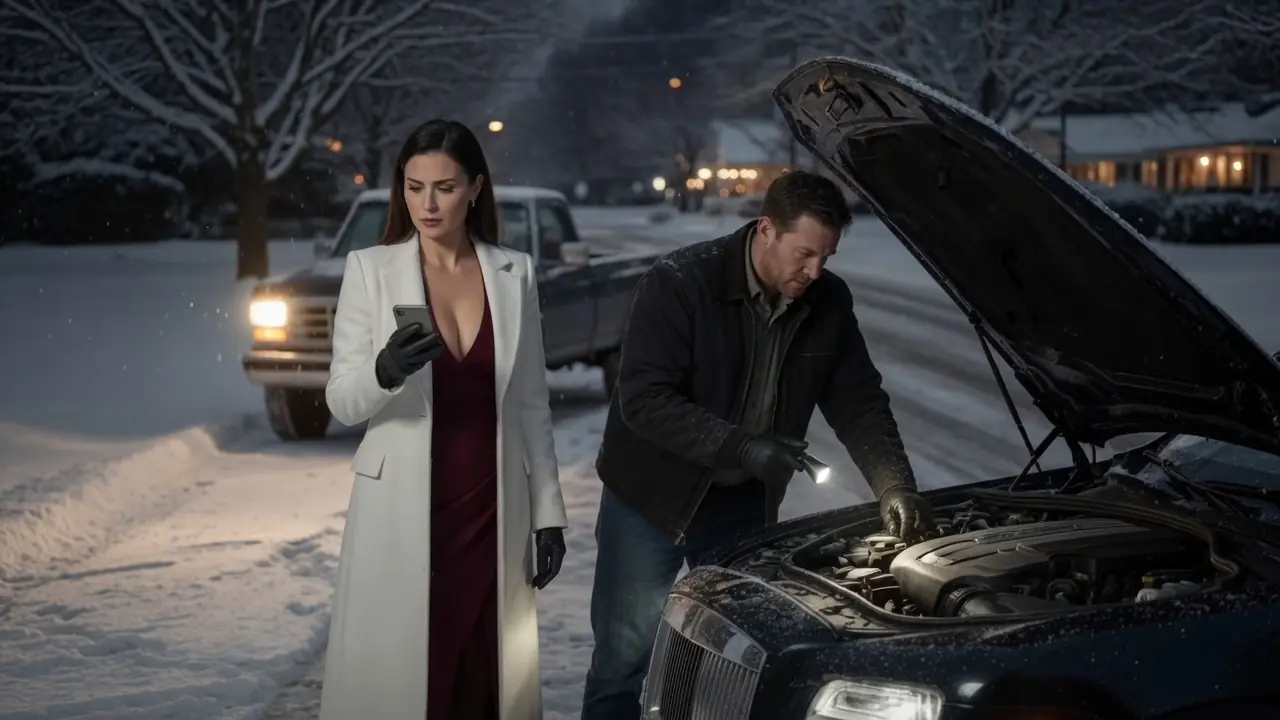
Sophia had typed three different excuses and deleted them all. Food poisoning felt too childish. A migraine felt too believable and therefore too tempting. In the end, guilt won because her best friend, Marcy, had sworn the man was kind, patient, and not the type to brag about himself. Sophia had laughed at that description because kindness did not rescue failing companies, patience did not satisfy investors, and quiet men rarely survived the world she lived in.
By 6:10, she was driving north toward Maple Street in her black luxury sedan, still checking emails at every red light. The reservation was at Evergreen Café, a small place outside the city that Marcy insisted had the best soup, the softest bread, and the least judgmental waitstaff in Ohio. Sophia’s phone kept buzzing from the passenger seat, each vibration tightening the knot behind her ribs. One investor wanted revised projections by morning, another wanted a meeting about “leadership options,” and a third had attached a spreadsheet that basically asked her to fire thirty-two people before Christmas.
Then the car jerked once.
Sophia looked down as a warning light flashed across the dashboard. The engine coughed, lost power, and forced her to guide the car onto the shoulder just beneath a green road sign that read: Evergreen Café - 3 Miles - Maple Street. Snow moved across the windshield in fine white streaks. She turned the key again, but the engine only clicked, as if even the car had decided this date was a bad idea.
For a moment, Sophia sat there with both hands on the wheel, too exhausted to be angry. Then her phone buzzed again, and anger found her after all. She stepped out into the cold in her white winter coat and burgundy dress, boots sinking lightly into the snow beside the road. The wind bit through the thin leather of her gloves while headlights passed in the distance without slowing.
She called roadside assistance and was told the wait could be ninety minutes. She called the café, but the line rang busy. Finally, she texted Marcy: Car died. Maybe the universe agrees with me.
Marcy responded almost instantly: Do not cancel. I will text him. Stay safe.
Sophia almost threw the phone into the snow.
Ten minutes later, an old blue pickup slowed behind her sedan and pulled onto the shoulder. Its headlights washed across the snow, and a man stepped out wearing a dark work jacket, jeans, heavy gloves, and the tired expression of someone who had already lived through a long day. He looked to be in his late thirties, broad-shouldered, with dark hair damp from the snow and eyes that immediately went to the open hood of her car instead of her clothes.
“Need help?” he called.
Sophia held her phone tighter. “Roadside assistance is coming.”
“In this weather, that could mean tonight or Thursday.”
“I’m fine.”
The man glanced at the dead car, the snow, the darkening road, then back at her. “Your car disagrees.”
Sophia hated that he was right. She hated more that he said it without arrogance. He walked toward the front of the sedan, keeping enough distance that she did not feel crowded. “I can take a look. If you’d rather I don’t, I’ll wait in my truck until your tow comes.”
That made her pause.
Most men offered help like a performance. This one offered it like a choice.
“Fine,” she said. “But I’m already late, so if you can’t fix it, please don’t pretend.”
A faint smile crossed his face. “I’ve got a daughter. I stopped pretending I can fix everything years ago.”
He lifted the hood, pulled a flashlight from his pocket, and leaned over the engine. Sophia stood beside him, one eye on her phone and the other on the road. He worked quietly, checking cables, listening when she tried the key, then returning to the engine with calm efficiency. His pickup idled behind them, old but steady, with a booster pack and toolbox visible in the bed.
“What happened before it died?” he asked.
“It jerked once. Then lost power.”
“Any recent service?”
“Yes.”
He looked at a loose connection near the battery and frowned. “Was the service done by people who hate bolts?”
Despite herself, Sophia almost laughed. “Luxury dealership.”
“That answers the question.”
Her phone buzzed again. She glanced down and saw another investor email with the subject line Urgent: Board Alignment Before Monday. The words made her stomach tighten. She turned away and muttered, “Perfect. My company may collapse, my car is dead, and I’m missing a date I never wanted in the first place.”
The man looked up briefly. “Bad night.”
“You have no idea.”
“Probably not.”
She shoved the phone into her coat pocket. “I’m supposed to meet some stranger at Evergreen Café. My friend thinks I need dinner with a stable single dad, as if a man who packs school lunches is going to solve a corporate crisis.”
The man stopped moving.
Sophia did not notice at first. She kept talking because stress had cracked the careful wall she usually kept around herself. “He is probably already sitting there wondering why the cold executive woman couldn’t show up on time. Or worse, he’s relieved because he didn’t want to come either.”
The man slowly turned his head toward the road sign.
Then he looked back at her.
“Sophia Lauron?” he asked.
Her eyes sharpened. “How do you know my name?”
He pulled one glove off and reached into his jacket, taking out a folded reservation note with Evergreen Café, 6:30, Sophia and Ethan written across the top in Marcy’s cheerful handwriting. Snow collected on the edge of the paper. Sophia stared at it, then at him, as understanding moved through her with awful clarity.
“You’re Ethan Walker,” she said.
He gave a small, embarrassed nod. “The stable single dad.”
Sophia closed her eyes. “Of course.”
Ethan looked back under the hood, though his mouth twitched as if he was trying not to smile. “For the record, I was also dreading the date.”
That made her open her eyes. “Excuse me?”
“I don’t mean because of you. I mean because my sister described you as brilliant, terrifying, and allergic to nonsense.”
“That was supposed to be a compliment?”
“I think from my sister, yes.”
Sophia stared at him for a moment, then looked down at her dead car. The whole situation was so absurd that the tension inside her chest loosened by one unexpected inch. “So instead of meeting at a warm café, you found me on the side of the road insulting you before dinner.”
“Pretty much.”
“And you’re still fixing my car.”
“I already started.”
“Why?”
Ethan tightened the connection and reached for the booster pack. “Because leaving someone stranded in snow just because she insulted my lunch-packing abilities seems petty.”
Sophia looked away, ashamed. “I’m sorry.”
He glanced at her. “Accepted.”
“No, really. I didn’t know it was you.”
“That’s not the part that needs apologizing for.”
She winced because he was right, and he had said it gently enough that she could not defend herself. “I’m sorry I reduced you to a stereotype because I was angry.”
Ethan connected the booster pack. “That one works better.”
Sophia stood beside him in silence as he told her to try the engine again. This time, the sedan started with a rough cough, then settled into life. Relief went through her so quickly that she had to grab the open door for balance. Ethan listened for a moment, then closed the hood.
“You should be able to drive it to the café,” he said. “But don’t shut it off until you get there. I’ll follow you.”
Sophia looked toward the sign. “You still want to go?”
Ethan brushed snow from his sleeve. “Do you?”
The practical answer was no. She had emails to answer, projections to revise, investors to appease, and a car that needed real service. But something about Ethan standing there in the snow, calm and unoffended, made her tired of running from one crisis into another. “I could use soup,” she admitted.
“Then let’s start with soup.”
Evergreen Café sat at the corner of Maple Street, glowing softly through the snow with steamed windows and a small wreath on the door. Sophia parked near the entrance and left the engine running until Ethan checked it once more. He told her it would start again, but not to trust it for long. She wanted to say she rarely trusted anything, but the joke felt too honest, so she swallowed it.
Inside, the café was warm and crowded in a comfortable way. A waitress recognized Ethan immediately and waved from behind the counter. “Lily’s with your sister tonight?”
Ethan nodded. “For two hours, if I don’t ruin the evening.”
The waitress looked at Sophia and smiled. “Good luck to both of you, then.”
Sophia followed him to a booth by the window. She removed her white coat carefully, suddenly aware of how polished she looked compared to him. Ethan noticed but did not seem intimidated. He hung his jacket on the hook, sat across from her, and folded his hands on the table like a man prepared to listen rather than perform.
For the first few minutes, they talked about ordinary things. The weather. The car. Marcy’s terrible matchmaking habits. Ethan explained that his sister worked with Marcy at a hospital and had decided he needed “adult conversation that did not involve math homework or unpaid bills.” Sophia admitted Marcy had threatened to appear at her office with soup if she canceled again.
Then the waitress brought soup, bread, and coffee. Sophia took one spoonful and realized she had not eaten since morning. Ethan noticed but did not comment. He simply pushed the bread basket a little closer to her side of the table.
That small gesture nearly undid her.
“So,” Ethan said after a while, “company crisis?”
Sophia almost gave the polished answer. It hovered automatically at the edge of her mouth: challenging quarter, investor pressure, strategic recalibration. Instead, she looked at the snow outside and found herself too tired for polished lies.
“My company makes modular medical diagnostic units,” she said. “Small clinics use them in rural areas. We had a government contract delay, a supplier failure, and two investors who think the solution to every problem is cutting people who actually know how the machines work.”
Ethan listened without interrupting.
“I built Lauron Medical Systems because my father died in a town where the nearest proper diagnostic lab was two hours away,” she continued. “I wanted smaller communities to have faster care. But now the people who funded the mission want to sell the patent portfolio and close the manufacturing floor.”
Ethan’s expression changed. “How many employees?”
“One hundred and twelve. Thirty-two on the floor most at risk.”
“And you’re three months from running out of cash?”
Sophia looked at him sharply. “Did Marcy tell you that?”
“No. You said it on the road without using the number.”
She sat back. “You pay attention.”
“I fix machines for a living. Paying attention is cheaper than guessing.”
“What do you do exactly?”
“Maintenance supervisor at Calder Foods. Before that, industrial systems technician. Before that, too many side jobs.” He paused. “And before Lily, I used to do contract work in small manufacturing plants.”
Sophia studied him. “You’re not just a roadside mechanic.”
“No. But roadside mechanic sounds more useful on a snowy evening.”
For the first time that night, she smiled without meaning to.
Ethan told her about Lily, his six-year-old daughter who hated peas, loved dinosaurs, and asked difficult questions at inconvenient times. Her mother had left when Lily was two and drifted in and out until finally choosing not to come back. Ethan did not tell the story with bitterness, which somehow made it sadder. He spoke like a man who had learned to keep his anger in a drawer so his daughter would not trip over it.
“She thinks I’m on an important business dinner,” Ethan said.
Sophia raised an eyebrow. “Technically true.”
“She also packed me a granola bar in case the date went badly.”
Sophia laughed. It startled her, the sound coming so freely. “Smart girl.”
“She is.”
The conversation grew easier after that. Sophia found herself telling him about investors she could not stand, board calls that felt like interrogations, and the loneliness of being the final name on every impossible decision. Ethan did not offer empty encouragement. He asked concrete questions about production bottlenecks, supplier substitutions, machine downtime, labor schedules, and whether her floor workers had been asked for solutions.
The last question stopped her.
“Of course they have managers,” she said.
“That’s not what I asked.”
Sophia held his gaze. “You’re direct.”
“So are broken machines.”
She looked down at her coffee. “No. I haven’t asked them directly. I get reports.”
“Reports are what people write after they’ve made the truth presentable.”
The sentence landed with uncomfortable force. Sophia thought of the manufacturing floor she had not visited in six weeks because every day had been swallowed by investors, lawyers, and executives speaking in controlled panic. She thought of the people whose jobs were being discussed in spreadsheets by men who had never watched the units assembled.
“What would you do?” she asked.
Ethan looked surprised. “You’re asking me?”
“You fixed my car in the snow after I insulted you. I trust your judgment more than my investors right now.”
He leaned back, thinking. “I’d go to the floor before announcing anything. Ask the people closest to the work where waste actually happens. Not where the reports say it happens. I’d look for downtime patterns, rework, over-ordering, unnecessary approvals, vendor delays, and machine changeover losses.”
Sophia stared at him.
“What?” he asked.
“That is the first useful advice anyone has given me in three weeks.”
“I’m sorry the bar is that low.”
She laughed again, softer this time.
By the end of dinner, neither of them had checked the time in nearly an hour. Sophia’s phone still buzzed in her coat pocket, but she ignored it. Ethan received one text from his sister saying Lily had fallen asleep on the couch with a dinosaur book on her face. He smiled at the message in a way that made Sophia’s chest ache unexpectedly.
When the bill came, Sophia reached for it automatically.
Ethan caught the edge of the paper. “No.”
“I can pay.”
“I know.”
“Ethan, I’m a CEO.”
“And I’m the man who asked for soup after fixing your car. We can split it.”
Sophia looked at him, then let go. “Fine.”
“Was that painful?”
“Deeply.”
Outside, the snow had slowed. Ethan walked her to the sedan and waited while she started it. The engine turned over, but not happily. He frowned and told her to take it straight home or to a shop first thing in the morning.
Sophia looked at him through the open door. “Would you look at it properly?”
“I can recommend someone.”
“That is not what I asked.”
Ethan hesitated. “I don’t want to become the useful man you call only when things break.”
The honesty of it quieted her. She leaned on the doorframe, feeling the cold air move between them. “I don’t want that either.”
“Good.”
“Would you look at my company?”
He blinked. “Your company?”
“The production floor. Not as a date. As a consultant. I’ll pay you fairly.”
“I have a full-time job.”
“I’ll work around your schedule.”
He studied her carefully. “Sophia, if you want someone to tell you what your executives missed, I can do that. But if I walk in there and find out the workers have been ignored, I won’t soften it.”
“I don’t want softened.”
“Yes, you do,” he said. “Most people in charge do.”
Sophia looked down, then back at him. “Maybe. But I need the truth more.”
Ethan nodded slowly. “Then I’ll look.”
The next Saturday, Ethan walked into Lauron Medical Systems wearing a work jacket and carrying a notebook. Sophia met him in the lobby, not in a suit this time, but in jeans, boots, and a company fleece. He noticed the change but only said, “Good. You’re dressed to hear things.”
They spent six hours on the manufacturing floor. Ethan spoke to technicians, assemblers, machinists, quality inspectors, and warehouse staff. He asked simple questions and waited through long silences until people realized he actually wanted answers. Sophia stood beside him, hearing truths that made her ashamed.
A machine had been losing calibration every third cycle for months. A new software update had added unnecessary inspection steps. One supplier’s packaging caused damage that workers were quietly fixing by hand before final assembly. Managers had been hiding delays because nobody wanted to be blamed during investor review.
By the end of the day, Ethan’s notebook was full.
Sophia’s face was pale.
In the conference room, he laid out the problems plainly. None of them were easy, but none required firing thirty-two people. The biggest losses came from rework, downtime, rushed vendor changes, and executive decisions made too far from the workbench. If fixed quickly, they could extend the company’s cash runway and strengthen Sophia’s argument against a forced sale.
Sophia sat silently after he finished.
Finally, she said, “I almost fired people because I didn’t walk downstairs.”
Ethan did not comfort her. “Yes.”
The word hurt because it was clean.
Sophia nodded. “Then Monday, I walk downstairs.”
She did.
The first meeting was awkward. Floor employees stood with crossed arms, waiting for a speech. Instead, Sophia apologized. She did not blame the investors, the market, or management layers. She said she had allowed pressure to pull her away from the people who knew the work best.
Then she asked them to help save the company.
That changed the room.
Not all at once. Trust never returns instantly. But by the end of the week, teams had identified enough process improvements to cut waste by twelve percent. By the end of the month, downtime dropped, rework decreased, and one supplier was replaced with a local vendor who delivered better parts in half the time. Investors still pushed, but Sophia now had numbers, worker support, and a recovery plan grounded in reality.
Ethan continued consulting evenings and Saturdays. Sometimes Lily came with him, sitting in Sophia’s office with crayons while Ethan inspected the floor. The first time Sophia met Lily, the little girl studied her seriously and asked, “Are you the lady whose car was broken?”
Sophia smiled. “Yes.”
“Did my dad fix it?”
“He did.”
Lily nodded. “He fixes lots of things, but sometimes he forgets dinner.”
Sophia looked at Ethan. “I have noticed.”
That night, Sophia ordered pizza for all three of them in the break room. Lily drew a picture of a car, a factory, and three stick figures standing beside a sign that said No More Broken Stuff. Ethan taped it to Sophia’s office wall before they left. Sophia kept it there even after investors started visiting again.
Three months later, Lauron Medical Systems secured bridge funding without layoffs. The board accepted Sophia’s recovery plan after the numbers became impossible to dismiss. One investor still suggested “leadership enhancement,” and Sophia, calmer than she had ever been in a boardroom, told him leadership had already been enhanced by listening to the people he wanted to cut.
Ethan heard about it later and laughed so hard he nearly spilled coffee.
Their relationship did not become simple just because the company survived. Sophia still worked too much. Ethan still hesitated whenever her world looked too expensive and fast. Lily still asked questions that could stop an adult in place, like whether Sophia would leave if things got hard because her mother had.
Sophia answered that one carefully.
“I can’t promise I’ll never make mistakes,” she told Lily. “But I don’t leave people because life gets hard.”
Lily considered this. “Do you like dinosaurs?”
“I can learn.”
“That’s not a yes.”
Sophia looked at Ethan, who was trying not to smile. “Then yes. I like dinosaurs.”
Lily nodded. “Okay. You can stay for dinner.”
The first time Sophia came to Ethan’s small house, she brought flowers and a dessert too fancy for the chipped kitchen table. Ethan cooked spaghetti because it was one of the four meals he could make without consulting the internet. Lily insisted Sophia sit in the chair with the least wobble. Sophia accepted the honor solemnly.
After dinner, Ethan and Sophia stood on the porch while Lily watched a cartoon inside. The night was cold but clear. Sophia looked at the old blue pickup in the driveway, the same truck that had idled behind her on the snowy road.
“I was horrible that night,” she said.
“You were scared.”
“That doesn’t excuse it.”
“No,” Ethan said. “But it explains where we started.”
She looked at him. “And where are we now?”
He took his time answering. “Somewhere I don’t dread dinner.”
Sophia smiled. “That’s romantic in a very mechanical way.”
“I do my best.”
Months later, Evergreen Café became their place. Not because the first date had been perfect, but because it had been honest. They returned on snowy evenings, rainy Saturdays, and once after Lily’s school play when she insisted the café needed to hear her review of her own performance. Sophia learned to silence her phone during meals. Ethan learned that letting someone help did not make him less of a father.
One year after the night her car died, Sophia drove to Maple Street again. This time, the company was stable, the workers had received bonuses, and the investors had stopped sending emails that sounded like threats. Ethan sat beside her, not in the pickup this time, but in her repaired sedan, while Lily sang softly in the back seat.
They passed the green sign: Evergreen Café - 3 Miles - Maple Street.
Sophia slowed.
“That was where it died,” she said.
Ethan looked out at the shoulder. “Good thing.”
She laughed. “My car breaking down was a good thing?”
“If it hadn’t, we would’ve met at the café, made polite conversation, and probably never seen each other again.”
Sophia thought about that. He was right. If they had met normally, she might have hidden behind her title, and he might have hidden behind caution. Instead, she had met him under an open hood in the snow, with panic in her pocket and no room for pretending.
Lily leaned forward from the back seat. “Is this where Dad saved you?”
Sophia looked at Ethan.
Then she looked back at Lily. “Yes,” she said softly. “But not just the car.”
Ethan reached across the console and took her hand.
Outside, the road curved toward Maple Street, and the café lights waited ahead. The snow had begun again, gentle over the windshield, covering the shoulder where two strangers had met by accident and discovered they had both been dreading the wrong thing.
They had not needed a perfect date.
They had needed a broken car, a cold night, and one person willing to stop.