Garrett Wade Morrison stood under the buzzing fluorescent lights of his two-bay garage, one hand hovering over the master switch. Outside, snow fell hard over Pinewood Ridge, Vermont, turning the road into a white blur and softening the whole town into silence. It was December 31st, 8:15 p.m., and everyone with sense was already home, warm, fed, and waiting for midnight. Garrett should have been one of them.
His seven-year-old daughter, Emma, was at their small house behind the garage, probably asleep on the couch under her star-patterned blanket. Mrs. Della Price from next door had promised to sit with her until Garrett closed, and Garrett had promised he would not be late. He had made that promise three times that day, once at breakfast, once when he packed Emma’s dinner, and once when she held his face in both hands and asked if he would be home before the fireworks on television. Garrett had said yes because fathers sometimes promised hope before they knew if time would allow it.
He looked across the garage at the old wooden desk where a framed MIT diploma sat half-hidden behind invoices, parts catalogs, and a coffee mug full of broken pens. The paper had his full name printed cleanly across it: Garrett Wade Morrison, Bachelor of Science in Mechanical Engineering. Once, that name had belonged to a young man who thought he would build engines, design systems, and work in rooms with glass walls and clean whiteboards. Now it belonged to a single dad who patched brakes, replaced batteries, changed tires, and fixed whatever came limping into his garage.
Garrett did not hate his life. He loved Emma, loved the quiet rhythm of Pinewood Ridge, and loved the honesty of tools that did exactly what they were made to do. But some nights, especially at the end of a year, the old dream in his desk drawer felt heavier than usual. He reached for the light switch, ready to lock the garage and walk through the snow to his daughter.
Then headlights flashed through the front window.
Garrett lowered his hand from the switch and listened. A car rolled slowly into the lot, engine coughing in uneven bursts before going silent near the gas pump. The vehicle was sleek, black, and far too expensive for most people in Pinewood Ridge. Its hazard lights blinked weakly through the snow, and after a moment, the driver’s door opened.
A woman stepped out into the storm, one hand gripping her phone, the other pulling her beige trench coat tighter around her body. She had blonde hair, sharp cheekbones, and the tense posture of someone used to solving problems with a call, a command, or a signature. None of those things seemed to be working now. She looked toward Garrett’s garage with fear disguised as irritation.
Garrett sighed once, then unlocked the side door and stepped outside. “You need help?”
The woman turned quickly. “Is this garage open?”
“It was closed.”
Her eyes moved over his worn jacket, his beanie, his grease-stained gloves, and the snow clinging to his boots. “I need a certified technician, not someone guessing in a blizzard.”
Garrett stopped a few feet from her car. He was too tired to be insulted loudly, so he answered quietly. “Then you picked a bad night to break down in a town with one garage.”
Her jaw tightened. “This is a Whitmore Avenir. It has a custom electrical system, advanced drive controls, and diagnostic software your shop probably doesn’t even carry.”
Garrett glanced at the car. “Does it start?”
“No.”
“Then right now, it’s a very expensive thing blocking my driveway.”
The woman stared at him, surprised by the calmness in his voice. Her phone screen lit up, then died. She pressed the power button again, but nothing happened. For the first time, the confidence in her face faltered.
Garrett softened a little. “Come inside before you freeze.”
“I can wait in the car.”
“No, you can’t. The battery’s failing, and the cabin heat won’t hold long.” He pointed toward the garage. “Inside.”
She hesitated, then followed him through the side door. The warmth of the garage was thin but real, carried by an old heater humming near the tool chest. Garrett pointed to a chair beside the desk and handed her a towel to brush snow from her coat. She accepted it reluctantly.
Garrett nodded. “Garrett Morrison.”
She watched him pull on a thicker pair of gloves. “Do you know who I am?”
“No.”
That seemed to bother her more than the cold. “I run Whitmore Systems.”
Garrett paused only slightly. He knew the company. Everyone in engineering knew Whitmore Systems, a powerful automotive technology firm famous for high-end control modules, electric drive systems, and impossible deadlines. He had once applied there after college and never answered the second interview because Emma’s mother had gotten sick, bills had piled up, and life had turned sharply away from ambition.
He kept his face still. “Then you know cars can’t be fixed by reputation.”
Claire looked away first.
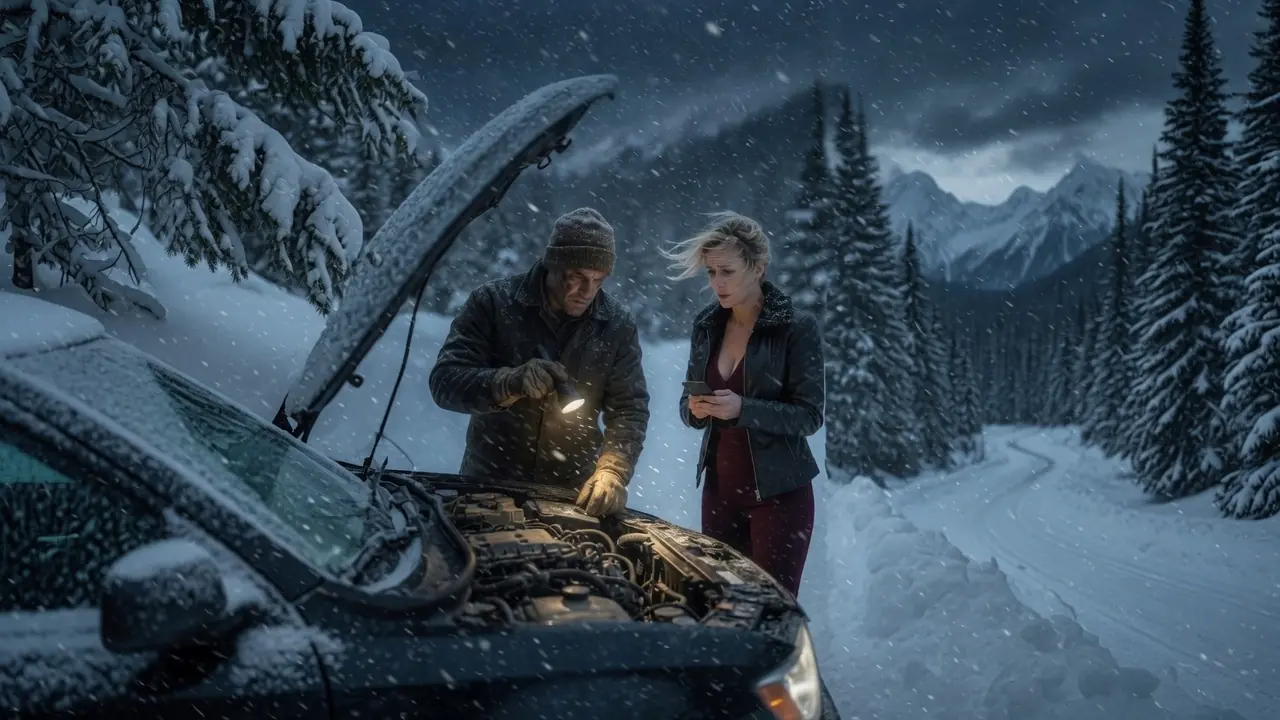
Garrett pushed open the garage door just enough to guide her car inside. The engine bay was wet with snow, steam lifting from parts that had been stressed by cold and failure. He raised the hood and clipped a work light to the frame. Claire stood nearby with her arms folded, shivering despite the heater behind her.
“I don’t need a small-town mechanic pretending he understands a car like this,” she said.
Garrett leaned over the engine bay with his flashlight. “Maybe not, ma’am. But you do need someone who won’t leave you freezing out there.”
The words quieted her.
For the next twenty minutes, Garrett worked without showing off. He checked the battery, tested voltage drops, traced the cold-start circuit, inspected the relay housing, and listened when the car gave him half-answers. Claire watched in silence, but her expression slowly changed. She had expected rough guesses and simple tools. Instead, she saw precision.
“You’ve worked on Avenir systems before?” she asked.
“No.”
“Then how do you know where to look?”
Garrett adjusted the light. “Because the car wants to start, but something is blocking the signal before ignition authorization. When expensive machines fail, people blame the expensive parts first. Usually, it’s the cheap connection hiding behind them.”
Claire stepped closer. “That sounds like engineering.”
“It’s repair.”
“It sounds like both.”
Garrett said nothing. He removed a small cover, cleaned moisture from a corroded connection, reset a cold-affected relay, and checked the harness for tension. Then he climbed into the driver’s seat and turned the key. The engine hesitated once, then came alive, smooth and controlled, filling the garage with steady sound.
Claire exhaled sharply, almost laughing from relief. “You fixed it.”
Garrett shut the hood. “It’ll get you where you’re going. But you need a proper inspection when the weather clears. That connection housing isn’t sealed well enough for Vermont winters.”
Claire pulled out her wallet. “How much?”
“No charge.”
Her head lifted. “Excuse me?”
“You were stranded in a blizzard on New Year’s Eve. I’m not making that a bill.”
“I can pay.”
“I know.”
“Then why refuse?”
Garrett looked toward the house behind the garage, where one small upstairs window glowed faintly through the snow. “Because my daughter is waiting at home, and I pray someone would stop for her too.”
Claire’s face changed. Not dramatically, not in a way that made speeches possible, but enough for Garrett to notice. She looked toward the window as if she had forgotten that people could carry whole lives outside their work.
“You have a daughter?” she asked.
“Emma. Seven.”
“And you were closing?”
“Yes.”
Claire looked down at the wallet in her hand, suddenly ashamed of it. “I spoke badly to you.”
“Yes.”
“I was scared.”
“That doesn’t make it kinder.”
“No,” she said quietly. “It doesn’t.”
Garrett picked up a rag and wiped his hands. “Road’s bad heading south. If you’re going past Miller’s Bend, don’t. Pull into the inn and wait until morning.”
“I have a board call at midnight.”
“Then they can learn patience.”
Claire almost smiled. “You don’t know my board.”
“No. But I know ice.”
She looked at him for a long moment, then put her wallet away. “Thank you, Garrett Morrison.”
He nodded. “Happy New Year, Claire Whitmore.”
She drove away slowly, taillights disappearing through the falling snow. Garrett locked the garage, turned off the lights, and walked home with cold hands and an uneasy feeling he did not understand. Emma was asleep when he entered, curled under her blanket with a half-eaten cookie beside her. Mrs. Price whispered happy New Year and left.
At midnight, Garrett sat on the couch with Emma asleep against his side while fireworks flashed silently on television. His phone buzzed once with an unknown number. The message read: I made it to the inn. You were right about Miller’s Bend. Thank you again.
Garrett stared at it longer than necessary.
Then he typed: Good. Stay warm.
The next day, life went back to what it had been. Cars needed oil, brakes needed replacing, invoices needed paying, and Emma needed help with spelling words. Claire Whitmore became a strange story Garrett told no one because it felt too unlikely to explain. A CEO in a blizzard. A luxury car. A small electrical fault. A thank-you message that sat in his phone until he finally deleted it months later.
Years passed.
Emma grew taller, lost baby teeth, learned multiplication, and began asking questions Garrett did not always know how to answer. She noticed the MIT diploma behind the invoices one rainy afternoon and asked why he hid it. Garrett told her he did not hide it. She looked at the stack of unpaid bills covering the bottom half of the frame and gave him the same doubtful look her mother used to give.
“Were you supposed to build something important?” Emma asked.
Garrett smiled gently. “I built you.”
She rolled her eyes because at eleven, love embarrassed her. “Dad, I mean before me.”
He looked at the diploma, then at the shop beyond the office window. “I had plans.”
“What happened?”
“You happened.” He saw her face fall and quickly added, “And that was the best thing that ever happened. But grown-up life sometimes makes you choose which dream gets fed first.”
Emma thought about that. “Did your other dream starve?”
The question stayed with him for days.
By the time Emma was twelve, Mitchell’s Garage was doing better, though never comfortably. Garrett had loyal customers, a decent reputation, and a way of fixing problems other shops gave up on. Still, the roof needed repair, the diagnostic system was outdated, and one serious month could still knock everything sideways. Garrett kept working, kept saving, kept telling himself that stable was enough.
Then, on another December afternoon, a black SUV pulled into the garage lot.
Garrett was tightening a belt on a delivery van when he heard the tires on gravel. He looked up and saw Claire Whitmore step out, older now by several years, but still carrying the same sharp presence. Her blonde hair was shorter, her coat darker, and her expression softer than he remembered. She stood in the doorway for a moment, looking at the garage like someone returning to a place that had grown larger in memory.
Garrett wiped his hands on a rag. “Car trouble again?”
Claire smiled. “Not this time.”
He set the wrench down. “Then I’m either honored or worried.”
“Both might be fair.”
Emma, now twelve, stood near the office doorway with a notebook in her hand. “Dad, is this a customer?”
Garrett glanced at Claire. “Old customer.”
Claire looked at Emma and softened immediately. “You must be Emma.”
Emma narrowed her eyes. “You know me?”
“Your father mentioned you once.”
Emma looked at Garrett. “Once?”
Garrett sighed. “Go finish your homework.”
“I’m observing.”
“You’re eavesdropping with better vocabulary.”
Emma smiled and disappeared into the office, though not far enough to stop listening.
Claire stepped deeper into the garage. “I owe you a real explanation.”
“For what?”
“For why I came back.”
Garrett leaned against the workbench. “All right.”
She opened a leather folder. “Whitmore Systems is launching a cold-weather mobility division. We’re developing vehicle systems designed for rural regions, mountain towns, emergency conditions, places where failure is not an inconvenience but a danger.”
Garrett listened without reacting.
Claire continued, “Three years ago, a man with an MIT degree fixed my car in a blizzard with tools that should not have been enough and explained the problem better than my own engineers did later.”
Garrett’s face tightened. “You looked me up.”
“Yes.”
“I didn’t ask you to.”
“No,” Claire said. “You refused money and gave me advice instead. That made me curious.”
He crossed his arms. “Curiosity from rich people usually costs someone.”
She accepted the hit. “Fair.”
Garrett looked at the folder. “What do you want?”
“I want you to lead the field reliability program.”
He almost laughed. “I run a two-bay garage.”
“You also understand machines in real conditions. My engineers understand clean labs, simulations, controlled tests, and perfect documentation. They are brilliant, but many of them have never stood on a frozen roadside listening to a machine fail while someone’s safety depends on the answer.”
Garrett looked away. “I can’t move to Boston.”
“I’m not asking you to.”
That made him look back.
Claire placed the folder on the workbench. “We want to build the northern field lab here in Pinewood Ridge. Your garage becomes the service and testing hub if you agree. You keep ownership. Whitmore funds upgrades, equipment, staff, and a training program. You become director of field reliability, with a salary, equity, and control over local hiring.”
The garage seemed to go quiet around him. Garrett stared at the folder as if it might vanish if he blinked. He thought of the roof, the old lift, the outdated scanner, Emma’s future tuition, and the dream in the desk drawer that had not died after all. It had only been waiting under dust.
“What’s the catch?” he asked.
Claire smiled faintly. “You still don’t trust fast rescues.”
“No.”
“Good. Read everything. Bring a lawyer. Say no if you want.” She paused. “But know this, Garrett. I didn’t come back because you fixed my car. I came back because you understood why it failed.”
Emma appeared in the office doorway again. “Dad.”
Garrett looked at her.
She nodded toward the diploma half-hidden behind invoices. “Maybe this is the other dream asking for food.”
Garrett closed his eyes briefly. “You were absolutely supposed to be doing homework.”
“I finished enough.”
Claire hid a smile.
Garrett opened the folder slowly. The numbers were real. The proposal was real. The salary was more than he had made in years. But the part that held him was not the money. It was the map showing Pinewood Ridge as the proposed field lab location, with Mitchell’s Garage at the center.
“You’d put all this here?” he asked.
“Yes.”
“Why?”
Claire looked around the garage, at the tools, the old desk, the child’s drawing still taped near the office window, and the diploma nearly buried under bills. “Because the night I met you, I thought intelligence only counted when it came with titles, buildings, and polished rooms. You taught me that knowledge can wear grease on its hands and still see farther than a boardroom.”
Garrett did not answer for a long time.
Claire stepped closer, her voice gentler. “I was cruel to you that night.”
“You were scared.”
“I was both.”
He looked at her then.
She continued, “I don’t want to offer you something without saying that clearly. I looked down on you because this place was small and your coat was worn. Then you helped me anyway. That changed me more than I admitted at the time.”
Garrett’s face softened, though he tried to hide it. “People say blizzards make everything look different.”
“No,” Claire said. “Kindness did.”
Emma made a quiet sound from the doorway. “That was a good line.”
Garrett pointed at her without looking. “Office.”
“I’m going.”
She did not go.
Over the next month, Garrett read the proposal twice, then a third time with a local attorney. He argued over clauses, rejected language that gave Whitmore too much control, and insisted that his employees would be hired from the region whenever possible. Claire accepted more changes than he expected and pushed back only when she had a real reason. Slowly, the offer became less like a rescue and more like a partnership.
The hardest part was not business. It was fear.
One night, Garrett sat at the kitchen table with the contract in front of him while Emma made hot chocolate. Snow pressed against the windows, and the house felt very much like it had the night Claire first appeared. Garrett looked at the signature line and felt the old panic rise.
“What if I can’t do it?” he said.
Emma looked over. “Fix cars?”
“Lead engineers. Run a lab. Stand in rooms with people who never had to choose between a dream and their kid’s winter boots.”
Emma set a mug beside him. “Then tell them about winter boots.”
He laughed softly. “That’s your advice?”
“Dad, you always say machines tell the truth when people stop pretending. Maybe people do too.”
Garrett looked at his daughter, stunned by the wisdom children sometimes returned after years of listening. “When did you get so grown?”
“When you were fixing everyone’s cars.”
The next morning, Garrett signed.
Whitmore Systems announced the Pinewood Ridge Cold-Weather Field Lab in March. Reporters came, though Garrett hated cameras. Claire stood at the podium and spoke about rural safety, engineering under real conditions, and the importance of listening to people who worked beyond controlled environments. Then she called Garrett up to speak.
He almost refused.
Emma, standing in the front row, mouthed, “Other dream.”
Garrett took the microphone. His hands were steady, which surprised him.
“I’m not here because I knew more than everybody else,” he said. “I’m here because one snowy night, a machine failed in the real world, not in a lab. Real-world problems don’t care how impressive your design looks on paper. They care whether someone can get home safely.”
The room was quiet.
He continued, “This lab will test machines where they actually struggle. Cold roads. Rural hills. Bad timing. Tired people. We’re going to build systems that remember there are families waiting at the end of every drive.”
Claire watched from the side, and Garrett saw her eyes shine.
The garage changed over the next year. The roof was repaired, new diagnostic equipment arrived, and the second bay expanded into a testing shop. Local mechanics were hired and trained. Young engineers from Boston came to Pinewood Ridge and learned quickly that Garrett did not care how impressive their résumés were if they would not kneel in snow to understand a failure.
Emma visited after school and did homework in the upgraded office. Her father’s MIT diploma no longer sat behind invoices. Claire had it reframed, though Garrett complained about the expense until Emma said it belonged where people could see it. Now it hung beside Mason’s old drawing? No, beside Emma’s drawing from years before: Dad fixes everything.
Garrett eventually added a note beneath it in small letters: Especially when he lets others help.
Claire visited often. At first, it was strictly business. Then it became coffee after meetings, shared dinners when storms delayed her drive, and quiet talks in the garage after everyone else left. She learned about Emma’s love of science fairs and terrible jokes. Garrett learned that Claire had grown tired of rooms where everyone agreed with her because her name controlled their paychecks.
One evening, almost exactly four years after the blizzard, Claire stood with Garrett outside the garage while snow fell gently under the lot lights. The field lab glowed behind them, full of people working late by choice. A test vehicle idled near the bay, covered in sensors and frost.
“Do you ever think about that night?” Claire asked.
Garrett smiled. “The night you told me I couldn’t understand your car?”
She winced. “I deserved that.”
“Yes.”
“I think about it a lot,” she said. “I was so sure I knew what competence looked like.”
“And now?”
Claire looked at him, then through the window where Emma was helping an engineer label test parts. “Now I think it looks like a tired father reopening a garage door because a stranger might not make it home.”
Garrett’s smile faded into something quieter.
Claire stepped closer. “That night, you said you hoped someone would stop for your daughter. I built this place because I kept thinking every system should be designed around that sentence.”
Garrett looked toward Emma. She was laughing now, her face bright under the shop lights, completely at home in the world he had once thought he lost.
“You gave me my dream back,” he said.
Claire shook her head. “No. I found it buried under invoices. You kept it alive.”
Snow gathered on his jacket the way it had that first night, but this time he did not feel the same cold. He felt the warmth of the garage behind him, the future inside it, and the strange grace of a life that had circled back to a door he thought had closed.
Claire held out her hand, not as a CEO, not as a woman stranded on a roadside, but as someone who had learned the value of being helped before she deserved it. Garrett took it.
Across the lot, the old garage sign still read Mitchell’s Auto Repair, though beneath it a new sign had been added: Whitmore Field Reliability Lab.
Garrett liked that the old name came first.
It reminded him that the dream he found again had not replaced the life he built for Emma. It had grown from it. The small garage, the single father, the frozen roadside, the CEO’s broken car, the daughter waiting at home—all of it belonged to the same story.
Years earlier, Claire Whitmore had arrived in a blizzard thinking she needed a mechanic.
What she found was a man who understood machines, sacrifice, and the quiet engineering of kindness.
And when she came back with an offer, Garrett Morrison finally learned that some dreams do not disappear when life delays them.
Some dreams wait patiently, like an engine in winter, until the right person helps them start again.