Jake Mitchell had learned to recognize the sound of an empty garage. It was not silence exactly. It was the soft ticking of cooling engines, the groan of old pipes in the wall, the buzz of one stubborn light above bay three, and the wind pressing snow against the metal door like it wanted inside. At 9:15 on a December night in Columbus, Ohio, Mitchell’s Auto Repair should have been dark, locked, and forgotten until morning.
Jake stood near the front office with his coat zipped halfway, counting the day’s cash for the third time even though the number did not change. Two oil changes, one brake job, a battery replacement, and a discounted tire patch for a neighbor who promised to pay the rest next week. After rent, utilities, parts invoices, and the school lunch account he needed to refill for his son, there would not be much left. He put the bills into the old metal box and shut it with more force than necessary.
On the corkboard beside the desk, a crayon drawing hung beneath a magnet shaped like a tow truck. It showed Jake, his ten-year-old son Mason, and a crooked blue car with a smiling face. Mason had written, “Dad fixes everything,” across the top in uneven letters. Jake looked at it longer than he meant to. Some nights, those words felt like a medal. Other nights, they felt like a sentence he was still trying to live up to.
His wife, Lauren, had left three years earlier, not in a storm of shouting, but in the quiet way people leave when they are tired of waiting for life to become easier. She moved to Indianapolis with a new job, and Mason stayed with Jake because the boy hated change and Jake could not imagine waking up without him down the hall. They were not bitter anymore, not exactly. But the empty space she left had taught Jake how quickly a person could become both father and mother before breakfast.
That night, Mason was sleeping at Jake’s sister’s house because the garage had run late again. Jake hated those nights most. He hated calling his sister, hated saying he would be later than planned, hated hearing Mason in the background ask if Dad was coming before bedtime. Owning a garage sounded brave until the business owned every hour he had.
He turned off the office lamp, pulled his gloves on, and walked toward the bay door. Outside, the street lamps cast orange halos through steady falling snow. The parking lot was almost empty except for his dented pickup and a small dark sedan near the curb across the street. Jake reached up, grabbed the chain, and started dragging the big metal door down.
Then he heard crying.
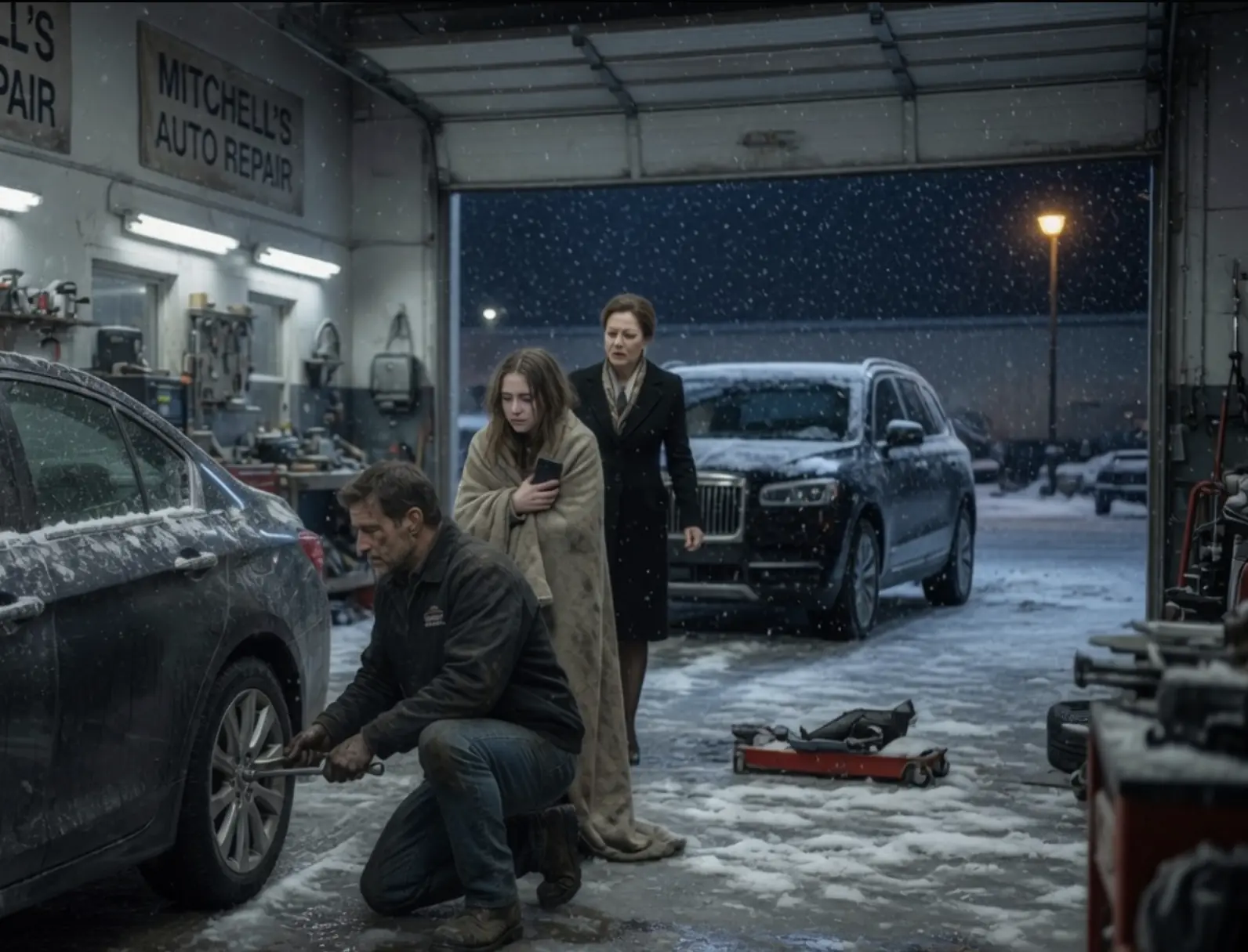
At first, he thought it was the wind catching under the door. He stopped, listened, and heard it again, a thin, scared sound coming from outside. Jake pushed the door back up enough to look out. Across the parking lot, beside the dark sedan, a teenage girl stood wrapped in what looked like a beige blanket, clutching a phone against her chest.
The front tire of her car was flat.
Jake closed his eyes for one second. He was exhausted, cold, behind on everything, and already late to pick up Mason’s winter coat from his sister’s house. Then the girl looked toward him, and he saw her face in the light. She was pale, trembling, and trying very hard not to look as frightened as she was.
Jake walked out into the snow. “You okay?”
The girl flinched, then wiped her cheeks quickly. She was maybe seventeen, blonde hair messy from the wind, wearing expensive-looking sneakers that were useless in snow. “I’m sorry,” she said. “I didn’t know the shop was closed.”
“It is,” Jake said. “But that doesn’t answer my question.”
She looked down at the tire. “I hit something in the road. I called my mom, but she didn’t answer at first. Then she texted that she was coming. I don’t know where she is. My phone’s almost dead.”
Jake glanced at the street. It was not a safe place for a young girl to wait alone in freezing weather. “What’s your name?”
“Emma.”
“I’m Jake. Let’s get you inside.”
She hesitated. “I don’t have money with me.”
“I didn’t ask for money.”
Her eyes filled again, maybe because kindness was harder to process than fear. Jake walked to the bay controls, lifted the garage door fully, and motioned toward the car. “Can you put it in neutral?”
Emma nodded quickly. Together, with Jake pushing and Emma steering, they got the sedan inside the garage. Snow blew in behind them, then Jake brought the door most of the way down, leaving just enough space for air and light.
“I’m okay.”
“You’re lying.”
She gave a small, embarrassed laugh through her tears and took it. The coat swallowed her, but the shaking eased a little. Jake turned on the portable heater near the office and pointed to the stool beside it. “Sit there. Keep your phone charging.”
Emma plugged her phone into the wall outlet with a cracked charger Jake kept for customers. “My mom is going to be so mad.”
Jake knelt beside the flat tire and pulled over his jack. “At you?”
“At everything.” Emma watched him work, her voice quiet. “She gets scared, and when she gets scared, she sounds angry.”
Jake understood that more than he wanted to. “Parents do that sometimes.”
“You have kids?”
“A son. Mason. Ten.”
“Does he think you’re angry when you’re scared?”
Jake loosened the lug nuts and paused. The question was too honest for a cold garage at night. “Probably more often than I’d like.”
Emma looked down at her phone. “My mom owns a company. She’s always in meetings, always fixing problems. I know she loves me, but sometimes it feels like I have to schedule time to be her daughter.”
Jake did not know what to say, so he stayed with what he knew. He lifted the car, removed the damaged tire, checked the spare, and found it usable. His hands were numb even inside his gloves, and his back complained every time he shifted, but the work steadied him. Machines asked for attention, not explanations.
Emma watched quietly for a while, then said, “Why are you helping me if I can’t pay?”
Jake fitted the spare into place. “Because you were crying in the snow.”
“That’s it?”
“That’s enough.”
She lowered her eyes. “Most people don’t think that’s enough.”
Jake tightened the lug nuts in a star pattern. “Most people are wrong about a lot of things.”
He had almost finished when headlights swept across the garage door window. A black luxury SUV pulled hard into the parking lot, stopping crookedly near the entrance. The driver’s door opened, and a woman stepped out fast, blonde hair pulled back, beige coat flying open in the wind. She moved like someone used to people clearing a path.
Emma stood up. “Mom.”
The woman rushed into the garage before Jake could speak. Her eyes went first to Emma wrapped in Jake’s old coat, then to Jake kneeling beside the wheel with a wrench in his hand. Her fear hardened instantly into suspicion.
“Step away from my daughter,” she said sharply. “Men like you don’t help girls for free.”
Jake rose slowly, keeping the wrench down at his side. He was too tired to be insulted gracefully, but he tried. “Your daughter was freezing outside, ma’am. I brought her car in and changed the tire.”
The woman stepped in front of Emma as if Jake had been threatening her instead of helping her. “Did he touch you?”
Emma’s face flushed. “Mom, no.”
“Did he ask you for anything?”
“No.”
Jake set the wrench on the tool cart. “I didn’t ask her for anything.”
The woman’s eyes moved around the garage, taking in the old lift, the patched floor, the heater, the invoices stacked near the desk, and the tired man standing in grease-stained work clothes. Her expression tightened. “Don’t dress it up like heroism. This garage looks desperate.”
That landed harder than Jake expected. Maybe because it was not entirely wrong. The garage was desperate some months. He was desperate some nights. But desperation was not dishonor, and he had never used it as permission to take from anyone.
Jake looked at her calmly. “Then maybe desperate men still know how to protect someone better than rich people who arrive late.”
Emma whispered, “Jake.”
The woman’s face changed at the sound of his name. She looked at him more carefully. “Jake Mitchell?”
“Yes.”
Her phone was still in her hand, and for the first time, Jake noticed the name on her screen. Victoria Hayes. Hayes Mobility Group. He knew that name because everyone in the auto-service world knew it. Hayes Mobility owned one of the largest chains of repair centers in the state, the kind with polished waiting rooms, digital inspection reports, and television commercials showing smiling families next to clean cars.
Victoria Hayes looked nothing like the commercial version of herself. Her eyes were red from fear, her hair was windblown, and her hand shook slightly around the phone. But the authority was still there. So was the judgment.
Emma stepped around her mother. “He gave me his coat. He let me charge my phone. He kept the garage open for me. Please don’t talk to him like that.”
Victoria looked at her daughter, and the anger in her face broke for half a second. “I called you six times.”
“My phone died before I could answer. Then it charged enough to text.”
“I thought something happened.”
“I know.” Emma’s voice softened. “But nothing did because he helped me.”
The garage went quiet except for the heater and the wind outside. Jake turned back to the car, lowered it from the jack, and checked the spare one final time. “It’ll get you home, but don’t drive too fast. Replace it tomorrow. The damaged tire’s sidewall is no good.”
Victoria looked at the tire, then at him. “How much?”
“No charge.”
Her eyes narrowed again, but not with the same certainty. “Why?”
Jake wiped his hands on a rag. “Because if my son were standing outside scared and cold, I’d hope someone helped him before asking for a card.”
Emma’s eyes filled. Victoria heard it too. Something shifted in her posture, small but visible, like a door inside her had opened just enough for shame to enter.
“You have a son?” she asked.
“Mason. He’s ten.”
“And you run this place alone?”
“I have one part-time helper when I can afford him.”
Victoria looked around again, but this time her eyes did not seem to be measuring failure. They were noticing details. The clean tools. The organized wall hooks. The handwritten thank-you cards near the office window. The children’s drawing on the corkboard that said Dad fixes everything.
She walked toward it slowly. “Your son drew this?”
Jake nodded. “A while ago.”
Victoria read it, then looked back toward Emma. Her daughter was still wearing Jake’s coat, hands tucked inside the sleeves, face calmer than when she arrived. For all Victoria’s money, all her company systems, all her emergency contacts, the person who had actually protected Emma that night was a tired single father in a struggling local shop.
“I owe you an apology,” Victoria said.
Jake did not answer quickly. “For what?”
She seemed surprised by the question, then understood it. “For assuming the worst because of how this place looked. Because of how you looked.”
Jake held her gaze. “And?”
Victoria swallowed. “For speaking to you like you were a danger when you were the person who kept my daughter safe.”
Emma looked at Jake, almost pleading with him to accept it.
Jake nodded once. “Apology accepted.”
Victoria exhaled, but Jake could tell she was not finished. People like her were used to solving discomfort by moving quickly into action. “Mr. Mitchell, I meant what I asked. What do I owe you?”
“You don’t.”
“I don’t like owing people.”
Jake almost smiled. “Then let your daughter know you’re glad she’s safe before asking for a receipt.”
The words hit Victoria harder than he intended. She turned toward Emma, and for the first time since entering the garage, she looked less like an executive and more like a mother who had almost let fear make her cruel. She stepped closer to her daughter and touched her face. “I’m glad you’re safe.”
Emma leaned into her, and Victoria wrapped both arms around her. The girl cried then, quietly, without trying to hide it. Jake looked away, giving them the privacy a small garage could offer.
A few minutes later, Emma went to warm up in the SUV while Victoria stayed behind. She stood near the repaired car, looking at Jake with a new seriousness. “I own Hayes Mobility Group.”
“I know.”
“You do?”
“Your commercials run during baseball games.”
For the first time, Victoria gave a tired, real smile. “Then you know we have repair centers across the state.”
“I know they’re cleaner than mine.”
“They’re not better because they’re cleaner.”
Jake said nothing.
Victoria walked toward his tool wall, studying the labeled drawers and neatly hung wrenches. “I built my company on systems. Speed. Branding. Consistency. But tonight I realized something uncomfortable. My daughter was stranded less than twenty minutes from one of my own service centers, and none of our emergency lines helped her faster than you did.”
Jake leaned against the fender. “I was here.”
“No,” Victoria said. “You chose to open the door.”
That sentence stayed in the air.
Jake looked toward the office clock. It was almost ten. He still needed to pick up Mason’s coat. He still needed to pay the parts supplier. He still needed to sleep, somehow, before the first customer arrived at seven in the morning. He did not have room in his life for wealthy strangers suddenly turning reflective.
Victoria reached into her coat and took out a business card. “I want to talk to you tomorrow.”
“About what?”
“A contract.”
Jake frowned. “I’m not selling my shop.”
“I’m not asking you to.”
“Then what kind of contract?”
Victoria looked toward the garage door where snow kept falling beyond the glass. “Hayes Mobility is launching a roadside safety program for teenagers, elderly drivers, and single parents. At least, it was only an idea until tonight. We need local partner garages that still know what community means.”
Jake almost laughed from disbelief. “You decided that in ten minutes?”
“I decided it the moment my daughter told me you gave her your coat.” Victoria held out the card. “I want Mitchell’s Auto Repair as our first independent partner. Paid retainer. Training support. Equipment upgrades covered by us. You keep your name, your shop, your standards. We help you stay open.”
Jake stared at the card without taking it. Offers like that did not happen to men like him in garages like this. They appeared in movies, in sales pitches, and in dreams that became embarrassing when morning arrived.
“What’s the catch?” he asked.
Victoria’s mouth tightened. “Fair question.”
“I’ve learned to ask.”
“The catch is accountability. You answer calls when you accept them. You keep records. You meet safety standards. You let us inspect the equipment we fund. And you teach my company something it forgot.”
Jake looked at her. “What’s that?”
Victoria glanced toward Emma waiting in the SUV. “That service begins before payment.”
Jake took the card.
The next morning, he almost convinced himself not to call. Men like Jake trusted bolts, invoices, and things they could hold. A business card from a woman who had insulted him, apologized, and offered help in the same hour felt too strange to trust. But Mason found the card on the kitchen table while eating cereal and asked why a fancy lady wanted to talk to him.
Jake told him the shorter version. A girl had needed help. Her mother owned a big company. She might offer the garage a contract. Mason listened with wide eyes, then looked at the drawing on the fridge.
“You helped her like you’d want someone to help me,” Mason said.
Jake nodded.
“Then maybe that’s why good things happen.”
Jake wished the world were that simple. But he called.
Victoria arrived at Mitchell’s Auto Repair at noon, not in the black SUV, but in a plain gray sedan. She wore a navy coat and carried a folder instead of a threat. Emma came with her, smiling shyly when she saw Jake. She had brought his work coat back, washed and folded, with a note from her tucked into the sleeve.
Thank you for opening the door.
Jake read it once and put it carefully in his desk drawer.
The meeting lasted two hours. Victoria asked about his equipment, customer base, debts, hours, and staffing. Jake answered honestly, even when the answers embarrassed him. He told her the lift needed service, the roof leaked near the storage room, and he had been turning away after-hours calls because he could not manage them alone.
Victoria did not pity him. That helped. She listened like a businesswoman, but now she spoke like someone who understood that numbers never told the whole story. By the end of the meeting, she offered a one-year pilot contract that would stabilize the garage, pay Jake for after-hours emergency response, fund a new tire machine, and provide software he could use without losing the personal way he ran the shop.
Jake read every page slowly.
“You don’t trust me,” Victoria said.
“I don’t trust fast rescues.”
She nodded. “Good. Read it twice.”
He did.
A week later, Mitchell’s Auto Repair became the first independent partner in the Hayes Roadside Care Network. Victoria did not announce it with a giant press release at first. She let Jake get used to the systems, hired his part-time helper full-time through the contract, and sent a trainer who treated Jake with respect instead of condescension. For the first time in years, Jake paid every bill before the due date.
Mason noticed the change before Jake admitted it. His father came home for dinner three nights in a row. There was less tension in his shoulders. The fridge had groceries that were not arranged like a math problem. One Saturday, Jake closed the shop at four and took Mason bowling, and the boy looked so happy that Jake had to turn away for a second.
Victoria visited often during the pilot’s first month. At first, Jake assumed she was checking on her investment. She was. But she was also learning. She watched him speak to customers who could not afford repairs all at once. She watched him explain safety without shaming people for being broke. She watched him tell an older woman which repair could wait and which one could not.
One afternoon, she stood beside him after a customer left and said, “My company lost this somewhere.”
“Lost what?”
“The human part.”
Jake wiped his hands. “Easy to lose when everything becomes a metric.”
Victoria looked at him. “You sound like someone who should teach my managers.”
Jake laughed. “I barely survived high school presentations.”
“I’m serious.”
“I know. That’s why I’m nervous.”
Two months later, Jake stood in front of forty Hayes Mobility managers in a training room that looked too clean for him. He wore his best shirt, though Mason told him it still looked like a work shirt. Victoria introduced him not as a charity case, not as a struggling mechanic she had rescued, but as the man who had reminded her company what service meant.
Jake told them about Emma only with her permission. He did not make himself the hero. He talked about cold weather, fear, assumptions, and the difference between asking, “Can they pay?” and “Are they safe?” The room was quiet by the end.
Victoria watched from the back, arms folded, eyes thoughtful.
Afterward, Emma found Jake in the hallway. “You did great.”
“I forgot half of what I meant to say.”
“Good,” she said. “The half you remembered mattered.”
Jake smiled. “You sound like your mom.”
Emma made a face. “Please don’t ruin my day.”
Over the next year, the program grew. Mitchell’s Auto Repair became stronger, but it did not become unrecognizable. The old sign stayed. The corkboard stayed. Mason’s drawing stayed, though Jake framed it after Victoria teased him about the curling corners. The garage got a new tire machine, better lighting, a repaired roof, and a second full-time mechanic named Luis who had two kids and needed steady work.
Jake remained a single dad, still tired sometimes, still careful with money, still more comfortable under a hood than in a meeting. But he was no longer drowning alone. He could leave early for Mason’s school events. He could pay Luis on time. He could help stranded drivers without wondering if kindness would close his shop.
Victoria changed too, though not all at once. Emma told Jake her mother answered calls faster now. Victoria built a teen roadside safety app with direct human support instead of endless menus. She also required every Hayes manager to spend one night shadowing an independent partner garage before they could oversee customer care.
The night of the program’s first anniversary, Victoria returned to Mitchell’s Auto Repair with Emma. Snow fell lightly, almost exactly as it had the year before. Jake was closing the bay door when he saw them standing near the entrance with a small box.
“You people have a strange habit of showing up when I’m trying to close,” Jake said.
Emma grinned. “Family tradition.”
Victoria handed him the box. Inside was a new sign, small enough for the office wall. It read: First Hayes Roadside Care Partner — Mitchell’s Auto Repair. Underneath, in smaller letters, was a line Jake had said during the training.
Service begins before payment.
Jake looked at it for a long moment. “That sounds too polished for something I said.”
Victoria smiled. “My marketing team cleaned it up.”
“Figures.”
Emma looked toward the bay where her car had once sat with a flat tire. “I was so scared that night.”
Jake nodded. “I know.”
“I don’t think I ever really thanked you enough.”
“You did.”
“No.” She looked at her mother, then back at him. “You didn’t just fix my tire. You made me feel like someone had time for me.”
Jake swallowed. He thought of Mason, of all the times he had been too tired, too worried, too busy surviving to make his son feel that way. “That matters,” he said quietly.
Victoria stepped closer. “It does.”
The three of them stood in the warm light of the garage while snow moved softly beyond the open door. Jake thought about how close he had come to locking up and driving away that night. One small choice—opening the door—had changed his business, his schedule, his son’s life, and even a company that had been too big to see what it was missing.
Mason came running in from the office with a soda in hand. “Dad, can we order pizza?”
Jake looked at the clock. For once, he did not need to count invoices before answering. “Yeah,” he said. “We can.”
Emma smiled at Mason. “Your dad fixes everything, huh?”
Mason looked at the framed drawing on the wall, then at Jake. “Not everything,” he said. “But he tries.”
Jake felt that sentence settle deeper than praise. It was truer. Kinder. More human.
Victoria looked around the garage with eyes very different from the ones she had brought into it a year earlier. Back then, she had seen desperation. Now she saw order, care, and a place where people were treated like they mattered before anyone knew what they could afford.
“I was wrong about this garage,” she said.
Jake smiled faintly. “You were wrong about me first.”
“I was.”
“And?”
She laughed softly, accepting the old echo of his challenge. “And you let me learn instead of making me your enemy forever.”
Jake glanced toward Emma. “Your daughter made a strong case.”
“She usually does.”
That night, they ate pizza in the office while the heater hummed and snow covered the parking lot. Mason showed Emma his toy car collection. Victoria took a call from one of her directors and told them it could wait until morning. Jake noticed and said nothing, but Emma noticed too, and her smile said enough.
After they left, Jake locked the garage and stood outside for a moment. The air was cold, his breath forming white clouds under the streetlight. The parking lot was quiet now, but he could still picture Emma standing there in the snow, scared and alone. He could still hear Victoria’s first cruel words. He could still feel the wrench in his hand and the old temptation to defend himself with anger.
Instead, he had fixed the tire.
Not because he expected reward.
Not because he knew who Emma’s mother was.
Not because kindness always came back with a contract and a new sign.
He had done it because a crying teenager was freezing outside his garage, and that had been enough.
Jake climbed into his pickup and looked at the office window, where Mason’s framed drawing was visible beneath the light. Dad fixes everything. He smiled, started the engine, and drove home to his son.
Behind him, Mitchell’s Auto Repair glowed in the snow, no longer just a struggling shop at the edge of town.
It was a place where one open door had become a second chance.