“You don’t have to do this alone.”
The voice came from behind Margaret Hale just as the flour sack slipped from her arms and crashed against the wooden steps of Miller’s General Store. Dust burst from the seams, rising around her faded blue dress like pale smoke. For one terrible second, every whisper in town seemed to stop, and every eye seemed to find her at once. She stood bent over, breath shaking, her fingers still curved around a weight she had failed to lift.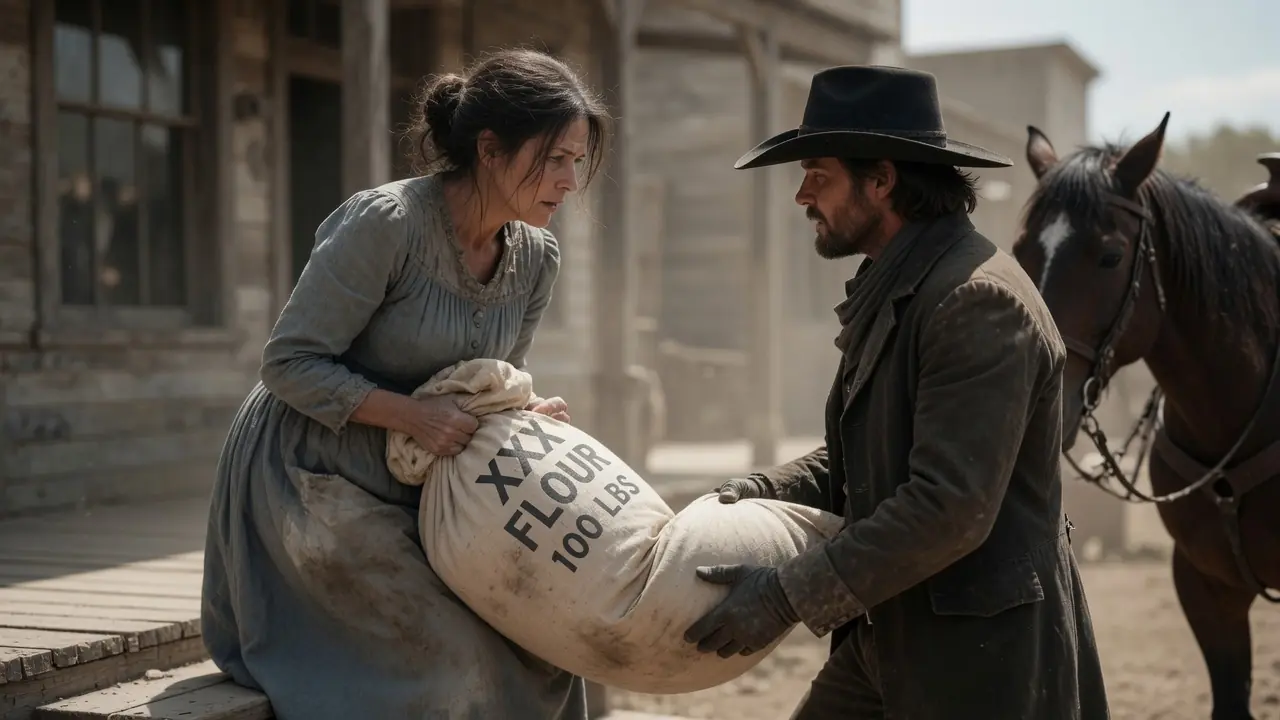
Margaret did not turn right away. She kept her eyes on the sack because looking at the people would make it worse. Her oldest boy, Samuel, stood stiffly beside the wagon, trying to look like a man though he was only eleven. Ruth held baby Thomas on her hip, Eli and Jonah clutched the broken toy wagon between them, and little Clara hid half behind Margaret’s skirt.
The town had been watching her fail for weeks. They watched her stretch flour until it became more hope than bread. They watched her children grow quieter at the market. They watched her walk into the general store with coins counted so carefully that even Mr. Miller stopped breathing when she placed them on the counter.
“She won’t make it,” someone whispered from the porch rail.
“Six children,” another voice murmured. “No husband. No stock. No way through winter.”
Margaret heard every word. She had become skilled at hearing cruelty while pretending not to. A widow learns quickly that pity can cut almost as deeply as contempt when it is spoken by people who never intend to help. She straightened slowly, wiped her hands on her dress, and turned toward the man who had spoken.
He stood beside a dark horse, tall and broad-shouldered beneath a long dust-covered coat. His hat shaded most of his face, but she could see a dark beard, steady eyes, and hands marked by rope burns and weather. He was not smiling. That alone made him different from the people on the porch.
“I wasn’t asking for help,” Margaret said, forcing her voice steady.
“I know,” he answered. “That’s why I offered.”
A few men near the store laughed under their breath. The cowboy did not look at them. He stepped forward, bent down, and lifted the sack of flour as if it weighed no more than a blanket. Then he picked up the second sack beside it and carried both to Margaret’s wagon without asking permission.
Margaret’s face burned. “I can manage.”
The cowboy set the sacks down carefully. “I believe you’ve been managing longer than most people would last.”
That stopped her. It was not pity. It was not praise either. It was recognition, and for some reason that nearly broke her more than mockery had.
“What’s your name?” he asked.
“Margaret Hale.”
“Caleb Ward.”
She knew the name faintly. A rancher twenty miles west, quiet, widowed maybe, though nobody ever said much about him in town. He bought supplies twice a month, paid cash, spoke little, and left before gossip could catch him. Men respected him in the uneasy way they respect someone who has survived enough to become difficult to measure.
Caleb looked toward her wagon. One wheel leaned badly, the mule looked half-asleep from age, and the boards creaked whenever one of the children shifted. “Where are you headed?”
“Past Dry Creek. The old Turner place.”
“That’s six miles.”
“Yes.”
“You’re walking beside this wagon with six children and two sacks of flour?”
Margaret lifted her chin. “I have walked farther for less.”
“I don’t doubt it.” Caleb glanced at the children. “But you don’t have to today.”
She folded her arms. “I can’t pay you.”
“I didn’t ask you to.”
“I don’t accept charity.”
“Good,” he said. “Neither do I. Call it a trade.”
“What trade?”
“You let me ride with someone interesting for six miles, and I don’t have to listen to my own thoughts.”
Samuel looked up at Margaret. His eyes were too serious for a boy. “Mama,” he whispered, “please.”
The word softened something she was trying hard to keep firm. She looked at all six children, at the cold light, at the long road waiting beyond town. Pride could warm a person for only a few minutes. Flour, wheels, and a steady horse could do more.
“All right,” she said. “Just the ride.”
Caleb nodded once, as if she had granted him something valuable. He hitched his horse behind the wagon, checked the loose wheel, tightened what he could with a strip of leather, and helped the younger children climb in. He did not lift Margaret. He offered his hand and waited until she chose to take it.
The wagon rolled out of town beneath a pale winter sky. Margaret kept her back straight even after they passed beyond the last house. She could still feel the townspeople watching, still hear their whispers following like dry leaves. Caleb sat beside her, reins loose in his hands, silent enough that the quiet did not demand anything.
The children changed first. Once the town disappeared behind them, Jonah asked whether Caleb had ever seen a bear. Eli asked if his horse could outrun a train. Ruth asked if his ranch had chickens, and Clara wanted to know whether cowboys slept standing up like horses.
Caleb answered every question seriously. Yes, he had seen a bear, but from far enough away to remain wise. No, his horse could not outrun a train, but the horse had better manners. Yes, the ranch had chickens, and no, cowboys did not sleep standing up unless they had made very poor choices.
Margaret almost smiled.
After a while, Caleb asked gently, “What happened to your husband?”
The road seemed to grow quieter. Margaret looked down at her hands, red from cold and work. “Fever. Three days from coughing to burial.”
“I’m sorry.”
“So am I.”
There was no more to say. Thomas Hale had been a kind man, though not always a practical one. He had loved his children, laughed loudly, and believed tomorrow would forgive what today could not pay. Then the fever took him, and tomorrow became Margaret’s responsibility.
By the time they reached the old Turner place, the sun had lowered behind the brown hills. Caleb slowed the wagon as the cabin came into view. Margaret saw the place as he must have seen it: the porch sagging, the barn leaning, the fence broken in six places, smoke rising from a chimney that barely drew properly. It was not much of a home, but her children shouted with relief as if it were a palace.
Inside, Caleb saw what the town had not. The cabin was poor, but spotless. Patched blankets were folded neatly at the end of narrow beds. Six small bowls sat clean beside the stove. A single shelf held flour, beans, salt, and one jar of peach preserves that Margaret had not opened because special things gave children something to look forward to.
Caleb set down the flour sacks near the table. “You’ll need more than this.”
“I know.”
“How will you survive the winter?”
Margaret opened her mouth, ready with the answer she always gave. We’ll manage. We always do. God willing. Something will come. But none of the answers reached her tongue.
For the first time since Thomas died, the truth escaped before pride could stop it. “I don’t know.”
The room went still. Samuel looked away, Ruth tightened her hold on the baby, and Margaret wished she could gather the words back. A mother should not say such things where children can hear them, but hunger had a way of stripping courage down to bone.
Caleb looked at the children, then back at her. “I own a ranch twenty miles west.”
Margaret stiffened. “I told you, I don’t want charity.”
“It isn’t charity. It’s work.”
“What work?”
“Cooking. Keeping house. Washing. Helping with chickens. Maybe managing a garden when spring comes.” He paused. “Food, wages, and a room for you and the children.”
Margaret stared at him. “You’re offering a widow with six children a job?”
“Yes.”
“Why?”
“Because I need help.”
“That’s not the whole truth.”
“No,” Caleb admitted. “But it is enough truth to begin with.”
She looked around the cabin. The old Turner place had belonged to Thomas’s uncle once, then to nobody, then to them because no one else wanted it. It was the last place her husband had repaired with his own hands before sickness took the strength from him. Leaving felt like betrayal.
“I can’t leave this place,” she whispered. “It belonged to my husband.”
Caleb nodded slowly. “I know.”
“You don’t know.”
“I know what it is to stay somewhere because the dead touched the walls.”
Those words turned her toward him.
His face had changed. Not much, but enough. Some hidden door had opened behind his eyes and closed again before she could see through it.
Then he said quietly, “But memories don’t keep children warm.”
The sentence filled the cabin like winter air.
Margaret looked at her children. Samuel pretending not to hope. Ruth rocking Thomas though her own hands were blue with cold. Eli and Jonah watching Caleb like he might be a story come true. Clara holding the broken toy wagon in both hands.
“What kind of room?” she asked.
“A bunkroom near the kitchen. Warm. Dry. Big enough.”
“And wages?”
“Fair ones.”
“And if it does not work?”
“I bring you back with more flour than you left with.”
That made her breathe out something close to a laugh. She wiped her eyes quickly, angry that tears had come. “You make strange bargains, Caleb Ward.”
“So I’ve been told.”
Two days later, Margaret packed what little they had. Clothes, blankets, Thomas’s Bible, her sewing box, a skillet, a framed tintype of her husband, and the peach preserves. She locked the cabin though there was nothing worth stealing except memory. Caleb arrived with a larger wagon just after dawn.
The ride to his ranch took half the day. The children grew restless, then excited, then silent as the Ward place appeared beyond a rise. It was not grand, but it was solid. A long ranch house sat near a line of cottonwoods, smoke rising steady from the chimney. Fences stood straight, cattle moved in the far pasture, and a red barn stood behind the house with a heavy lock on its double doors.
Margaret noticed the barn immediately because Caleb did not look at it.
The first week passed in work. Real work, honest work, exhausting but not hopeless. Margaret cooked breakfast for Caleb and three ranch hands, then for her children. She cleaned rooms that had not seen a woman’s care in years, mended shirts, scrubbed floors, sorted the pantry, and discovered that Caleb had more supplies than he admitted.
Her children changed in small ways. Their cheeks filled. Samuel stopped keeping one eye on the flour bin. Ruth sang while washing dishes. Eli and Jonah chased chickens with more enthusiasm than success. Clara adopted a barn cat that appeared offended by affection but accepted it anyway.
Caleb never intruded. He ate what Margaret served, thanked her every time, paid her the first week’s wages in coins placed in her palm, and never once called her helpless. That mattered more than she expected. Men had offered help before, but most of it came wrapped in ownership.
Still, the locked barn troubled her. Ranch life had many closed doors, but that barn was different. Caleb carried the key inside his coat. He never let the ranch hands enter. Once, in the middle of the night, Margaret heard him walk across the yard, unlock the barn, and remain inside for nearly an hour.
On the fifteenth day, a storm rolled in before noon. Wind rattled the windows, and rain turned the yard to mud. Caleb and the hands rode out to secure cattle near the lower creek. Margaret was in the kitchen when Clara came running inside, crying that the barn cat had slipped through a gap under the locked barn door.
Margaret took a lantern and went out despite the rain. She called for the cat, heard a faint mew from inside, and found that the lock had not been fully fastened. The door opened with a groan.
She stepped inside.
At first, the barn smelled of hay, cedar, and dust. Then the lantern light spread across the room, and Margaret stopped breathing. The space was not storage, not exactly. Six small beds stood along one wall, handmade from pine, each with a folded quilt at the foot. Shelves held children’s boots in different sizes, tin cups, wool coats, school slates, and a wooden cradle.
On the far wall hung a woman’s bonnet, faded with age, and beside it a small blue dress.
Margaret took one step deeper, heart pounding. A workbench held unfinished toys: carved horses, a wooden train, a doll missing one painted eye. In the corner sat sacks of flour, beans, sugar, and coffee enough to feed a family through winter. This was not charity gathered after he met her.
This had been waiting.
The barn door opened behind her.
Caleb stood in the rain, face drained of color.
For a moment neither of them spoke. Water dripped from his hat brim. Margaret held the lantern in one hand and the rescued cat against her chest with the other.
“I’m sorry,” she said. “Clara’s cat slipped inside. I didn’t mean to pry.”
Caleb looked at the beds, the shelves, the cradle, the blue dress. His throat worked, but no words came.
Margaret’s voice softened. “Who were these for?”
He stepped inside slowly and closed the door behind him. The rain became a dull roar against the roof.
“My wife,” he said at last. “Anna.”
Margaret stayed still.
“We had one daughter. Grace.” His eyes moved to the small blue dress. “She lived four years.”
“I’m sorry,” Margaret whispered.
Caleb nodded, but the movement looked painful. “Fever took them both in the same week. Anna first. Grace two days later.”
The lantern trembled in Margaret’s hand.
Caleb stared at the beds. “After they died, I started building things I didn’t need. A bed for the child I lost. Then another because I couldn’t stop. Then coats, toys, shelves, supplies.” He gave a broken little laugh. “Grief makes no sense when it has empty hands.”
Margaret understood too well.
“Why six beds?” she asked gently.
He looked at her then. “Because when I saw your children outside Miller’s, it felt like the barn finally knew what it had been waiting for.”
Tears filled her eyes before she could stop them.
Caleb stepped back, almost ashamed. “I should have told you.”
“Yes,” she said.
“I didn’t want you to think I was trying to replace anyone.”
“Were you?”
“No.” His answer came hard and immediate. “No one replaces the dead.”
Margaret looked at the beds again. “But sometimes the living need what grief made.”
Caleb’s face crumpled. He turned away, but not before she saw the pain fully. This strong quiet man, this cowboy who had lifted flour and offered shelter, had been living beside a barn full of love with no one to give it to. She had thought herself alone in carrying impossible weight. Caleb had simply carried his behind a locked door.
That night, after the storm passed, Margaret asked if the children could see the barn.
Caleb hesitated. “It may be too much.”
“For them?”
“For me.”
She appreciated the honesty. “Then I’ll stand beside you.”
The next morning, Caleb unlocked the barn in front of everyone. The children entered slowly at first, then with widening eyes. Clara found the doll. Eli and Jonah found the wooden train. Ruth touched the quilts with reverence, and Samuel stood stiffly until Caleb handed him a carved horse and said, “That one needs sanding if you’re willing.”
Samuel nodded like he had been given a man’s work.
No one spoke of replacing Anna or Grace. No one needed to. The barn became what it had always wanted to be: a place where grief turned into shelter.
Winter came hard that year. Snow closed the road to town twice, and wind piled drifts against the fences. But the Ward ranch stayed warm. Margaret cooked from a pantry that did not empty. Caleb taught Samuel to mend harness, showed Eli and Jonah how to feed stock safely, and let Ruth help count supplies. Clara named the barn cat Queen Victoria, though the cat answered to nothing.
People in town noticed. They noticed Margaret’s children wearing proper coats. They noticed Caleb buying extra schoolbooks. They noticed Margaret standing taller at Miller’s General Store, no longer bending beneath sacks she had no strength to carry. The whispers changed shape, as whispers always do.
Some said she had trapped him. Others said he had taken pity. Old Miller, who had seen Caleb’s face the day of the flour sacks, told them to shut their mouths and sell honest goods.
By spring, Margaret returned to the old Turner place once. Caleb drove her there, but waited outside while she went in alone. Dust covered the table. The stove was cold. Thomas’s presence lingered, but not as sharply as she feared.
She placed one hand on the wall and cried for the man she had lost, the life she could not save, and the guilt of surviving into something warmer. Then she opened the window and let fresh air move through the cabin.
When she came outside, Caleb was repairing the broken porch step without being asked.
“You don’t have to fix everything,” she said.
He glanced up. “I know.”
“Do you?”
A faint smile touched his mouth. “I’m learning.”
Summer brought work, laughter, and something neither of them named at first. Margaret remained employed at the ranch, but the line between worker and family grew less clear each week. She managed the kitchen, the garden, the household accounts, and eventually half the ranch hands with a look sharp enough to stop foolishness before it began.
Caleb changed too. He smiled more. He unlocked the barn whenever he wished now. Sometimes he sat there in the evening with the children, carving toys while they talked around him. The haunted silence inside him did not vanish, but it no longer ruled every room.
One evening, after supper, Margaret found him on the porch watching the sunset. The children were asleep. The air smelled of cut hay and distant rain.
“I was angry with you,” she said.
“For the barn?”
“For not telling me.”
He nodded. “I know.”
“But I understand.”
He looked at her. “Do you?”
“Yes. I had a cabin full of memories I thought I could not leave. You had a barn full of love you thought you could not open.”
Caleb’s eyes softened. “And now?”
“Now the children have beds.”
A quiet laugh escaped him.
Margaret stood beside him, hands folded. “You said no one should carry that much alone.”
“I meant it.”
“So did I, when I finally believed you.”
He turned toward her slowly. “Margaret.”
“Yes?”
“I don’t know what this is becoming.”
She looked out across the ranch, at the fences, the barn, the house warm with sleeping children. “Neither do I.”
“Does that frighten you?”
“Yes.”
“Me too.”
They stood in that shared fear without running from it. That was the beginning.
By the next winter, no one in town said Margaret would not survive. They had seen her survive too clearly. She arrived at Miller’s General Store in Caleb’s wagon with Samuel beside her and Ruth holding the list. Men who once whispered now stepped aside to make room.
One young woman near the porch struggled with a sack of flour while two boys laughed.
Margaret stopped.
She looked at Caleb. He smiled slightly, already knowing.
She walked up the steps, took one side of the flour sack, and said to the girl, “You don’t have to do this alone.”
The girl’s eyes filled.
Margaret carried the sack with her, not because she was stronger than before, though she was, but because she had learned the truth of help. It does not always weaken the person receiving it. Sometimes it gives them enough breath to remember they were strong already.
Years later, people told the story differently. Some made Caleb the hero, the cowboy who saved the widow. Others made Margaret the miracle, the woman who turned a grieving ranch into a home. The children told it best.
They said their mother had tried to carry winter alone until a man with sad eyes lifted the flour. They said he brought them to a ranch with a locked barn full of beds waiting for names. They said two broken lives did not heal each other all at once, but they made room until warmth had somewhere to stay.
Margaret never forgot the sound of that flour sack hitting the steps. For a long time, it had been the sound of humiliation. Later, it became the sound of a door opening.
Because if she had not dropped it, Caleb might not have stepped forward.
And if he had not stepped forward, she might never have learned that the weight of six children, grief, hunger, and winter was never meant to be carried by one set of arms.