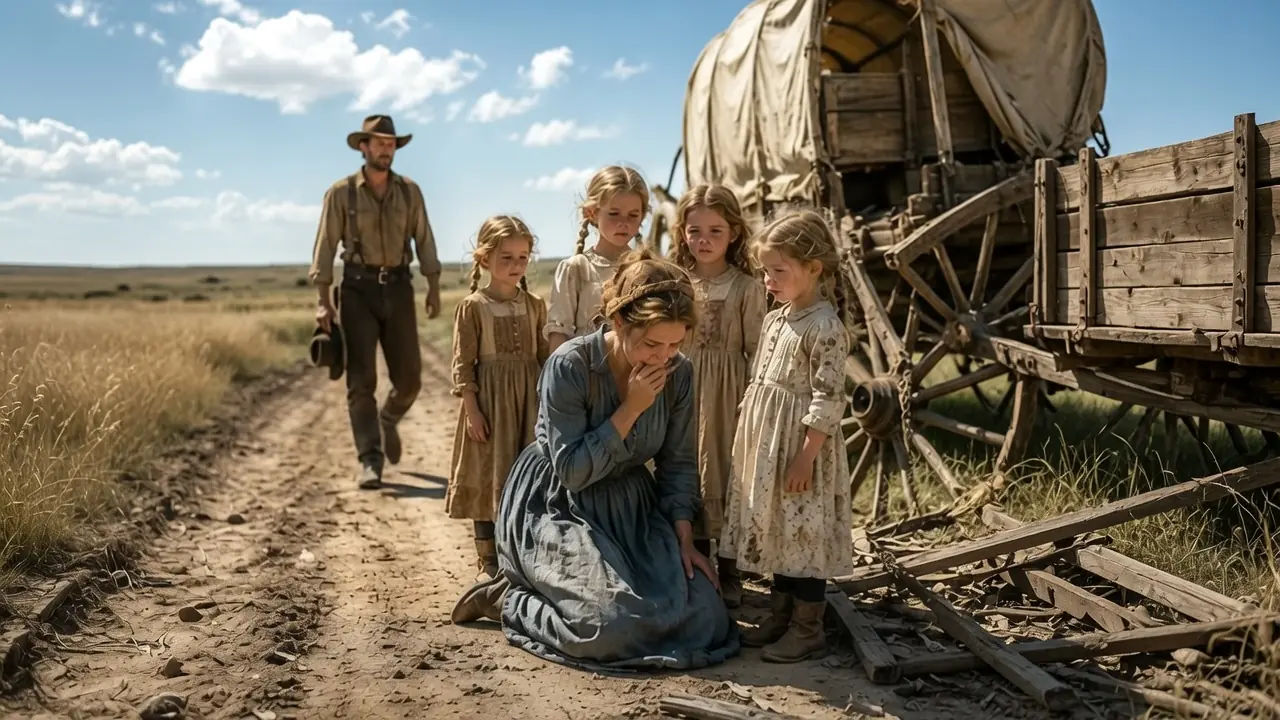
The wagon broke on a dry Oklahoma road with a sound Martha Lancaster would remember for the rest of her life. It was not a small crack, not the harmless complaint of tired wood, but a deep, final splitting that seemed to come from the heart of the earth itself. The rear wheel buckled, the axle snapped, and the covered wagon leaned into the rutted trail as if it had decided to die right there. Martha fell to her knees in the dust before she could stop herself.
Behind her, five little girls stood in a frightened line, their dresses faded from sun and washing, their faces thin from too many careful meals. Eliza, the oldest at twelve, held Pearl’s hand because Pearl was only four and had begun crying without making a sound. Clara and Ruth stood close together, trying to be brave because they had seen their mother cry too many times since their father died. Little Annie clutched a cloth doll with one button eye and stared at the broken wagon as if it were a dead animal.
Martha covered her mouth with one hand and tried to breathe. She had told herself they only needed to reach Oklahoma City, where a letter promised work cooking and cleaning for a family with means. One more mile, then another, then another, and perhaps the girls would have bread every morning and a roof that did not leak. But now the wagon had given out, and everything she owned in the world leaned crooked under the open sky.
Her husband John had been gone six months. He had been kicked by a horse in Missouri while repairing a neighbor’s fence, and infection took him faster than prayer could hold him. Martha had sold their small farm, paid the debts, packed what remained, and started west because staying near the grave of the man she loved did not feed children. Every mile since then had been bought with courage she did not know she still possessed.
She looked into the wagon bed and saw the little food left there. A half sack of flour, dried beans, a jar of peaches wrapped in cloth, two quilts, a few dresses, John’s Bible, and the letter promising work. It was not enough to survive long, and certainly not enough to repair a wagon. The girls watched her, waiting for her to become strong again, and that expectation hurt more than the broken axle.
“Mama?” Eliza whispered.
Martha wiped her face quickly, ashamed of the tears. “It’s all right,” she said, though the words were the thinnest lie she had ever told. “We’ll think of something.”
But the road was empty except for dust, grass, and wind. No town stood near enough to walk safely with children. No neighbor waited over the ridge. Martha pressed one hand against the broken wheel and finally bowed her head because there was nothing left in her that knew how to continue.
That was when Benjamin Quincy heard her crying.
He was mending fence near the south pasture when the sound reached him, small and human against the dry creak of the land. At first, he thought it might be a child, then a wounded animal, then something worse. He set down the fence post in his arms and stood still beneath the Oklahoma sun, listening. A man who had lived alone for three years learned to recognize every sound that did not belong.
Benjamin had known silence since Sarah died. His wife had been the laughter in his house, the voice from the porch, the song over the bread dough, the hand that touched his shoulder when supper was ready. Consumption took her before they could have children, and after the funeral, the ranch became too large for one man and too quiet for one heart. There were bedrooms unused, chairs untouched, and a kitchen table built for more than one plate.
He followed the sound across the road and saw the wagon. It sat broken in the dust, with five girls standing near it and a woman kneeling beside the shattered wheel. Her blue dress was faded, her bonnet hung crooked, and her shoulders shook in the way people shake when they have tried too long not to fall apart. Benjamin removed his hat before he called out.
“Madam,” he said gently, “do you need assistance?”
The woman looked up quickly. Her green eyes were swollen from crying, and dust had streaked her cheeks where tears had fallen. She stood too fast, wiping her face with both hands as if sorrow were something shameful. “I’m sorry,” she said. “I didn’t mean to stop on your land.”
Benjamin walked closer, careful not to move too quickly around frightened children. “Land has room enough for trouble to pass through,” he said. “What happened?”
“The axle broke.” Her voice trembled, but she forced it steady. “I don’t have money for repairs, and I don’t know how far we are from town. We were headed to Oklahoma City for work.”
“You’ll need both wheel and axle,” he said. “That is not a roadside fix.”
Her face folded inward, though she did not cry again. “I thought so.” She reached behind her and pulled the smallest child closer. “I’m Martha Lancaster. These are my daughters.”
Benjamin stood and nodded to each child. “Benjamin Quincy.” The oldest girl gave him a suspicious look, brave enough to be frightened openly. The youngest stared at his hat. He felt something shift painfully inside him at the sight of them standing there beneath the sun, all hunger and dust and desperate hope.
Martha drew herself upright. “If you can point us toward the nearest town, we’ll walk.”
“With five children?”
“I don’t have another answer.”
Benjamin looked toward the hill where his ranch house stood. The porch faced the road, and beyond it were empty rooms that had been waiting so long he had stopped expecting them to matter. He thought of Sarah then, not as grief, but as memory. She had once said their home felt like it had been built for children who had not arrived yet.
He turned back to Martha. “Then I have one.”
She watched him carefully.
“You and your daughters come to my house tonight,” he said. “You eat, wash, and sleep under a roof. Tomorrow I’ll haul the wagon to the barn and see what can be saved.”
Martha’s eyes widened. “Mr. Quincy, I can’t ask that of you.”
“You didn’t ask.”
“I can work,” she said quickly, pride rising to protect her from charity. “I can cook, clean, sew, wash, tend chickens, anything honest.”
Benjamin nodded. “Good. I have more work than hands, and the house has been waiting too long for a proper fire in the stove.”
The girls stirred behind her. Pearl stepped forward before anyone could stop her and slipped one small hand into Benjamin’s. “Do you have bread?” she asked.
Martha closed her eyes in humiliation, but Benjamin crouched to Pearl’s height. “Yes, ma’am,” he said softly. “Bread, beans, milk, and maybe molasses if Mrs. Harlan left any when she last helped with the pantry.” Pearl looked back at her mother with a seriousness too old for her face.
Martha began to cry again, but this time the tears were not the same. They came quietly, with her hand over her mouth, as if relief itself hurt. “Why would you do this for strangers?” she whispered.
Benjamin looked at the six faces before him, then toward the lonely house on the hill. “Because my house has been empty since Sarah died,” he said, his voice roughening. “And God just sent me six reasons to live again.”
By evening, the Lancaster girls were seated at Benjamin’s kitchen table with bowls of beans, cornbread, and milk. They ate politely at first, then with the hunger of children who had spent days pretending not to need more. Martha sat beside them but barely touched her food, watching each daughter as if counting their breaths. Benjamin pretended not to notice her tears dropping into her bowl.
The house changed that night. It was not loud, exactly, but alive. Chairs scraped, spoons clicked, Pearl asked if the cow had a name, and Annie fell asleep with her head against Clara’s shoulder before supper was done. Benjamin stood by the stove with his arms folded, feeling something open in his chest he had thought grief had sealed shut.
After the meal, Martha insisted on washing the dishes. Benjamin told her they could wait, but she shook her head. “If my girls sleep under your roof, my hands will earn it.” He understood pride well enough not to argue too hard. So he dried while she washed, and for a while the only sound between them was water, crockery, and the soft breathing of sleeping children in the next room.
“You were married?” Martha asked quietly after a time.
Benjamin looked toward the shelf where Sarah’s blue cup still sat. “Yes. Her name was Sarah.”
“I’m sorry.”
“So am I.”
Martha looked down at the soapy water. “My John died in January.” Her voice stayed steady, but her fingers tightened around the dishcloth. “He left me five daughters and no idea how to be both mother and father.”
Benjamin took the plate from her hands. “Maybe nobody knows how until they must.”
She looked at him then, and something like gratitude passed between them, not sweet or easy, but honest. They were two people standing in a kitchen with dead spouses behind them and living responsibilities in front of them. That was enough for the first night.
The next morning, Benjamin hauled the broken wagon to the barn with his team. Eliza and Clara followed, determined to help, while the younger girls chased chickens until Martha scolded them with more tenderness than anger. Benjamin inspected the damage fully and knew the repairs would take several days. The wagon was nearly done, but the family inside it was not.
Martha worked like someone afraid rest might be taken as laziness. She cooked breakfast, swept floors, mended a torn shirt of Benjamin’s without asking, and had the kitchen cleaner by noon than it had been in three years. By afternoon, she had organized the pantry, braided Pearl’s hair, and started dough for supper. Benjamin watched with a quiet ache as the house remembered how to be a home.
Still, Martha kept her carpetbag packed by the door. Every night, she folded the girls’ dresses neatly as if they might be told to leave by morning. Benjamin noticed but said nothing at first. He knew fear had its own stubborn schedule.
On the fourth day, rain came hard across the prairie. The road turned slick, the creek swelled, and travel became impossible. Martha stood on the porch watching the weather with worry in her eyes. “We’re delaying you,” she said.
Benjamin leaned against the post beside her. “Rain delays everything. No need to blame yourself for weather.”
“That isn’t what I mean.”
“I know what you mean.”
She looked at him, embarrassed by being understood. “People will talk if we stay too long.”
“People talk when the coffee is too hot and when it is too cold.”
“I have daughters.”
“And I have a reputation for minding my own business poorly enough that folks stopped expecting much else from me.”
That drew the smallest smile from her, and Benjamin felt as if the sun had broken through the clouds for one private second.
A week later, Mrs. Harlan rode over from the neighboring farm after hearing from the mail rider that Benjamin had taken in a widow and five girls. She was a stout, sharp-eyed woman who had known Sarah and did not tolerate foolishness. She inspected the house, asked Martha three direct questions, and then turned to Benjamin with one hand on her hip.
“You planning to let tongues wag without any answer?” she asked.
Benjamin frowned. “I was planning to fix a wagon.”
Mrs. Harlan snorted. “Men and wagons. Always thinking wood and iron are the only things needing repair.” She turned to Martha. “Child, do you feel unsafe here?”
Martha straightened. “No, ma’am.”
“Are you being asked for anything improper?”
“No.”
“Are your girls fed?”
Martha’s eyes filled. “Yes.”
Mrs. Harlan nodded. “Then I will tell town the widow is working for fair board and wages, and anyone who says otherwise may say it to me first.” She looked back at Benjamin. “And you will keep the arrangement proper, written, and witnessed.”
Benjamin nodded. “Gladly.”
So the arrangement became paper. Martha Lancaster would keep house, cook, mend, help with garden and poultry, and receive wages beside room and board for herself and her daughters. Benjamin signed it. Martha signed slowly, with a hand that trembled from the weight of being treated like someone whose work mattered enough to write down. Mrs. Harlan witnessed it with a satisfied nod.
Summer settled over the ranch, and the Lancaster girls bloomed like neglected flowers given water. Eliza learned to milk the cow and carried herself with new confidence. Clara discovered she loved horses and spent hours brushing the old mare, June. Ruth helped in the garden, Annie sang to the chickens, and Pearl followed Benjamin everywhere until he learned to walk slower so her little legs could keep up.
Martha changed more slowly. Her cheeks filled out, her hands stopped trembling, and she laughed once at supper when Pearl dropped a biscuit into her milk and declared it improved. Benjamin looked up at the sound and saw Martha cover her mouth, surprised by herself. It hurt him, realizing laughter had become unfamiliar to her.
One evening, he found her in the barn holding John’s Bible. The girls were asleep, the sky outside purple with dusk, and lantern light rested softly on the beams. Martha stood near the repaired wagon, which Benjamin had finished that morning. The new axle was strong, the wheel true, and the canvas patched.
“You can leave tomorrow,” Benjamin said gently.
Martha nodded, but did not look relieved.
He waited.
“I thought I would be glad when it was fixed,” she said.
“And are you?”
She pressed the Bible against her chest. “I don’t know.” Her voice broke on the last word. “Oklahoma City was supposed to be our chance, but now I’m afraid to take the girls back onto that road. I’m afraid of arriving and being told the work is gone. I’m afraid of being alone in a strange city with five children and no second wagon to break.”
Benjamin stepped closer, stopping several feet away so she would not feel crowded. “Then stay.”
She looked up quickly. “Mr. Quincy—”
“Stay under the arrangement we wrote. Stay for wages. Stay because the ranch needs hands, and because the girls have started putting names to chickens I never asked to own.”
Her lips trembled. “You are offering too much.”
“No,” he said. “I am asking for help.”
That sentence changed her face. Charity had made her cautious, but being needed allowed her to breathe. She looked toward the wagon, then toward the house where her daughters slept in real beds. “For the season,” she said.
Benjamin nodded. “For the season.”
But seasons have a way of becoming lives when people are kind enough not to rush them.
By autumn, Martha had turned the ranch kitchen into the warmest place in three counties. Men riding through began stopping to ask if Quincy still served coffee, and Benjamin always grumbled that he did not run a hotel while setting out cups anyway. The girls helped gather apples, dry herbs, and stack kindling. Even the house seemed to stand straighter with curtains washed, floors polished, and voices moving through its rooms.
The only trouble came from town.
A man named Silas Greer, who owned the freight stable, arrived one afternoon with a letter in his hand and greed in his eyes. He claimed Martha owed him for a supply loan John had taken before dying, though Martha had never seen such a loan and the signature looked suspiciously uneven. Silas waited until Benjamin was in the far pasture, then cornered Martha near the barn.
“A widow with five girls can’t afford legal trouble,” he said, smiling. “You sign over that wagon and whatever wages Quincy’s paying, and I’ll let it rest.”
Martha’s hand tightened around the feed bucket. “I owe you nothing.”
“You owe what I say you owe.”
Before she could answer, Eliza ran to fetch Benjamin. He came across the yard with his coat half-buttoned and his face dark. Silas turned with a false smile, but it slipped when Benjamin took the paper from his hand.
“This is fraud,” Benjamin said after one look.
Silas laughed. “You a judge now?”
“No. But Judge Mercer in town owes Sarah’s family a favor and dislikes forged signatures.” Benjamin stepped closer. “And I dislike men who circle widows like buzzards.”
Silas’s smile died. “You threatening me, Quincy?”
Benjamin folded the paper once and tucked it into his pocket. “No. I’m saving the threat for the judge. Leave.”
Silas left, but not before muttering that Martha had found herself a protector. Martha heard it, and shame rose in her face. Benjamin saw. “He meant to make kindness sound dirty,” he said.
“People often do.”
“Let them try,” Benjamin answered. “It will not change what is true.”
That night, Martha stood on the porch after the girls were asleep. “I don’t want to be a burden,” she said.
Benjamin came to stand beside her. “You are not.”
“You say that now.”
“I will say it tomorrow too.”
She looked at him, searching his face for pity, impatience, or regret. She found none. Only a lonely man who had begun to hope carefully, as if hope were a skittish horse.
“You gave my girls safety,” Martha whispered.
Benjamin’s voice softened. “They gave this house sound.”
“And me?”
He turned fully toward her. “You gave it heart.”
Martha lowered her eyes as tears slipped down her cheeks, but this time she did not hide them. Benjamin did not reach for her without permission. He only stood close enough that she knew she was not crying alone.
Winter came early that year. Snow touched the grass before Thanksgiving, and the wind rattled the windows at night. The girls hung paper stars in the kitchen, and Martha baked bread so often the house smelled like flour and warmth. Benjamin carved Pearl a little wooden horse for Christmas, and she slept with it clutched to her chest.
On Christmas Eve, Martha placed a small package in Benjamin’s hands. It was a scarf she had knitted from wool Mrs. Harlan had given her, dark brown and plain but warm. “It isn’t much,” she said.
Benjamin ran his rough fingers over the stitches. “Sarah made me one once,” he said quietly. Martha’s face fell. “I’m sorry.”
He shook his head. “Don’t be.” He wrapped it around his neck and looked at her with eyes full of memory and something new. “The heart can remember and still make room.”
Martha did not answer, but her hand came to rest lightly over his for one brief moment. It was not a promise. Not yet. It was only the first brave touch after two lives had been broken by loss.
Spring found the ranch stronger than it had been in years. The cattle were healthy, the garden ready, and the girls grew taller by the week. Eliza spoke of becoming a teacher. Clara wanted to train horses. Ruth wanted to plant sunflowers along the road, Annie wanted every chicken to have a ribbon, and Pearl told Benjamin she planned to marry the cow because it gave milk.
One Sunday after church, the preacher stopped Martha outside and said a family in Oklahoma City had written again, still needing a housekeeper. The wages were fair, the position respectable, and the city offered schooling for the girls. Martha took the letter with careful hands and felt the old crossroads rise before her.
That evening, she told Benjamin.
He listened without interrupting, though his face grew still. “It may be a good opportunity,” he said.
“You want us to go?”
“No.”
The honesty startled her.
Benjamin looked at the table where five girls had left crumbs, ribbons, a slate pencil, and one doll shoe. “I want you to choose freely,” he said. “Not because a wheel broke, not because hunger drove you, not because I opened a door when you had nowhere else to sleep.”
Martha’s eyes filled. “And if I choose to stay?”
His voice roughened. “Then I will thank God every morning and try to deserve it.”
The next day, Martha walked to the repaired wagon alone. She touched the wheel Benjamin had built, the canvas he had patched, the boards that had carried them from Missouri to the edge of collapse. That wagon had been her desperation. Now it was no longer a prison or a coffin for hope. It was simply wood.
She took the Oklahoma City letter from her pocket, folded it once, and placed it inside John’s Bible. Then she went inside, where Benjamin stood by the stove pretending not to wait.
“I am staying,” she said.
He closed his eyes for one moment. When he opened them, they shone.
“For the season?” he asked softly.
Martha smiled through tears. “For the life, if you will have us.”
Benjamin crossed the room slowly, as if every step needed permission. Martha met him halfway. When he took her hands, he did so gently, with reverence for everything those hands had survived.
“I loved Sarah,” he said.
“I loved John,” she answered.
“I know.”
“So we will not pretend they never existed.”
“No,” Benjamin said. “We will build where they left us.”
They married in June beneath the cottonwood tree near the fence line, with Mrs. Harlan crying into a handkerchief and Pearl dropping wildflowers faster than she could scatter them properly. Martha wore a clean blue dress, and Benjamin wore the scarf she had made even though the day was too warm for it. The girls stood around them, no longer frightened beside a broken wagon, but laughing in sunlight.
Years later, travelers on the Oklahoma road would still hear the story of the widow whose wagon broke at the edge of Benjamin Quincy’s ranch. Some told it as a tale of luck, others as Providence, and the girls grew up rolling their eyes because stories always made simple things sound too easy. They knew the truth was harder and better.
A wheel broke.
A mother nearly gave up.
A lonely man heard crying and chose not to keep walking.
That choice became supper, shelter, work, trust, love, and a family large enough to fill every empty room Sarah had once dreamed of.
And whenever Martha saw the old repaired wheel hanging on the barn wall, she touched it gently and remembered the day everything gave out on the road — and the man who saw not six burdens in the dust, but six reasons to live again.