The cold mountain current swirled around Evelyn’s leather boots as she crouched beside the iron drainage outlet.
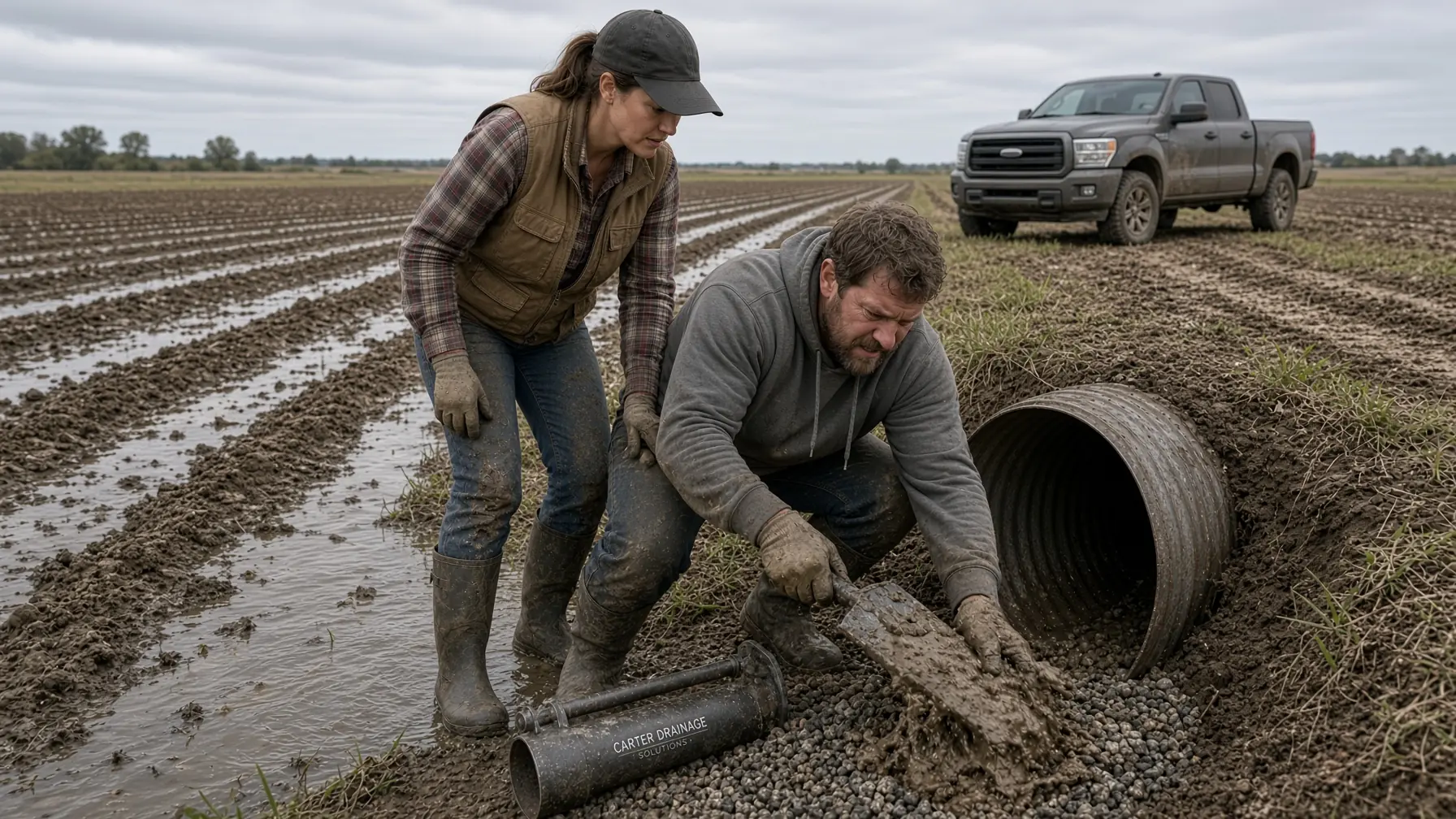
The creek water reached halfway up her shins.
Behind her, beyond the cottonwoods and rocky bank, twenty acres of potato ridges lay dark and shining beneath a morning sun that should have been drying them.
Instead, water seeped between the rows.
The lower field looked as if a storm had passed during the night.
But there had been no storm.
That was what frightened her.
Evelyn tightened both hands around the iron sounding rod and pushed it deeper into the ten-inch outlet pipe.
Three feet.
Four.
Five.
Then—
Thud.
Not stone.
Not packed mud.
Wood.
She struck it again.
Thud.
The sound traveled backward through the iron tube, deep and hollow.
Henry, standing above her on the bank, stopped breathing.
“What is it?”
Evelyn did not answer.
She shifted the rod slightly and drove it forward again.
Thud.
Solid.
Deliberate.
Her face changed.
“Something is blocking the outlet.”
Henry slid down the bank.
“Roots?”
“No.”
“Collapsed pipe?”
“No.”
She pulled the rod free.
The iron tip carried a thin curl of pale, swollen wood.
“Cedar.”
Henry stared.
“That pipe is iron.”
“I know.”
For several seconds neither spoke.
Then Henry looked downstream.
Something metallic lay half-buried beneath gravel beside the culvert mouth.
He stepped into the creek and dragged it free.
An iron slide-hammer.
Heavy.
Forged.
The kind drainage crews used to drive expanding plugs and repair couplings.
Mud covered the handle.
Henry wiped it against his coat.
Letters emerged.
Stamped into the iron.
R.S.S. — DRAINAGE & TILE DIVISION
Below that:
PROPERTY OF A. STERLING
Henry’s face emptied.
Then filled with something much worse.
“Arthur.”
Evelyn stared at the tool.
The Regional Starch Syndicate.
Arthur Sterling.
The man who had spent nearly a year trying to buy their fifty-acre homestead.
Eight dollars an acre.
Always the same offer.
Always delivered as though Henry should be grateful.
Sterling controlled the largest starch-processing concern in the valley.
He also sat on the agricultural loan commission tied to the county bank.
And three months earlier, surveyors working for a railroad subsidiary had quietly marked a proposed freight spur across the western edge of the homestead.
Henry had refused to sell.
Then Sterling reminded him of the mortgage.
Seven hundred dollars.
Due after harvest.
Henry had laughed.
“We’ll pay it with potatoes.”
Sterling had smiled.
“I hope the potatoes agree.”
At the time, Henry thought it was arrogance.
Now he looked toward the drowning field.
His hands began to shake.
The drainage system had been installed before they planted.
That was the only reason Henry had dared put potatoes on the lower acres.
The soil was rich volcanic loam.
Dark.
Deep.
Full of mineral ash deposited over centuries.
But beneath it lay a dense layer that trapped spring groundwater.
Evelyn’s father had dealt with similar ground in Ohio.
He taught her about tile drainage when she was a girl.
Porous clay pipe buried several feet below the surface.
Water entered through the joints and walls.
Gravity carried it toward a main outlet.
Keep the water table low and the soil breathed.
Block the outlet and the entire field changed.
Evelyn climbed the creek bank.
From there she could see the damage clearly.
The highest ridges still held their shape.
The lowest ones had slumped.
Dark water glistened in the furrows.
One potato plant leaned sideways.
Another had yellowed overnight.
She knelt.
Dug carefully.
Pulled out a tuber.
The skin was still firm.
Good.