Lacy Worthington was not supposed to be inside the Iron Jaws garage.
She was only nine years old, chasing a half-deflated rubber ball across Hawthorne Park after Owen Miller kicked it too hard during a chaotic game of tag.
The ball bounced over the curb, rolled through the open bay doors, and disappeared beneath a long workbench inside the motorcycle club’s garage.
Owen stopped at the sidewalk and shook his head. “Forget it,” he muttered. “That ball belongs to them now.”
But Lacy did not move away.
She stood at the entrance and looked inside. Rows of motorcycles gleamed under the overhead lights, polished tanks reflecting the room like dark mirrors. Leather saddlebags hung low, helmets rested on wall pegs, and tools lay across benches in careful lines.
It smelled like motor oil, leather, coffee, and something faintly sweet from the break room in the back.
The place felt huge to her, a grown-up place, a place full of men with heavy boots and deep voices. She knew kids were not supposed to wander into places like that. But the ball was hers, and her mother had always said if something was yours, you took responsibility for it.
So Lacy stepped inside.
No one noticed her at first. A few bikers were bent over a motorcycle near the far wall. Someone laughed in the office. A radio played quietly, low enough that the sound blended with the soft clink of tools.
Lacy found the ball under the workbench, pressed against a toolbox wheel. She crouched, reached for it, and was about to leave when something above the office door caught her eye.
A wooden beam stretched across the garage ceiling. Most of it was coated with dust, thick and gray, the kind that collected slowly over years. But above the office door, there was a small round patch where the dust looked disturbed.
Lacy tilted her head.
In the center of that clean circle was something small, round, and dark.
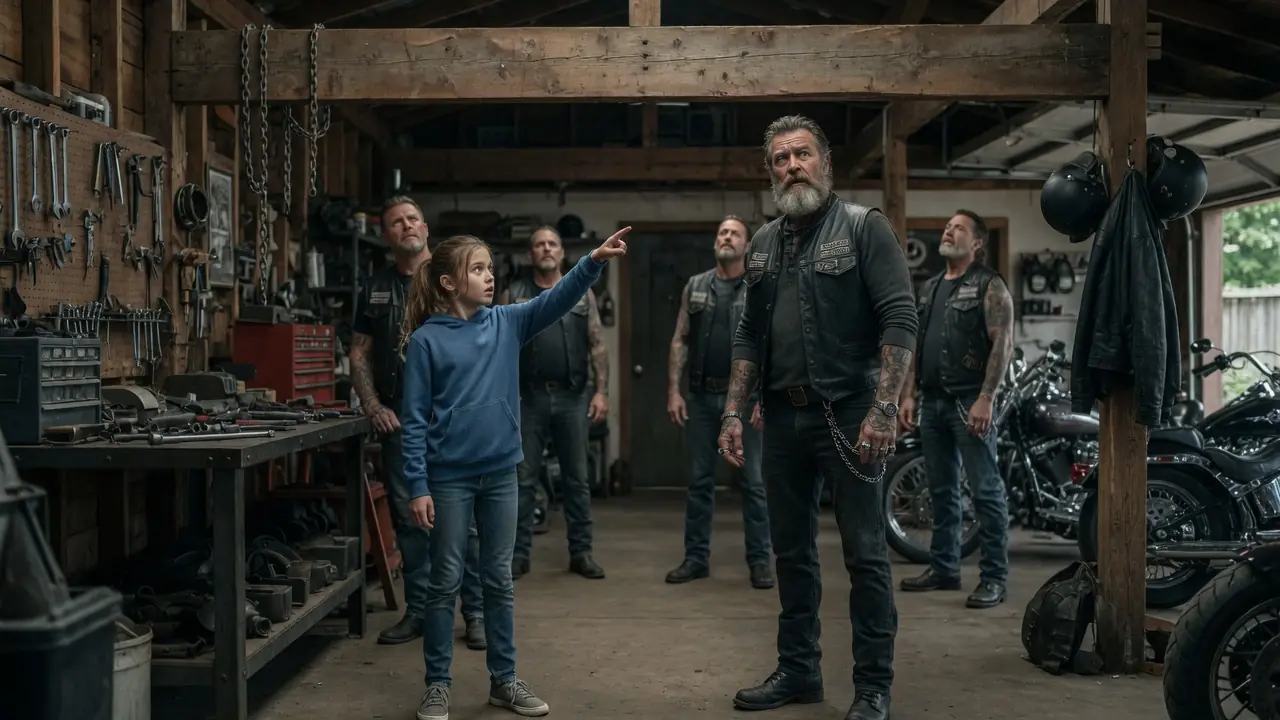
She stood up slowly and pointed.
“There’s a camera up there,” she said.
Three grown men turned at once.
One of them, Randy, an older biker with a gray beard and arms covered in faded tattoos, raised one eyebrow. “We don’t do spy movies here, sweetheart.”
Lacy did not laugh. She kept pointing.
“It’s real,” she said. “See the dust around it? Someone touched that spot recently. The beam is dirty everywhere else, but right there it’s clean.”
The garage went quiet.
A tall man named Dean McCrae stepped out of the office. He was the president of the Iron Jaws, a calm man with suncreased skin, broad shoulders, and eyes that seemed to measure everything before he spoke.
He looked at Lacy, then at the beam.
Randy grumbled, but he dragged the folded ladder from behind the tool racks and set it under the beam. He climbed slowly with a flashlight between his teeth. When he reached the top, he leaned in, went still, and muttered one word.
“Damn.”
Within minutes, the garage changed.
The music was turned off. Bikes were rolled aside. A workbench was cleared. Randy came down holding a tiny dark device no bigger than a quarter, with a thin wire hidden behind the beam and spliced toward the overhead power strip.
Lacy stood beside her ball, suddenly aware that every adult in the garage was looking at the little object in Randy’s hand.
“It’s live,” Randy said, turning it carefully. “Red light is still on.”
Dean’s face did not change, but the room felt colder.
“Call Gary Worthington,” he said.
Lacy looked up quickly. “My dad?”
Dean glanced at her. “Your dad knows wiring better than anyone in town.”
Twenty minutes later, Gary Worthington pulled up in his work truck. He looked like a man who had come from three jobs at once, with his shirt tucked in too tightly, his hair thinning at the front, and a toolbox in one hand.
He saw Lacy first.
“What happened?” he asked.
“I found something,” she said.
Gary looked from his daughter to Dean, then to the device on the workbench. His face tightened immediately.
“This isn’t yours?” Dean asked.
Gary shook his head. “No.”
He sat down, opened the casing carefully, and studied the miniature board inside. “This is recent. Maybe installed in the last couple of weeks. Small transmitter, clean work, not some cheap toy.”
“Can you trace it?” Dean asked.
“Maybe,” Gary said. “But not with what I have in the truck. I’ll need equipment from my shop and time to look at the ceiling panels.”
Dean looked at Lacy.
“You really saw it just from the dust?”
She nodded. “Things look wrong when they don’t match.”
For the first time, Dean smiled.
“You’ve got good eyes,” he said. “Eagle Eye.”
Lacy blinked. “Is that my name now?”
Randy snorted. “Sounds like it.”
Someone brought her hot chocolate in a paper cup, too sweet and full of marshmallows. Another biker found an old patch and pinned it upside down on her hoodie.
“Probationary,” Randy said. “You don’t wear it straight until you earn it.”
Lacy smiled so hard her cheeks hurt.
Gary watched all of it quietly. He was proud of her, but there was worry under the pride. A hidden camera did not appear in a motorcycle club garage by accident.
On the ride home, Lacy sat beside him with the ball in her lap. The device was sealed in a small case between them.
“You know you shouldn’t have gone in there,” Gary said.
“I know.”
“And you know I’m proud of you, right?”
Lacy turned toward him, surprised. “Really?”
Gary nodded. “You saw something nobody else saw. That matters.”
For a moment, they drove in silence.
Then Lacy asked, “Dad, do you think someone is trying to hurt them?”
Gary kept his eyes on the road. “I don’t know, honey. But if someone is watching them, it means someone is planning something.”
Back at the garage, Dean stood alone beneath the empty beam. He ran his fingers over the clean circle in the dust and thought about Preston Grant.
Years ago, Preston had been his friend. They had grown up on the same block, fixed bicycles together, and once built a small motorbike from junk parts and a lawn mower engine. Preston had left town on a scholarship and come back years later in expensive suits, talking about redevelopment, clean investments, and removing bad elements from Hawthorne.
Dean had never trusted the way Preston said the word clean.
Now he wondered if he should have trusted his instincts sooner.
The next morning, the Iron Jaws garage became a command center.
Gary arrived before sunrise with equipment from his shop. He stood on a ladder, sleeves rolled up, tracing power lines and checking hidden corners. Dean watched from the side while Randy and two younger bikers moved toolboxes and opened ceiling panels.
“No other cameras inside,” Gary said finally. “But the first one was sending a strong signal. It didn’t need to go far.”
“Local?” Dean asked.
“Very local.”
That was when Lacy walked in carrying a tablet under one arm.
Gary stared at her. “Lacy, why aren’t you at school?”
“It’s Saturday.”
He closed his mouth.
She put the tablet on the workbench. “I searched for signal reports near here. Weird public network pings. Things that showed up where they shouldn’t.”
Randy leaned over and squinted. “She speaks English, right?”
Lacy ignored him and pointed at the map. “The signal bounced near the storage building east of the garage.”
Gary studied the screen, then looked at his daughter. “That’s actually good.”
Dean leaned closer. “How sure are you?”
“Sure enough to check.”
Five minutes later, Dean, Gary, and Lacy stood outside a rust-stained storage facility behind the garage. Dean owned the building, but some units were subleased. He had not personally checked the records in months.
Before they could call a locksmith, one of the roll-up doors rattled.
A young man in a polo shirt stepped out holding a clipboard. The moment he saw Dean, his face went pale. He tried to turn away, but Dean’s voice stopped him.
“Hold up.”
The clipboard slipped from the man’s hands.
Dean picked it up and read the top sheet. “Unit 14B. Rented under Iron Jaws Motorcycle Maintenance Fund.”
Gary took the paper and frowned. “That’s fake.”
“How do you know?” Dean asked.
“Because the database number on this form belongs to a system I built for the city years ago. Whoever made this copied old formatting. It looks official if you don’t know what you’re seeing.”
Lacy peered into the unit.
Inside were three large black crates. One lid had cracked, revealing polished motorcycle parts wrapped in plastic. Lacy noticed the tags first.
“These shipping codes are wrong,” she said.
Dean looked at her. “Wrong how?”
“They’re old. We saw the new ones on the parts shelves yesterday. These are made to look recent, but they’re using old tags.”
Gary started taking pictures.
“This is a setup,” he said. “Someone planted parts and paperwork here to make it look like the club is moving illegal inventory.”
Dean’s jaw tightened.
“Who has enough money and enough reason to build a lie this clean?” he asked.
Gary hesitated.
Then he said the name Dean was already thinking.
“Preston Grant.”
That night, the clubhouse stayed quieter than usual.
Lacy sat near the back wall with a notebook someone had given her. She was not drawing flowers or cartoons. Her pages were filled with wiring paths, signal arrows, floor layouts, and little circles marking blind spots.
Randy looked over her shoulder. “Where does a kid learn to do that?”
“I like puzzles,” Lacy said. “They make sense. People don’t.”
Randy chuckled. “Ain’t that the truth.”
In the office, Dean and Gary talked with the door partly open.
“Preston owns three companies leasing properties around this block,” Gary said. “One of them is tied to a tech firm that does surveillance logistics. Another is connected to a redevelopment trust trying to rezone Hawthorne Park and everything around it.”
Dean rubbed his forehead. “If he makes the club look criminal, the city pulls our standing. Then the garage goes, the park goes, the whole block becomes his.”
“He didn’t just want to buy you out,” Gary said. “He wanted to bury you first.”
Dean looked through the office window at Lacy.
A child had seen what grown men missed.
“Then we stop reacting,” he said. “We prepare.”
By Monday afternoon, the garage looked careless on purpose.
Toolboxes were left open. A motorcycle sat half blocking the meeting table. Two bikers argued loudly about inventory near the spot where the hidden camera had been aimed. To anyone watching, the Iron Jaws looked nervous and disorganized.
But behind the act, everything was planned.
Gary had installed secure internal cameras. Lacy had a corner table the men jokingly called “the nest.” From there, she watched the screens and marked anything strange. She wore a crooked homemade vest with the Iron Jaws logo stitched onto the back.
At 3:08 p.m., Gary leaned toward his monitor.
“We’ve got activity.”
Lacy sat up straighter. “Where?”
“Not the storage unit,” Gary said. “Across the street.”
She traced the signal path with her finger. “Gas station. The bounce is coming from the gas station.”
Dean did not move from his chair. “Someone local.”
Ten minutes later, a man stepped out of the gas station convenience store with a phone pressed to his ear. He wore a plain delivery jacket with no logo. He looked toward the garage without fully turning his head.
“That’s him,” Lacy said. “The man from the storage unit.”
Gary zoomed in and captured the image.
Dean smiled without warmth. “Let’s give him what he came for.”
Inside the garage, the staged argument grew louder. A chair scraped across the floor. A wrench dropped with a sharp clang. One younger biker slammed both hands on the table.
The man across the street ended his call.
Gary checked the signal. “He cut the line.”
Lacy leaned closer to the second screen. “Wait. There’s another ping.”
Gary frowned. “That’s not video.”
“It’s a trigger,” Lacy said. “Like he’s alerting someone.”
At four o’clock, a dark sedan rolled slowly past the garage.
Dean caught the plate number.
Randy noticed his expression. “You know them?”
“No,” Dean said. “But I know who they belong to.”
That night, the garage went dark.
The Iron Jaws scattered quietly. Gary parked his truck two blocks away with Lacy beside him, watching the storage unit from across the street. Dean and Randy waited in the alley shadows.
Lacy had insisted on coming.
“If they move the parts, you need someone watching the details,” she said.
Gary wanted to argue, but he knew she was right.
At 11:42 p.m., the sedan returned.
Two men got out. One rolled up the storage unit door. The other began moving the crates around, placing them in a way that made the scene look active and recently used.
Lacy raised the camera and recorded everything.
“They’re staging it,” she whispered.
Then headlights flooded the alley.
Three police cruisers arrived too quickly, too cleanly, as if someone had timed the call in advance.
Gary’s voice tightened. “They called it in.”
One of the men tried to run. The other froze.
Dean stepped from the shadows with his hands raised.
The officers hesitated when they saw him calm, when they saw Gary recording from the truck, when they saw the open crates and the timestamps proving the planted scene had been watched all night.
“This isn’t what it looks like,” one officer muttered.
Dean’s face stayed hard. “That’s the whole point.”
By morning, statements had been taken. Phones were collected. One man admitted he had been hired to place items in the unit and wait for instructions. The call logs led to a shell company under Preston Grant’s redevelopment network.
Still, Preston was not arrested.
Not yet.
Dean knew men like Preston did not stand close enough to their own dirt unless they believed they were untouchable. So the Iron Jaws did the one thing Preston had not expected.
They went public.
The city council chamber was full two nights later.
Residents filled the wooden benches. City staff sat with folders. Reporters stood near the wall. Preston Grant arrived in a tailored navy suit, smiling like a man who had already counted the votes in his favor.
Lacy sat between Gary and Dean, wearing her patched vest over a clean blue hoodie. Her hair was pulled back tightly because she said she wanted to look ready. In her lap was a folder full of photographs, timelines, signal maps, and the storage documents.
The council president adjusted his microphone.
“Next item,” he said. “Rezoning proposal 1452B, submitted by the Grant Redevelopment Trust.”
Preston stepped forward.
“This project represents a chance to revitalize a neglected section of Hawthorne,” he began. “We have consulted experts, reviewed safety concerns, and created a plan that will bring new housing, new business, and renewed value to this community.”
Behind him, an assistant revealed glossy development drawings.
Luxury apartments. Smooth sidewalks. Private storefronts. No Iron Jaws garage. No park. No basketball court. No kids.
Then the council president looked toward Dean.
“We have also received a formal challenge alleging unlawful surveillance, forged documentation, and attempted entrapment. A statement will be heard.”
Dean stood.
Everyone expected him to walk forward.
Instead, he looked at Lacy.
“You sure?” he asked quietly.
She nodded.
Gary squeezed her shoulder. “Go ahead, kiddo.”
The microphone was too tall. A city worker lowered it for her.
Lacy stood in front of the council, small but steady.
“My name is Lacy Worthington,” she said. “I’m nine. I live on Lemon Street, and I play at Hawthorne Park almost every day. The park you’re about to erase.”
A few people shifted in their seats.
Lacy opened her folder.
“Last week, I found a hidden camera in the Iron Jaws garage. It wasn’t theirs. It was aimed at their meeting table, and it was sending video through a signal point near the gas station.”
She held up a photograph of the camera, the small dark lens circled in red.
“My dad helped trace it. The signal connected to equipment linked to a company owned by Mr. Grant.”
Preston’s smile disappeared.
Lacy lifted the next page. “Then we found a storage unit rented under a fake club name. There were motorcycle parts inside and forged papers meant to make the club look guilty. But the shipping codes were wrong, and the rental documents were fake.”
Preston’s attorney stood quickly. “This is inappropriate. She is a child.”
Gary stood beside her. “And her evidence is backed by technical documentation. I submitted the device report, the footage, and the independent review to the council office this afternoon.”
Dean stepped forward.
“We also have video of two men altering the storage unit before police arrived. One of those men was working under a company tied to Mr. Grant’s redevelopment trust.”
The chamber went silent.
Preston’s face tightened. “This is a smear campaign by a group with a long history of questionable civic behavior.”
Dean turned toward him.
“And yet you are the one connected to shell leases, hidden cameras, and staged evidence.”
One councilman, quiet until then, leaned toward his microphone.
“I was at Hawthorne Park last weekend,” he said. “A girl fell from the monkey bars. Three Iron Jaws members reached her before her parents did. They stayed until she stopped crying. That does not prove everything, but it proves enough for me to want every document in this proposal reviewed before we vote.”
The vote was delayed.
Two days later, Preston Grant was arrested on charges tied to fraud, unlawful surveillance, and conspiracy. The redevelopment deal collapsed. The park remained open, and the Iron Jaws garage kept its doors.
Weeks later, Hawthorne looked the same from a distance, but it felt different.
The basketball net had new chains. The park benches were repaired. The Iron Jaws garage had a fresh coat of paint and a mural across one wall showing a little girl pointing up toward a ceiling beam.
No face, no name.
Just a raised hand and two words beneath it.
Look closer.
Lacy sat in her corner of the garage, sketching again. This time, she was not drawing signal paths. She was designing a new space beside the garage, half workshop, half learning lab, where kids could learn wiring, repairs, safety, and how to ask the right questions.
Gary leaned over her shoulder.
“Thinking big?”
“Maybe,” she said.
He looked at her with pride he no longer tried to hide. “You changed a lot of lives, Lace.”
She smiled without looking up. “I just saw what was already there.”
Dean walked over and placed a small paper bag on the bench beside her.
Inside were clear safety goggles, a wrench-shaped keychain, and a patch with a red eagle stitched across it.
This one was not upside down.
Lacy ran her thumb over the thread.
“Scout,” the patch read.
Dean’s voice was quiet. “You didn’t just help us. You reminded us why this place matters.”
Lacy looked around the garage at the men who had once seemed too big and too scary to approach, at her father tightening a loose wire by the office door, at Randy teaching a teenager how to sand a gas tank, at the open bay doors leading out toward the park.
She had gone into the garage chasing a runaway ball.
She had found a camera, uncovered a lie, and helped save a place that had been protecting the neighborhood long before anyone thought to thank it.
Sometimes, the smallest voice in the room is the one brave enough to point upward.
Sometimes, a child sees the truth because grown-ups have stopped looking.
And sometimes, all it takes to save a home is one person willing to say, “Something is wrong here,” and refuse to look away.