Riker heard him before he saw him.
A high, thin voice cut through the convoy’s exhaust roar, cracking with effort in the way a child’s voice cracks when it is being pushed past what it was built to do.
Then he saw the shape in the right mirror.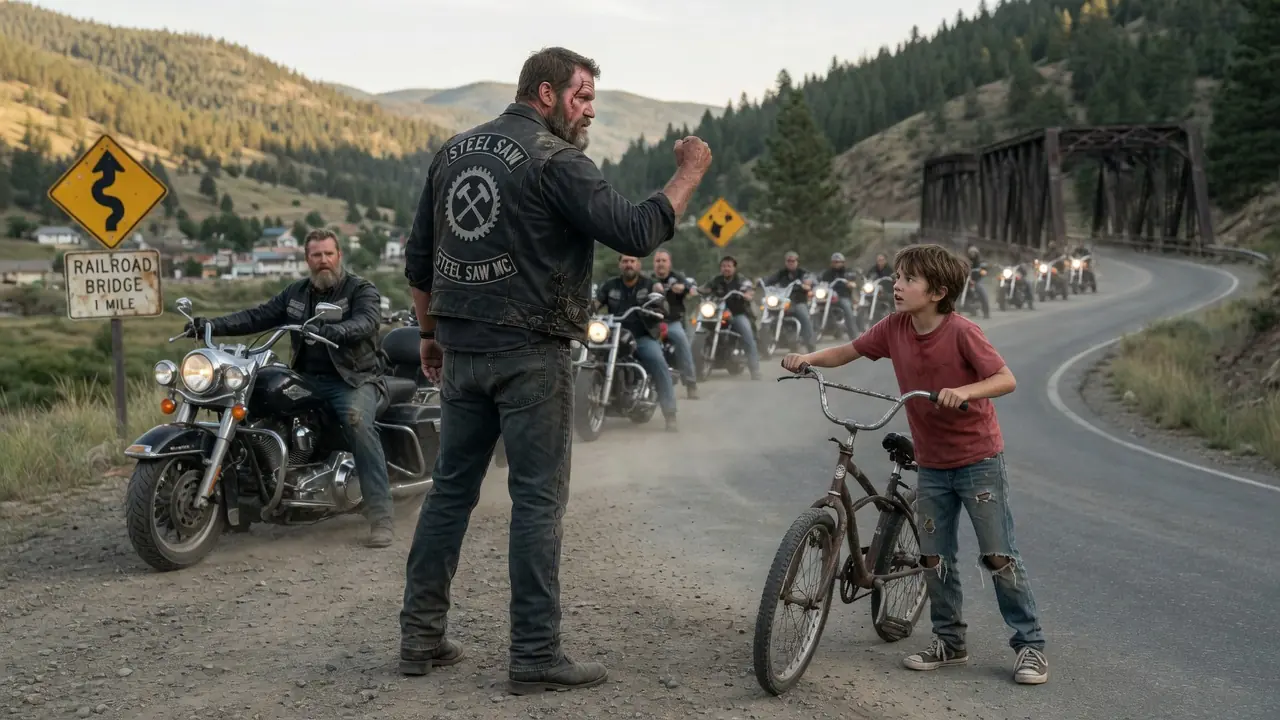
A small boy on a rust-eaten bicycle was standing up on the pedals, pumping with everything he had. His face was tilted upward, his mouth wide open, screaming something the wind shredded before it reached them.
Riker Cross had twelve years of Army Ranger training and fifteen years of riding point for the Steel Saw Chapter. In all that time, he had developed exactly one rule about his instincts.
Never dismiss them.
Never.
Not once.
Not for any reason.
And right now, his instincts were telling him the boy was screaming something that mattered.
Riker hit the brake.
Eleven sets of brakes answered behind him.
It was the controlled, synchronized deceleration of men who had ridden together long enough that the column moved like a single organism, each rider reading the one ahead. Twelve choppers settled to a ragged standstill on Tulain Mountain Road, their engines holding at a patient rumble.
Then came silence.
The boy coasted the last twenty yards and dropped his bike in the gravel. He kept running, chest heaving, and stopped four feet from Riker’s Road King with his hands on his knees and his head down, pulling air like every breath hurt.
Riker cut his engine.
He stepped off the bike and stood there, six feet three, two hundred and forty pounds, with a face that looked like it had been carved from the same hard material as the mountains around them. A scar cut along his jaw from a night in eastern Afghanistan that he never talked about.
On the back of his cut were the words Road Captain, Steel Saw Chapter, Hells Angels.
He looked at the boy.
Nine years old, maybe ten. Dark hair stuck to his forehead with sweat. Jeans with holes in both knees. One sneaker had a broken lace knotted twice. On his left shoulder, visible where his T-shirt had shifted during the sprint, was a bruise the size of a fist, fresh enough to still be deep red at the edges.
The color of something done deliberately.
And recently.
Riker crouched down to the boy’s eye level.
“Take a breath,” he said. “Then tell me.”
The boy took a breath.
He looked up at Riker with eyes that were terrified and absolutely certain at the same time, the specific combination that only exists in people who have seen something real and are fighting hard to be believed.
“They’re waiting for you around the corner,” he said. “The men with the guns. They’re going to kill you.”
The boy’s name was Leo Montgomery, and he lived three blocks off the mountain road in a house that needed paint and a new porch step, with a mother who worked double shifts at the county hospital and a bicycle that was three years too small for him, which he rode anyway because it was his.
He had been collecting beetles that afternoon in the abandoned Harwick Industrial Building off Route 7, a long concrete structure the town had been promising to demolish for six years without ever getting around to it. That made it perfect for beetles.
And apparently for other things.
Leo had been in the back corner of the third floor, flat on his stomach with a mason jar, when voices came up from the loading bay two floors below. He stayed flat because something in the quality of those voices told him that was the right thing to do.
Low.
Deliberate.
The voices of men being careful not to be overheard.
He told Riker what he heard, and Riker listened the way he listened to field reports, without expression, without interruption, filing each piece in its proper place.
Three vehicles.
Corner of Route 7 and the mountain road junction.
Under the old rail bridge.
Barriers laid across the road.
Heavy weapons.
Twelve to fifteen men by Leo’s count.
Instructions overheard clearly.
Wait for the bikes.
Nobody rides out.
And one other thing.
One name.
“They kept saying the mayor said,” Leo told him. “Like, ‘The mayor said make it look like a gang thing.’ And, ‘The mayor said make sure nobody finds the bikes.’”
He paused.
“Mayor Sterling.”
Riker was quiet for a moment.
“You heard that name specifically?”
“Yes, sir. Three times.”
Leo looked at him directly.
“I wrote it down.”
He produced a folded piece of notebook paper from his jeans pocket and held it out. On it, in the careful block letters of a child who understood the importance of accuracy, were names, times, and fragments of conversation transcribed from memory within minutes of hearing them.
Riker took the paper.
He read it.
He folded it carefully and put it in the inner pocket of his cut.
Then he stood and looked at his eleven brothers, all still on their bikes, all watching him with the patient alertness of men who had ridden with him long enough to know that when Riker Cross went quiet and still, it meant something was being calculated.
And the calculation would be thorough.
“Roar,” he said to the nearest rider, a compact, broad-shouldered man with a military bearing that mirrored Riker’s own. “Get the drone up. Route 7 junction. Rail bridge corner.”
He looked back at Leo.
“You rode out here to warn us?”
“Yes, sir.”
“On that bike?”
Riker looked at the rust-eaten bicycle lying in the gravel.
“How long did that take you?”
Leo considered it.
“About twenty minutes. I was going as fast as I could.”
Riker looked at the bruise on the boy’s shoulder.
He thought about a nine-year-old deciding alone to get on a bicycle too small for him and ride twenty minutes on a mountain road to warn a dozen Hells Angels about an ambush. He thought about what that had cost the boy in terms of pure nerve.
“You did good,” Riker said.
It came out simply, without decoration, which was how he said everything he meant completely.
He turned to his brothers.
“Cole, take the boy back to the clubhouse. Side roads, not the main. Make sure he’s inside before you come back.”
Then he looked at the mountain road, at the bend two hundred yards ahead where the rail bridge shadow fell across the junction, and where a group of armed men were currently waiting for a column of motorcycles that was no longer coming.
“The rest of you,” he said, “kill your lights and follow me.”
The drone was the kind of modified equipment that had no obvious business being in a motorcycle club saddlebag, except that Riker Cross had never fully stopped being an Army Ranger, and the chapter had learned not to ask too many questions about the contents of his kit.
It went up fast.
A few moments later, the feed came through to Riker’s phone.
The corner of Route 7 and the mountain road junction, seen from above in thermal overlay, looked exactly like what it was.
A carefully prepared kill zone.
Three black SUVs with no visible plates were positioned in a staggered formation under the rail bridge. Their engine heat showed as dim orange shapes in the thermal image. Road hazards had been placed in two lines across the pavement, one at the entry to the junction and another farther in, designed to trap the riders before they could react.
Fourteen figures, thermal bright against the cool road surface, were distributed between the vehicles and the shadowed pillars of the bridge.
Riker counted their positions twice.
Two held elevated points, one on the bridge itself and one on the concrete support. The others were positioned to close from both sides once the motorcycles were disabled.
It was professionally designed.
Not improvised.
Not the kind of thing assembled from greed and enthusiasm.
Someone with operational training had set this up.
Riker looked at the feed for ninety seconds without speaking. Then he rotated the drone to survey the terrain behind the junction. The hillside rose steeply on the north side of the road, wooded with pine and scrub juniper, accessible from the service trail that ran along the rail line above the bridge.
He had ridden past it a hundred times.
He had never thought about it from this angle.
He thought about it now.
“We’re not going through the road,” he said. “We’re going over.”
He mapped it out for them in three minutes flat. The service trail access point six hundred yards back. The slope. The tree coverage. The positions relative to the men watching from the bridge.
He assigned each man a role with the efficiency of someone who had planned dangerous work in harder places and understood that the difference between a plan that worked and one that failed was usually the quality of the preparation.
“High positions first,” he said. “Then the flanks. We have terrain advantage and surprise. We use both completely.”
He looked around the circle.
“Nobody fires unless I give the word. We’re not here to kill anyone. We’re here to take their phones, take whatever evidence they’re carrying, and find out exactly who hired them.”
He paused.
“Silas Vance is the man running this. I want Vance intact and talking.”
Riker looked at the drone feed one more time. Fourteen men were waiting confidently in a trap that was about to become something else entirely.
“We have the high ground,” he said.
One of his brothers grinned.
“Rangers lead the way.”
The rail service trail was narrow, unlit, and not designed for eleven men moving in single file through mountain scrub in the dark. But it was accessible, and it put them on the ridge directly above the rail bridge in eighteen minutes of careful movement.
Riker timed it.
The ambush team below was still waiting.
He could see their thermal signatures on his phone’s drone feed, patient and undisturbed, their confidence in the completeness of their setup entirely intact.
That confidence was about to be revised.
The man watching from the bridge was the closest, positioned below the ridge line, focused entirely on the road from which the motorcycles were supposed to come.
That was not the direction they came from.
Riker moved down from the ridge with controlled silence and reached him before the man fully understood anything had changed. What followed was quick, disciplined, and restrained, the kind of close-quarters control designed to end resistance without lasting damage.
Moments later, the man was restrained on the bridge concrete, his communication headset removed.
Riker put the headset on.
Below, he heard Silas Vance’s voice.
Calm.
Professional.
A man accustomed to managing operations from the center.
“Position check,” Vance said.
Riker said nothing.
He waited.
Thirty seconds later, his brothers came down out of the darkness on both sides of the junction simultaneously. Not loudly. Not like a brawl. But with the organized efficiency of people who had rehearsed this dynamic in one form or another for the better part of their adult lives.
The outer positions went first, isolated before they could support each other. The second elevated watcher was taken at the same time. The men near the SUVs realized too late that the road they had chosen as a trap had become a trap for them instead.
By the time Silas Vance understood that something had gone wrong, the wrong thing had already finished happening.
He was the last one standing, literally in the center of the junction. His men were restrained and seated against the SUV tires on both sides of him. His weapon lay on the road several feet away, placed there after being removed from his hands in a manner he was still processing.
Vance was forty-three years old, professionally competent, and had been in difficult situations before. He understood, the way competent people understand things quickly and without argument, that this particular situation had already been resolved.
Riker stood in front of him.
“The phone,” Riker said.
Vance looked at him for a moment.
Then he reached into his jacket and produced an encrypted satellite phone, the kind with secure deletion protocols.
“The code,” Riker said.
A longer pause this time.
Roar, standing at Vance’s right, applied pressure to the man’s shoulder in a way that clarified the situation immediately.
Vance gave him the code.
The phone opened.
There, in a message thread that had not been deleted because Vance had not expected to need to delete it tonight, were the instructions.
Direct.
Specific.
Timestamped.
And signed at the sender’s end with an account that traced, through two steps of verification Riker completed on the spot, to a city government communications account registered to Mayor Julian Sterling’s office.
Wait for the convoy.
Leave no survivors.
Stage the scene to indicate a rival gang conflict.
Payment on confirmation.
Riker read it twice.
He photographed it from several angles with his own phone. He forwarded the photographs to three separate encrypted destinations simultaneously.
Then he looked at Vance.
“You’re going to sit here,” he said, “until the people I just sent this to arrive. That’s going to take about two hours.”
He looked at the restrained men along the SUVs.
“All of you are.”
He picked up Vance’s encrypted phone and put it in his pocket.
Then he climbed back up the ridge to where his Road King was parked on the service trail and dialed the clubhouse.
“Wyatt,” he said when the chapter president picked up, “we have a problem, and we have a solution. Let me tell you about both.”
Julian Sterling had been mayor of Ridgeline for eight years.
In those eight years, he had done what men in his position do when they have ambition that exceeds their conscience and intelligence that exceeds their judgment. He had looked for leverage, found it, and used it until using leverage became the only mode he knew.
The money had started as a convenience.
Diverted pension fund allocations.
Small at first.
Routed through a network of municipal contractors that he had cultivated over a decade of city council work. Then larger. Then systematic.
The Steel Saw Chapter had been an unexpected complication.
They had no official interest in municipal finance, but they had community roots. Community roots meant information. And somewhere in the dense web of informal knowledge that a motorcycle club accumulates over thirty years in a county, a thread had started to unravel toward him.
Nothing formal.
Nothing prosecutable.
But Riker Cross had asked questions twice of people who then asked Sterling’s associates.
And Sterling was a man who understood that questions were the first step toward answers he could not afford anyone to reach.
He was in his office at city hall when his phone showed that Vance’s check-in call had not come. He waited fifteen minutes.
Then he called Vance’s line.
It rang through to a generic voicemail.
Sterling set his phone down on his mahogany desk and picked up his wine glass, a 2017 Napa Cabernet, decanted and exactly right. He looked at the painting on the opposite wall, a local mountain landscape bought at a charity auction.
He had paid four thousand dollars for it and written the purchase off as a municipal beautification expense.
He took a sip.
He set the glass down.
Then he pressed the intercom for his administrative assistant, though at this hour, what he really needed was his personal security chief.
“I need the car ready,” he said. “And the secondary bag.”
The secondary bag contained one hundred and forty thousand dollars in cash, two passports, and the confirmation for a private airstrip booking forty miles east. Sterling had maintained it as insurance for three years, paying the airstrip owner in cash installments that never appeared on any record.
Every careful man had an exit.
Sterling had built his with the same methodical attention to detail that he brought to everything.
He was at his desk composing a final encrypted message to the money transfer network that would move his remaining liquid assets offshore before morning when his office door opened.
It was not his security chief.
It was Sergeant Briggs from the city police department, a loyal man, one of several officers whose careers Sterling had helped in exchange for useful discretion.
Briggs came in with the expression of a man carrying bad news and unsure how the recipient would handle it.
“Sir,” Briggs said, “there’s a situation developing at the Steel Saw clubhouse.”
“What kind of situation?”
“The Hells Angels are gathering. A lot of them. They’re in communication with the FBI field office. An agent named Briggs.”
“Briggs is a common name,” Sterling said.
“A different Briggs, sir. Agent Evelyn Briggs. FBI. She’s been in town for six weeks. Apparently, she’s been building a case.”
The sergeant looked briefly at the floor.
“About the pension fund.”
Sterling sat very still.
Briggs continued.
“Sir, there’s also the ambush team on Route 7. They’re not responding, and there are reports…”
Sterling looked at the door behind Briggs.
He looked at the window.
He looked at the secondary bag beside his desk, packed and ready.
Then he picked up the bag.
Wyatt Thorne had been the Steel Saw Chapter’s president for sixteen years. He was fifty-three years old, with silver hair worn back from a face that had accumulated the particular weathering of a man who had spent five decades outside and had not spent much time worrying about it.
He was not a man who raised his voice.
He had found, over sixteen years of chapter leadership, that the quieter he was, the more clearly people heard him. The things worth saying were worth saying at volume zero.
When Riker’s call came through with the full account, the ambush, the drone footage, the encrypted phone with the mayor’s instructions, and the photographs already transmitted to secure locations, Wyatt listened without interrupting.
When Riker finished, Wyatt was quiet for four seconds.
Then he said two words.
“The furnace bell.”
It was a term that had been used exactly twice in sixteen years.
Within ninety seconds, the Steel Saw Chapter’s emergency frequency was broadcasting a coded signal that cascaded through four county relay points and three regional networks, reaching every chapter in contact range with a message that translated simply.
Full muster.
Steel Saw clubhouse.
Now.
The clubhouse itself was currently surrounded by thirty-two city police vehicles.
Sergeant Briggs had been efficient, arriving with a force assembled through Sterling’s network of cooperative officers and establishing a perimeter with lights running and a bullhorn commanding everyone inside to surrender immediately on charges that had been fabricated so recently they were still warm.
Agent Evelyn Briggs of the FBI was also present.
She had arrived eleven minutes after the police perimeter was established, parked her vehicle at the edge of it, and spent those eleven minutes in a progressively escalating argument with the police commander about jurisdiction, probable cause, and the consequences of conducting an unauthorized assault on a civilian structure based on charges she was already in the process of demonstrating were fabricated.
The police commander, a broad man named Captain Holt, had been on Sterling’s payroll for six years. He informed her that she had no jurisdiction in a city police matter and that if she did not step back, he would have her removed.
She stepped back exactly far enough to make a phone call.
She was on that call when the sound started.
It began, as these things always began, as a vibration.
The road itself picked up a signal from beyond the visible horizon and transmitted it upward through tire rubber, boot leather, and the soles of thirty-two police officers’ shoes.
Then the sound arrived.
Not from one direction.
From all of them.
From every access road, side street, and highway ramp that fed into the blocks surrounding the Steel Saw clubhouse.
Captain Holt turned in a slow circle.
Eight hundred and twelve motorcycles.
The Steel Saw Chapter was sixty-one men. Four affiliated chapters within the county had added two hundred and forty more. Three chapters from adjacent counties that had been monitoring the frequency had committed their full muster. Another three hundred and fifteen riders arrived from farther out.
The remainder were independents, associates, and men who had heard the furnace bell through informal channels and had decided without being asked that they were on the right side of this.
They filled every street.
They came in from the north on Ridgeline Avenue, a column that stretched back six blocks and was still turning the corner as the front reached the perimeter. They came in from the east on the county road, from the west on the industrial bypass, and from the south on three residential streets simultaneously.
The columns converged on the clubhouse block from every available angle and settled into a ring that pressed the police perimeter inward from outside.
Their engines idled, all of them.
The combined frequency was a physical presence, not aggressive, just enormous and impossible to ignore. It pressed against eardrums and sternums and against the decision-making capacity of thirty-two men who were suddenly acutely aware of the arithmetic.
The headlights, more than eight hundred sets of them, turned the night street into daylight.
Captain Holt looked at the light.
He looked at the shadows it cast, his own men’s shadows stretching long across the road toward him.
The shadows of people standing between a light source and a wall, with nowhere to go.
Then he looked at Agent Evelyn Briggs, who had finished her phone call and was watching him with complete professional composure.
“The FBI director has authorized my intervention in this matter,” she said pleasantly. “Which means this scene is now federally controlled. I need you to stand your men down.”
She paused.
“Or you can explain your position to the federal judge who is currently being woken up to review your probable cause documentation.”
Another pause.
Captain Holt looked at his men.
He looked at eight hundred motorcycles.
He made the calculation.
He lowered his hand from his holster.
“Stand down,” he said.
The weapons went to the ground in a wave. The sound of thirty-two sidearms finding the asphalt simultaneously was the specific sound of an argument being lost.
Wyatt Thorne came out of the clubhouse front door with his hands open and visible, not because he was surrendering, but because he had no reason to hide anything.
He walked through his own perimeter to where Evelyn Briggs was standing.
“I believe you have something for me,” she said.
“Riker’s on his way,” Wyatt replied. “He has the phone.”
Julian Sterling made it as far as the parking garage beneath city hall before Riker found him.
Not because Riker had predicted the exit route specifically, though the parking garage made tactical sense for a man trying to leave a building unnoticed, but because eight hundred motorcycles had closed the street-level exits thirty seconds before Sterling reached any of them.
The garage was the last viable option.
Therefore, it was the only option.
Sterling was moving fast, the secondary bag over his shoulder, heading for his personal vehicle, a black town car that would have taken him to the airstrip if the airstrip had still been accessible.
It was not.
Roar had driven out there forty minutes earlier on Riker’s instruction and had a quiet conversation with the airstrip owner. The runway lights were shut off. The booking was canceled.
Riker stepped out from behind a support pillar.
Sterling stopped.
He was fifty years old and expensively maintained, with the groomed handsomeness of a man who understood that appearance was a form of authority and had invested in it accordingly. He was wearing a suit that cost more than most people’s monthly salary. His hair, which had been perfectly arranged six hours ago, was less so now. There was a damp patch on his collar.
His eyes landed on Riker and went through a rapid sequence of calculations that all arrived at the same answer.
“I can make this—”
“Leo Montgomery,” Riker said.
Sterling blinked.
“Nine years old,” Riker continued. “Lives three blocks from Route 7. Rides a bike that’s too small for him. He has a bruise on his shoulder that someone put there.”
Riker walked toward him slowly.
“He rode twenty minutes on that bike to warn us because it was the right thing to do.”
He stopped two feet from Sterling.
“You sent fourteen men with weapons to kill twelve people because they were asking the right questions. Because you stole the pension money of retired teachers, firefighters, city workers, and school custodians in this county, and you needed those questions to stop.”
He looked at Sterling with the flat, complete attention of a man who had run the calculation and arrived at a final number.
“You almost killed twelve of my brothers. You would have killed Leo if he hadn’t run.”
Sterling tried once more.
“Whatever you think you have—”
“I have your messages,” Riker said. “Timestamped. Your account. Your instructions.”
He held up Vance’s phone.
“And I have Agent Briggs outside.”
Then he reached out and took the secondary bag from Sterling’s shoulder.
Not violently.
Just took it.
“The money in here,” Riker said, “is going back.”
Then he stopped Sterling with one controlled strike, precise and restrained, the kind of strike delivered by a man who wanted it to mean something specific and had enough self-discipline not to do more than the situation required.
Sterling fell back against the hood of the town car and slid down to the garage floor, the last architecture of his position removed all at once.
He stayed down.
The garage door opened behind Riker, and footsteps approached.
Evelyn Briggs entered with two federal agents behind her, moving with the brisk efficiency of someone who had been building toward this moment for six weeks and intended to do it correctly.
She read Sterling his rights in the concrete quiet of the parking garage, her voice level and unhurried, while he sat against the town car with the expression of a man discovering for the first time what the bottom of a thing felt like.
She took the encrypted phone from Riker.
She took the secondary bag.
Then she looked at Riker with an expression that was professionally neutral, and underneath that neutrality, carried satisfaction that was entirely justified.
“You’ll need to come in for a statement,” she said.
“I know,” Riker replied.
“The boy,” she said. “Leo. He’s a witness. He’s protected.”
Riker looked at her.
“He was protected when he got on that bicycle,” he said. “And he is protected now.”
He held her gaze.
“That’s not changing.”
She considered this for a moment.
Then she nodded.
The pension fund recovery took six weeks.
Federal asset seizure, forensic accounting, and the dismantling of the offshore transfer network took time, but once the financial crimes unit had the encrypted data from Vance’s phone, the structure that had taken Sterling four years to build began to fall apart in days.
The recovered amount was ninety-three percent complete.
The remaining seven percent, by the standard of what had been lost and what had come back, felt like a rounding error.
The distribution was made through the county pension administrator on a Tuesday morning. Retired teachers, firefighters, city maintenance workers, school custodians, and clerks who had been told for two years that their pension accounts had suffered market losses found on that Tuesday that the losses had been reversed.
Some of them did not believe it at first.
Some called the pension office to verify.
Some stood in their kitchens holding the notification letter and said nothing for a long time.
The town square had been cleaned up by Saturday morning, and a temporary stage had been assembled near the center. By noon, the crowd was large enough that the streets adjacent to the square were full.
It was not an official event.
No one had issued permits. No politicians were scheduled to speak because there were functionally no politicians left to speak. Sterling had taken three members of the city council with him in the federal sweep.
It was simply the town assembling itself the way towns assemble when something significant has happened and people want to be together in the same place for a while.
The Steel Saw Chapter arrived at two in the afternoon.
Eight hundred motorcycles took up the surrounding streets. Their riders mingled with the crowd in the specific way large men in leather cuts mingle when they have decided to be present for something rather than apart from it.
An old woman in a folding chair reached up and took Wyatt Thorne’s hand when he walked past. She held it for a moment and said something he bent down to hear. Then he straightened up and looked at the middle distance for a moment in the way he always did when he was having feelings he was not going to examine in public.
Riker stood apart from the main crowd near the square’s edge with Leo beside him.
Leo was wearing new sneakers.
The duct-taped shoe had been replaced two days after the Route 7 night by a chapter member who had taken the boy to a sporting goods store and told him to pick what he wanted and not look at prices.
Leo had picked sensibly, which Riker found unsurprising.
The bruise on his shoulder was fading now, yellow at the edges, the body quietly reabsorbing what someone had done to it. The question of who had put it there, and what would happen about it, was being addressed through channels Agent Briggs was professionally aware of and had chosen, for now, not to interfere with.
Wyatt appeared beside them carrying something small and folded.
He set it on the square’s low stone wall beside Leo and opened it.
It was a cut.
Child-sized.
Properly made.
The Steel Saw Chapter patch was on the back, and beneath it, embroidered in letters by a chapter member’s wife who did leather work, were the words Steel Guard.
Leo looked at it.
He looked at Wyatt.
Then he looked at Riker.
“That’s yours,” Riker said. “If you want it.”
Leo picked it up. He held it for a moment, examining the stitching on the back and running his thumb over the patch. Then he put it on, which required some assistance because of the size of his arms relative to the armholes.
Once it was on, he stood straight in the way people stand when something fits.
“Steel Guard,” Leo said.
“You earned it,” Wyatt replied.
Riker looked at the boy in the too-large cut standing in the town square in the afternoon light and thought about a nine-year-old getting on a rust-eaten bicycle and riding twenty minutes into the path of twelve motorcycles because it was the right thing to do.
He thought about the specific quality of nerve that required.
The nerve that does not come from the absence of fear, but from deciding in the presence of it to move anyway.
Around them, eight hundred engines turned over.
The sound rolled across the square and through the streets of the town. It was not aggressive. It was not a threat.
It was simply present.
The deep mechanical voice of something large and loyal that was going to keep existing regardless of what anyone thought about it.
Leo tilted his head back and let the sound wash over him.
Riker watched him.
Then he put on his helmet.