The first fish disappeared so quickly that Della Marsh almost laughed.
One flash of silver.
One flick of a tail.
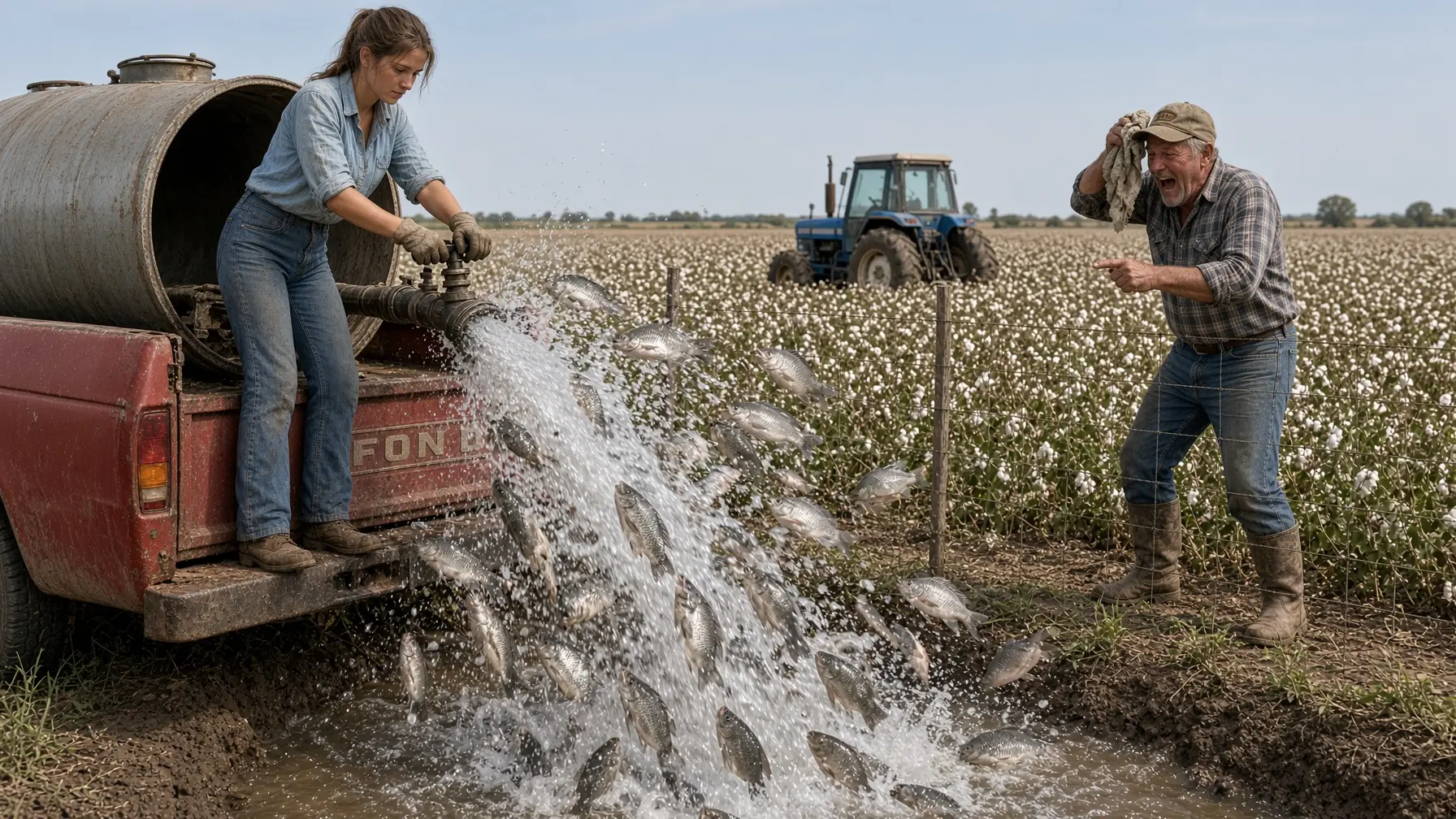
Then nothing but muddy irrigation water.
She crouched beside the headgate with both sleeves rolled above her elbows and reached into the transport tank again.
Another tilapia kicked against her palms.
She lowered it into the ditch.
Gone.
Behind her, hundreds more circled inside the tank strapped to the bed of her father’s old Ford pickup.
The truck sagged beneath the weight of the water.
So did Della.
Twenty-four years old.
Four months after burying her father.
Three hundred acres of exhausted Mississippi cotton ground behind her.
Almost no money left.
And now most of what remained was swimming away through brown irrigation water.
A tractor engine slowed across the fence.
Della did not look up.
She knew the sound.
Henry Patterson.
Closest neighbor.
Fifty-something.
Broad through the chest.
Sunburned face.
A man who had grown cotton long enough to treat bad news like weather.
His tractor stopped.
Engine cut.
Silence fell across the field.
“Della.”
She lifted another fish.
“Yes, Mr. Patterson?”
“What in God’s name are you doing?”
“Stocking the ditches.”
He climbed down.
Walked toward the fence.
His own fields stretched behind him in alternating bands of strong green and fertilizer-burned yellow.
He wiped his forehead with a rag.
“Stocking them?”
“Yes.”
“With fish?”
Della nodded.
Patterson looked at the irrigation ditch.
Then at the fish tank.
Then at her.
“What for?”
She held the tilapia for another second.
Patterson smiled.
“A fish fry?”
Della lowered the fish into the water.
“No, sir.”
It disappeared.
“For the cotton.”
Patterson’s smile faded.
He stared at her.
Della stood.
Wiped wet hands against her jeans.
The old Ford creaked slightly beneath the tank.
Patterson looked toward the farmhouse.
The cracked porch.
Peeling paint.
Rusting Massey Ferguson near the barn.
Then at Della again.
“Your daddy die and leave you some secret I don't know about?”
Della looked toward the passenger seat of the pickup.
Seven leather-bound journals sat inside.
“No.”
“Then what are you doing?”
“Trying something.”
“With your last money?”
“Yes.”
Patterson sighed.
Not angry.
Almost sad.
“Della.”
She waited.
“That land needs nitrogen.”
“I know.”
“Fish aren't fertilizer.”
“I know.”
“That dirt's worn out.”
“I know.”
He stared at her.
“You got an answer for everything except whether this makes sense.”
Della gave him a small smile.
“I don't know if it does yet.”
That seemed to bother him more than certainty would have.
Patterson leaned against the fence.
“You're not even sure?”
“No.”
“Then why in hell are you doing it?”
Della turned toward the pale field.
“Because I’m sure the way we've been doing it isn't working.”
Patterson followed her gaze.
For a long moment he said nothing.
Then he climbed back onto the tractor.
Before starting it, he called:
“You need help getting those fish out?”
Della looked over.
“I thought I was crazy.”
“You can be crazy and still need help.”
That made her laugh.
Patterson climbed down again.
Together, they emptied the rest of the tank.
By sunset, the fish were gone.
By the end of the week, the story was everywhere.
Della Marsh had inherited a farm that was dying slowly.
Not dramatically.
That would have been easier.
No fire.
No flood.
No single terrible harvest.
The land had simply been giving less and demanding more every year.
Her father, Elias Marsh, had grown cotton there for thirty-eight seasons.
His father before him.
By the late 1960s, the pattern had become impossible to ignore.
More fertilizer.
More water.
More pesticide.
More borrowed money.
Then slightly better yields.
Then worse soil.
Then more fertilizer again.
The county co-op had a phrase for it.
“Feeding the crop.”
Elias had started calling it something else.
“Borrowing from next year.”
Della remembered one evening when she was sixteen.
Her father had come inside with a fistful of soil.
He placed it on the kitchen table.
Her mother was still alive then.
She looked at him.
“What is that doing in my kitchen?”
Elias ignored her.
He crumbled the dirt between his fingers.
Dry.