The tractor’s front wheels lifted before Ruth Anne Caldwell understood that the plow had caught something.
She threw her weight forward, reaching for the controls as a sharp metallic crack split the September morning. Behind her, the single-bottom plow jerked upward, the broken hitch pin released, and the implement slammed into the earth hard enough to send loose stones rolling down the furrow.
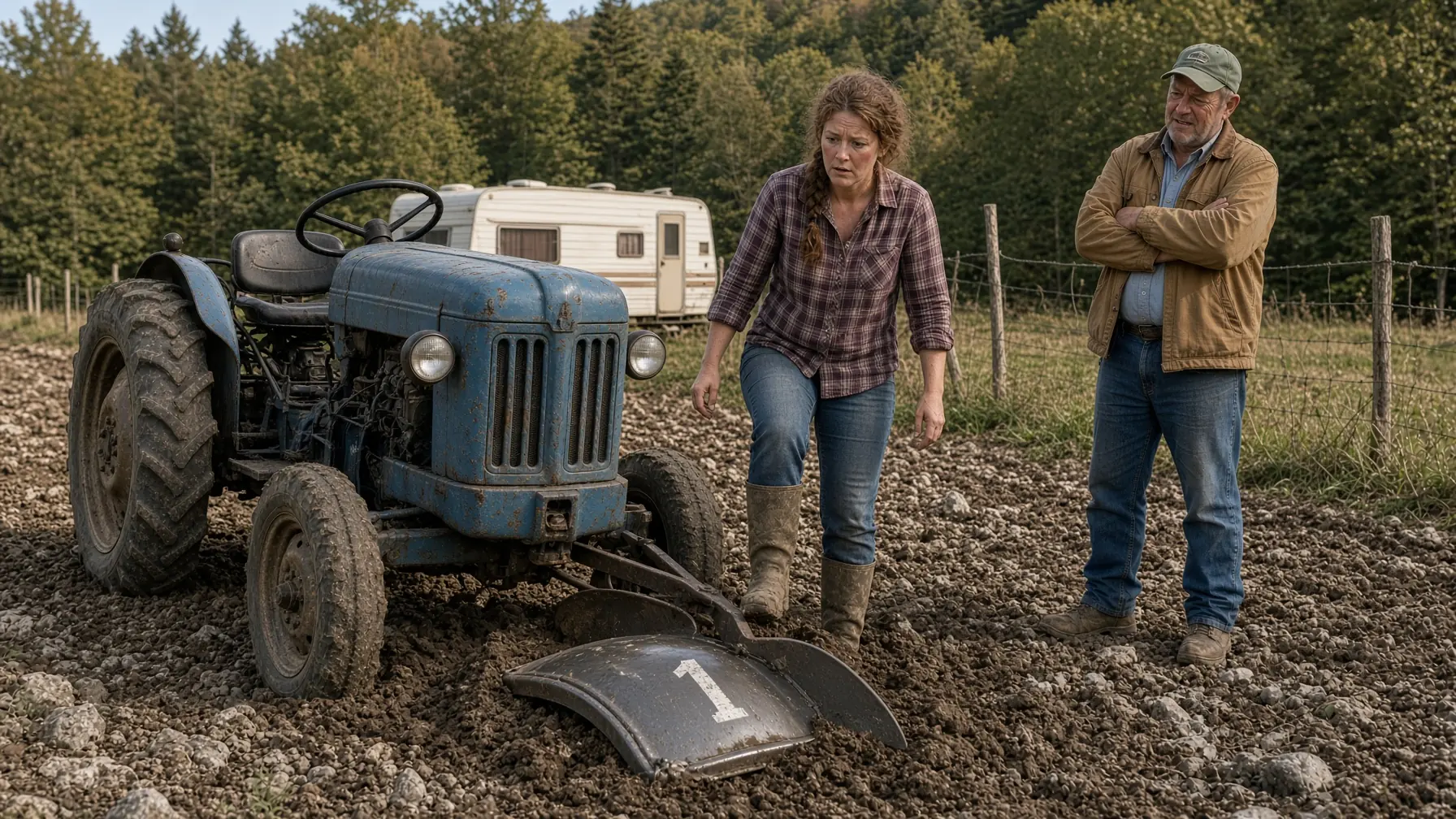
Ruth Anne killed the engine.
For a moment, she stayed in the seat with both hands braced, listening to the last uneven turn of the motor. Then the hollow went quiet.
She looked back.
The plow lay crooked in the freshly opened ground. Beyond it, the field she had spent all summer clearing still looked more like a riverbed than a vegetable farm.
Another buried boulder. Another repair she could barely afford.
Ruth Anne climbed down from the blue tractor, her knees unsteady beneath her work clothes. She had dragged more than two tons of cobbles out of that field by hand, and apparently the earth had decided to keep producing them.
But the object protruding from the furrow was not stone.
She crouched beside it.
A curved steel rim showed through the dirt. Across the top, beneath a smear of moist soil, someone had painted a number in white.
One.
Ruth Anne brushed it with her thumb, exposing more of the faded mark. Then she looked across the empty field toward her secondhand camper, suddenly aware of how alone she was.
Someone had buried something here.
And they had numbered it.
Six months earlier, the land had still been advertised on the feed store bulletin board.
The listing had hung there for almost four years, its corners curled and its lower edge faded by sunlight through the front window. Eighteen acres in Monroe County, West Virginia. Steep ground, creek frontage, poor access in wet weather.
The asking price was $9,800.
Most people in the store did not bother reading the description anymore. They knew the place by another name.
The boneyard.
Smooth gray river cobbles crowded the bottomland, some no larger than a fist, others as big as bread loaves. The slope above it grew briars, brush, and enough stubborn grass to disguise the rocks until a plow found them.
The last man who had tried to farm it had given up in 1952. His fence posts were still leaning where he had left them.
When Ruth Anne asked about the listing, conversation at the counter slowed.
She was thirty-six, a widow, and known to several of the men only as Danny Caldwell’s wife. They remembered his family. They knew the Caldwells had farmed in the valley for generations, and that seemed to make her interest in the parcel more puzzling.
Surely someone had warned her.
One man advised her to buy ground a person could actually use. Another suggested that the asking price was cheap only if she intended to leave it alone.
Ruth Anne listened.
She had spent eleven years working night shifts in emergency rooms in Charleston. She was accustomed to hearing several people tell her what was impossible while she tried to decide what could still be done.