The peaches were already beginning to collapse beneath their own weight when Nora Dijkstra slammed her notebook onto the wooden bin.
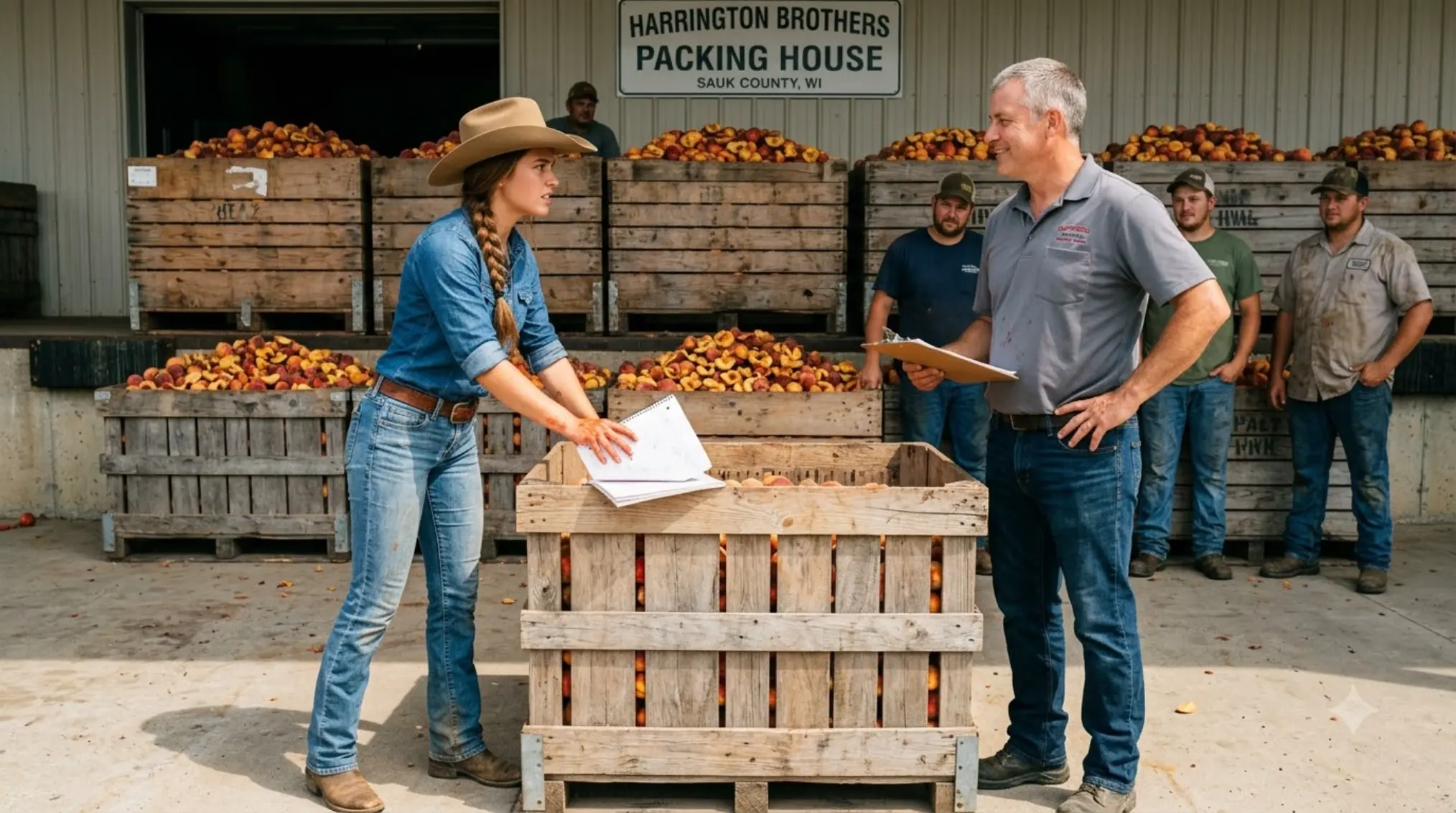
Juice sprayed across the stained boards.
Several workers standing near the loading dock stopped talking.
Dale Harrington did not.
He remained on the opposite side of the crate with his clipboard against his stomach and the irritating little smile he had worn every time Nora tried to explain something he had decided not to understand.
Behind him, forty-three wooden bins filled the gravel lot outside Harrington Brothers Packing House.
Every one of them contained split peaches.
Some had opened cleanly along one side.
Others had cracked near the stem.
A few were beginning to soften under the July heat.
Almost none were rotten.
None would be sold.
By the end of the week, roughly thirty tons of fruit would disappear into the waste stream.
Again.
Nora stared at Dale.
“Trash?” she said. “You throw away thirty tons every July because you’re too stubborn to see money sitting in front of you.”
One of the workers shifted uncomfortably.
Dale looked at the notebook.
Then at Nora.
She was nineteen, barely five-four, and looked even younger standing beside men who had worked orchards longer than she had been alive. Her chestnut hair was pulled into one long braid beneath a tan cowboy hat. Her blue denim shirt was darkened with sweat between the shoulders, and peach juice stained her fingers.
Dale’s gray polo remained remarkably clean.
“You’re nineteen,” he said. “Don’t lecture me about an industry I’ve run for twenty-two years.”
Nora stepped closer.
“Then keep laughing, Dale. My cider stand will sell your ‘waste’ before your trucks finish hauling it away.”
The smile left his face.
For one second, nobody moved.
Then Dale lowered his clipboard.
“This isn’t your fruit.”
“I know.”
“And this isn’t your packing house.”
“I know that too.”
“Then what exactly are you doing here?”
Nora looked toward the mountains of split peaches.
“Watching you bury money.”
Dale gave a humorless laugh.
“You’ve had one good summer selling bottles from a roadside table.”
“Two.”
“Two little summers.”
“Enough to know the difference between waste and raw material.”
Dale’s jaw tightened.
A man behind him whispered something to another worker.
Nora could not hear it.
She did not care.
She had heard worse.
The first time she presented the idea at the Sauk County Co-op, Wes Crowley had laughed and called peach cider a nice hobby.
That had been almost a year earlier.
She remembered everything about that morning.
The smell of burnt coffee.
Dale’s practiced patience.
Bud Seavert staring into his cup instead of looking at her.
And the way Nora had driven home afterward with both hands locked around the steering wheel because she refused to cry until she reached the orchard road.
Her father, Raymond, had been pruning late apples when she arrived.
He looked at her face and asked only one question.
“Bad?”
Nora climbed down from the truck.
“Expected.”
Raymond nodded.
He was not a man who wasted words trying to soften what could not be changed.
Nora had inherited that from him.
She had also inherited sixty acres of questions he had never thought to ask.
The Dijkstra orchard sat on a mixture of sandy slope and heavier ground west of Baraboo, where her grandfather Emmett had planted the first peach trees in 1961.
Everybody told him peaches were too risky there.
Too much frost.
Too much weather.
Wrong soil.
Emmett planted them anyway.
By the time Raymond took over in 1989, the orchard had a reputation for consistent fruit and boring management.
Raymond liked boring.
Boring paid bills.
Boring kept trees healthy.
Boring preserved contracts.
Harrington Brothers bought nearly everything the Dijkstras could grow.
Grade A went to supermarkets.
Grade B went to roadside markets and smaller retailers.
Then there were the peaches nobody wanted.
Split fruit.
Cosmetic rejects.
Cull fruit.
Every July, when dry heat was followed by heavy rain, peaches on the lower slope expanded too quickly and their skins tore open.
The flesh remained sweet.
Sometimes sweeter.
But the fruit could not survive days of shipping and display.
So it was rejected.
Raymond received a damage payment.
He hated losing the value but accepted it as part of farming.
Nora never did.
At seventeen, she started writing down the bins.
Not because anyone asked her.
Because numbers annoyed her until she understood them.
She counted how many bins left the orchard.
How many reached Harrington Brothers.
How many came back rejected.
She estimated weight.
Then value.
By the time she finished high school, she knew that tens of thousands of dollars in peaches were disappearing every summer.
The fruit was being grown.
Irrigated.
Pruned.
Sprayed.
Harvested.
Transported.
Then discarded because its skin looked wrong.
That made no sense to her.
During her first year at the University of Wisconsin, Nora found Dr. Annika Sorensen.
Dr. Sorensen taught agricultural economics and had the terrifying habit of answering student questions with another question.
Nora brought her the split-fruit problem.
“What can I do with peaches that are too ugly for grocery stores?”
Dr. Sorensen looked at her.
“Why are you asking what you can do with ugly peaches?”
Nora frowned.
“Because that’s the problem.”
“No.”
Dr. Sorensen slid Nora’s notebook back.
“The problem is that you accepted somebody else’s definition of the product.”
That sentence stayed with her.
Nora started reading.
Value-added processing.
Fermentation.
Juice.
Preserves.
Small winery licenses.
Direct-to-consumer agricultural economics.
She discovered orchard owners in Michigan using rejected apples for cider.
New York farms converting bruised fruit into preserves.
Vermont operations selling fermented products for several times the raw fruit value.
She studied processing costs.
Equipment.
Licensing.
Labor.
Margins.
By spring, her spreadsheet had seventeen tabs.
She returned home in June and put the notebook beside her father’s coffee.
Raymond listened.
Nora explained everything.
He said very little.
When she finished, he rubbed one thumb against the coffee cup.
“You’ve done a lot of work.”
“That’s not an answer.”
“No.”
“Do you think it could work?”
Raymond looked toward the kitchen window.
Beyond it, rows of peach trees followed the slope.
“I think Harrington Brothers has bought our fruit for thirty years.”
Nora’s shoulders dropped.
“That isn’t an answer either.”
“It’s part of one.”
He told her relationships mattered.
Contracts mattered.
Processing equipment cost money.
Food licensing was complicated.
A sixty-acre orchard was already enough work.
Nora heard the refusal underneath every practical sentence.
She closed the notebook.
“All right.”
Raymond looked at her.
“You angry?”
“Yes.”
“Good.”
She blinked.
He drank his coffee.
“Means you’ll check the numbers again.”
Nora almost smiled.
Her mother Carolyn waited an hour before finding her in the equipment barn.
“You were right,” Carolyn said.
Nora looked up from stacking crates.
“About what?”
“Your father.”
“He said no.”
“He said he needs time.”
“That is farmer language for no.”
Carolyn smiled.
“No. Farmer language for no is no.”
Six weeks later, Raymond found Nora near the lower orchard.
“You still want to try it?”
She turned.
“What?”
“Peach processing.”
“Yes.”
“Old equipment shed.”
Nora stared.
“You’re serious.”
“Ten acres.”
Her mind immediately began calculating.
Raymond held up one finger.
“One season.”
“Okay.”
“You lose money, we stop.”