“She is ugly and will never marry,” Agnes Fairchild said, her voice sharp, cold as stone. The words echoed through the grand hallway, hitting harder than a slap.
Helena knelt on the cold marble floor with a scrub brush in her hand. Soap stung her fingers, and the pale blue ribbon in her dark hair slipped loose with each movement.
Morning light poured through the tall windows, unforgiving, revealing every mark on the floor, every tear she tried to hide. No warmth came with the light, only silence and shame.
“Be sure the floor shines before his grace arrives,” Agnes continued, adjusting her lace cap. “Though I doubt the Duke of Strathmore would notice a creature like you, you will remain in the servants’ quarters while he is here.”
Helena kept her eyes down. Silence had always been safer than words. Her gray dress was worn thin at the knees, patched carefully many times. Her hands shook, but she scrubbed on.
Sebastian Blackwood, Duke of Strathmore, was the most desired man in society: a widower with quiet strength that drew whispers wherever he went. Wealth, land, and power followed him, yet he stood apart from ambitious families. Every lady wanted him; every mother planned for him.
“Prudence will wear her new rose silk gown,” Agnes went on. “The color suits her face. Unlike some who were cursed at birth with features no gown could save.”
The brush slipped from Helena’s hand and splashed into the bucket. She caught it quickly, but a tear slid down her cheek. She bent lower to her task, swallowing the sting of shame.
“When his grace arrives, you will stay in the kitchen,” Agnes said sharply. “He must not see you. I will not have our family judged for your unfortunate looks.”
Helena worked in quiet rhythm, her body moving by habit while her mind drifted. She dreamed of being seen, of being treated kindly, of mattering, even just a little.
Late afternoon brought carriage wheels in the courtyard. In her hurry to leave, she struck the bucket; soapy water spread across the polished floor.
The front door opened. The butler stepped inside, then froze. Behind him stood a tall man whose presence filled the space effortlessly. Dark hair touched with silver framed his face. His green eyes, flecked with gold, fell on Helena as she knelt.
“It appears a young lady is in trouble,” Sebastian said, his voice deep and steady. He extended a hand toward her. “Please, allow me.”
Helena stared at his glove, unsure if it was real. No man had ever offered her such courtesy.
“I am nobody, your grace,” she whispered. “Just a relation of Mrs. Fairchild. I clean.”
“Nobody?” Sebastian repeated, thoughtfully. “I doubt that very much.”
Agnes appeared then, her smile forced. “Your grace, how kind of you to notice my unfortunate niece.”
Sebastian looked from aunt to niece, understanding crossing his face.
The next morning, Helena found peace among the parish garden roses. She knelt in the soil, tying broken stems, coaxing life into flowers damaged by a storm. Here she was useful, and here, no one judged her.
“You have gentle hands, Miss Fairchild,” Sebastian said, appearing quietly. She turned sharply.
“Your grace,” she said, curtsying.
“Please,” he said kindly. “I often walk here. I enjoy the quiet.”
She returned to the roses. “I tend what others forget.”
“With care, damaged things can grow again,” he added. “A truth beyond gardening.”
He asked why her aunt treated her harshly. Helena admitted she was an orphan, dependent, and a burden.
Sebastian’s green eyes softened. “And an embarrassment?”
“She says I am ugly and will never marry. I have nothing to offer.”
“You offer more than many who boast beauty and wealth. You have kindness, strength, grace.”
Helena looked away. “You are too kind, your grace.”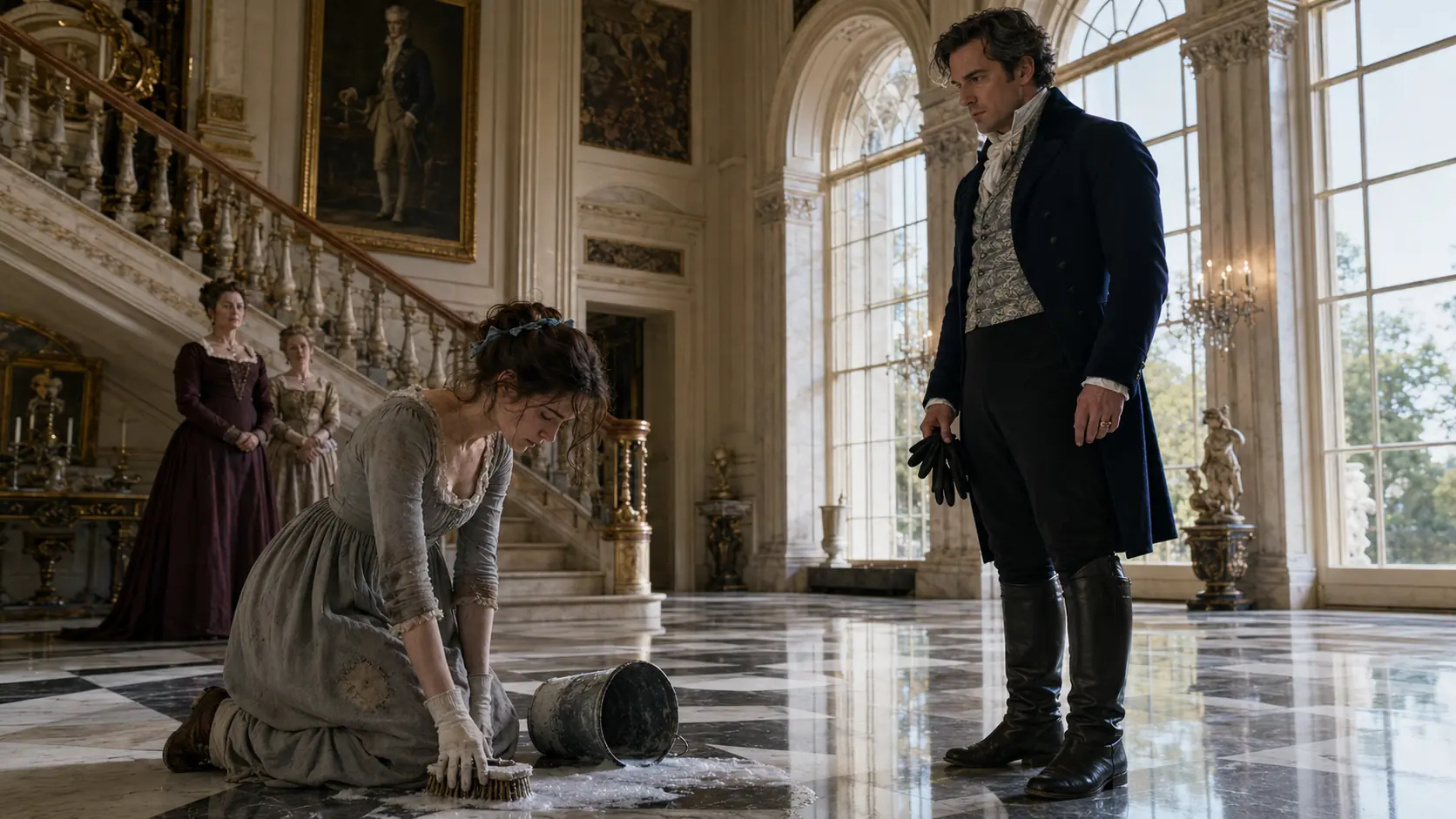
“If your aunt learns of this talk, so be it. Do you help elsewhere?”
“I read to children at the orphanage twice a week,” she admitted.
“May I join you next time?” he asked.
She looked up, surprised. “If you wish.”
“Tomorrow morning. Here.”
Helena felt hope stir for the first time in years.
At the orphanage, Sebastian joined her. Children watched him with wide eyes.
“I am only a duke,” he told them. “But Miss Helena has the heart of a princess.”
“True royalty is shown by actions,” he added. “And hers shine brightly.”
Weeks passed. Quiet kindness grew into something deeper. One morning, Sebastian warned her about her aunt’s cruel rumors. Helena insisted he must stay away, but he refused.
“I saw how you are treated. You deserve better.” He held her hands and placed blue ribbons in her palm. “Someone sees you.”
He spoke of a ball. She would attend and be protected. That night, Helena hid a blue silk gown beneath her bed, clutching the ribbon. Tomorrow would change everything.
At Lady Harrington’s ball, Helena arrived, heart pounding. Agnes appeared, fury hidden beneath forced politeness.
“You have some nerve, stealing finery and forcing your way in,” Agnes hissed.
“Lady Harrington invited me,” Helena said quietly.
The ballroom shimmered with crystal and gold. Whispers swirled. Helena felt the weight of every eye.
Then Sebastian stepped forward, commanding attention. “Miss Fairchild. May I have this dance?”
Agnes gasped. “Your grace, surely you mean Prudence.”
“I am quite certain,” he said, coolly.
Helena placed her hand in his. As they danced, she forgot the crowd, the fear. She felt safe in his arms.
When the dance ended, Sebastian held her hand. The room fell silent.
“For weeks I have watched how society judges worth,” he said. “How kindness is mocked and vanity praised. You call this woman ugly. You are wrong.”
Helena tried to pull back, but he held her gently.
“She restores what others abandon. She gives love without seeking reward. She endures cruelty with dignity.”
Sebastian dropped to one knee. “Helena Fairchild, will you marry me?”
Tears streamed down her face.
“I have nothing,” she whispered.
“You have everything,” he replied.
“Yes,” she said, her voice breaking.
The room erupted in applause. Agnes stood frozen, defeated. Sebastian tied the blue ribbon around Helena’s wrist and kissed her without shame.
In the days that followed, Helena faced gossip and doubt, but Sebastian’s steady support reminded her she belonged. She forgave her aunt, not for Agnes but for herself.
Winter came. Snow fell softly over the estate. Helena touched her ribbon, joined by jewels she never imagined owning.
“You are still surprised,” Sebastian said.
“I am,” she admitted. “But I am learning.”
“You were never invisible. I was simply the first to truly look.”
Years later, when gray touched their hair, Sebastian still looked at her as if she were the greatest treasure. Helena believed that love was found not by beauty or fortune, but by kindness and courage. Once called ugly, she became a duchess, chosen for the heart she always carried—a beauty that truly mattered.