For three years, nobody wanted the eighteen acres outside Independence, Virginia.
The county listing described it politely:
Unimproved pasture. Rocky. Limited agricultural potential.
Local farmers were less charitable.
They called it the Stony Waste.
Heavy red clay.
Wild blackberry thickets.
Scrub pine.
Limestone scattered everywhere from fist-sized chunks to buried shelves broad enough to stop a plow.
The previous owner had tried running cattle there and quit.
Another man leased it for hay and broke enough equipment in two seasons that he never returned.
So when the price eventually dropped to twelve thousand dollars in the spring of 1991, people assumed the county would be waiting another three years.
Then Ethan Vance bought it.
Every dollar he had.
Thirty-two years old.
Former diesel mechanic.
No wife.
No children.
No inherited farm.
Just a pickup, a used tractor, a collection of tools, and the kind of confidence that looks almost identical to stupidity until something works.
His older brother called the purchase:
“Eighteen acres of expensive rocks.”
Ethan disagreed.
“The rocks came free.”
That joke became less funny by October.
The summer had been harder than he expected.
Ethan spent April and May cutting brush.
June dragging roots.
July clearing fence lines.
August repairing the tractor after a limestone slab bent part of the three-point linkage.
September hauling out stones.
Every time he thought he had cleared the worst section, another buried ridge appeared.
Still—
the soil beneath the scrub was not dead.
Compacted.
Acidic in places.
Poorly managed.
But not dead.
Ethan had taken samples to the county Extension office.
They told him what he already suspected.
Lime.
Organic matter.
Patience.
He planned to spend two years improving the ground before expecting respectable hay.
That was fine.
Machines had taught him that neglected things rarely became useful because somebody wanted them to.
They became useful because somebody did the work.
On October 16, Ethan started breaking the lower pasture.
Cold morning.
Forty-eight degrees.
Gray sky.
Soil still wet from rain two days earlier.
He drove an old red tractor slowly across the field, pulling a heavy three-bottom plow behind him.
First pass.
Second.
Third.
Clay rolled over in thick red slabs.
The tractor struggled.
Nothing unusual.
Then, halfway through another pass—
the engine loaded suddenly.
Rear tires spun.
The plow jerked hard enough to slam Ethan against the steering wheel.
A deep metallic vibration ran through the tractor frame.
Not stone.
Ethan killed the throttle immediately.
Clutch.
Neutral.
Engine off.
Silence returned to the pasture.
He climbed down.
His first thought was the plow.
Broken share.
Bent beam.
Maybe another buried limestone shelf.
He walked behind the tractor.
The plow sat crooked in the furrow.
One bottom had struck something solid.
Ethan grabbed a shovel from beside the fence.
Then a hand trowel.
He began removing wet clay.
Ten minutes later, he saw metal.
Dark.
Curved.
He scraped more.
The object widened beneath the soil.
Ethan stopped.
This was not discarded farm junk.
The surface was too regular.
He cleared another foot.
Then another.
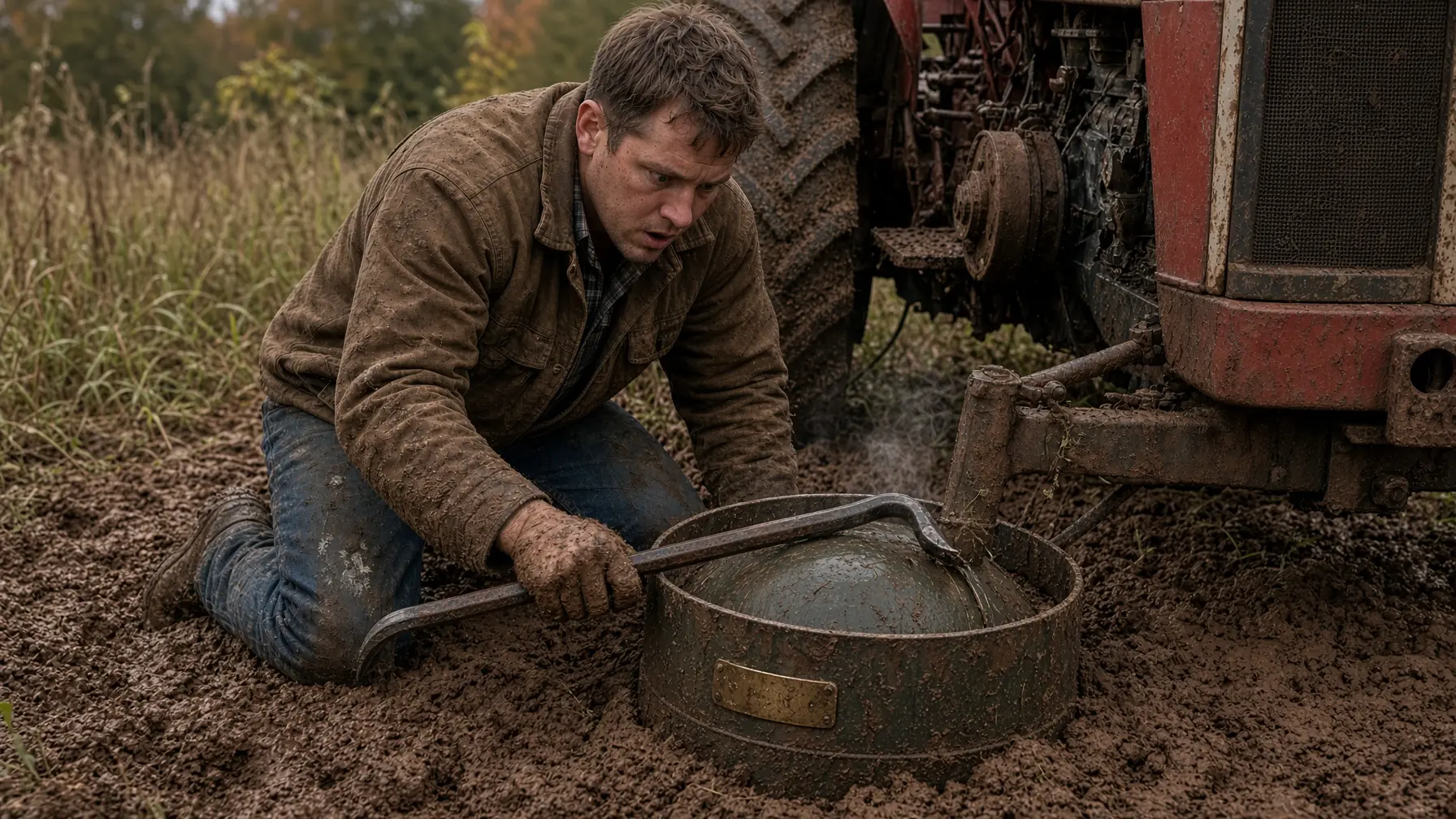
A curved iron shell emerged.
Heavy bands ran across it.
Large rivets.
Something like a tank.
Or boiler.
But it was buried horizontally.
Deliberately.
Ethan stood.
Looked across the empty pasture.
No building had ever stood there according to the county maps he had seen.
He knelt again.
Brushed dirt from the top.
His scraper struck brass.