“Cracked, lumpy, too ugly. I don’t buy compost, son.”
Roger Pruitt dropped the tomato onto the wooden crate as if it had offended him personally. The fruit rolled once, stopped against another deeply ribbed tomato, and lay there with its green shoulders facing the light. Behind him, the receiving belts at Delsey Packing carried hundreds of perfect round tomatoes into the sorting hall, their smooth skins shining beneath fluorescent lamps. They all looked almost identical. Nico Belanti had spent fifteen years learning that nothing alive was quite so uniform, but the men around the loading dock seemed proud of proving otherwise.
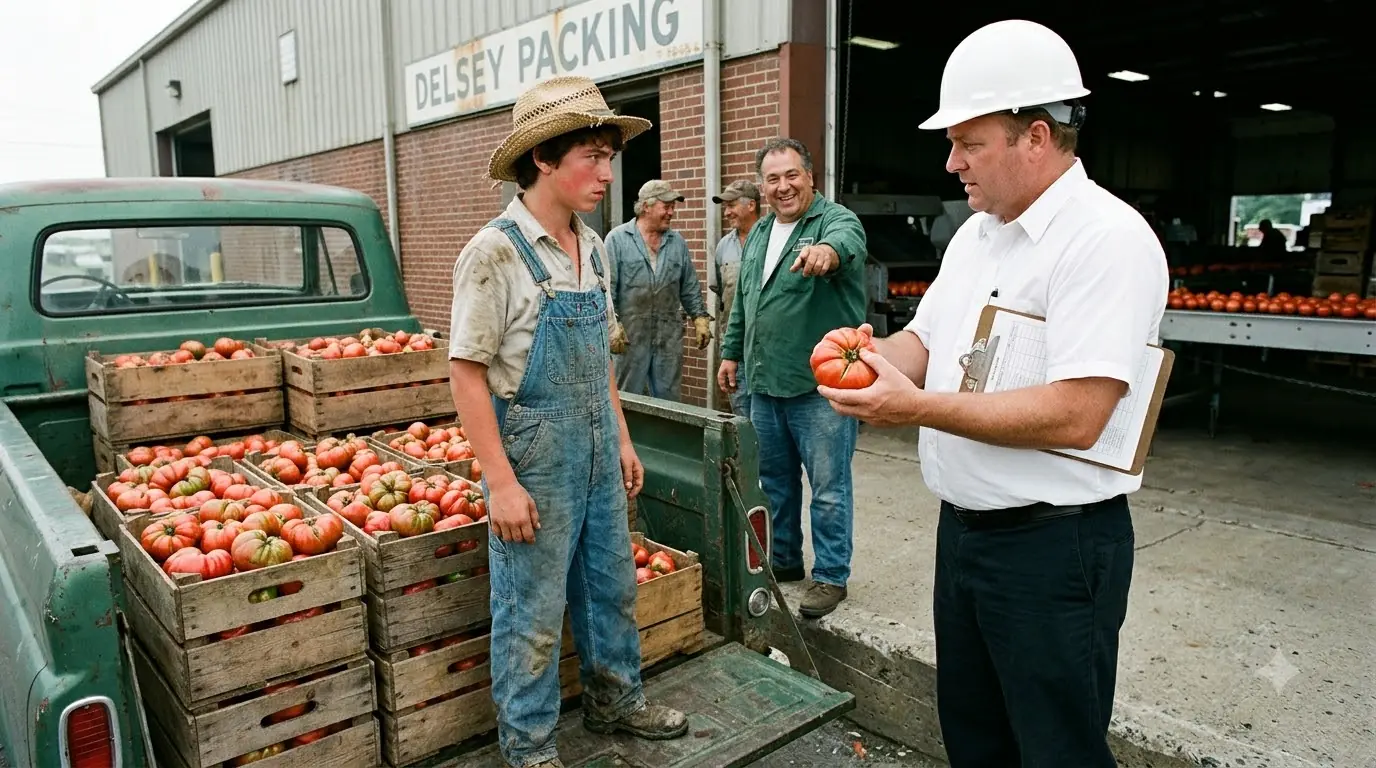
Nico stood beside forty-eight crates in the bed of his father’s old green pickup. His work boots were still damp with dew from the fields, and the cuffs of his overalls held a thin line of dark soil. He had been awake since four that morning, cutting ripe fruit from vines by headlamp, carrying it carefully to the barn, lining each crate with folded paper, and trying not to bruise what the long drive might bruise anyway. Twelve hundred pounds of tomatoes stood stacked behind him, the first substantial harvest from two acres he had cultivated himself.
The dock smelled of wet cardboard, diesel exhaust, bleach, and fruit ripening faster than the plant wanted it to. The air vibrated with machinery. A forklift backed toward a pallet, its warning beeper punctuating the conversation, while men in gloves moved cartons under signs that divided produce into grades. Nico had imagined those signs would help people recognize quality. Now he understood that the word quality meant something very different here.
Roger was forty-eight, the manager of a plant his family had operated for three generations. He wore a white hard hat and carried a clipboard under one arm. Nothing about him suggested uncertainty. He had the calm confidence of a man whose decisions became policy without needing to be defended in the room where they were made.
“These look like they lost a fight with a hailstorm,” said Frank Tesoriero from farther down the dock. Frank grew three hundred acres of contract tomatoes and had the broad face of a man who spent much of his summer squinting into fields. He laughed at his own joke, then kept laughing when two dockworkers joined him.
Nico looked down into the nearest crate. The fruit was strange to anyone expecting supermarket symmetry. Each tomato had deep ribs and folds, some wide as a fist, others smaller and heavy for their size. Green persisted around certain shoulders even when the lower flesh was a beautiful, wet red. Scar tissue marked the places where growth had gone unevenly. His grandmother called them costoluto, a word she pronounced as lovingly as other people pronounced the names of grandchildren.
“You haven’t tasted one, sir,” Nico said.
Roger’s eyes remained on the grading slip. “I don’t need to.”
“It’s different inside.”
“That may be.” Roger turned the sheet around so Nico could see the box he had marked. “It’s also different on the outside, and the outside gets it rejected before anybody eats it. These are culls. If I send them across nine hundred miles, half the shipment comes back soft.”