For thirty years, everyone in Whitfield County agreed on one thing.
The field was useless.
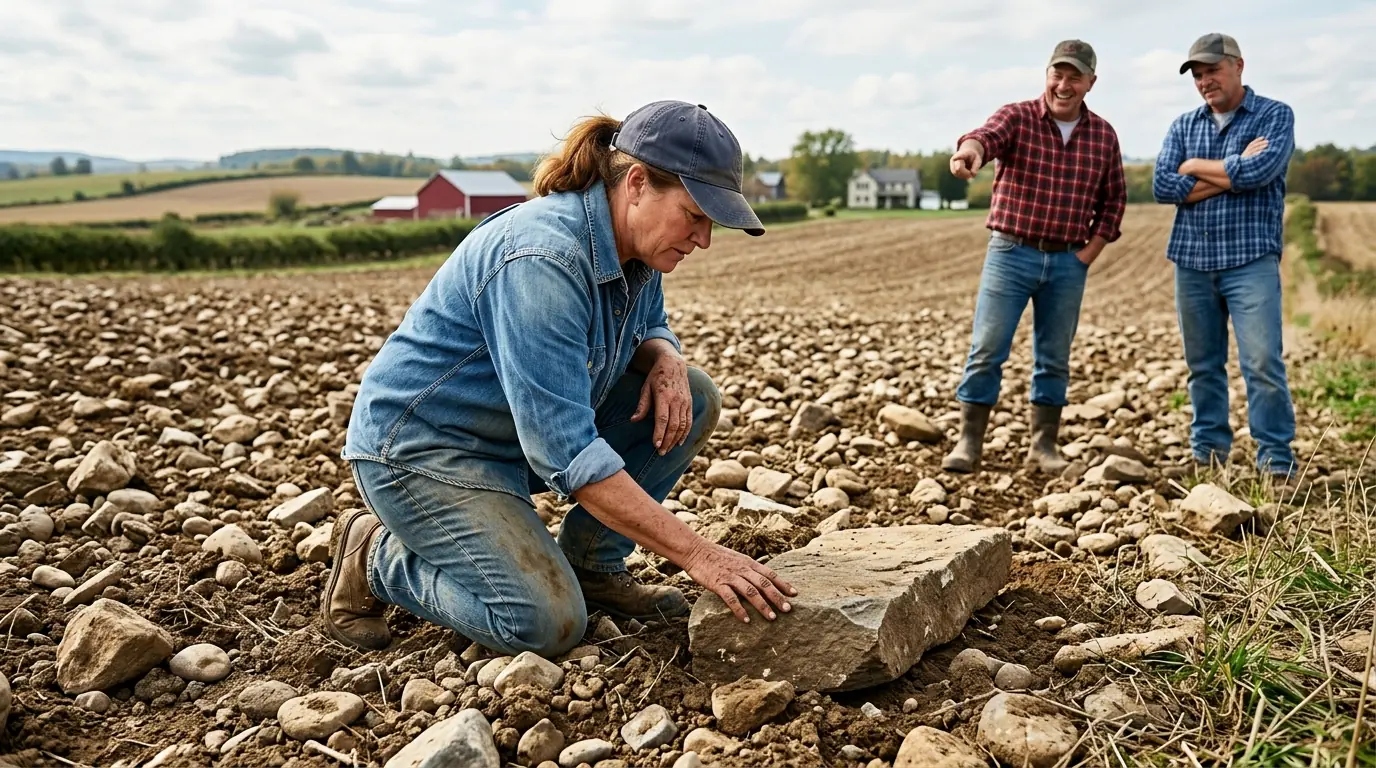
They called it The Rock Field.
Not because it had a few stones.
Every farm had stones.
This was different.
The twenty-eight-acre parcel on the north side of County Road 6 seemed to grow rocks faster than crops.
Small stones worked their way to the surface every spring.
Flat slabs hid beneath shallow soil.
Boulders sat just deep enough to catch plow blades.
Three tractors had broken implements there.
One farmer bent a disc axle.
Another destroyed two mower blades in the same afternoon.
For decades, men had tried the obvious solution.
Remove the rocks.
Truck after truck carried them away.
Children were paid by the bucket.
Teenagers were paid by the hour.
One owner rented a loader for three weeks.
Another hired a crew that cleared nearly four acres before calculating what the remaining twenty-four would cost.
He stopped the next morning.
Eventually, everybody stopped.
Everybody except Carol Whitfield.
And Carol did something none of them expected.
She stopped removing the rocks too.
Carol was fifty-eight when she bought the field.
Her late husband, Ray, had wanted it twenty years earlier.
Not because he thought it was good farmland.
Because it bordered their property.
Carol had refused.
“You want to pay money for the field that eats tractors?”
Ray had smiled.
“Cheap acreage.”
“Cheap for a reason.”
They never bought it.
Ray died thirteen years later.
Heart attack.
Fast.
Unexpected.
Afterward Carol kept farming their 140 acres alone with seasonal help from her nephew Ethan.
Corn.
Soybeans.
A little hay.
Nothing glamorous.
By then The Rock Field belonged to the county after a failed tax sale.
Nobody wanted it.
The minimum bid dropped twice.
Carol eventually bought all twenty-eight acres for less than some neighbors paid for a used pickup.
That started the jokes immediately.
At Denny’s Feed & Supply, Walter Kemp looked at her receipt and laughed.
“You finally lost it, Carol?”
She set a bag of mineral salt on the counter.
“Probably.”
“Thirty years we've been pulling rocks out of that dirt.”
“I know.”
“And you're going to farm it?”
“I didn't say that.”
Walter grinned.
“What else are you going to do with twenty-eight acres?”
Carol looked at him.
“I don't know yet.”
That answer made everyone laugh harder.
Carol did not care.
She had learned something after Ray died.
Not knowing was uncomfortable.
It was not fatal.
The first spring, Carol tried what everyone else had tried.
She cleared stones.
Ethan ran the skid steer.
Carol followed behind with a rake and marking flags.
They worked twelve days.
At the end of twelve days, they had a mountain of rocks beside the road and less than three usable acres.
Ethan wiped sweat from his forehead.
“This is stupid.”
Carol leaned on the rake.
“Yes.”
He stared.
“You're agreeing with me?”
“I’m fifty-eight, not blind.”
“What do we do?”
Carol looked across the field.
Rows of gray stones interrupted the green weeds.
Some protruded from the soil.
Others formed strange shallow rises.
“Stop.”
Ethan frowned.
“For today?”
“No.”
“For all of it.”
“What?”
“We stop clearing.”
Ethan laughed.
“Then why did you buy it?”
Carol kept staring at the field.
“That’s what I’m trying to figure out.”
For two weeks, she did almost nothing.
At least that was what neighbors thought.
They saw Carol walking the field in the mornings.
No tractor.
No loader.
No shovel.
Just an orange survey flag tucked into her back pocket and a notebook in her hand.
Walter stopped beside the road one afternoon.
“You giving the rocks names now?”
Carol smiled.
“Only the friendly ones.”
He laughed.
“You know what your problem is?”
“What?”
“You think too much.”
“Probably.”
Walter drove away.
Carol waited until the dust settled.
Then returned to her notebook.
She had noticed something.
The rocks were not random.
At first she thought her mind was inventing patterns.
Human beings liked patterns.
Rows in clouds.
Faces in wood grain.
Meaning where none existed.
So Carol measured.
One flat stone.
Thirty-two feet.
Another.